

The traditional model of passive property oversight in the Grand Duchy has transitioned into a discipline requiring rigorous, private equity-driven optimization. Institutional investors frequently encounter the dual pressures of a mature, high-competition market and an increasingly complex regulatory landscape. It is widely understood among sophisticated market participants that achieving consistent yields now demands more than simple geographic exposure; it requires a sophisticated alignment of interests and structural precision.
This article offers a definitive analysis of real estate asset management Luxembourg, focusing on the strategic frameworks necessary for institutional success through 2026. We examine how to navigate the revised AIFMD and UCITS requirements effective April 2026 while optimizing holdings against the 7% property transfer tax and the evolving IMOB land tax framework. By moving beyond basic administration toward active value creation, managers can ensure long-term capital preservation and the fulfillment of fiduciary obligations. The following sections provide a clear roadmap for structuring diversified portfolios that remain resilient in a shifting financial environment.
Key Takeaways
- Understand the fundamental shift from passive property administration to active, private equity-driven optimization within the Grand Duchy.
- Identify the structural advantages of the Reserved Alternative Investment Fund (RAIF) and Special Limited Partnership (SCSp) for institutional real estate holdings.
- Learn how to navigate the 2026 regulatory environment, including AIFMD 2 and EU Taxonomy, to maintain high standards of real estate asset management Luxembourg.
- Gain a strategic roadmap for asset-level value creation through operational modernization and the selection of appropriate risk-return profiles.
- Explore how performance-based fee structures and carried interest models ensure the alignment of interests between managers and institutional investors.
The Evolution of Real Estate Asset Management in Luxembourg
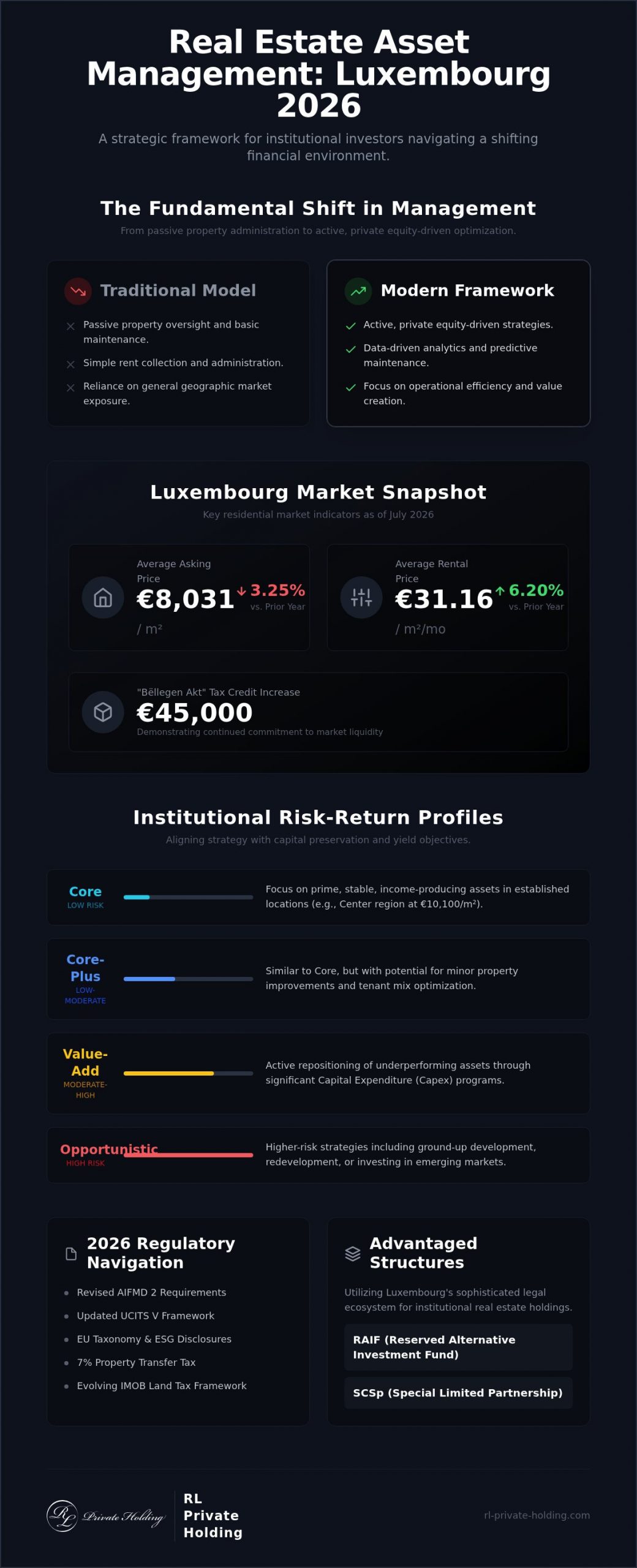
The landscape of real estate asset management Luxembourg has undergone a profound transformation. While property management once focused on basic maintenance and rent collection, the 2026 environment demands a more sophisticated approach. Institutional investors now prioritize active strategies to combat yield compression in a mature market. As of July 2026, the average asking price for residential properties stands at €8,031 per square meter, reflecting a slight 3.25% decrease from the previous year. This price correction, paired with a 6.20% increase in rental prices to €31.16 per month per square meter, creates a divergent market that rewards disciplined asset selection over passive ownership.
The Shift Toward Institutional Asset Management
Traditional property oversight no longer provides the margins required for institutional portfolios. Yield is now generated through operational efficiency and the integration of data-driven analytics. These tools allow managers to evaluate property performance against real-time benchmarks and predictive maintenance cycles. Real estate asset management is a strategic financial discipline focused on maximizing the risk-adjusted performance of property holdings through active lifecycle management and structural optimization. By applying fundamental real estate investment principles, firms can identify inefficiencies in a building’s energy profile or tenant mix before they impact the bottom line. Modern portfolio construction requires this active, interventionist mindset to ensure consistent returns.
Luxembourg’s Position in the Global Financial Landscape
Luxembourg serves as the primary gateway for pan-European capital due to its unparalleled legal certainty and political stability. The Grand Duchy offers a sophisticated ecosystem of fund administrators and legal experts who specialize in complex cross-border structures. The strategic intersection of private equity investment management and real estate has become a hallmark of the local market. This synergy ensures that real estate asset management Luxembourg remains a top-tier choice for global institutional partners seeking transparency and risk mitigation. Recent government measures, such as the July 2026 increase of the “Bëllegen Akt” tax credit to €45,000, demonstrate a continued commitment to market liquidity and stability. These frameworks provide a secure environment for long-term capital preservation in an otherwise volatile global economy.
Strategic Frameworks for Institutional Real Estate Portfolios
Institutional investors categorise their exposure across four primary risk profiles: Core, Core-Plus, Value-Add, and Opportunistic. In the current environment, where interest rates have stabilised at elevated levels, selecting an appropriate strategy is critical for capital preservation. Core strategies focus on prime assets in the Center region, where asking prices reached €10,100 per square meter in July 2026. Conversely, Value-Add strategies seek higher returns through the active repositioning of underperforming assets. Each framework requires a distinct operational approach to ensure that the risk taken is adequately compensated by the projected yield.
Value Creation Strategies in a Mature Market
To achieve alpha in a mature landscape, managers must implement rigorous Capital Expenditure (Capex) programs. These initiatives often target energy efficiency and building modernisation to meet the evolving standards outlined in Deloitte’s 2026 Real Estate Predictions. Operational overhead can be reduced by leveraging institutional scale across a portfolio, particularly in procurement and property maintenance. Optimising the tenant mix is equally vital. Securing long-term leases with high-credit-quality occupants provides the cash flow stability necessary to weather cyclical fluctuations. Active management also involves regular lease audits to ensure that indexation clauses are correctly applied in a high-inflation environment.
Portfolio Diversification and Risk Allocation
Diversification remains a cornerstone of institutional portfolio construction. Managers must balance stable, income-producing assets with growth-oriented developments. In the residential sector, market data from Q2 2026 shows existing houses saw a +2.7% price increase, while existing flats experienced a -1.4% adjustment. This divergence highlights the importance of granular sectoral allocation. Effective real estate asset management Luxembourg requires a disciplined approach to geographic distribution, often contrasting the high-demand Center region with emerging opportunities in the North, where asking prices are lower at €5,941 per square meter.
Technology plays an increasing role in this process. Automated reporting and real-time data visualisation enhance transparency, allowing for more precise risk assessment across commercial, residential, and industrial sub-sectors. For those seeking to optimise their current holdings, a consultation with a specialist in institutional asset management can provide the necessary structural clarity. By integrating these strategic frameworks, investors can achieve long-term capital preservation while navigating the complexities of the Grand Duchy’s property market.
Direct vs. Indirect Real Estate Management Structures
The selection of a holding vehicle is as critical as the asset selection itself. Within the scope of real estate asset management Luxembourg, the choice between direct ownership and indirect fund structures often hinges on the desired level of control and the specific tax profile of the institutional allocator. Direct structures offer maximum governance but may lack the scalability found in managed vehicles. Conversely, indirect structures allow for pooled capital and shared risk, which are essential for large-scale acquisitions across various European jurisdictions. Selecting the wrong framework can lead to structural inefficiencies that erode the yield benefits of even the most high-performing assets.
The Rise of the Special Limited Partnership (SCSp)
The Luxembourg special limited partnership has emerged as the premier vehicle for private real estate investment. Its popularity stems from its tax transparency and high degree of contractual flexibility. This allows managers to tailor governance rights and distribution waterfalls to meet specific investor needs. Unlike more rigid corporate forms, the SCSp functions as an extension of private equity principles, enabling active management at the asset level while maintaining a discreet, institutional framework. For real estate asset management Luxembourg, the SCSp facilitates efficient capital calls and distributions, making it ideal for value-add and opportunistic strategies that require rapid execution and precise alignment of interests.
Indirect Investment via Alternative Investment Funds (AIFs)
For institutional allocators seeking a more diversified approach, the Reserved Alternative Investment Fund (RAIF) provides an efficient path to market. RAIFs benefit from an accelerated time-to-market because they don’t require direct CSSF approval at the fund level, provided they’re managed by an authorised Alternative Investment Fund Manager (AIFM). This structure is particularly effective for club deals and co-investments, where multiple institutional partners pool resources to acquire high-value commercial or residential assets. It offers a layer of professional distance and institutional gravity that individual direct holdings often lack.
Tax efficiency remains a primary driver for these indirect structures. Proper structuring ensures access to Luxembourg’s extensive network of double tax treaties, which is vital for cross-border real estate holdings. Institutional investors must also consider the liquidity profile of their chosen vehicle. While open-ended funds offer more frequent redemption windows, closed-ended structures align better with the long-term nature of real estate assets. This prevents forced liquidations during market corrections and protects the interests of long-term capital providers. Governance remains a priority, and institutional allocators typically require clear reporting lines and transparency regardless of the chosen vehicle’s complexity.
Risk Mitigation and Regulatory Compliance Protocols
The regulatory environment for real estate asset management Luxembourg has entered a period of heightened scrutiny. Starting in April 2026, the revised AIFMD and UCITS frameworks impose stricter requirements for governance, liquidity management, and reporting. These changes necessitate a proactive approach to compliance that goes beyond mere box-ticking. Institutional investors must also adhere to CSSF Circular 25/901, which modernises the oversight for SIFs and SICARs. Managing these requirements effectively is essential to maintaining the structural integrity of a portfolio and ensuring that all cross-border transactions meet the latest AML/CFT standards.
Liquidity remains a primary concern in private real estate portfolios. Elevated interest rates have made asset disposal more complex, often extending the time required to exit a position. To address this challenge, managers must implement robust liquidity stress tests and maintain a clear understanding of the IMOB framework, which introduced a tax on unoccupied housing in January 2026. While the current rate is 0% for the first five years, the reporting obligations are immediate. Navigating these complexities requires a partner with a deep understanding of the local market and a commitment to institutional excellence.
ESG Integration as a Value Driver
Sustainability has transitioned from a peripheral concern to a central pillar of asset valuation. Integrating EU Taxonomy standards into the management process is no longer optional for those seeking institutional capital. Energy efficiency directly impacts long-term asset valuations by reducing operational costs and appealing to a growing pool of ESG-conscious tenants. Integrating ESG compliance directly into the investment lifecycle ensures that assets remain liquid and desirable, effectively mitigating terminal value risk caused by regulatory obsolescence. Regular reporting on these metrics provides the transparency that global allocators demand in a competitive landscape.
Institutional Governance and Reporting Standards
Ensuring transparency requires rigorous accounting oversight and a methodical approach to data management. Valuation risks are particularly acute in a fluctuating interest rate environment, where traditional cap rates may no longer reflect market realities. Managers must provide frequent, accurate valuations to protect investor interests and maintain trust. This process is supported by a sense of “quiet authority,” where sensitive institutional data is managed with the highest level of discretion and professional distance. By maintaining these high standards, firms can offer the stability and predictability that are the hallmarks of a disciplined investment partner.
Institutional investors seeking to align their portfolios with these evolving standards should consider the benefits of a partnership with an established firm. You can learn more about how to structure your holdings for maximum efficiency by exploring our real estate asset management services. This proactive approach ensures that your investments remain compliant and performant through 2026 and beyond.
RL Private Holding: Aligning Interests in Real Estate Management
The Grand Duchy’s property market requires more than technical compliance; it demands a partner whose interests are fundamentally tied to the asset’s performance. RL Private Holding operates as a discreet entity within the global financial landscape, providing real estate asset management Luxembourg with a focus on long-term capital preservation and institutional gravity. We understand that the alignment of interests between managers and investors is the cornerstone of a successful mandate. While many firms rely solely on fixed administrative fees, our framework prioritizes performance through a disciplined balance of management fees and carried interest. This mechanism ensures that our strategic focus remains fixed on achieving the specific yield and value-creation targets established by our institutional partners.
A Disciplined Approach to Asset Management
Our firm applies the same level of analytical rigor to real estate as we do to our private equity and venture capital portfolios. This multi-sector expertise allows us to view property assets through a broader financial lens, identifying opportunities for modernization that others might overlook. By operating as a diversified holding company, we maintain a stable capital base and a long-term investment horizon. This structural permanence is vital in a market where transaction volumes can fluctuate, as seen in the subdued office market activity of 2026. We maintain a professional distance from market volatility, focusing instead on the underlying principles of asset-level efficiency and operational excellence. This disciplined approach ensures that each property within a global portfolio contributes effectively to the overall risk-return profile.
Next Steps for Institutional Allocation
Evaluating a strategic partner in Luxembourg requires a thorough assessment of their ability to manage complex, multi-sector portfolios. RL Private Holding provides a transparent yet discreet framework for institutional allocators seeking to optimize their real estate holdings. Initiating a mandate begins with a comprehensive audit of existing structures and an alignment of strategic objectives for the 2026-2030 cycle. Our team coordinates the transition from passive oversight to active management, ensuring that all regulatory reporting under AIFMD 2 and CSSF Circular 25/901 is handled with precision.
For those seeking a steady hand in the background of major property investments, our firm offers the stability and world-class expertise required for success. We invite sophisticated investors to explore our frameworks for capital preservation and active value creation in the European market. If you are ready to discuss your portfolio’s specific requirements, you may contact RL Private Holding for institutional asset management inquiries. Our methodical approach ensures that your real estate asset management Luxembourg remains resilient and performant in an increasingly sophisticated global environment.
Securing Institutional Performance in a Shifting Landscape
The Grand Duchy’s property market in 2026 demands a transition from traditional oversight to active, private equity-driven asset optimization. Success now requires a commitment to regulatory precision, specifically regarding the revised AIFMD frameworks and ESG reporting mandates that define modern asset valuations. Effective real estate asset management Luxembourg relies on the selection of robust investment vehicles, such as the SCSp, and a rigorous alignment of interests between managers and allocators. By integrating data-driven analytics and operational modernization, institutional investors can ensure long-term capital preservation even in a mature, high-competition environment.
Firms that combine global portfolio expertise with performance-aligned fee structures, such as carried interest models, provide the stability necessary to navigate these complexities. RL Private Holding offers the discreet institutional management and strategic focus required to thrive in this evolving financial sector. It’s time to Explore Strategic Real Estate Asset Management with RL Private Holding to optimize your holdings for the years ahead. A disciplined approach to structural efficiency and professional distance remains the most reliable path toward consistent yield and institutional permanence.
Frequently Asked Questions
What is the primary role of a real estate asset manager in Luxembourg?
The primary role involves the strategic financial optimization of property portfolios to maximize risk-adjusted returns for institutional investors. Managers oversee the entire asset lifecycle, including the selection of holding structures, capital expenditure planning, and high-level lease negotiations. This function is distinct from day-to-day operations, focusing instead on long-term capital preservation and the alignment of the portfolio with broader investment mandates within the Luxembourgish regulatory framework.
How does the SCSp structure benefit real estate investors?
The Special Limited Partnership (SCSp) offers significant benefits through its tax transparency and high degree of contractual flexibility. This structure allows institutional allocators to tailor governance rights and distribution waterfalls to meet specific requirements without the rigidity of traditional corporate forms. It provides a discreet and efficient vehicle for private real estate strategies, enabling managers to execute capital calls and distributions with high precision and minimal administrative friction.
What are the typical management fees for real estate asset management in Luxembourg?
Fee structures in the Grand Duchy are typically categorized into fixed management fees and performance-based carried interest. Fixed fees generally cover the operational costs of fund administration and portfolio oversight, while carried interest aligns the manager’s incentives with the successful achievement of specific hurdle rates. These structures vary based on the complexity of the mandate and the specific risk profile of the underlying assets, ensuring a disciplined approach to value creation.
How is ESG compliance affecting real estate valuations in 2026?
ESG compliance has become a central determinant of terminal value and asset liquidity in 2026. Properties that meet EU Taxonomy standards often command higher valuations due to lower operational costs and increased demand from institutional tenants. Conversely, assets that fail to meet sustainability benchmarks face the risk of regulatory obsolescence and potential brown discounts, which can significantly erode long-term capital appreciation and complicate exit strategies in a competitive market.
What is the difference between property management and asset management?
Property management is a tactical function focused on the day-to-day operations, maintenance, and tenant interactions of a specific building. In contrast, real estate asset management Luxembourg is a strategic discipline that treats properties as financial assets within a broader portfolio. It focuses on maximizing investment performance through capital structure optimization, strategic repositioning, and rigorous risk mitigation protocols to ensure the long-term fulfillment of institutional investment objectives.
Can institutional investors use Luxembourg structures for global real estate assets?
Luxembourg structures are frequently utilized by institutional allocators to hold and manage diversified global real estate portfolios. The Grand Duchy’s extensive network of double tax treaties and its established legal framework make it an ideal gateway for cross-border investments. Vehicles like the RAIF and SCSp provide the necessary scalability and transparency to manage assets located across different jurisdictions while maintaining a centralized and sophisticated governance model in a stable financial hub.
How does AIFMD 2 impact real estate fund management?
The AIFMD 2 framework introduces enhanced requirements for governance, liquidity management, and regulatory reporting for alternative investment fund managers. These revisions increase the burden of transparency and necessitate more robust stress-testing protocols for private real estate portfolios. Managers must ensure that their operational frameworks are fully aligned with these new standards to maintain compliance and protect investor interests in an environment of heightened regulatory scrutiny and market volatility.
Why is Luxembourg considered a hub for real estate private equity?
Luxembourg is considered a primary hub due to its combination of political stability, legal certainty, and a highly sophisticated ecosystem of professional service providers. The availability of flexible investment vehicles tailored to the needs of institutional allocators provides a secure environment for large-scale capital deployment. This infrastructure, supported by a proactive regulatory body, ensures that the Grand Duchy remains the preferred jurisdiction for complex real estate private equity strategies and long-term portfolio management.