

Regulatory compliance is often viewed as a restrictive cost center, yet for the disciplined fund manager, it functions as a primary strategic asset. As the industry moves toward 2026, the transition to AIFMD II introduces a layer of complexity that demands more than mere adherence; it requires institutional foresight. Successfully navigating AIFMD for private equity funds is no longer just about meeting reporting deadlines but about refining the very architecture of fund operations. This methodical approach ensures that regulatory alignment supports rather than hinders your investment objectives.
It’s likely you find the escalating costs of reporting and the intricacies of cross-border marketing passports to be significant operational hurdles. The lack of transparency in recent regulatory updates often complicates the path to efficient capital raising across European jurisdictions. This guide provides a comprehensive roadmap to master these complexities and operationalize the necessary requirements for the coming year. We’ll examine the specific shifts in delegation rules, liquidity management tools, and the technical steps required to ensure your fund maintains seamless access to global capital markets through a structured compliance framework.
Key Takeaways
- Understand the technical transition from AIFMD I to the enhanced AIFMD II framework to ensure institutional alignment in 2026.
- Master the structural requirements of the Depositary function and the selection of an authorized AIFM when navigating AIFMD for private equity funds.
- Leverage the EU Passporting framework to facilitate seamless capital raising across the EEA without the administrative burden of multiple national private placement regimes.
- Implement a methodical gap analysis of fund documentation to operationalize compliance and optimize deal sourcing efficiency.
- Integrate regulatory reporting into your broader institutional portfolio management strategy to transform compliance into a driver of long-term stability.
The Regulatory Evolution: Navigating AIFMD for Private Equity in 2026
The regulatory landscape for European alternative investments has reached a critical inflection point. The transition from the original Alternative Investment Fund Managers Directive (AIFMD) to the refined AIFMD II framework represents a move toward greater harmonisation and oversight. For those tasked with navigating AIFMD for private equity funds, this evolution isn’t merely a procedural update; it’s a structural realignment of how capital is managed and reported. This shift demands a methodical review of fund structures to ensure they remain resilient under enhanced scrutiny.
Luxembourg remains the preeminent jurisdiction for these structures, offering a robust ecosystem of regulated service providers and legal certainty. Institutional Limited Partners (LPs) increasingly view a fund’s internalised compliance capabilities as a key differentiator. It signals institutional discipline and a commitment to transparency that mitigates operational risk. The definition of an Alternative Investment Fund Manager (AIFM) now encompasses a broader range of activities, ensuring that diverse strategies fall under a unified supervisory umbrella. This expansion requires managers to be more diligent in their classification and reporting duties.
Key Legislative Shifts in AIFMD II
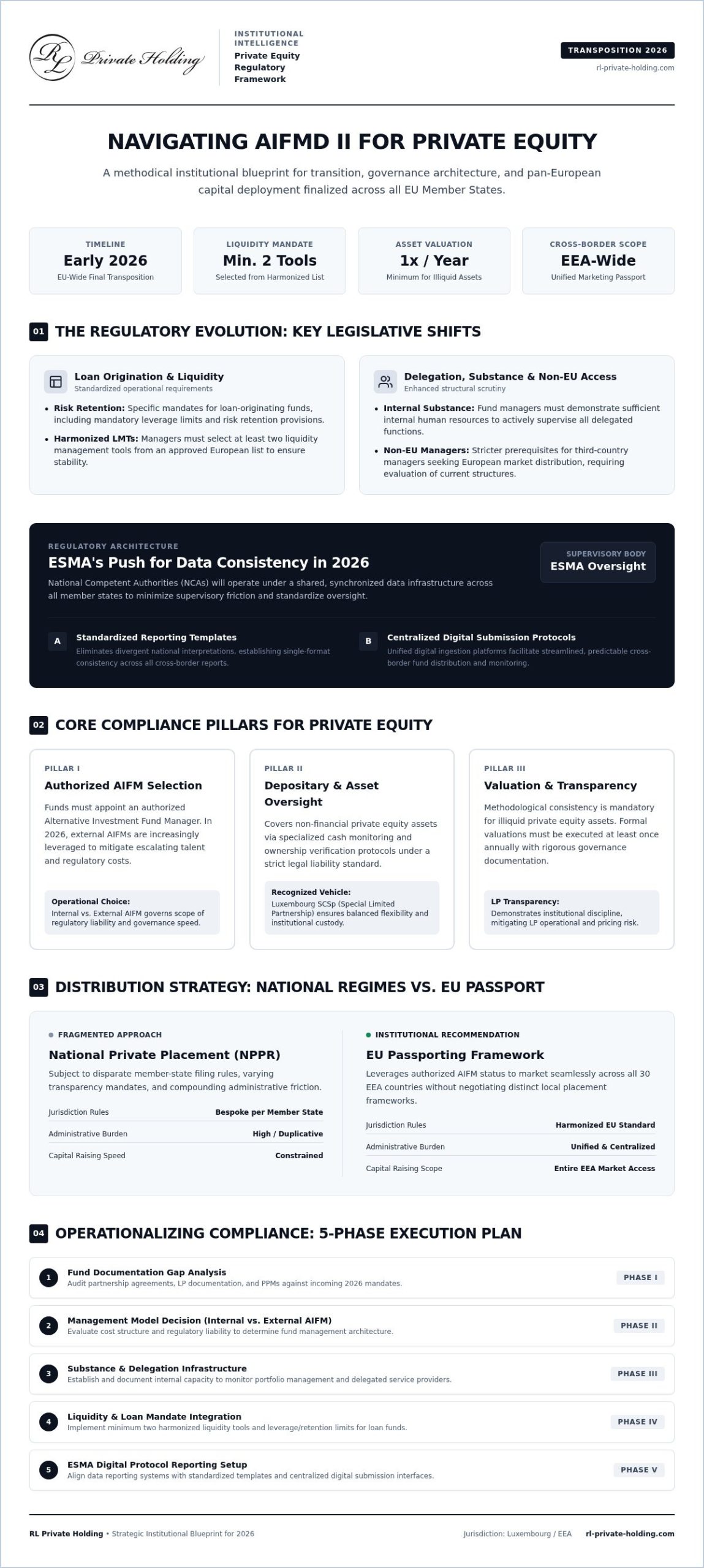
AIFMD II introduces specific mandates for loan-originating funds, including leverage limits and risk retention requirements to ensure financial stability. Liquidity management tools are now standardized, requiring managers to select at least two appropriate instruments from a harmonized list. There’s a heightened focus on delegation and substance. Managers must demonstrate that they retain sufficient internal resources to oversee delegated functions effectively. Non-EU managers face stricter conditions for accessing the European market, making it essential to evaluate the adequacy of existing marketing arrangements to avoid disruptions in capital raising.
The Role of ESMA in 2026 Oversight
Oversight in 2026 is characterized by ESMA’s push for data consistency through standardized reporting templates and centralized digital submission protocols. This shift reduces the friction of cross-border supervision by ensuring that national competent authorities operate with a shared data set. The transposition and full implementation of the AIFMD II framework are finalized across all EU member states as of early 2026. This unified approach facilitates a more predictable environment for navigating AIFMD for private equity funds across multiple jurisdictions, allowing for more efficient operational planning and cross-border fund distribution.
Fundamental Compliance Pillars for Private Equity Managers
Compliance for private equity managers is built upon a foundation of structural accountability. Every fund must appoint an authorized Alternative Investment Fund Manager (AIFM). The choice between internal and external management models significantly impacts operational flexibility. In 2026, many firms prefer external AIFMs to mitigate the rising costs of regulatory talent. Navigating AIFMD for private equity funds involves selecting a management structure that aligns with the fund’s specific investment horizon. This decision dictates the scope of regulatory liability and the efficiency of the fund’s internal governance.
Depositary Oversight in Private Equity
Depositaries face unique challenges when overseeing non-financial assets like technology firms or real estate holdings. Unlike liquid securities, these assets require specialized cash monitoring and ownership verification protocols. The liability regime for depositaries is strict, which directly influences fund operating costs. Utilizing a Luxembourg special limited partnership provides a recognized, compliant vehicle that simplifies these oversight requirements. It’s a structure that balances flexibility with the rigorous asset safekeeping standards demanded by institutional LPs. This methodical approach to asset custody ensures that the fund remains transparent and secure throughout its lifecycle.
Valuation and Transparency Standards
Methodological consistency is paramount for illiquid private equity assets. AIFMD requires that valuations are performed at least once a year. More frequent updates are often necessary during capital calls or distribution events to maintain accuracy. Managers must choose between an internal valuation function, which requires strict functional independence from portfolio management, or appointing an external valuation expert. Transparency reports for national competent authorities must detail the liquidity profile and leverage of the fund. This ensures regulators have a clear view of systemic risk while providing investors with reliable performance data. Managing the complexity of recurring Annex IV reporting is an essential part of this process, requiring high-level data on investment strategies and geographical focus.
Maintaining these pillars requires a partner with a steady hand and institutional depth. RL Private Holding provides the disciplined management necessary to maintain these standards across diversified global portfolios. By integrating these compliance requirements into the core operational framework, fund managers can focus on value creation without compromising regulatory integrity. This disciplined approach transforms compliance into a marker of institutional quality.
Strategic Marketing and the EU Passporting Framework
The AIFMD marketing passport serves as a primary tool for institutional fundraising within the European Economic Area. It enables managers to approach professional investors in all member states through a unified notification process. This replaces the fragmented approach of National Private Placement Regimes (NPPR), which often impose diverse requirements and fees across different jurisdictions. By 2026, the efficiency of the passporting framework has made it the preferred choice for firms seeking to scale their operations globally with institutional gravity. It provides a level of legal certainty that fragmented regimes cannot match.
Successfully navigating AIFMD for private equity funds involves mastering the rules set by Directive (EU) 2019/1160. This legislation clarifies the boundaries of pre-marketing, allowing for initial investor engagement without triggering the full compliance burden of a formal fund launch. Managers must maintain precise records of these activities to avoid regulatory disputes. This discipline ensures that the transition from testing the market to active fundraising is seamless and transparent. In 2026, NPPRs remain a viable alternative for certain niche strategies, yet they’re subject to tighter scrutiny regarding disclosure standards and local reporting requirements.
Navigating Cross-Border Distribution
Notification procedures for marketing in different EU Member States require the AIFM to act as a central coordinator. The AIFM ensures that all investor communications are consistent with the fund’s formal regulatory disclosures. Strategic use of the private equity investment management pillar allows for a cohesive approach to cross-border alignment. This ensures that the fund’s value proposition is communicated effectively while remaining within the strictures of the passporting framework. Methodical coordination between the AIFM and local distributors is essential to maintain the fund’s reputation across diverse European markets.
Compliance in Third-Country Marketing
Accessing European capital as a non-EU manager under AIFMD II requires a deep understanding of cooperation agreements between regulatory bodies. Managers from third countries often face evolving requirements regarding transparency and operational substance. Reliance on reverse solicitation has become increasingly hazardous as regulators in 2026 demand higher standards of proof regarding investor initiative. It’s no longer a reliable strategy for proactive capital raising. A methodical, proactive compliance strategy remains the only secure path for non-EU funds to secure European institutional capital without risking significant regulatory penalties or market exclusion.
Operationalizing Compliance: A Step-by-Step Implementation Guide
Transitioning from regulatory theory to operational reality requires a methodical, sequential approach. For managers navigating AIFMD for private equity funds, the implementation phase is where institutional discipline is most visible. It’s not enough to simply understand the rules; you must embed them into the fund’s daily lifecycle. Following a structured roadmap ensures that no technical requirement is overlooked during the transition to the 2026 standards.
- Step 1: Conduct a thorough gap analysis of existing fund documentation. This involves auditing delegation agreements and internal policies to ensure alignment with AIFMD II updates.
- Step 2: Select and appoint a regulated AIFM and Depositary. This selection should prioritize partners with a deep understanding of the Luxembourg regulatory environment.
- Step 3: Establish a robust Risk Management and Liquidity Management framework that meets the new harmonized standards.
- Step 4: Configure Annex IV reporting systems. Use automated data extraction to minimize manual errors and ensure consistency across all filings.
- Step 5: Implement ongoing monitoring and periodic investor disclosures. This maintains transparency and fulfills your fiduciary duties to Limited Partners.
Establishing the Risk Management Framework
A compliant risk management framework must address market, credit, liquidity, and operational risks with equal precision. For illiquid private equity portfolios, stress testing is a mandatory component of this process. It’s essential that the risk management function remains functionally and hierarchically independent from the portfolio management team. This separation prevents conflicts of interest and ensures that risk limits are monitored objectively. Managers must document these processes clearly to satisfy the oversight requirements of national competent authorities.
Data Management and Reporting Cycles
Reporting frequency is determined by your Assets Under Management (AUM) thresholds, with larger funds typically facing quarterly obligations. Consistency is vital; the data provided in Annex IV filings must align perfectly with SFDR disclosures and local tax filings to avoid regulatory red flags. The integrity of a fund’s regulatory standing depends entirely on the precision and consistency of its Annex IV data submissions. By centralizing data management, you reduce the cost of compliance while improving the speed of reporting. If your firm requires support in establishing these rigorous protocols, consider our professional private equity management services to ensure your operations meet the highest institutional standards.
Integrating AIFMD Compliance into Institutional Portfolio Management
Integrating AIFMD compliance into the broader portfolio management strategy is a hallmark of institutional maturity. Navigating AIFMD for private equity funds effectively means that regulatory considerations are present at every stage of the investment lifecycle, from initial deal sourcing to the final exit. During the due diligence phase, managers must evaluate how a target’s capital requirements align with the fund’s leverage limits and liquidity management tools. This proactive assessment prevents operational bottlenecks and ensures that the acquisition remains within the fund’s established risk parameters. By treating compliance as a strategic input, managers can optimize their deal flow while maintaining a disciplined regulatory posture.
Compliance as a Trust Factor for LPs
Institutional investors and Limited Partners increasingly view a rigorous compliance framework as a primary indicator of operational quality. For these sophisticated entities, a manager’s ability to meet AIFMD standards is a proxy for their commitment to fiduciary excellence and wealth preservation. This is particularly relevant when aligning with family office investment strategies in Luxembourg, where UHNWIs prioritize structures that offer both flexibility and institutional security. A transparent compliance record reduces the perceived risk of the manager, facilitating smoother capital raising and long-term partnership development. It’s a trust factor that distinguishes established firms from those with less disciplined operational backgrounds.
The Future of PE Regulation Beyond 2026
The regulatory environment will continue to evolve as the industry looks toward the eventual introduction of AIFMD III and the deeper integration of ESG mandates. Digitalization is already reshaping the sector, with regulatory technology (RegTech) becoming essential for managing the volume of data required for modern reporting. Adopting these digital protocols early allows fund managers to maintain institutional gravity even as the technical landscape shifts. The future of private equity regulation will likely focus on real-time transparency and cross-border data consistency, requiring a steady and methodical approach to fund governance. Navigating AIFMD for private equity funds in 2026 and beyond demands a partner who can anticipate these shifts with precision.
RL Private Holding remains a dedicated partner in this journey, providing the global scale and expertise necessary to manage these complex structures with exclusivity. Our methodical approach to private equity and asset management ensures that compliance remains a silent but powerful driver of value. By partnering with an authoritative expert, fund managers can focus on strategic growth while we ensure their organizational framework remains secure and transparent in a shifting global landscape.
Securing Operational Excellence in a Regulated Landscape
The transition to the 2026 regulatory framework requires a shift from reactive reporting to proactive operational integration. Managers who prioritize institutional-grade compliance frameworks find themselves better positioned to attract sophisticated capital. By establishing a robust risk management structure and utilizing the EU passporting framework, firms achieve seamless cross-border distribution while maintaining the highest standards of asset safekeeping. Successfully navigating AIFMD for private equity funds ultimately reinforces a fund’s market position and operational stability. It’s a process that transforms regulatory requirements into a marker of institutional quality.
RL Private Holding brings decades of experience in the Luxembourg financial sector to help you manage these complexities. Our approach focuses on global portfolio management across private equity and venture capital, ensuring your fund operations meet the rigorous demands of global institutional LPs. We invite you to explore strategic investment management with RL Private Holding to align your firm with the future of European fund regulation. Maintaining institutional gravity in a shifting landscape is a methodical commitment that yields significant strategic dividends for the disciplined manager.
Frequently Asked Questions
What are the primary differences between AIFMD I and AIFMD II for PE funds?
AIFMD II introduces harmonized rules for loan-originating funds and standardized liquidity management tools. It also enhances transparency regarding delegation arrangements and the substance of the AIFM. While AIFMD I established the baseline for fund oversight; the updated framework focuses on systemic risk mitigation and cross-border consistency. These changes require managers to refine their internal governance to meet the 2026 implementation standards across the European Economic Area.
How does AIFMD impact the marketing of private equity funds to EU investors?
The directive enables managers to use a single marketing passport to reach professional investors throughout the EU. This streamlined process removes the need to navigate diverse national private placement regimes for every member state. Successfully navigating AIFMD for private equity funds involves following the pre-marketing rules established in 2019 to engage investors before a formal launch. This unified framework provides the legal certainty required for large-scale institutional capital raising.
Is a depositary mandatory for all private equity funds under AIFMD?
Yes, every Alternative Investment Fund managed by an authorized AIFM must appoint a single depositary. The depositary’s role includes cash flow monitoring, asset safekeeping, and general oversight of the fund’s operations. For private equity funds, this involves verifying the ownership of non-financial assets like equity in private companies or real estate. It’s a critical oversight function as the depositary remains strictly liable for the loss of financial instruments held in custody.
How does AIFMD II address loan-originating private equity funds?
AIFMD II introduces a specific regime for funds that provide credit directly to companies. These funds must now adhere to leverage limits and risk retention requirements to ensure financial stability. Managers are required to implement robust credit assessment processes and monitor their loan portfolios for concentration risks. These rules aim to harmonize the private credit market while protecting the broader financial system from the risks associated with non-bank lending activities.
What are the reporting requirements for AIFMs managing private equity assets?
AIFMs must fulfill recurring Annex IV reporting obligations that detail the fund’s investment strategies, leverage levels, and liquidity profiles. The frequency of these submissions depends on the total assets under management; with larger funds reporting on a quarterly basis. Navigating AIFMD for private equity funds requires high-level data accuracy to ensure consistency with other regulatory filings like SFDR. This reporting provides national regulators with the data necessary to monitor systemic risk effectively.
Can non-EU fund managers use the AIFMD marketing passport?
Non-EU managers don’t currently have access to the AIFMD marketing passport. They must rely on National Private Placement Regimes to market their funds within individual EU member states. Each country has its own set of requirements and disclosure standards for these regimes. While AIFMD II maintains the possibility of extending the passport to third countries; this remains subject to future decisions by the European Commission and the European Securities and Markets Authority.
How does valuation independence work for illiquid private equity assets?
Valuations for private equity assets must be performed by an entity that is functionally independent from the portfolio management team. This can be an internal valuation department or an external professional valuer. For illiquid assets; valuations are required at least once a year or whenever there’s a significant change in the asset’s value. There’s a strict requirement for this independence to ensure that the Net Asset Value reflects an objective assessment of the holdings.
What is the role of the national competent authority in AIFMD oversight?
The national competent authority is responsible for the authorization and ongoing supervision of AIFMs within its jurisdiction. They review regulatory filings; monitor compliance with capital requirements; and have the power to conduct on-site inspections. These authorities cooperate with ESMA to ensure a consistent application of the directive across the EU. Their oversight ensures that fund managers operate with the necessary substance and internal controls to protect institutional investors and maintain broader market integrity.