

Executing a subscription agreement marks the formal beginning, rather than the conclusion, of an institutional investment relationship. For limited partners seeking to understand what to expect after committing to a PE fund, this transition often introduces immediate operational complexity. Managing internal treasury reserves against unpredictable capital call notices can create friction, while the early unrealized negative returns of the J-curve often provoke unnecessary anxiety. These early phases are an inherent component of private market deployment, yet managing them successfully requires disciplined liquidity planning and transparent oversight.
This guide establishes a clear framework for the operational, financial, and reporting milestones that follow your initial capital commitment. You will gain a structured roadmap of the multi-year capital deployment cycle, actionable clarity on managing liquidity needs, and a thorough understanding of quarterly reporting standards and exit distributions. What follows is a practical breakdown of how capital stewardship unfolds from initial drawdown through final asset realization.
Key Takeaways
- Understand the operational mechanics of transitioning from subscription execution to formal investor onboarding and active capital call management.
- Learn what to expect after committing to a PE fund regarding the J-curve phase, distinguishing early accounting write-downs from long-term enterprise value.
- Establish clear expectations around institutional reporting cadences, connecting quarterly unaudited performance updates with comprehensive year-end audited disclosures.
- Examine the multi-year operational transformation horizon, where disciplined asset stewardship and strategic add-on acquisitions drive fundamental portfolio growth.
- Prepare for the liquidity harvesting phase as investment cycles shift toward asset monetization, distribution waterfalls, and final capital distributions.
The Transition from Subscription Execution to Initial Capital Calls
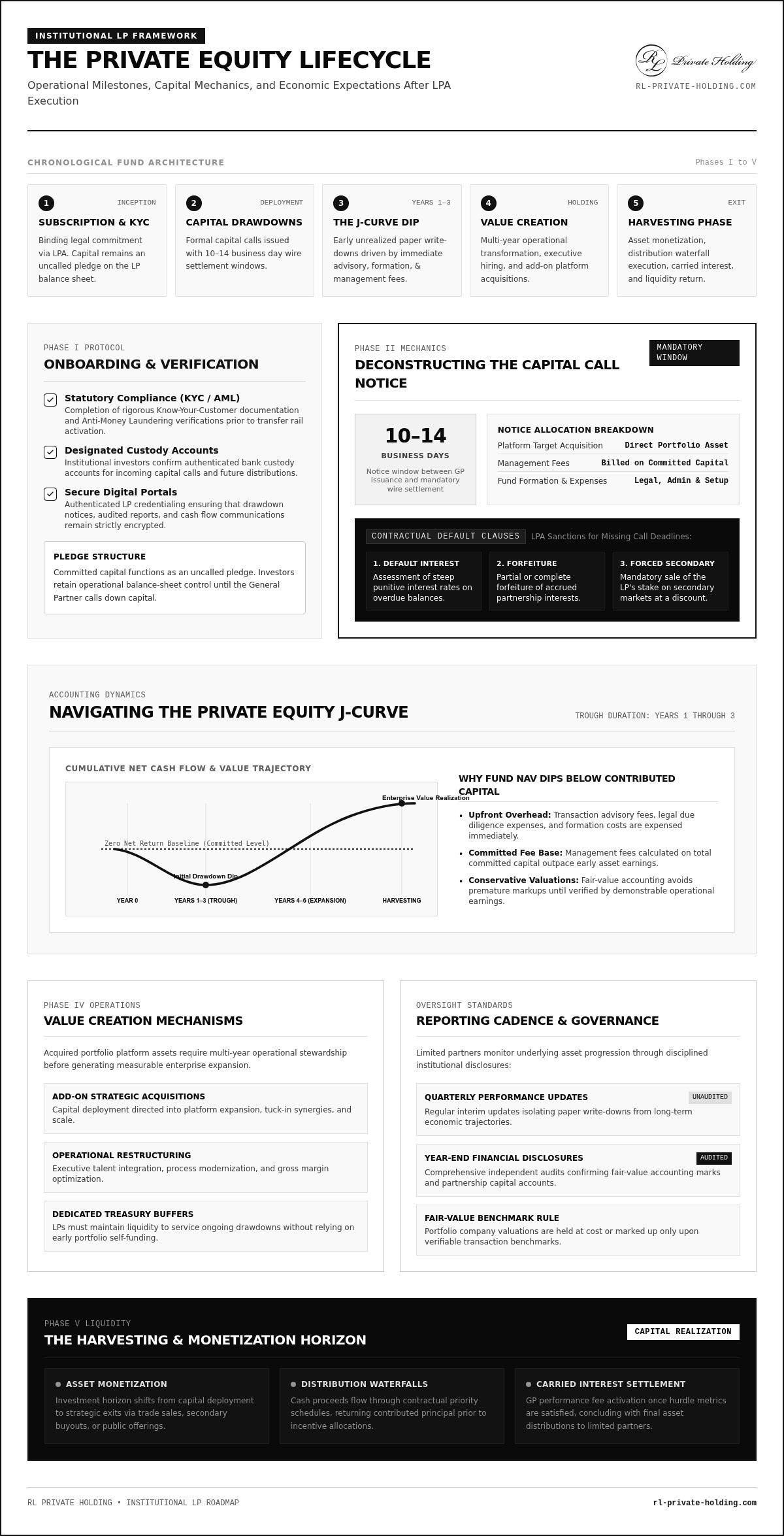
Executing a Limited Partnership Agreement (LPA) establishes a binding legal commitment to provide capital, yet cash remains within the investor’s balance sheet until drawn down. Knowing what to expect after committing to a PE fund begins with recognizing that committed capital functions as an uncalled pledge. Rather than remitting a lump-sum transfer at inception, limited partners (LPs) retain operational control of their funds until the General Partner (GP) activates an institutional drawdown schedule based on deployment opportunities.
Onboarding Formalities and Anti-Money Laundering Verifications
Before any transfer rails open, the general partner’s compliance team initiates rigorous onboarding protocols. Investors must complete Know-Your-Customer (KYC) documentation and Anti-Money Laundering (AML) verifications to satisfy statutory mandates. Institutional investors confirm designated custody accounts and establish authenticated credentials for secure digital investor portals, ensuring all future distribution and drawdown correspondence adheres to strict data-security standards within the wider private equity fund structure.
Deconstructing the Mechanics of a Capital Call Notice
When the fund identifies an investment target or requires partnership working capital, it issues a formal capital call notice, also known as a drawdown notice. Understanding what to expect after committing to a PE fund during this phase requires close attention to the structural components of these documents:
- Notice Window: Drawdown notices typically provide ten to fourteen business days between issuance and the mandatory wire transfer settlement date.
- Allocation Breakdown: The notice specifies the exact proportion of capital allocated toward platform acquisitions versus management fees and fund formation expenses.
- Settlement Instructions: Verified bank routing details and account numbers accompany the call, requiring rigorous internal treasury callbacks to prevent wire fraud.
Discipline is vital here. Failing to meet a capital call triggers contractual default provisions outlined in the LPA. Default penalties are severe: they can include charging steep default interest rates, forfeiting accrued partnership interests, or forcing a secondary sale of the defaulting LP’s stake at a substantial discount. Maintaining dedicated treasury reserves ensures that incoming drawdowns are fulfilled seamlessly throughout the multi-year investment cycle.
Navigating the J-Curve: Accounting for Early Fund Economics
A primary consideration when evaluating what to expect after committing to a PE fund centers on early negative performance. During the initial two to three years, fund net asset values routinely drop below total contributed capital. This trajectory creates the characteristic private equity J-curve. Transaction advisory costs, legal due diligence expenses, and organizational overhead are recognized immediately. Acquired portfolio assets, however, require multi-year holding periods before operational restructuring generates measurable enterprise gains.
The Mathematical Reality of Early Negative Cash Flows
During early deployment, management fees calculated on committed capital outpace immediate portfolio earnings. Newly onboarded platform investments rarely produce early liquidity. Capital is absorbed instead by operational integration, executive hires, and add-on acquisitions. As outlined in the Institutional Limited Partners Association’s Private Equity 101 for LPs guidance, this phase represents an accounting reality rather than systemic underperformance. Allocators should maintain liquid treasury buffers to service ongoing drawdown obligations without expecting early portfolio self-funding.
Interpreting Initial Valuations and Quarterly Statements
Quarterly statements received during the fund’s initial stages require measured interpretation. General partners mark portfolio investments under conservative fair-value accounting frameworks. Assets are rarely marked up until confirmed by demonstrable earnings growth or verifiable transaction benchmarks. Understanding what to expect after committing to a PE fund involves isolating paper write-downs from actual economic trajectory. Limited partners evaluate this progression through distinct institutional metrics:
- Distributed to Paid-In (DPI): Tracks realized cash capital returned to investors relative to cumulative drawn capital. In years one through three, DPI predictably hovers near zero.
- Total Value to Paid-In (TVPI): Combines distributed proceeds with remaining unrealized net asset value against paid-in capital, providing an interim benchmark of portfolio value creation.
Early internal rates of return are inherently distorted by fee timing and uncalled capital pacing. Allocators engaging institutional partners for private equity investment management look past interim accounting volatility, focusing instead on long-term compound growth across the full asset lifecycle.
Governance, Reporting Cadence, and Ongoing Fund Monitoring
Institutional private equity relies on disciplined operational transparency to safeguard investor interests throughout a multi-year fund lifecycle. Allocators clarifying what to expect after committing to a PE fund must understand the formal oversight mechanisms managers utilize. Effective fund administration combines regular unaudited quarterly portfolio snapshots with comprehensive, independently audited annual disclosures. Alongside these written reports, managers host Annual General Meetings (AGMs) where limited partners directly engage portfolio company executives to assess operating initiatives firsthand.
Deciphering Quarterly and Annual Financial Disclosures
Every quarter, fund managers issue unaudited performance packages providing granular updates on underlying assets. These documents present operating metrics like EBITDA growth, enterprise leverage ratios, debt service coverage, and regulatory compliance filings. Year-end reporting transitions to formal audited financial statements prepared under standard GAAP or IFRS guidelines by independent audit firms. For funds with a calendar year-end, managers typically distribute these comprehensive audited balance sheets within 120 days. These packages detail individual asset valuations, management fee offsets, and operating expenses to verify that partner capital is managed within statutory boundaries.
The Strategic Role of the Limited Partner Advisory Committee
The Limited Partner Advisory Committee (LPAC) serves as an essential institutional balance within fund governance. Knowing what to expect after committing to a PE fund includes recognizing how the LPAC operates on behalf of the broader limited partner base. Rather than directing day-to-day investment decisions, the LPAC convenes to resolve structural considerations, such as:
- Conflict Resolution: Evaluating and approving transactions where potential conflicts of interest emerge between the general partner and the fund.
- Valuation Methodologies: Reviewing deviations from standard valuation policies or write-offs of distressed holding assets.
- Related-Party Transactions: Approving transactions involving affiliate entities, co-investment vehicles, or GP-led secondaries.
These structured checks and balances reflect established private equity investment management protocols. Structured governance preserves alignment, maintains clear accountability, and protects investor capital across unpredictable market cycles.
Value Creation Mechanisms During the Core Holding Horizon
Following initial platform deployment, the fund enters its core operational horizon, typically spanning three to five years. For allocators assessing what to expect after committing to a PE fund, this phase represents the operational engine of the partnership. Rather than relying on market timing or passive multiple expansion, general partners initiate active operational transformations across portfolio companies to institutionalize performance, expand enterprise margins, and compound fundamental equity value.
Operational Engineering and Organic Revenue Expansion
General partners embed dedicated operating partners and sector specialists directly into portfolio company governance. These executives optimize working capital management, implement robust internal controls, and streamline commercial workflows. Management focuses capital expenditure on modern software infrastructure, supply chain consolidation, and sales-force reorganization. Progress is tracked systematically against baseline financial models developed during underwriting, ensuring portfolio companies achieve durable organic revenue expansion and EBITDA margin improvements.
Strategic Add-On Acquisitions and Strategic Scaling
Beyond organic operational improvements, fund managers expand enterprise scope through strategic buy-and-build programs. Allocators examining what to expect after committing to a PE fund during years three through five will observe regular execution of strategic add-ons:
- Market Consolidation: Acquiring smaller, fragmented competitors at lower valuation multiples to achieve immediate scale and cost synergies.
- Credit Facility Optimization: Utilizing subscription lines and portfolio debt facilities to fund bolt-on acquisitions without requiring immediate equity drawdowns from limited partners.
- Operational Cross-Pollination: Integrating intellectual property, geographic footprints, and product lines across sister holdings to expand market share.
Managing diversified portfolio holdings across multiple jurisdictions requires robust legal and administrative frameworks. Sophisticated investment managers often structure these holding vehicles using specialized cross-border jurisdictions, such as the Luxembourg special limited partnership, to manage complex multi-asset holdings efficiently. As portfolio companies reach target operational maturity, capital calls taper off dramatically, preparing the partnership for liquidity realization. Discover how institutional allocators align with disciplined capital stewardship by partnering with RL Private Holding for wealth management services.
The Harvesting Phase: Liquidity Realization, Carried Interest, and Exit Dynamics
As portfolio companies mature and achieve operational milestones, the partnership pivots from active value creation to capital monetization. Understanding what to expect after committing to a PE fund during this final horizon centers on cash flow reversal. The heavy capital outflows that define earlier years transition into liquidity distributions, shifting the fund’s operational focus toward disciplined exit execution and distribution mechanics.
Primary Divestment Routes in Modern Private Equity
Fund managers pursue three distinct monetization pathways, depending on market liquidity and asset maturity:
- Strategic Trade Sales: Selling platform companies directly to strategic corporate buyers seeking geographic expansion, complementary product lines, or immediate market dominance.
- Secondary Buyouts: Divesting mature assets to larger private equity sponsors equipped to guide the enterprise through its subsequent growth phase.
- Public Market Listings: Executing initial public offerings (IPOs) when macro capital market conditions support enterprise equity listings.
General partners evaluate these routes against prevailing interest rate dynamics and valuation multiples, selecting the liquidity mechanism that maximizes net proceeds for limited partners.
Deconstructing the Institutional Distribution Waterfall
When divestments materialize, proceeds flow through the distribution waterfall established in the Limited Partnership Agreement. Knowing what to expect after committing to a PE fund regarding exit cash flows requires understanding this precise settlement order:
- Return of Contributed Capital: Net realization proceeds flow directly to limited partners until they recover their drawn capital for realized investments alongside allocated fund expenses.
- Preferred Return Hurdle: Investors receive a cumulative preferred return, historically set at an 8% annual hurdle, before the general partner participates in portfolio profits.
- General Partner Catch-Up: Once the hurdle rate is fulfilled, a contractual portion of remaining gains flows to the GP until performance fees align with agreed partnership terms.
- Carried Interest Allocation: Final net profits are distributed according to the partnership split, typically directing 80% to limited partners and 20% to the general partner as carried interest.
Institutional contracts also feature clawback covenants. If later asset exits underperform earlier realisations, the GP must return excess carried interest distributions. This mechanism ensures total performance compensation strictly reflects cumulative, fund-level net profitability upon final wind-down.
Mastering the Long-Term Private Equity Lifecycle
Understanding what to expect after committing to a PE fund enables institutional allocators to approach multi-year deployment with clarity and operational composure. From managing initial capital call schedules and interim J-curve accounting marks to tracking operational milestones and final waterfall distributions, each phase follows a structured trajectory. Successful participation in private markets requires viewing legal commitment as an active partnership, supported by proactive liquidity management and long-term capital allocation.
Navigating this complex multi-year lifecycle demands an experienced partner committed to transparent oversight. Maintaining institutional governance standards aligned with international fiduciary practices ensures investor interests remain safeguarded throughout shifting market cycles. Through disciplined portfolio stewardship across private equity, venture capital, and real estate, managers turn uncalled pledges into durable, realized value. To strengthen your capital allocation strategies across alternative asset classes, Explore Institutional Private Equity Solutions with RL Private Holding.
Frequently Asked Questions
How quickly will my capital be deployed after executing commitment documentation?
Capital deployment occurs gradually rather than immediately after signing. General partners call capital opportunistically over an investment period that typically spans three to five years. Initial drawdown notices generally arrive within the first several months to cover platform seed transactions and organizational setup costs, meaning your committed reserves remain in your own custody until specific investment opportunities arise.
What occurs if an investor fails to meet a scheduled capital call deadline?
Failing to fulfill a capital call triggers contractual default procedures defined in the partnership agreement. Managers issue formal cure notices, yet continued non-compliance can result in substantial financial penalties. These repercussions include charging default interest rates on overdue amounts, suspending voting rights, forfeiting accrued profit shares, or forcing a distressed secondary transfer of the defaulting investor’s partnership interest.
Can an LP sell or transfer their fund commitment before the fund liquidates?
Limited partners can transfer fund commitments through the secondary market, though all transactions require explicit general partner consent. Because private equity commitments are legally illiquid, transfers involve comprehensive legal review, purchaser accreditation checks, and administrative transfer fees. Understanding what to expect after committing to a PE fund includes recognizing that secondary sales often trade at negotiated discounts to net asset value.
What is the typical duration of the private equity commitment and investment cycle?
The standard private equity fund lifecycle spans ten to twelve years from initial closing to final liquidation. The first three to five years constitute the active investment phase where managers draw capital to acquire platforms. The remaining years focus on operational growth and harvesting asset value through trade sales, sponsor recapitalizations, or initial public offerings to return proceeds.
How frequently do limited partners receive valuation reports and portfolio updates?
Limited partners receive unaudited financial packages and detailed narrative progress updates on a quarterly basis. In addition, managers deliver comprehensive annual audited financial statements, typically distributed within 120 days of the fund’s fiscal year-end. These reports outline asset-level valuation methodologies, holding-level operating performance, debt leverage figures, and net partnership fee allocations under international accounting standards.
How do management fees change once the initial investment period concludes?
Management fee calculations shift substantially once the active investment period finishes. During early deployment, fees are calculated as a percentage of total committed capital. After the investment window closes, the fee basis typically transitions to the lower net invested capital base or remaining active asset cost, reducing overall annual fund overhead as managers focus purely on asset stewardship and divestment.