

A rise in reported earnings is not, by itself, proof that a portfolio company has become more valuable. Maximizing value from a portfolio company requires improvements that strengthen underlying performance, not just short-term financial results.
Investors and management teams know they must balance growth, cash generation and investment in capabilities. The challenge is turning that principle into action. Value-creation plans can lack clear owners and milestones, while immediate gains may not last. Without defined measures, it can also be difficult to separate operational progress from changes in market conditions.
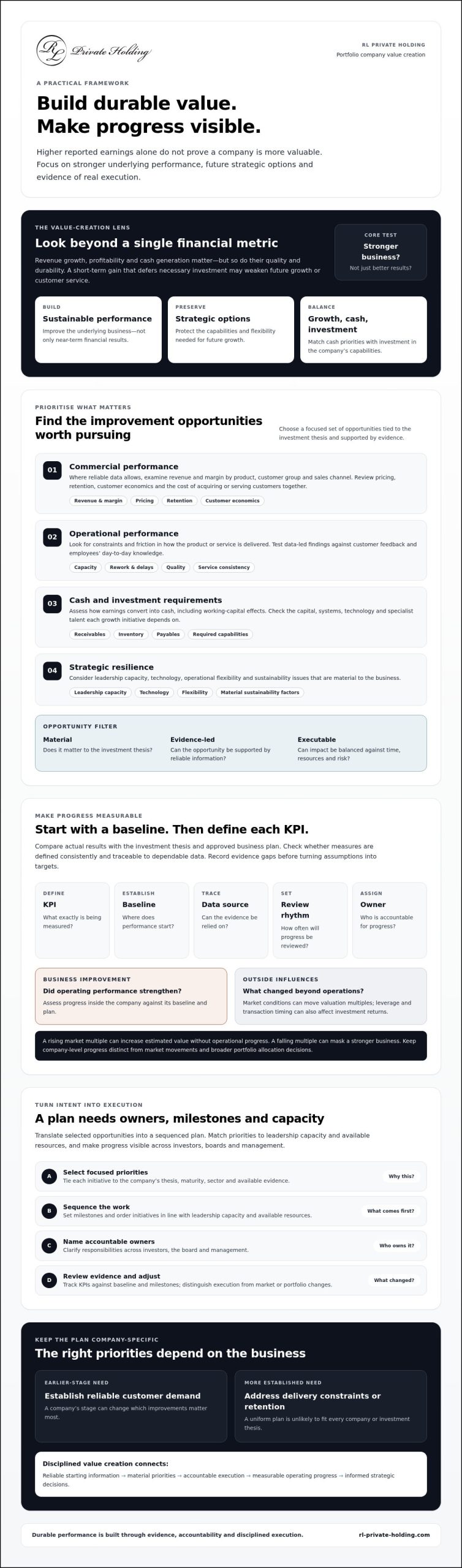
This article offers a practical framework for identifying and prioritising improvement opportunities, assigning accountability across investors, boards and management, and tracking progress against clear milestones. It also explains how to assess whether financial gains reflect stronger operating performance and how to balance near-term cash priorities with investment in future growth. The aim is a disciplined plan that makes progress visible and supports informed strategic decisions.
Key Takeaways
- Define portfolio-company value through durable business performance and future strategic options, rather than relying on a single financial metric.
- Prioritise commercial and operational drivers by assessing where customer economics, productivity, quality or capacity can improve.
- Make progress measurable by defining each KPI, its baseline, data source, review frequency and accountable owner.
- Turn maximizing value from a portfolio company into an executable plan by sequencing initiatives and matching priorities to leadership capacity and available resources.
- Assess company performance within the context of disciplined investment management, while distinguishing business improvement from wider market or portfolio changes.
What Maximizing Value from a Portfolio Company Really Means
Maximizing value from a portfolio company means building sustainable business performance and preserving strategic options, not pursuing a single financial metric in isolation. Revenue growth, profitability and cash generation matter, but so do their quality and durability. A temporary earnings increase achieved by deferring necessary investment, for example, may weaken the company’s ability to grow or serve customers over time.
Separate improvement within the business from changes outside it. A company’s performance can strengthen while its valuation multiple falls because of market conditions. Conversely, a rising market multiple can increase estimated value without any underlying operational progress. Changes to broader portfolio allocation are a separate investment decision, not evidence that the company itself has improved. For background on the structure and terminology of private equity funds, consult this foundational reference.
A disciplined approach starts with a small number of material priorities, each with a clear owner and a way to assess execution. The right priorities depend on the company’s maturity, sector, investment thesis and the quality of available evidence. An early-stage business may need to establish reliable customer demand; a more established company may need to address delivery constraints or improve customer retention. A uniform plan is unlikely to suit both.
How company value differs from investment returns
Operating progress can contribute to investment returns, but it does not guarantee an outcome. Returns also depend on factors such as leverage, market conditions and transaction timing, which may sit partly or wholly outside management’s control. Assess company-level progress separately from these influences. This distinction helps investors see whether an initiative improved the business, even if other factors affected the investment’s overall result. Returns cannot be assured.
Why a portfolio-company plan needs a defined starting point
Before setting targets, establish a baseline using reliable financial, commercial and operational information. Compare actual results with the investment thesis and approved business plan, then identify where they diverge. Check how metrics are defined, whether they are recorded consistently and whether data can be traced to a dependable source. If evidence is incomplete, record the limitation before converting assumptions into targets. Otherwise, the plan may create false precision rather than useful accountability.
Which Portfolio Company Value Drivers Deserve Priority?
A useful assessment considers commercial performance, operations, cash requirements and strategic resilience. Maximizing value from a portfolio company does not mean selecting every plausible improvement. It means identifying opportunities that are material to the investment thesis and supported by evidence, then weighing their likely impact against the resources, time and risks involved in execution.
How to assess commercial and operational opportunities
Where reliable data allows, analyse revenue and margin by product, customer group and sales channel. This can show, for example, whether growth depends on a narrow group of customers or whether one route to market produces weaker margins. Review pricing, retention, customer economics and the cost of acquiring or serving customers together. Higher sales alone may not improve profitability.
Then examine the processes used to deliver the product or service. Capacity constraints, rework, delays, quality issues or inconsistent service may limit growth or increase costs. Test analytical findings against customer feedback and employees’ knowledge of day-to-day workflows. Data can point to possible causes; people close to the work can help determine whether those causes are accurate and addressable.
How to assess financial and strategic resilience
Reported earnings provide only part of the picture. Examine how effectively earnings convert into cash, including the effects of receivables, inventory, payables and other working-capital needs. Assess the capital requirements and dependencies of each growth initiative, such as additional systems, technology or specialist talent. A plan that assumes these resources without confirming their availability may set targets the company cannot deliver.
Strategic resilience also matters. Consider whether the company has the leadership capacity, technology and operational flexibility to execute its priorities, and identify sustainability considerations that are material to its business. Connect each proposed initiative to the investment thesis and company-specific risks. This keeps improvement work focused on the rationale for ownership rather than a generic checklist.
Use a consistent screening test before adding an initiative to the plan:
- Potential impact: Could it materially improve growth, margins, cash generation, resilience or strategic options?
- Evidence quality: Do reliable data and relevant customer or employee input support the opportunity?
- Time and resources: Can the company implement it with its available leadership, capital and capabilities?
- Execution risk: What dependencies or trade-offs could delay results or disrupt core operations?
Prioritise opportunities that clearly connect to the investment thesis, have credible supporting evidence and offer a realistic path to execution. To understand an investor’s broader context, RL Private Holding’s investment activities span technology, real estate, asset management, private equity and venture capital.
How to Measure Progress Without Mistaking Short-Term Gains for Value
A measurement system should show both whether an initiative is being implemented and whether it is producing a durable business outcome. Leading indicators track actions or early conditions management can influence. Lagging indicators show the resulting financial or operating performance, often after a delay. Maximizing value from a portfolio company depends on reading these measures together, rather than treating an early milestone or a single reporting period as proof of lasting improvement.
Which KPIs show execution and which show outcomes?
Pair each initiative with measures that are clearly defined and consistently available. For every KPI, record its calculation, baseline, accountable owner, review frequency and data source. Select indicators that management can influence and investors can review reliably. Validate targets and benchmarks against the company’s circumstances rather than applying them universally.
For example, a pricing initiative might track completion of customer and contract reviews as a leading indicator, alongside realised price and gross margin as outcomes. Gross margin may rise in reported EBITDA while cash flow remains weak because collections have slowed or investment needs have increased. Customer retention and service quality can help reveal whether the change is sustainable or creating a hidden trade-off.
| Initiative | Leading indicator | Outcome measure | Potential trade-off |
|---|---|---|---|
| Improve pricing discipline | Priority contracts reviewed against approved pricing criteria | Realised price and gross margin | Customer retention or sales volume may be affected |
| Reduce delivery delays | Completion of identified process changes | On-time delivery and service-related costs | Added capacity or systems may require investment |
| Strengthen collections | Overdue accounts assigned and followed up | Cash collected and receivables trend | Changes to payment terms may affect customer relationships |
These are examples of measures, not prescribed targets. Interpret results alongside the baseline, business conditions and any concurrent changes. Do not attribute an outcome to one initiative unless the analysis supports that conclusion. A change in EBITDA or cash flow may have several causes, including shifts in volume, input costs or investment timing.
How governance keeps measurement decision-useful
Set a review cadence suited to the initiative and the speed at which its indicators change. Management can assess execution and resolve operational dependencies; board and investor discussions can focus on material variances, risks and decisions requiring oversight. If a milestone is missed, establish the cause, assess dependencies and agree whether to adjust resources, timing or scope. For related governance context, see the private equity investment management framework.
How to Turn a Portfolio Company Value Plan into Execution
A value plan becomes operational when each priority is translated into work, ownership and decisions. Maximizing value from a portfolio company calls for a sequence that leadership can deliver with available resources, not an extensive list of initiatives competing for the same people, capital and management attention.
How to build a sequenced, accountable improvement plan
Use the investment thesis and diagnostic findings to build a focused roadmap. For each workstream, record the intended outcome, accountable owner, milestones, dependencies, resource requirements and principal risks. Separate actions management can begin with existing capabilities from initiatives with longer lead times, such as new technology, specialist recruitment or additional capital.
- Confirm the starting point. Document the evidence behind the opportunity and note any assumptions or data gaps.
- Select initial priorities. Choose work with a clear link to the investment thesis and a realistic path to execution. Defer lower-priority initiatives if leadership capacity is constrained.
- Assign ownership and dependencies. Name a management owner for each workstream, then identify requirements across technology, talent, capital, customers and operating processes.
- Set milestones and decision points. Specify what must be completed, by whom and when, including approvals or resources needed to proceed.
- Review evidence and adapt. Compare progress with milestones, test whether assumptions still hold and adjust scope when new evidence warrants it. Keep accountability clear even when the plan changes.
Sequencing matters. A growth initiative may depend on hiring experienced staff or upgrading systems before the company can serve additional customer demand. Record those dependencies explicitly rather than treating the projected outcome as immediately achievable. For growth-stage businesses, the venture capital investment framework provides related context on investment considerations.
How investors and management can coordinate without blurring roles
Management should retain responsibility for operating decisions and delivery. Investors and the board provide oversight, assess progress against agreed priorities and address decisions reserved for their review. Agree in advance which material variances, resource requests or changes in scope require escalation. This reduces uncertainty without displacing management ownership.
Use a consistent reporting format for reviews: milestone status, evidence, dependencies, risks, decisions required and next steps. Focus discussion on resolving barriers and making decisions, not reproducing status updates across separate forums. Revisit the plan as evidence changes, while recording why priorities or assumptions have shifted.
For more information on RL Private Holding’s investment activities, explore the firm’s investment approach.
How RL Private Holding Connects Company Performance to Investment Discipline
For investors, company-level performance is one part of a broader assessment. Consider improvements against the investment objectives, the evidence available and the company’s capacity to execute. This helps distinguish operational progress from wider portfolio decisions or external market changes, keeping conclusions grounded in what the business can demonstrate.
RL Private Holding is a privately held investment holding company that manages a diversified global portfolio. Its investment focus spans technology, real estate, asset management, private equity and venture capital. This breadth provides relevant investment context, but it does not mean that companies in different sectors should follow the same improvement plan or that RL Private Holding applies a particular operating method to its portfolio.
How a diversified investment perspective informs company-level assessment
Sector context can shape the questions investors ask. A technology company may need to examine whether its systems and talent can support its growth strategy, while a real estate business may face different operational and capital considerations. These are prompts for company-specific analysis, not universal prescriptions. Appropriate priorities depend on the company’s market, capabilities, investment thesis and supporting evidence.
Keep company performance distinct from portfolio-level considerations. A business can make operational progress even if its sector faces headwinds; likewise, changes to portfolio allocation do not establish that an individual company has improved. A disciplined assessment considers both perspectives without making unsupported claims about performance or investment outcomes. For maximizing value from a portfolio company, the practical standard is evidence of progress that aligns with its objectives and can be sustained with its available capabilities.
What investors should establish before proceeding
Before making ambitious commitments, investors and management should confirm the company’s baseline, material priorities, leadership capacity and reporting quality. They should also agree on decision rights, governance responsibilities and a review process. These foundations connect targets to credible information and clarify accountability as execution proceeds.
RL Private Holding’s broad investment activity is relevant context, not a claim of specific portfolio-company results or a guaranteed approach. Readers seeking information about its investment focus and investment and wealth management services can explore RL Private Holding.
Build Durable Progress Into the Next Investment Decision
Maximizing value from a portfolio company depends on connecting a small number of material priorities to clear ownership, reliable measures and regular review. A defined baseline helps distinguish genuine operating improvement from market movements, while balanced indicators show whether financial gains are supported by stronger customer outcomes, cash generation and execution capacity.
The framework is practical: select initiatives that fit the company’s investment thesis and resources, assign accountable owners, and revisit assumptions as evidence develops. Demonstrate progress rather than presume it. This discipline supports better decisions while keeping short-term results in perspective.
RL Private Holding is a privately held investment holding company managing a diversified portfolio, with a stated focus spanning technology, real estate, asset management, private equity and venture capital. Its investment and wealth management services include private equity investment management, venture capital funding and real estate asset management.
With clear priorities and consistent accountability, leadership can build evidence of sustainable progress and make informed choices about the company’s next stage. To discuss RL Private Holding’s investment focus and services, explore RL Private Holding.
Frequently Asked Questions
What does maximizing value from a portfolio company mean?
Maximizing value from a portfolio company means improving sustainable business performance and strengthening strategic options, rather than focusing on one financial metric alone. It involves selecting priorities that fit the investment thesis, assigning accountable owners and measuring progress against a credible baseline. Distinguish company-level improvement from valuation changes driven by market multiples, leverage, broader portfolio decisions or transaction timing.
How do private equity investors create value in a portfolio company?
Private equity investors can support value creation by aligning management around priorities tied to the investment thesis. These may include commercial growth, pricing, customer retention, operational reliability, cash conversion or investment in capabilities. Effective execution requires clear management ownership, relevant measures and governance that addresses dependencies. Investor oversight can inform strategic decisions, while initiatives should remain grounded in the company’s market, available evidence and capacity to execute.
Which KPIs should a portfolio company track?
A portfolio company should track KPIs that reflect its strategy, operating model and improvement priorities. Measures may include revenue growth, gross margin, customer retention, service quality, productivity, cash conversion and working-capital trends. Pair outcome measures with execution indicators, such as completed milestones. Define each KPI consistently, establish a baseline, name an owner and document its data source and review frequency. Validate targets for the individual company rather than assuming they are universal.
How can investors distinguish sustainable value from short-term gains?
Investors can assess sustainability by checking whether financial gains are supported by durable operating and customer outcomes. Consider reported earnings alongside cash flow, retention, quality, productivity and required investment. A temporary increase in EBITDA may not indicate stronger performance if it depends on deferred spending or coincides with deteriorating service. Review results over an appropriate period, account for external influences and avoid attributing change to an initiative unless the analysis supports that conclusion.
What happens if a portfolio company misses its value-creation milestones?
A missed milestone should prompt a review, not an automatic assumption of failure. Determine whether the cause was execution, an unmet dependency, limited resources, a change in market conditions or an incorrect assumption. Management and investors can then decide whether to adjust timing, scope or resources, while maintaining clear ownership and escalation responsibilities. Record the rationale and revise relevant measures where necessary so future reviews remain useful and accountable.
Can a portfolio company improve value without cutting costs?
Yes. A company can strengthen value through revenue quality and business capabilities without making cost reduction the primary lever. Options may include improving customer retention, refining pricing, developing more effective sales channels, increasing capacity or investing in technology and talent. The appropriate opportunity depends on the investment thesis and available evidence. Assess expected benefits alongside required resources, execution risks and potential effects on cash generation and customer outcomes.
How often should a portfolio-company value plan be reviewed?
Review frequency should reflect the pace of each initiative, the availability of reliable data and the decisions required. Management may need to monitor execution indicators more frequently than longer-term financial outcomes can be assessed. Establish a regular schedule for management, board and investor discussions, with clear escalation points for material delays or risks. The cadence should support timely decisions without creating duplicate reporting or obscuring accountability.