

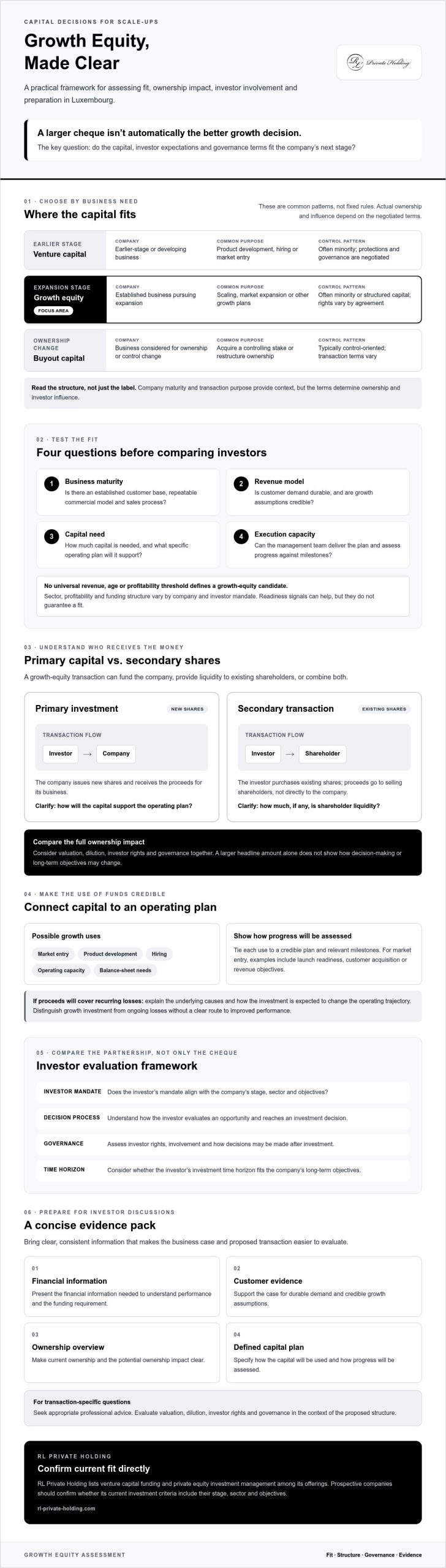
A larger cheque isn’t necessarily the better growth decision. When assessing growth equity for scale-ups Luxembourg-based companies may pursue, the central question is whether the capital, investor expectations and governance terms fit the business’s next stage.
Venture capital, growth equity and buyout capital can involve different company stages, ownership expectations and levels of investor influence. The distinctions also vary between providers. A headline funding amount won’t show how a proposed investment could affect dilution, decision-making or long-term objectives.
This guide explains when growth equity may suit a scale-up, how it compares with other forms of private capital, and what to assess when evaluating investors in Luxembourg. It also covers how to prepare an evidence-based case for investor discussions, including the operating and financial information that supports a useful evaluation. RL Private Holding has interests in venture capital and private equity, but prospective companies should confirm directly whether its current investment criteria include their stage, sector and objectives.
Key Takeaways
- Assess whether growth equity fits your scale-up by examining its maturity, revenue model, capital needs and intended use of funds, rather than relying on the funding label alone.
- Compare primary growth capital with secondary transactions. Consider how valuation, dilution, investor rights and governance could affect ownership and decision-making.
- Use a consistent framework to evaluate growth equity for scale-ups Luxembourg, including investor mandate, decision process, governance approach and investment time horizon.
- Prepare clear financial information, customer evidence, an ownership overview and a defined capital plan for investor discussions. Seek appropriate professional advice on transaction-specific questions.
- RL Private Holding lists venture capital funding and private equity investment management among its offerings. Confirm its current stage fit and investment criteria directly.
What Growth Equity Means for Scale-Ups in Luxembourg
Growth equity is capital invested in an established company to support its next phase of expansion. It commonly takes the form of a minority shareholding or a structured equity investment, though the arrangement depends on the transaction. For an overview of the concept and how it relates to other private capital strategies, see What is growth equity.
There is no universal revenue, age or profitability threshold that makes a company a growth-equity candidate. More useful questions are whether the business has a repeatable commercial model, how much capital it needs and how management plans to use it. A Luxembourg scale-up might seek funding to enter additional markets, expand its team or develop its product. The case should be supported by evidence, not ambition alone.
Where Growth Equity Fits in a Company’s Funding Journey
A scaling business often has established customers and sales processes, alongside plans to expand its reach or capacity. Investors will assess whether customer demand is durable, growth assumptions are credible and the management team can execute the plan. These signals can help indicate readiness, but they don’t guarantee a fit. Sector, profitability and funding structure vary by company and investor mandate.
Growth Equity Compared with Venture Capital and Buyouts
These categories describe common patterns, not fixed rules. A company’s maturity and the purpose of the transaction provide context, while the negotiated terms determine ownership and investor influence. Assess growth equity for scale-ups Luxembourg by examining the actual structure rather than relying on the label.
| Capital type | Typical company stage | Common transaction purpose | Control expectations |
|---|---|---|---|
| Venture capital | Earlier-stage or developing businesses | Fund product development, hiring or market entry | Often a minority investment, with negotiated investor protections and governance rights |
| Growth equity | Established businesses pursuing expansion | Provide capital for scaling, market expansion or other growth plans | Often minority or structured capital; rights and involvement depend on the agreement |
| Buyout capital | Businesses considered for a change in ownership or control | Acquire a controlling stake or restructure ownership | Typically control-oriented, though transaction terms vary |
The distinctions can overlap. A growth investment may include significant governance rights, and a transaction may combine new capital for the company with a sale of existing shares. Consider the investment purpose, ownership impact and decision-making provisions together. This gives a more useful basis for comparison than assuming a company’s stage determines the right type of capital.
How Growth Equity Works: Capital, Ownership, and Investor Involvement
A growth-equity transaction can provide capital to the company, liquidity to existing shareholders, or both. In a primary investment, the company issues new shares and receives the proceeds for its business. In a secondary transaction, an investor purchases existing shares from shareholders, so the proceeds go to the sellers rather than directly to the company. A scale-up seeking funds for expansion should clarify how much of the transaction will support operations and how much, if any, will provide shareholder liquidity.
What Scale-Ups May Use Growth Capital to Fund
Companies may seek growth capital for market entry, product development, hiring, increased operating capacity or balance-sheet needs. Each use should connect to a credible operating plan and milestones that let management and investors assess progress. For example, a market-entry allocation could be tied to launch readiness, customer acquisition or revenue objectives. This helps investors evaluate the funding requirement and the company’s ability to deploy the capital.
Equity can support a defined plan, but it isn’t a substitute for one. If proceeds will cover recurring losses, explain their underlying causes and how the investment is expected to change the operating trajectory. A credible plan should distinguish investment in growth from ongoing losses without a clear route to improved performance.
How Equity Terms Shape the Partnership
In a primary share issue, valuation and the amount of newly issued equity together determine dilution. In a simplified transaction, an investor’s post-money ownership equals the new investment divided by the post-money valuation, while existing shareholders’ ownership is reduced accordingly. The negotiated valuation, share class and transaction structure affect both the amount raised and the ownership retained by founders and other shareholders.
Ownership is only one part of the agreement. Terms may include board representation or observer rights, information rights, reserved matters requiring investor consent, liquidation preferences and anti-dilution provisions. These provisions can affect decision-making and the distribution of proceeds in future transactions. Their scope depends on the negotiated documents and the company’s circumstances. Obtain qualified legal advice before agreeing to terms, particularly where preference or price-adjustment clauses are involved.
Some investors may contribute strategic perspective, sector knowledge or relevant relationships, but the investment label alone doesn’t guarantee the nature or extent of that involvement. Clarify expectations directly and document material rights and obligations. For context on Luxembourg’s private-capital ecosystem, consult the Luxembourg Private Equity and Venture Capital Association. Companies considering growth equity for scale-ups Luxembourg can also review RL Private Holding’s investment interests and confirm directly whether its current criteria fit their stage and proposed transaction.
How to Assess Growth Equity Fit and Compare Investors
A funding proposal should pass two tests: whether the company is prepared to raise capital, and whether a particular investor’s approach fits its objectives. When considering growth equity for scale-ups Luxembourg, compare potential partners on more than the amount of capital available. Mandate fit, decision-making, governance expectations and investment horizon all matter after a transaction closes.
Is a Scale-Up Ready to Raise Growth Equity?
Start with the evidence behind the plan. Review historical performance, forecasts, unit economics, customer concentration and the consistency of management reporting. Then connect the proposed investment to specific milestones, such as launching in a new market or increasing delivery capacity. If the raise is mainly intended to extend runway, explain the operating rationale rather than presenting a later fundraising date as the goal.
Identify unresolved questions before diligence begins. Ownership records, intellectual-property arrangements, legal matters or gaps in management capacity may require professional review. Addressing them early helps the company present a coherent account of its readiness and risks.
Questions to Ask a Prospective Growth Investor
Ask each investor to explain its current mandate, preferred company stage, sector scope and internal decision authority. Clarify expected involvement after investment, reporting cadence, governance rights and its approach to potential follow-on funding. These questions help distinguish a relevant fit from a broad expression of interest.
Assess strategic support as carefully as financial terms. Request relevant references where appropriate, respect confidentiality and verify claims independently. Treat informal discussions as indications, not commitments, unless expectations are reflected in agreed documentation.
Core diligence checklist: compare mandate and stage fit, sector scope, investment decision process, governance rights, reporting expectations, time horizon, follow-on approach and verifiable strategic support.
Use the same comparison framework for each prospective investor instead of relying on separate impressions from meetings. An evaluation record can capture stated criteria, confirmed details, open questions and the company’s view of alignment. Keep evidence distinct from assumptions, particularly when assessing access to expertise or commercial relationships.
- Financial quality: Are results, forecasts and unit economics supported by reliable records?
- Customer evidence: Do retention, concentration and sales data support the growth assumptions?
- Execution capacity: Can the management team deliver the proposed milestones while maintaining core operations?
- Capital plan: Is the amount sought tied to defined uses and measurable progress?
Don’t assume every investor follows the same model. Confirm current criteria directly, including any requirements relating to sector, ownership or governance, before treating a discussion as a viable funding path.
Preparing for Growth Equity in Luxembourg: Diligence and Structure
Preparation helps founders present a consistent investment case and identify issues that could affect valuation, timing or transaction structure. For growth equity for scale-ups Luxembourg, start before formal diligence: define the funding objective, organize company records, understand the ownership position and obtain appropriate professional advice.
What to Prepare Before an Investor Discussion
Assemble reliable, current records that management can explain and update. Investors may request financial statements, forecasts, ownership records, material contracts and relevant company policies. Check that documents are complete and consistent, and identify gaps rather than waiting for diligence to uncover them.
Set out a use-of-funds plan that connects each allocation to assumptions and operating milestones. Include downside scenarios, such as slower customer acquisition or delayed market entry, and explain how management would respond. Be ready to discuss the company’s market position, material risks, governance arrangements and capital alternatives. A clear explanation of why equity is appropriate is more useful than a funding target without supporting rationale.
Luxembourg and Cross-Border Considerations to Verify
Luxembourg’s relevance may reflect the company’s legal structure, the location or profile of investors, and cross-border operations. These factors can influence which documents, reporting expectations and transaction questions need attention. They don’t create one standard structure for every company or investment.
Ask qualified Luxembourg legal counsel and tax advisers to assess the specific entity and proposed transaction. Have appropriate advisers verify any regulatory implications, tax treatment, fund-related questions or cross-border considerations that may apply. The analysis depends on the facts and structure, so general information should not be treated as legal or tax advice.
Before discussions advance, review who owns the shares, whether ownership records align with company documents, and whether contracts or other obligations could affect an investment. Confirm which governing documents may need review and how investor reporting expectations can be met. These steps help surface transaction-specific questions early without presuming a particular outcome.
For broader context on investment frameworks, read RL Private Holding’s Luxembourg venture capital strategic framework. RL Private Holding lists venture capital funding and private equity investment management among its offerings, but a dedicated growth-equity mandate is not confirmed. Review RL Private Holding’s investment interests and confirm directly whether its current mandate, stage criteria and transaction approach fit your company.
Choosing a Growth Equity Partner and Taking the Next Step
The right partner is not necessarily the investor offering the most capital. Weigh strategic fit, acceptable dilution, governance expectations and the company’s ability to execute its plan. When assessing growth equity for scale-ups Luxembourg, compare the proposed investment with other funding routes and consider how each could affect ownership, cash flow and decision-making over time.
How to Compare a Direct Investor with Other Funding Routes
Retained earnings can fund growth without adding a new shareholder, but the amount available depends on the company’s financial position and other operating priorities. Debt generally involves repayment obligations, so assess it against cash flow and the company’s ability to meet them. Equity may provide capital without scheduled principal repayments, but it dilutes existing ownership and can introduce negotiated governance rights.
A strategic investor may bring relevant industry knowledge or commercial relationships, but the value and terms of that support need to be verified. Each route has different execution requirements and implications for control. Compare them against the company’s objectives, financial circumstances and legal position, with professional advice where appropriate, rather than assuming one source is preferable.
A Disciplined First Conversation with an Investor
Present the company’s stage, strategic objectives, intended use of funds and material constraints clearly. Explain the milestones the capital is meant to advance, the assumptions behind the plan and any factors that could affect execution. Ask whether the investor’s current mandate covers the company’s stage, sector and geography. Clarify who makes investment decisions and what information is needed for an initial assessment.
RL Private Holding lists venture capital funding and private equity investment management among its offerings. The available information does not confirm a dedicated growth-equity mandate, so prospective companies should verify current criteria and fit directly. For related portfolio and investment context, see the private equity investment management framework.
Before proceeding, record the points that matter most to the company: the ownership it is prepared to relinquish, the governance provisions it can accept, and the evidence that its operating plan is achievable. A first discussion can then focus on fit and open questions rather than headline funding alone. Related information is available on RL Private Holding’s website.
Make Your Next Funding Decision with Clarity
Choosing growth equity for scale-ups Luxembourg is a strategic decision about more than capital. A sound assessment connects the company’s maturity and growth plan with the investor’s mandate, while weighing dilution, governance rights and the evidence supporting execution. Comparing equity with other funding routes can clarify which trade-offs best fit the company’s objectives.
Preparation strengthens the decision. A clear use-of-funds plan, reliable financial and ownership records, and early professional review of transaction-specific questions can make investor discussions more focused. Assess terms and investor expectations carefully before making a commitment.
RL Private Holding states that its investment focus includes technology, venture capital and private equity, and that it manages a diversified global portfolio. Its information does not confirm a dedicated growth-equity mandate, so companies should verify current stage fit and investment criteria directly.
A disciplined approach can help you enter investor conversations with greater clarity and make a funding decision grounded in your company’s priorities.
Frequently Asked Questions
What is growth equity, and how does it differ from venture capital?
Growth equity is investment in an established company seeking capital to expand, often through newly issued shares, although structures vary by transaction. Venture capital more commonly funds earlier-stage companies developing products or establishing a market position. The categories can overlap, and neither label determines the exact ownership or governance terms. Consider the company’s maturity, revenue model, funding purpose and investor expectations to understand which approach is relevant.
Is growth equity suitable for a profitable scale-up?
Yes. Profitability doesn’t rule out growth equity. A profitable scale-up may consider it when additional capital could support a defined expansion plan, such as entering a new market or increasing operating capacity. The decision depends on the company’s goals, financial position and willingness to share ownership and governance rights. Compare equity with retained earnings or other financing routes, and assess whether the proposed capital advances measurable business milestones.
How much ownership do founders give up in a growth-equity investment?
There is no standard ownership percentage. It depends on the negotiated valuation, investment amount, share structure and any existing securities. In a primary share issue, the company issues new shares and founders’ ownership is diluted as those shares are added to the total. A secondary sale transfers existing shares instead. Model both the immediate ownership impact and possible future dilution, and review investor rights with qualified legal and financial advisers.
What do growth-equity investors look for in a scale-up?
Investors commonly assess whether a company can execute its growth plan. They may review historical financial performance, forecasts, unit economics, customer demand and management capacity, as well as the intended use of funds, market position, risks and governance. Requirements differ by investor mandate, sector and transaction. Prepare a coherent capital plan that links funding to specific milestones, and support assumptions with reliable records rather than growth projections alone.
Can a Luxembourg company raise growth equity from international investors?
A Luxembourg company can approach international investors, but interest and transaction feasibility depend on the company, the investor’s mandate and the proposed structure. Cross-border participation may raise company-specific legal, tax, regulatory, reporting or documentation questions. Don’t assume one set of rules applies to every transaction. Ask qualified Luxembourg and relevant cross-border advisers to assess the facts, including investor rights, ownership arrangements and any regulatory considerations, before committing to a structure.
What documents should a scale-up prepare for growth-equity due diligence?
Prepare current financial statements, forecasts, ownership records, material contracts and relevant company policies. Investors may also request information on customers, revenue drivers, intellectual property, management, operations and existing obligations. Keep records consistent and identify missing or unresolved items early. A clear use-of-funds plan should explain assumptions, milestones and downside scenarios. The exact request list varies by investor and transaction, so confirm its scope as discussions progress and seek professional advice where needed.
How does growth equity differ from a private-equity buyout?
Growth equity generally provides capital to help a company expand, often without transferring control, though rights depend on negotiated terms. A private-equity buyout is typically structured around acquiring a controlling stake or changing ownership. The distinction isn’t absolute: transactions can combine new company capital with sales by existing shareholders, and governance arrangements vary. Compare the transaction’s purpose, ownership consequences, investor influence and proceeds flow in the documents rather than relying on the label.
To discuss your investment objectives and confirm whether they align with RL Private Holding’s current criteria, contact RL Private Holding through its website.