

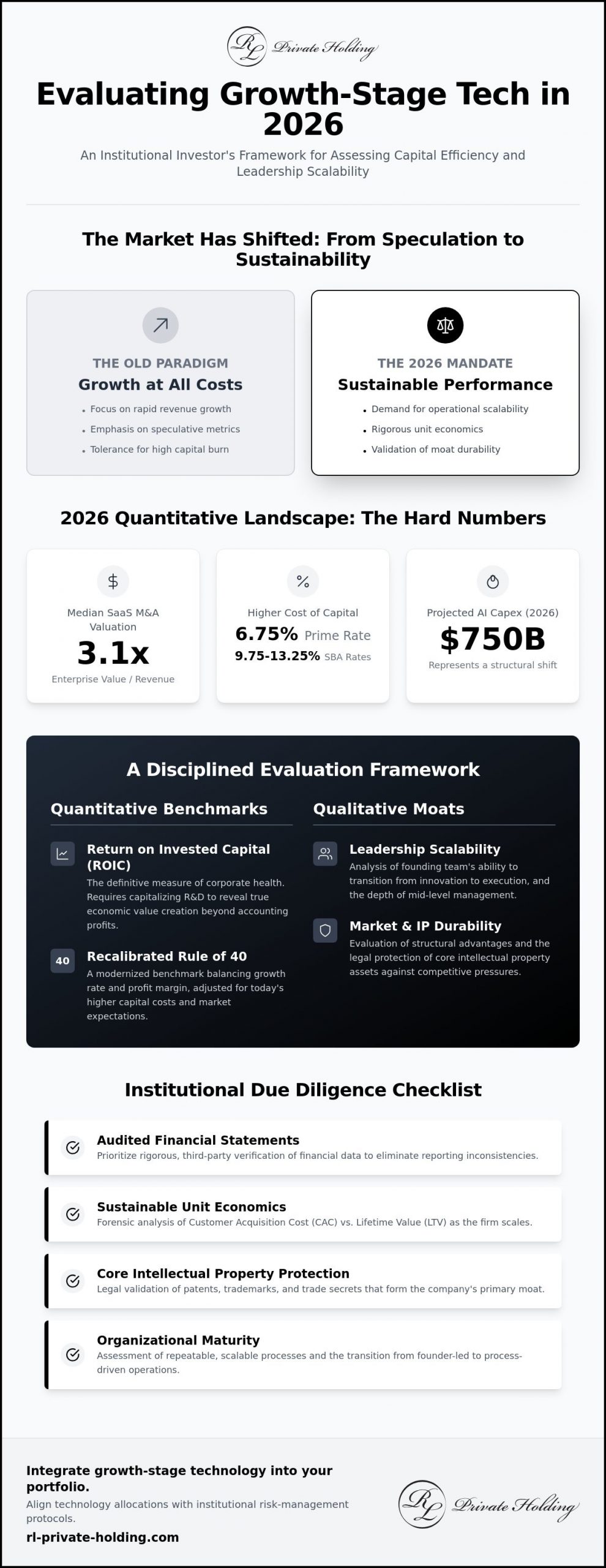
The premium once placed on rapid revenue growth has shifted toward a rigorous demand for operational scalability and verifiable unit economics. As median SaaS valuation multiples for private M&A transactions settle near 3.1x revenue, the margin for error in capital allocation has narrowed significantly. Institutional investors recognize that evaluating growth-stage tech companies now requires a departure from speculative metrics in favor of a disciplined assessment of moat durability and organizational maturity. It’s a transition from measuring raw potential to validating sustainable performance.
The prevalence of inconsistent reporting standards and high valuation volatility makes it difficult to identify which firms possess the structural integrity to lead their respective sectors. This article provides a sophisticated framework for assessing capital efficiency and leadership scalability within the current financial environment. We will analyze the essential quantitative benchmarks for 2026, explore the implications of proposed SEC reporting threshold changes, and establish a methodology for aligning technology investments with institutional risk-management protocols.
Executive Summary
- Examination of the transition from initial product-market fit to repeatable operational scaling as the primary indicator of growth-stage maturity.
- Application of 2026 quantitative benchmarks, focusing on Return on Invested Capital (ROIC) and a recalibrated Rule of 40 when evaluating growth-stage tech companies.
- Analysis of qualitative moats, specifically the scalability of founding leadership and the depth of mid-level management.
- Framework for institutional due diligence, prioritizing audited financial statements and the legal protection of core intellectual property assets.
- Strategic integration of technology allocations within a diversified portfolio, emphasizing alignment with private equity and real estate asset management.
The Transition from Startup to Growth-Stage: Defining the Evaluation Pivot
The transition from a startup to a growth-stage entity represents a fundamental shift in corporate identity and operational requirements. While early-stage ventures focus on establishing product-market fit, the growth stage demands the implementation of repeatable, scalable processes. In 2026, evaluating growth-stage tech companies requires looking past the venture-backed momentum that often masks underlying operational weaknesses. The current environment has moved decisively away from the “growth at all costs” mentality. Investors now prioritize sustainable unit economics, as evidenced by the median Enterprise Value to Revenue multiple for private M&A transactions settling at 3.1x. Business durability is no longer a secondary concern; it is the primary metric for long-term value preservation. This pivot requires a disciplined analysis of how a company manages its customer acquisition costs and lifetime value ratios as it moves into broader market segments.
The Risk Profile of Growth Equity vs. Early-Stage VC
The allocation of Growth capital involves a transition from binary risk to execution risk. In the early stages, the primary question is whether the technology functions or if a market exists. At the growth stage, the technology is proven, but the ability to manage a global organization is not. This period is often described as an operational “chasm” where companies fail due to internal complexity rather than external competition. Additionally, the cost of capital significantly influences valuations in 2026. With the prime rate at 6.75% and SBA variable rates ranging from 9.75% to 13.25%, the hurdle for profitability is higher than in previous cycles. Institutional investors must ensure that the company’s internal rate of return exceeds these benchmarks after accounting for the increased risks of scaling. A disciplined framework must account for the fact that capital is no longer cheap, making efficiency a prerequisite for any significant investment.
The Role of Market Timing and Structural Shifts
Success in the technology sector often depends on distinguishing between transient trends and permanent structural shifts. The massive capital expenditure on AI, projected to reach $750 billion in 2026, represents a structural shift that creates tailwinds for infrastructure and software providers. However, individual applications may only be riding a temporary wave of adoption. Entry timing in the technology lifecycle is critical. Entering too early results in excessive burn during market education, while entering too late leads to compressed margins. Market timing in the context of growth equity serves as a rigorous test of whether a company’s business model possesses the structural durability to survive the normalization of its industry. Companies that rely on temporary market imbalances rather than fundamental utility rarely survive the transition to a mature market participant.
Quantitative Benchmarks: Assessing Unit Economics and Capital Efficiency
The institutional validation of a technology firm relies on its quantitative performance and the efficiency of its capital deployment. Evaluating growth-stage tech companies involves a move beyond top-line revenue toward a forensic analysis of how incremental capital generates value. In 2026, the median Enterprise Value to Revenue multiple of 3.1x for private transactions reflects a market that prizes disciplined efficiency over unbridled expansion. Investors must determine if a company’s growth is fueled by a sustainable engine or by high-burn subsidies that will eventually collapse under their own weight. This requires a deep dive into the relationship between customer acquisition and long-term retention.
Return on Invested Capital (ROIC) in Technology
Return on Invested Capital serves as the definitive measure of corporate health, even for asset-light technology models. Calculating ROIC in this sector requires capitalizing R&D and sales expenses to understand the true cost of creating an economic moat. It’s essential to differentiate between accounting profits, which can be manipulated through aggressive capitalization policies, and true economic value creation. A high ROIC suggests that the firm possesses a structural advantage that competitors cannot easily replicate. As firms refine their Private Equity Investment Management strategies, this metric becomes the primary filter for identifying long-term leaders.
Analyzing Unit Economics at Scale
Unit economics often shift as a company expands into secondary markets or broader demographics. A critical part of due diligence is assessing whether unit margins improve through economies of scope or degrade due to increased competition and churn. While frameworks for evaluating early-stage companies emphasize product-market fit, growth-stage assessment prioritizes the marginal cost of the next dollar of revenue. The Rule of 40 serves as a critical benchmark where the sum of a company’s year-over-year revenue growth rate and its EBITDA margin must equal or exceed 40% to demonstrate a healthy balance between expansion and profitability. In the Q3 2025 period, the median EBITDA margin for SaaS companies reached 9.3%, indicating that profitability is no longer a distant goal but a current requirement for growth-stage health. If the cost to acquire a customer rises while the lifetime value remains stagnant, the company’s capital efficiency is in jeopardy.
The impact of churn rates on long-term efficiency can’t be overstated. Even a small increase in monthly churn can significantly erode the lifetime value of a customer cohort. This erosion forces the company to spend more on acquisition just to maintain its current revenue base. A disciplined framework examines the net revenue retention (NRR) to ensure that existing customers are expanding their usage. Companies that maintain an NRR above 110% demonstrate a level of market durability that justifies higher valuation multiples. This quantitative rigor ensures that the transition from venture-backed momentum to fundamental business durability is supported by empirical data.
Qualitative Moats: Analyzing Leadership and Market Durability
While quantitative metrics provide a snapshot of current efficiency, qualitative factors determine the long-term sustainability of those results. Evaluating growth-stage tech companies requires a rigorous assessment of the human and structural elements that protect a firm from competitive erosion. In an environment where capital is often available to competitors, the durability of a company’s moat rests on its organizational maturity and the strategic depth of its intellectual property. It’s not enough to have a superior product; the company must possess a structural advantage that becomes more formidable as the business scales. This durability is the primary differentiator between a temporary market leader and a permanent institutional asset.
Leadership and Organizational Maturity
The transition from a founder-led startup to a professionally managed corporation represents a critical inflection point. Institutional investors must evaluate whether the initial leadership team possesses stage-appropriate traits for managing a global organization. This founder pivot involves shifting from direct involvement in every decision to the creation of robust systems and the delegation of authority. A key indicator of maturity is the depth of mid-level management. These individuals represent the engine of execution and are responsible for maintaining operational integrity during periods of rapid expansion. A company that relies solely on the vision of its founders is inherently fragile. Effective institutional governance, facilitated by a disciplined board of directors, ensures that Venture Capital Funding is allocated toward long-term value preservation rather than short-term milestones. This transition to professional management is where the most significant execution risks reside.
Market Dominance and Competitive Defense
Identifying structural moats is essential in a landscape where technological advantages can be fleeting. Network effects and high switching costs remain the most reliable defenses against market entry. In 2026, the role of proprietary data has emerged as a primary competitive advantage. As analyst estimates place capital spending on AI at approximately $750 billion this year, companies that control unique data sets possess a significant lead in training specialized models. This data moat creates a virtuous cycle where better insights lead to better products, which in turn attract more users and more data. Additionally, a firm’s pricing power serves as a litmus test for its market dominance. A sustainable leader maintains its margins even during economic downturns because its services are integrated so deeply into client workflows that the cost of replacement exceeds the cost of the subscription. True market durability is found where brand equity and technical superiority intersect to create a significant barrier to entry.
The Institutional Due Diligence Checklist for Growth-Stage Tech
Institutional due diligence requires a transition from trust-based relationships to evidence-based verification. Evaluating growth-stage tech companies at this level necessitates a move beyond unaudited management accounts toward comprehensive financial audits. This process ensures that revenue recognition policies align with international standards, particularly as companies prepare for potential public offerings or strategic exits. Legal and intellectual property (IP) diligence is equally vital. Securing core assets through robust patent filings and clear chain-of-title documentation is a prerequisite for global expansion. Without these protections, a company’s market dominance is perpetually at risk from litigation or technical replication. It’s about protecting the value that has already been created.
Technical and Operational Audits
The scalability of a firm’s engineering infrastructure often dictates its growth ceiling. A thorough technical audit assesses the depth of the engineering team and the robustness of the current platform. Hidden technical debt, often accumulated during the rapid-growth startup phase, can impede future development and inflate maintenance costs. Technical due diligence is non-negotiable for growth-stage tech because it reveals whether the software architecture can support the projected transaction volume without a total system rebuild. Identifying these structural bottlenecks early allows for a more accurate valuation and a clearer roadmap for future capital expenditure. Organizations that ignore these underlying issues often face significant operational failures just as they reach peak market demand.
Regulatory and Governance Frameworks
Data privacy and ESG compliance have become central pillars of the technology investment landscape. As regulatory bodies increase their scrutiny, companies must demonstrate rigorous internal controls and financial reporting transparency. The proposed SEC rule changes in 2026, which suggest raising the “large accelerated filer” threshold to $2 billion in public float, highlight the evolving nature of public market readiness. Ensuring that an investment structure aligns with institutional standards is critical for risk mitigation. To ensure your portfolio meets these rigorous requirements, consider the advantages of professional Private Equity Investment Management. This oversight provides the stability needed for long-term growth.
Finally, assessing a company’s path to liquidity is a core component of the diligence process. Exit readiness involves evaluating the alignment between the company’s financial performance and the expectations of public markets or strategic acquirers. With median SaaS valuations in 2026 reflecting a more cautious environment, a clear path to profitability is essential for a successful IPO. This systematic approach to due diligence ensures that institutional capital is deployed into organizations with the structural integrity to withstand market volatility. It’s a disciplined method for identifying the leaders of the next decade.
Strategic Allocation: Integrating Growth-Stage Tech into a Diversified Holding
The integration of technology into a broader institutional portfolio requires a strategic balance between capital appreciation and risk mitigation. Evaluating growth-stage tech companies serves as a critical mechanism for identifying assets that complement traditional holdings such as real estate and private equity. While real estate provides stable cash flow and tangible security, growth-stage technology offers the non-linear upside necessary for long-term wealth expansion. This dual approach ensures that the portfolio remains resilient across different economic cycles. The objective is to create a structure where the volatility of technology is tempered by the permanence of industrial and commercial assets.
Luxembourg has established itself as a primary hub for managing these global technology portfolios. The use of SOPARFI (Société de Participations Financières) and Alternative Investment Fund (AIF) structures allows for the efficient management of cross-border holdings. These vehicles provide the regulatory transparency and tax efficiency required by institutional partners. By utilizing these frameworks, a private holding company can manage its technology investments with the same level of discipline and oversight usually reserved for traditional asset classes. Institutional allocators seeking to maximize structural efficiency within this jurisdiction should examine the comprehensive venture capital Luxembourg strategic frameworks that detail the legal structures and tax advantages available in 2026. This structural integrity is essential for maintaining professional distance and strategic focus.
The Private Holding Perspective on Growth Equity
A diversified holding company possesses a unique vantage point when evaluating growth-stage tech companies. Unlike traditional venture capital funds that operate on fixed ten-year cycles, a private holding structure can prioritize long-term wealth preservation. This patient capital approach allows the firm to support technology leaders through various stages of organizational maturity without the pressure of premature exits. RL Private Holding identifies these leaders by focusing on firms that demonstrate both technical superiority and the potential for operational scalability. It’s a method that aligns the high-growth potential of the technology sector with the stability of an established global presence. This alignment is fundamental to the firm’s identity as a disciplined global partner.
Optimizing Portfolio Performance
The synergy between Venture Capital Funding and traditional asset management creates a robust ecosystem for capital growth. Managing liquidity and exit cycles within a broader holding company requires a methodical approach to capital recycling. When technology investments reach maturity, the proceeds can be reallocated into stable assets or new growth opportunities, maintaining a consistent risk-return profile. This disciplined cycle ensures that the portfolio remains dynamic while adhering to institutional risk-management protocols. Institutional partners seeking exposure to these markets must focus on structures that provide both transparency and strategic depth. You can explore RL Private Holding’s approach to technology venture capital to understand how these principles are applied to current market opportunities.
The Future of Institutional Technology Allocation
The transition from speculative venture-backed growth to disciplined institutional performance requires a rigorous methodology. Evaluating growth-stage tech companies in the current environment demands a focus on capital efficiency and organizational scalability. By prioritizing audited financial transparency and structural moats such as proprietary data and high switching costs, investors can identify the sustainable leaders of the next decade. These benchmarks ensure that technology allocations contribute to long-term value preservation rather than temporary momentum.
RL Private Holding applies this institutional gravity to every investment decision. Headquartered in Luxembourg, the premier financial hub for institutional investors, our firm leverages global investment scale and diversified sector expertise. This includes specific capabilities in Real Estate Asset Management and Private Equity Investment Management. This integrated perspective allows us to manage complex portfolios with a steady hand and strategic focus. It’s the foundation for sustainable wealth within the global financial landscape. We invite you to discover our strategic approach to Venture Capital and Private Equity. A disciplined approach to scaling ensures that today’s technology leaders become tomorrow’s institutional pillars.
Frequently Asked Questions
What is the most critical metric when evaluating a growth-stage tech company?
The Rule of 40 serves as the most critical quantitative benchmark when evaluating growth-stage tech companies. This metric requires the sum of revenue growth and EBITDA margin to exceed 40%, ensuring that expansion doesn’t come at the expense of fiscal sustainability. In Q3 2025, the median EBITDA margin for SaaS companies reached 9.3%, reflecting a broader institutional shift toward profitability. Investors use this balance to distinguish between companies with organic momentum and those relying on unsustainable capital burn.
How does growth-stage due diligence differ from early-stage venture capital?
Growth-stage due diligence prioritizes execution risk and operational scalability over the binary market risk found in early-stage ventures. While early-stage assessments focus on product-market fit, growth-stage analysis examines the repeatability of sales processes and the robustness of internal controls. This shift requires a forensic review of audited financial statements rather than the unaudited management accounts common in seed-round funding. It’s a transition from validating a concept to auditing a corporate machine.
Why is ROIC more important than revenue growth for mature technology firms?
Return on Invested Capital (ROIC) is superior to raw revenue growth because it measures the true economic efficiency of a company’s business model. High revenue growth can be misleading if it’s achieved through excessive customer acquisition costs that exceed the lifetime value of the user. ROIC demonstrates whether a firm possesses a genuine economic moat. In a market where the median private M&A multiple is 3.1x revenue, capital efficiency is the primary driver of valuation premiums.
How do you assess the “Founder Pivot” in a rapidly scaling organization?
Assessing the founder pivot involves analyzing whether the original leadership can transition from tactical involvement to strategic governance. Investors look for the implementation of professional management structures and the presence of experienced mid-level executives who can operate independently. A company’s reliance on a single visionary often indicates a lack of organizational maturity. Successful scaling requires founders to build systems that function without their direct supervision, ensuring institutional permanence.
What role does technical debt play in growth-stage technology valuations?
Technical debt acts as a significant valuation discount because it represents a deferred liability that will eventually require capital expenditure. If a company’s software architecture can’t support projected transaction volumes, future revenue growth will be stalled by the need for a total system rebuild. During the evaluation process, engineering audits identify whether the current technology stack is a scalable asset or an operational bottleneck. High levels of debt suggest that future funding will be diverted from expansion to maintenance.
How should institutional investors structure their growth-stage tech allocations?
Institutional investors should structure technology allocations within a diversified holding company to balance high-growth upside with long-term wealth preservation. Integrating growth-stage tech with stable assets like real estate mitigates the inherent volatility of the technology sector. This approach allows for patient capital deployment, avoiding the artificial exit pressures often associated with traditional venture capital fund cycles. It ensures that the portfolio remains resilient across various economic environments.
What are the primary exit strategies for growth-stage technology investments in 2026?
The primary exit strategies in 2026 include strategic M&A and Initial Public Offerings (IPOs) supported by evolving regulatory frameworks. Proposed SEC rule changes, such as raising the large accelerated filer threshold to $2 billion, are intended to make public markets more accessible for mid-sized technology firms. Additionally, private M&A remains a viable path, with median valuations currently hovering around 3.1x revenue. These options provide clear liquidity paths for institutional partners.
How does a Luxembourg holding structure benefit technology investment portfolios?
A Luxembourg holding structure offers institutional investors a combination of regulatory transparency and tax efficiency through SOPARFI and AIF frameworks. These vehicles are specifically designed for managing global technology portfolios and cross-border assets. Luxembourg’s position as a premier financial hub ensures that investment structures meet the highest standards of international governance. For a detailed analysis of how these frameworks operate within a structured venture capital Luxembourg strategy, institutional allocators can examine the specific legal and tax considerations that govern these vehicles in 2026. This provides a stable and predictable environment for the long-term management of sophisticated capital allocations.