

While global venture capital assets are projected to reach $3.8 trillion by 2028, the distinction between retail-focused vehicles and institutional-grade structures remains a critical hurdle for sophisticated allocators. Sophisticated investors recognize that selecting a venture capital fund Luxembourg provides unparalleled access to the European technology sector; however, the regulatory complexity of cross-border investments and the lack of transparency in private market fee structures often create significant friction.
This analysis provides an institutional-grade framework to evaluate the Luxembourg ecosystem through the lens of structural advantages and strategic allocation. You’ll gain a technical understanding of the legal frameworks, such as the Reserved Alternative Investment Fund (RAIF) and the SICAR, while identifying the criteria necessary to select partners that prioritize wealth preservation. We’ll examine how to align high-growth technology exposure with a disciplined investment strategy, ensuring that your capital remains secure within a well-ordered, global framework. By reviewing the implications of AIFMD II and the refined knowledgeable investor thresholds, this guide prepares you to identify high-performing partners in a complex market.
Key Takeaways
- Identify the jurisdictional benefits of Luxembourg, including its AAA credit rating and political stability, which provide a secure foundation for long-term alternative investment strategies.
- Examine the technical distinctions between specialized structures such as the RAIF and SICAR to determine the most effective venture capital fund Luxembourg for specific time-to-market and risk-capital requirements.
- Establish a framework for evaluating growth-stage portfolios using institutional KPIs and sophisticated risk mitigation techniques across diverse sectors and geographies.
- Understand the critical role of governance and AIFMD compliance in ensuring transparency and protecting investor interests through independent board oversight.
- Learn how to integrate venture capital into a multi-asset institutional portfolio to achieve long-term wealth preservation and strategic technology exposure.
The Strategic Advantage of Luxembourg as a Venture Capital Hub
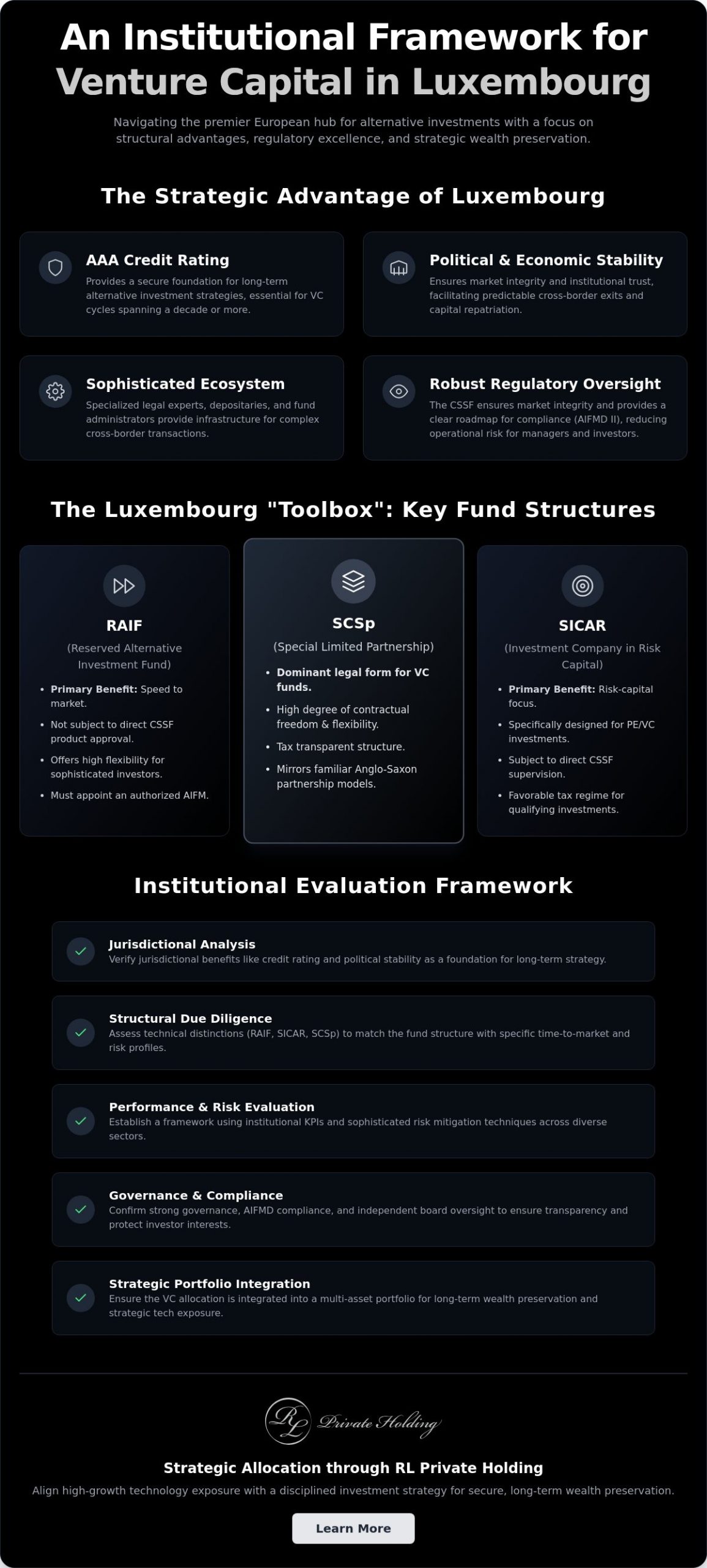
Luxembourg has solidified its position as the primary European domicile for alternative investment funds. The nation’s AAA credit rating serves as a foundational pillar for institutional investors who prioritize long-term stability. This fiscal reliability remains essential when committing capital to venture capital cycles that often span a decade or more. The jurisdiction offers a sophisticated ecosystem comprising specialized legal experts, depositaries, and fund administrators who understand the technical nuances of illiquid asset classes. These professionals provide the necessary infrastructure to manage complex cross-border transactions and regulatory reporting with precision.
The strategic importance of a venture capital fund Luxembourg lies in its ability to provide a secure, regulated vehicle for global technology investments. The “Luxembourg Toolbox” offers a variety of unregulated and regulated vehicles that cater to different risk appetites and operational requirements. By utilizing these structures, investors benefit from a legal environment that’s both flexible and robust. This allows for the efficient deployment of capital into emerging sectors like fintech, healthtech, and green energy without the administrative delays found in less specialized jurisdictions.
Defining the Luxembourg VC Ecosystem
A clear distinction exists between retail-facing products and the institutional-grade private holdings that characterize the Grand Duchy’s core strength. While the retailization of private markets is an emerging trend, the most significant concentration of tech-focused capital remains within structures tailored for sophisticated allocators. Global institutional investors prefer this environment because it allows them to integrate venture capital exposure into broader wealth preservation strategies. Rather than viewing VC as a standalone speculative bet, these investors treat it as a tactical component of a multi-asset holding company. This alignment ensures that high-growth assets are managed with the same rigor as traditional private equity or real estate holdings.
Economic and Political Stability Factors
Stability is a structural requirement for the 10-year lifecycles typical of private markets. When establishing a venture capital fund Luxembourg, the regulatory oversight provided by the Commission de Surveillance du Secteur Financier (CSSF) ensures market integrity and institutional trust. The nation’s political neutrality facilitates cross-border European and global exits, which is a critical factor for funds targeting high-growth startups across multiple jurisdictions. This environment creates a predictable path for the deployment and eventual repatriation of capital. It reinforces the trust that institutional partners place in the Luxembourg hub, especially during periods of global market volatility. The presence of a dedicated regulatory framework provides a clear roadmap for compliance, which reduces operational risk for fund managers and investors alike.
Structural Frameworks for Venture Capital Funds in Luxembourg
Luxembourg’s structural versatility is a primary reason for its leadership in the alternative investment sector. The Strategic Advantage of Luxembourg is evident in its “toolbox” approach, which allows fund managers to tailor vehicles to specific investor requirements and asset classes. The Special Limited Partnership (SCSp) has emerged as the dominant legal form for a venture capital fund Luxembourg. This structure provides significant contractual freedom and tax transparency, mirroring the partnership models familiar to Anglo-Saxon investors while operating within a stable civil law jurisdiction. It’s particularly effective for growth-stage technology investments where flexibility in capital calls and distributions is required.
The implementation of AIFMD II in April 2026 will further refine these frameworks by introducing harmonized rules for loan-originating funds and enhancing liquidity management. For sophisticated investors, these structural choices are not merely administrative; they’re tactical decisions that impact speed of execution and long-term tax efficiency. Choosing the correct vehicle requires a technical understanding of the balance between regulatory oversight and operational agility.
RAIF vs. SICAR: Selecting the Optimal Vehicle
The Reserved Alternative Investment Fund (RAIF) has become the standard for managers seeking rapid time-to-market. It doesn’t require direct authorization from the CSSF, as oversight is provided through its authorized Alternative Investment Fund Manager (AIFM). This indirect supervision maintains institutional integrity while allowing funds to launch in weeks rather than months. Conversely, the Investment Company in Risk Capital (SICAR) is a regulated product specifically designed for venture capital and private equity. While it involves more administrative overhead and direct CSSF supervision, it offers a specialized tax regime where income from securities is exempt from corporate income tax. Both structures are reserved for “knowledgeable investors,” a category for which the minimum investment threshold was reduced to €100,000 in 2024.
The SOPARFI as a Venture Capital Holding Structure
While the RAIF and SICAR function as fund vehicles, the SOPARFI (Société de Participations Financières) serves as a strategic holding company. It’s a fully taxable commercial entity that benefits from Luxembourg’s extensive network of double tax treaties. Institutional investors utilize SOPARFIs to manage diversified technology portfolios, taking advantage of the participation exemption regime. This regime can exempt dividends and capital gains from tax, provided the holding meets specific criteria regarding ownership percentage and duration. Integrating these holding companies into a broader wealth management service framework allows for the efficient repatriation of capital following successful exit strategies. This structural precision ensures that venture capital allocations remain aligned with the overarching goals of a private holding, providing a steady hand in the background of high-stakes technology investments.
Evaluating Performance and Risk in Luxembourg Venture Capital
Performance evaluation in the private markets requires a methodical approach that transcends surface-level internal rate of return (IRR) figures. Institutional allocators focus on realized multiples, specifically Distributed to Paid-In (DPI) and Total Value to Paid-In (TVPI) ratios, to assess the actual cash-on-cash returns of a venture capital fund Luxembourg. These metrics provide a sober view of a fund manager’s ability to not only identify high-potential technology assets but also to execute successful exits. The objective nature of these figures is essential for maintaining institutional gravity in a sector often prone to marketing hyperbole. Sophisticated investors prioritize partners who demonstrate a “quiet authority,” characterized by a consistent track record and a disciplined adherence to stated investment mandates.
Understanding the impact of investment management fees is equally critical for long-term ROI. Opaque fee structures can significantly erode the compounding benefits of high-growth assets. According to the Luxembourg Financial Regulator (CSSF) Statistics, the transparency provided by regulated and indirectly supervised funds helps allocators better quantify these costs. A disciplined GP selection process involves a granular analysis of management fees, operational expenses, and carried interest hurdles to ensure that the interests of the fund manager remain strictly aligned with the long-term wealth preservation goals of the investor.
Due Diligence Protocols for Institutional Allocators
A rigorous due diligence framework begins with an assessment of the investment committee’s technical expertise. It’s not enough to evaluate the fund’s broad strategy; one must examine the specific industry experience of the individuals making the final capital allocation decisions. This involves analyzing the quality of the underlying portfolio companies, their revenue growth trajectories, and their competitive positioning within global markets. Additionally, institutional partners scrutinize the history of carried interest structures. They look for evidence that the GP is incentivized to prioritize sustainable, high-quality exits over short-term valuation spikes that don’t translate into realized gains.
Risk Management in Technology Investments
Mitigating the inherent volatility of growth-stage technology requires a strategic approach to diversification. Within a Luxembourg private equity framework, this is achieved through a calculated spread across different technology sectors and geographical regions. By avoiding over-concentration in a single niche, a fund can better withstand cyclical downturns in specific markets. Institutional allocators seeking a structured methodology for this approach can benefit from reviewing venture capital portfolio diversification frameworks that outline repeatable models for balancing sector exposure, investment stages, and vintage years. Risk-adjusted returns in a venture capital context represent the net gain of a portfolio relative to the specific volatility and capital loss risks inherent in early-to-growth stage technology enterprises. This disciplined focus on risk management ensures that venture capital remains a stable, albeit high-growth, component of a multi-asset institutional portfolio.
Governance and Regulatory Excellence in the Luxembourg Ecosystem
The Luxembourg financial landscape is defined by a rigorous adherence to European Union standards, specifically the Alternative Investment Fund Managers Directive (AIFMD). For a venture capital fund Luxembourg, compliance isn’t merely a legal obligation but a strategic asset that signals institutional maturity to global allocators. The upcoming implementation of AIFMD II, with a transposition deadline of April 16, 2026, will further refine these standards. It introduces harmonized rules for loan-originating funds and mandates enhanced liquidity management tools. These updates ensure that the ecosystem remains resilient against market shocks, providing a stable environment for the deployment of long-term capital.
Transparency remains the cornerstone of this regulatory framework. Institutional-grade vehicles are required to maintain high reporting standards, ensuring that investors have a clear view of portfolio health and operational risks. This includes managing the complexities of ESG and sustainable finance. The introduction of SFDR 2.0 is expected to bring more structure to these disclosures, requiring fund managers to integrate environmental and social considerations into their risk management processes with technical precision. This disciplined approach to reporting reinforces the “quiet authority” that characterizes the Grand Duchy’s financial sector.
The AIFM Framework and Investor Protection
Credibility in the venture capital sector is often tied to the strength of the Alternative Investment Fund Manager (AIFM). This entity provides essential oversight, acting as a bridge between the fund and the regulator. Key functions include:
- Independent Depositary Oversight: Ensuring that fund assets are safekept and that cash flows are monitored with institutional rigor.
- Central Administration: Managing the fund’s net asset value (NAV) calculations and maintaining the register of investors with precision.
- Regulatory Reporting: Adhering to strict CSSF reporting cycles to maintain market integrity and institutional trust.
These layers of protection are vital for sophisticated investors who require a steady hand in the background of their high-stakes technology allocations. They ensure that the fund operates within a well-ordered and transparent framework, minimizing operational risks that are often opaque in less regulated jurisdictions.
Institutional Governance Standards
Professional governance extends beyond simple compliance. It involves the strategic composition of the board of directors, where the inclusion of independent directors is considered a best practice. These professionals provide objective oversight, balancing the discretionary management of the GP with the fiduciary interests of the LPs. In a private holding framework, this governance structure facilitates long-term value creation by ensuring that investment decisions are subjected to rigorous internal scrutiny. It prevents the drift of investment mandates and ensures that fee structures remain transparent and aligned with performance. To explore how these structures can be optimized for your portfolio, consider reviewing our private equity investment management services.
Strategic Allocation through RL Private Holding
RL Private Holding operates with a philosophy of disciplined capital deployment, prioritizing sectors that demonstrate both technological resilience and long-term scalability. By moving beyond the speculative nature of early-stage startups, the firm focuses on growth-stage opportunities that align with the structural advantages of a venture capital fund Luxembourg. This approach ensures that technology exposure is not an isolated risk but a calculated component of a broader institutional strategy. The firm utilizes private holding structures to maintain a high degree of control and transparency, offering a more stable alternative to traditional, blind-pool fund models. This structural choice allows for a more direct alignment between capital allocation and the specific wealth preservation goals of the investor.
The integration of venture capital into a multi-asset institutional portfolio requires a steady hand and a long-term perspective. RL Private Holding views technology investments as a primary driver of future value, yet it balances this exposure with established asset classes to mitigate cyclical volatility. This methodology reflects a commitment to institutional gravity, where every investment is subjected to the same rigorous scrutiny as traditional private equity or real estate holdings. By maintaining this professional distance and objective focus, the firm ensures that its portfolio remains resilient across varying market conditions.
A Disciplined Approach to Growth-Stage Technology
The identification of high-potential sectors requires a technical understanding of global market shifts. RL Private Holding leverages its expertise across multiple asset classes to create internal synergies that benefit the overall portfolio. For instance, the intersection of technological innovation and institutional real estate provides unique opportunities for value creation that traditional venture capital funds often overlook. By integrating venture capital with private equity and real estate asset management, the firm achieves a balanced risk profile. This exclusivity in management ensures that capital is only allocated to projects that meet rigorous internal benchmarks for stability and strategic growth.
Partnering for Long-Term Wealth Preservation
Securing an institutional legacy requires more than just high-yield returns; it demands a partner capable of navigating the regulatory and structural complexities of the Grand Duchy. RL Private Holding acts as a worldly and highly organized partner, providing the methodical planning necessary for multi-generational wealth preservation. The firm’s presence in the Luxembourg landscape allows for the seamless integration of global technology assets into a well-ordered holding framework. This disciplined focus on institutional gravity provides the stability required to withstand market volatility while capturing the upside of the digital economy. For those seeking to align their technology exposure with a sophisticated global partner, we invite you to Contact RL Private Holding for professional investment management insights.
Optimizing Institutional Technology Allocations
The selection of a venture capital fund Luxembourg represents a sophisticated decision for institutional allocators seeking to balance high-growth exposure with structural integrity. As examined, the technical nuances of vehicles like the RAIF and SICAR, combined with the rigorous oversight of the AIFMD framework, provide the necessary transparency for long-term capital commitments. A disciplined approach to GP selection and fee analysis remains critical for ensuring that private market returns align with broader wealth preservation goals.
RL Private Holding maintains its presence in the Grand Duchy to provide a steady hand in the management of diversified global portfolios. By integrating growth-stage technology with institutional real estate and private equity, the firm achieves a level of professional discipline that transcends traditional fund structures. This global scale, supported by institutional-grade governance, ensures that every allocation is managed with precision and a focus on permanent strategic growth. It’s this commitment to stability and exclusivity that defines our role as a disciplined global partner.
We invite you to Explore Strategic Investment Management at RL Private Holding to learn how our worldly expertise can secure your institutional legacy. Establishing a well-ordered framework today ensures a resilient and high-performing portfolio for the future.
Frequently Asked Questions
What is the primary advantage of a Luxembourg RAIF for venture capital?
The primary advantage of a Reserved Alternative Investment Fund (RAIF) is its significantly reduced time-to-market due to the absence of direct CSSF authorization. By utilizing an authorized Alternative Investment Fund Manager (AIFM), a venture capital fund Luxembourg can be established in a matter of weeks. This structure maintains institutional credibility through indirect supervision while providing the operational agility required for competitive technology investments.
How does a SICAR differ from a standard investment fund structure?
A SICAR differs from standard funds by being specifically designed for investment in risk capital, offering unique tax advantages for venture capital and private equity. Unlike a Specialized Investment Fund (SIF) which requires risk diversification, a SICAR is tailored for concentrated investments in high-growth companies. Income derived from securities held by a SICAR is generally exempt from corporate income tax, making it a preferred vehicle for pure technology plays.
Can institutional investors use a SOPARFI for venture capital investments?
Institutional investors frequently utilize a SOPARFI as a strategic holding vehicle for venture capital allocations. While it’s a fully taxable commercial company, it benefits from Luxembourg’s extensive double tax treaty network and the participation exemption regime. This allows for the tax-efficient repatriation of dividends and capital gains after a successful technology exit, especially when integrated into a broader private holding framework.
What are the typical management fees for venture capital funds in Luxembourg?
Management fees in Luxembourg typically follow institutional standards, though specific structures vary based on the fund’s complexity and asset class. Investors should expect a combination of an annual management fee and a performance-based carried interest hurdle. The Grand-Ducal Regulation of January 8, 2026, also specifies fixed CSSF fees for fund managers, such as the €42,000 annual lump sum fee for an AIFM, which contributes to the fund’s operational transparency.
How does AIFMD regulation affect venture capital fund managers?
AIFMD regulation imposes strict governance, depositary, and reporting requirements on fund managers to ensure investor protection. The implementation of AIFMD II by April 16, 2026, will introduce even more rigorous liquidity management and reporting obligations for a venture capital fund Luxembourg. These standards enhance the credibility of Luxembourg-domiciled funds, providing a stable and well-ordered environment that sophisticated global allocators expect for their technology portfolios.
What is the minimum investment typically required for institutional VC funds?
The minimum investment threshold for accessing specialized Luxembourg funds is legally defined by the knowledgeable investor status. As of July 2024, this threshold was reduced to €100,000, broadening the pool of eligible participants for structures like the RAIF and SICAR. Many institutional-grade vehicles may set higher internal minimums to maintain the exclusivity and professional distance required for large-scale wealth management strategies.
How does Luxembourg facilitate cross-border technology exits?
Luxembourg facilitates cross-border technology exits through its political neutrality and a legal environment that’s highly predictable for global buyers. Its position as a leading financial hub provides access to a sophisticated network of M&A advisors and legal experts who specialize in international transactions. This infrastructure ensures that capital can be efficiently realized and repatriated following the acquisition or public offering of a portfolio company.
Why is ESG becoming a critical factor in Luxembourg venture capital?
ESG is becoming a critical factor due to the increasing integration of sustainable finance requirements into European regulatory frameworks. The upcoming SFDR 2.0 will mandate more structured disclosures, requiring fund managers to report on how environmental and social factors impact their investment decisions. Aligning with these standards is essential for maintaining institutional trust and securing capital from allocators who prioritize sustainable, long-term growth.