

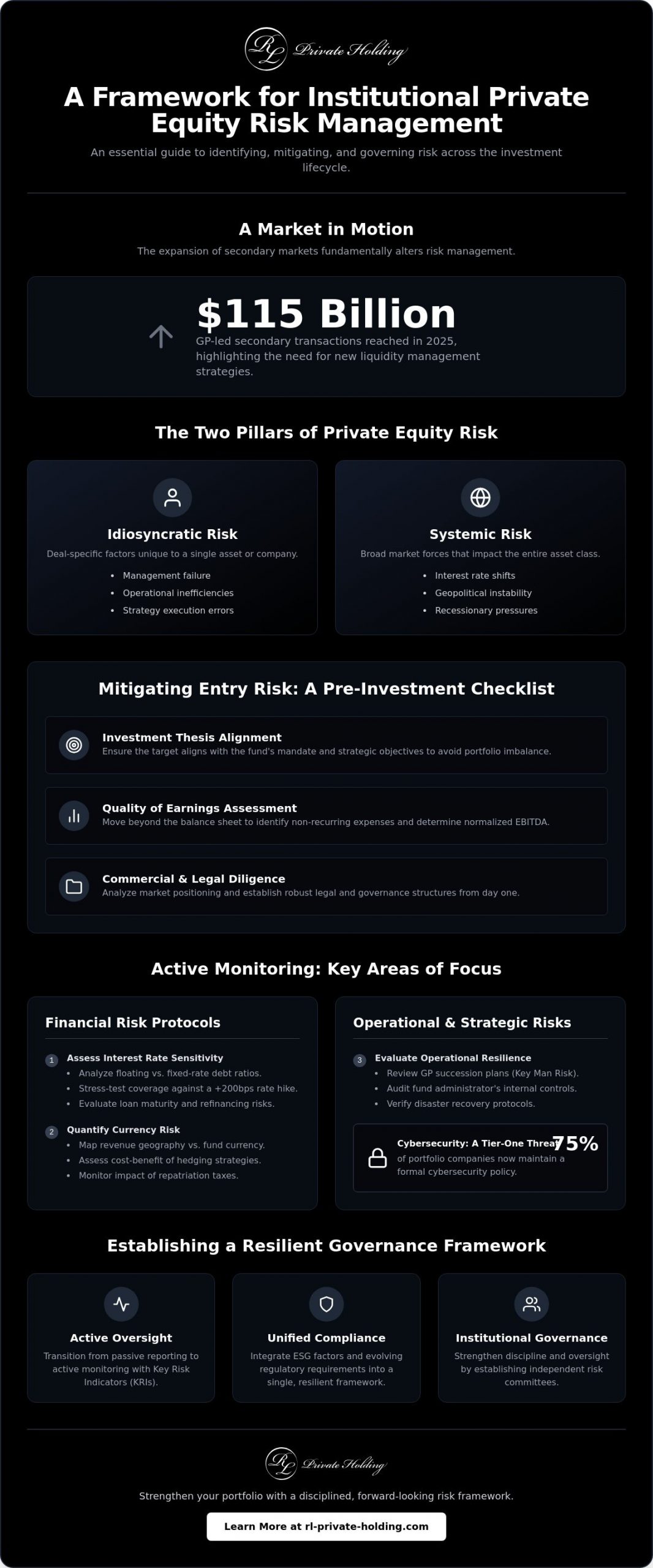
GP-led secondary transactions reached $115 billion in 2025, a figure that highlights the evolving nature of liquidity management in the private markets. This expansion of the secondary market, alongside the growth of private credit, has fundamentally altered the landscape of private equity risk management for institutional allocators. Risk isn’t just a passive defensive measure; it’s an active lever for value creation that requires a high degree of organizational discipline and technical precision.
Institutional investors recognize that information asymmetry and the difficulty of quantifying non-financial risks remain persistent challenges to portfolio stability. This article serves as a definitive guide to establishing a robust risk framework, offering a comprehensive checklist designed to align with global institutional standards. We provide a methodical overview of essential protocols for identifying and mitigating risks across the investment lifecycle, including the implications of the October 2026 Form PF compliance deadlines and the integration of operational value creation strategies.
Key Takeaways
- Differentiate between idiosyncratic deal-specific risks and systemic market factors to establish a structured risk hierarchy for institutional portfolios.
- Implement a rigorous pre-investment due diligence checklist that prioritizes investment thesis alignment and technical quality-of-earnings assessments.
- Transition from passive reporting to active oversight through the development of Key Risk Indicators (KRIs) for real-time portfolio monitoring.
- Integrate ESG factors and evolving EU regulatory requirements into a unified compliance framework to ensure long-term portfolio resilience and transparency.
- Strengthen institutional governance by establishing independent risk committees that provide disciplined oversight of private equity risk management protocols.
Categorising Private Equity Risks: A Structural Overview
Effective private equity risk management requires a departure from the high-frequency monitoring typical of public markets. Because of the illiquid nature of alternative assets, risk must be evaluated through a long-term lens that accounts for the J-curve effect and the structural complexities of fund commitments. To understand the fundamental framework of this asset class, one might first ask, What is Private Equity? at its core. It’s a strategy where capital is locked for extended periods, making the distinction between idiosyncratic and systemic risks critical for institutional stability. Idiosyncratic risks are deal-specific factors, such as a management failure at a single portfolio company. Systemic risks are broader market forces, like interest rate shifts or geopolitical instability, that impact the entire asset class simultaneously.
Funding risk and liquidity constraints present unique challenges during periods of market volatility. While market risk involves valuation fluctuations, liquidity risk centers on the difficulty of exiting an investment at a fair price within a desired timeframe. Institutional investors must manage these variables with precision to avoid forced secondary sales at significant discounts. The methodical categorisation of these threats ensures that capital remains protected throughout the extended lifecycle of a fund.
The Taxonomy of Financial Risks
Financial risks in private equity are often amplified by leverage and global exposure. Funding Risk is the contractual uncertainty of capital commitment fulfillment, where an LP’s inability to meet a capital call can jeopardize the fund’s strategy. Institutional frameworks must account for these potential defaults before they impact the broader portfolio.
- Checklist: Assessing interest rate sensitivity in leveraged buyout (LBO) structures
- Analyze the ratio of floating-rate versus fixed-rate debt within the portfolio.
- Stress-test debt service coverage ratios against a 200-basis point increase in funding costs.
- Evaluate the maturity profile of underlying loans to identify refinancing risks.
- Checklist: Quantifying currency risk in global multi-sector portfolios
- Map the geographic distribution of revenue versus the functional currency of the fund.
- Assess the cost-benefit of hedging strategies in volatile emerging markets.
- Monitor the impact of repatriation taxes on net internal rate of return.
Operational and Strategic Risks
Operational risks often center on the human and technical infrastructure supporting the investment. Key man risk remains a primary concern, as the departure of a principal partner can trigger clauses that halt a fund’s investment period. In 2026, cybersecurity has emerged as a tier-one operational threat. Research indicates that 75% of portfolio companies now maintain a formal cybersecurity risk policy, reflecting the heightened sensitivity to data breaches and digital infrastructure integrity.
- Checklist: Evaluating the operational resilience of portfolio companies
- Review the GP’s succession plan and talent retention history for key investment professionals.
- Audit the internal controls and reporting transparency of the fund administrator.
- Verify the existence of robust disaster recovery protocols for all critical investment data.
The Pre-Investment Due Diligence Checklist: Mitigating Entry Risk
Entry risk represents the most significant variable in the long-term performance of a fund. A disciplined approach to private equity risk management begins long before the capital is deployed. This process starts with a rigorous investment thesis alignment check to ensure the target company matches the fund’s specific mandate and strategic objectives. Without this initial alignment, even a high-performing asset can create structural imbalances within an institutional portfolio.
Financial due diligence must move beyond the basic balance sheet to scrutinize the quality of earnings. This involves identifying one-time gains and non-recurring expenses to determine the normalized EBITDA. Commercial due diligence complements this by analyzing market positioning and the durability of the competitive moat. These efforts are supported by legal and structural reviews that establish robust governance from day one. For those seeking professional guidance in these complex phases, private equity investment management services provide the necessary institutional oversight to navigate these entry requirements.
Quantitative Assessment Protocols
Quantitative modeling provides the mathematical foundation for risk mitigation. Projections must be grounded in historical reality rather than optimistic growth trajectories. EV/EBITDA multiples should be benchmarked against 10-year sector averages to ensure the entry price aligns with long-term valuation trends. This historical context prevents the overpayment often seen during periods of peak market exuberance.
- Checklist: Stress-testing internal rate of return (IRR) projections
- Model exit scenarios based on multiple contraction and expansion.
- Stress-test revenue growth assumptions against a 20% decline in the target’s primary market segment.
- Evaluate the impact of delayed exit timing on the total fund IRR.
- Checklist: Evaluating debt service coverage ratios (DSCR) in acquisition financing
- Assess the company’s ability to meet interest obligations if cash flow drops by 15%.
- Verify that acquisition financing includes sufficient headroom for operational volatility.
Qualitative Risk Factors in Venture and PE
Growth-stage and technology-heavy investments require a different set of qualitative filters. These factors are often more predictive of success than historical financial data in rapidly evolving sectors. It is essential to identify potential regulatory hurdles in the target company’s sector, particularly concerning data privacy and international trade, before committing capital.
- Checklist: Assessing management team chemistry
- Review the historical execution capability of the founders across previous market cycles.
- Audit the team’s ability to pivot during technical or regulatory disruptions.
- Evaluating the scalability of technology stacks
- Determine if the current technology stack can support a 5x increase in user volume without a complete rewrite.
- Assess the technical debt and its potential impact on future product development timelines.
Active Portfolio Monitoring: A Checklist for Value Preservation
The transition from pre-investment due diligence to active board-level oversight marks a critical shift in the investment lifecycle. Once capital is deployed, the focus of private equity risk management moves from identifying potential flaws to preserving and enhancing asset value. This phase requires a disciplined governance framework where the General Partner (GP) maintains a steady presence within the portfolio company’s strategic decision-making process. Effective monitoring is not a passive exercise; it involves the continuous validation of the initial investment thesis against real-world operational performance.
Establishing Key Risk Indicators (KRIs) is essential for real-time portfolio tracking. These indicators provide early warning signs of operational drift or financial distress before they manifest as permanent capital loss. Quarterly valuation reviews, supported by independent audits, ensure that the portfolio’s carrying value remains transparent and realistic. When an asset underperforms, the firm must be prepared to execute mid-course corrections with surgical precision. A well-structured long-term private equity investment strategy transforms these monitoring protocols from reactive measures into proactive drivers of sustained value creation.
- Checklist: Strategies for mid-course correction in underperforming assets
- Conduct a formal audit of the 100-day plan to identify specific execution gaps.
- Evaluate the necessity of a management team realignment or the introduction of specialized operating partners.
- Assess the viability of a debt restructuring to alleviate liquidity constraints during market volatility.
- Review the competitive landscape to determine if the original “moat” has been compromised by technological shifts.
Reporting and Transparency Standards
Information asymmetry remains a significant challenge for institutional Limited Partners (LPs). To mitigate this, GPs should utilize standardized reporting templates, such as those established by the Institutional Limited Partners Association (ILPA). These frameworks ensure that data is presented in a consistent, hierarchical fashion, allowing for more efficient cross-portfolio analysis. Transparency in fee structures is equally vital, particularly as regulatory scrutiny of fund expenses increases in 2026.
- Checklist: Essential data points for monthly GP-to-LP reporting packages
- Detailed breakdown of portfolio company EBITDA performance against original projections.
- Updated schedules for capital calls and distributions to assist LPs with liquidity planning.
- Checklist: Verifying the accuracy of assets under management (AUM) fee calculations and fund expense allocations.
Exit Strategy and Timing Risk
Exit timing is frequently influenced by broader market liquidity rather than the internal maturity of the asset. Institutional investors must monitor “dry powder” levels across the industry to gauge the depth of the secondary and trade sale markets. With GP-led secondary transactions growing to $115 billion in 2025, continuation vehicles now offer a structured alternative for assets that require extended holding periods beyond the traditional fund life.
- Checklist: Preparing for multiple exit paths
- Maintain “shelf-ready” financial statements to capitalize on favorable IPO windows in the 2026 regulatory environment.
- Identify potential strategic acquirers early in the holding period to build long-term relationships.
- Checklist: Assessing the impact of macro-economic shifts, such as interest rate volatility, on planned exit horizons and valuation multiples.
ESG and Regulatory Risk: A Compliance Checklist for Modern Portfolios
Regulatory oversight has transitioned from a peripheral concern to a primary pillar of private equity risk management. In 2026, the landscape is defined by the divergence between US and European standards, particularly as the EU undergoes a review of the Sustainable Finance Disclosure Regulation (SFDR). Research indicates that 53% of funds launched between 2023 and 2024 are classified as Article 8 under current SFDR guidelines, reflecting a significant institutional shift toward transparent ESG integration. For firms operating within global structures, the Luxembourg financial center continues to set the benchmark for compliance, providing a stable framework that mitigates the uncertainty of shifting jurisdictional rules.
Mitigating “greenwashing” risk is no longer just a reputational necessity; it’s a legal requirement. Verified impact reporting ensures that sustainability claims are backed by technical data, protecting LPs from the fallout of regulatory audits. This disciplined approach to compliance is a core component of private equity investment management, where structural integrity is prioritized over marketing hyperbole.
The ESG Integration Checklist
A robust ESG framework must be embedded into the investment lifecycle rather than treated as an overlay. This ensures that non-financial risks are quantified and managed with the same rigor as traditional financial metrics. Institutional investors now expect a methodical approach to documenting these factors throughout the holding period.
- Step 1: Conducting a materiality assessment for each portfolio company. Identify the specific environmental and social factors that could impact long-term valuation within the company’s specific sector.
- Step 2: Establishing carbon footprint and diversity, equity, and inclusion (DEI) baselines. Use 2025 data as a reference point to measure progress against global institutional standards and internal benchmarks.
- Step 3: Implementing continuous ESG monitoring and annual sustainability audits. Ensure that portfolio companies maintain the same reporting discipline as the fund itself to provide a unified data set for LPs.
Regulatory and Geopolitical Compliance
Compliance risks extend beyond environmental factors to include the complex web of international tax and trade laws. The implementation of the October 1, 2026, Form PF amendments highlights the increasing demand for granular reporting on fund operations and conflict management. These requirements demand a high level of internal discipline and a clear organizational hierarchy.
- Checklist: Ensuring adherence to Anti-Money Laundering (AML) and Know Your Customer (KYC) protocols. Verify that all onboarding procedures meet the latest EU and US requirements to prevent financial crime exposure.
- Checklist: Monitoring cross-border tax regulation changes. Assess the implications of Base Erosion and Profit Shifting (BEPS) and the Anti-Tax Avoidance Directive (ATAD) on fund structures and distribution models.
- Assessing geopolitical instability. Evaluate how trade policy shifts impact global supply chains and the cost of capital for portfolio companies operating in volatile regions.
Institutional Governance: Establishing a Risk-Resilient Framework
Institutional governance represents the final and most critical layer of a robust private equity risk management framework. It’s the structural mechanism that ensures individual deal assessments and portfolio monitoring protocols are executed with consistency across the entire organization. At RL Private Holding, stability is achieved through a combination of global diversification and disciplined oversight. This approach prioritizes long-term capital preservation over short-term volatility, positioning the firm as a steady hand within the complex global financial landscape. Effective governance requires a clear organizational hierarchy where risk management isn’t an isolated function but a core component of the investment process.
Building an independent risk committee is a fundamental step for any institutional structure. This body provides the necessary distance from the investment team to offer objective analysis of potential exposures. It ensures that the hurdle rate, which remains typically at 8% in 2026, is met with appropriate risk-adjusted returns rather than through excessive leverage or speculative growth strategies. A culture of risk awareness must permeate the entire team, ensuring that every professional understands their role in maintaining portfolio integrity.
- Checklist: Building an independent risk committee
- Appoint members with no direct involvement in deal sourcing or day-to-day portfolio management.
- Establish a formal mandate for the committee to veto transactions that exceed predefined risk thresholds.
- Schedule monthly reviews of portfolio-wide concentration risks across sectors and geographies.
- Mandate a direct reporting line from the risk committee to the board of directors or the investment holding company principals.
The Role of the Investment Holding Company
A diversified global portfolio serves as a natural hedge against sector-specific downturns. By spreading capital across private equity, venture capital, and real estate, an investment holding company can absorb idiosyncratic shocks without compromising the overall portfolio’s integrity. This is particularly valuable in sectors like growth-stage technology venture capital, where the steady hand of an institutional partner provides the required discipline to navigate rapid scaling challenges and technical debt.
- Checklist: Aligning long-term wealth management goals
- Verify that the fund’s risk appetite matches the liquidity requirements of the overarching wealth management strategy.
- Assess the impact of the 20% carried interest standard on net returns across different market cycles.
- Ensure that management fees, which frequently range from 1.5% to 2% for large and mid-sized funds respectively, are transparently allocated.
Next Steps for Institutional Investors
Refining an institutional framework is a continuous process of auditing and adjustment. Investors should evaluate their current protocols against benchmarks established by global leaders to ensure they remain resilient in a volatile economic climate. Engaging with sophisticated partners can help refine these structures and optimize investment management fee arrangements to ensure alignment between GPs and LPs. Professional risk management remains the hallmark of a sophisticated private equity strategy. It’s the differentiator that allows institutional investors to navigate market volatility with composure.
- Checklist: Auditing your current risk management protocols
- Review internal compliance with the October 1, 2026, Form PF reporting amendments.
- Stress-test current valuation methodologies against the 2026 capital gains tax brackets and net investment income tax (NIIT) requirements.
Explore RL Private Holding’s strategic approach to investment management to learn more about our disciplined framework for global asset oversight and capital preservation.
Strengthening Institutional Resilience in Private Markets
The integration of a structured risk framework is the defining characteristic of a mature investment strategy. Success in the private markets depends on the ability to move beyond basic financial metrics toward a holistic understanding of operational, regulatory, and ESG factors. By implementing a repeatable due diligence checklist and establishing independent oversight, institutional allocators can preserve value even during periods of significant market volatility. This disciplined approach ensures that capital remains protected throughout the extended lifecycle of each asset.
RL Private Holding operates with this same institutional-grade stability and a focus on long-term strategic growth. Headquartered in Luxembourg, a premier global financial center, the firm maintains a diversified portfolio across technology, real estate, and asset management. We prioritize technical precision in private equity risk management to ensure our global partners benefit from a steady hand in an increasingly complex landscape. Our commitment to structural integrity and transparent reporting remains the foundation of our organizational framework.
Discover RL Private Holding’s Disciplined Approach to Investment Management
We encourage you to refine your internal protocols to meet these evolving global standards and ensure your portfolio remains resilient against future systemic shifts.
Frequently Asked Questions
What are the most common risks in private equity today?
The most prevalent risks include funding risk, market liquidity constraints, and increasing regulatory complexity. Institutional investors must also manage idiosyncratic operational threats such as cybersecurity, which now impacts 75% of portfolio companies. These factors are compounded by the October 2026 Form PF compliance deadlines, which demand higher levels of reporting transparency and conflict management.
How does private equity risk management differ for venture capital investments?
Venture capital requires a focus on qualitative variables such as management team execution capability and technology stack scalability. Unlike buyout strategies that prioritize debt service coverage ratios, private equity risk management in venture focuses on mitigating the high idiosyncratic failure rates of individual assets. It involves a “steady hand” approach to ensure that rapid growth doesn’t outpace the company’s operational infrastructure.
Can ESG integration actually reduce financial risk in a PE portfolio?
ESG integration identifies non-financial liabilities that could impact long-term valuation while ensuring alignment with European disclosure standards. With 53% of funds launched in recent years classified as Article 8 under SFDR, these frameworks have become fundamental to mitigating regulatory exposure. Verified impact reporting protects LPs from the legal and reputational fallout associated with greenwashing and non-compliance.
How do General Partners (GPs) mitigate liquidity risk for their investors?
GPs utilize continuation vehicles and GP-led secondary transactions, which expanded to $115 billion in 2025, to provide structured liquidity options. They also monitor market “dry powder” levels to optimize exit timing across IPO and trade sale channels. This methodical approach to liquidity ensures that assets aren’t forced into secondary sales at significant discounts during periods of market volatility.
Is private equity risk management more critical in growth-stage technology sectors?
Growth-stage technology investments carry heightened technical and operational risks that demand disciplined institutional oversight. Effective private equity risk management ensures that rapid expansion doesn’t compromise the company’s underlying structural integrity or create unmanageable technical debt. This oversight is essential for preserving the competitive moat and ensuring the asset remains attractive for future exit paths.
What role does Luxembourg play in global private equity risk management standards?
Luxembourg serves as a premier global financial center that provides the legal and structural stability necessary for complex investment vehicles. It acts as a regulatory benchmark, offering a transparent environment that aligns with the highest international compliance standards. This jurisdictional stability is a critical factor for institutional investors seeking to mitigate cross-border tax and legal uncertainties.
How should institutional investors evaluate a firm’s risk management framework during due diligence?
Investors should audit the firm’s reporting transparency and the independence of its internal risk committee. Evaluation must include a technical review of fee structures, such as the standard 20% carried interest, and the GP’s history of adhering to global compliance mandates. A robust framework is characterized by a disciplined, hierarchical approach to identifying and mitigating risks across the entire investment lifecycle.