

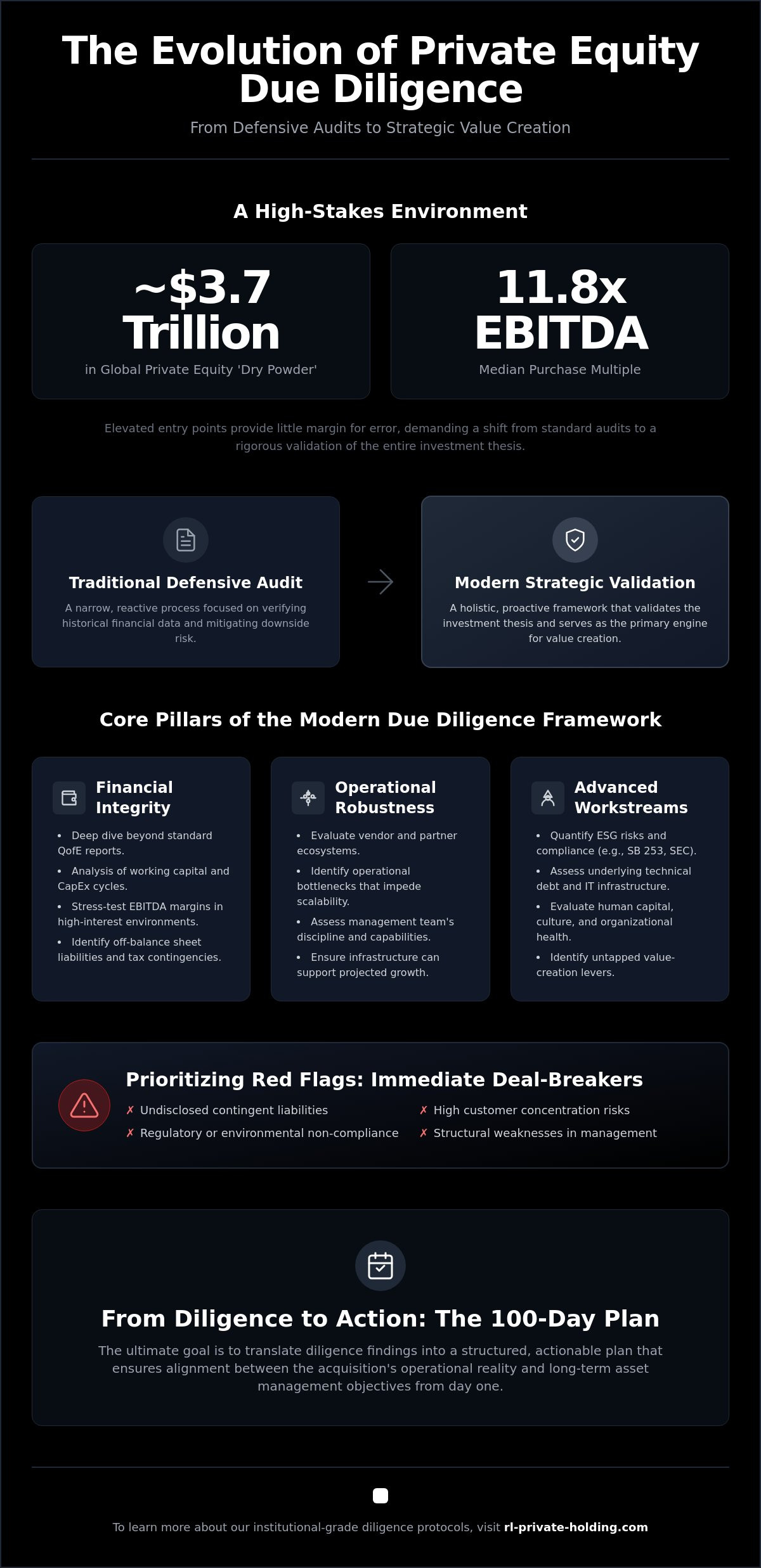
With global private equity firms holding approximately $3.7 trillion in dry powder as of early 2026, the competition for high-quality assets has driven median purchase multiples to 11.8x EBITDA. Such elevated entry points provide little margin for the information asymmetry or incomplete risk assessments that frequently result in post-acquisition complications. In this environment, a standard defensive audit is insufficient to safeguard institutional capital. Instead, rigorous private equity due diligence must function as a strategic validation of the investment thesis and the primary engine for long-term value creation.
It is a common concern among investment professionals that quantifying intangible assets, such as human capital or underlying technical debt, remains a significant hurdle during the bidding process. This guide provides a comprehensive framework for establishing institutional-grade protocols that align a target’s operational reality with your strategic objectives. We will examine a repeatable methodology for mitigating downside risk and ensuring that every acquisition contributes to the stability of a global portfolio, regardless of macroeconomic shifts or evolving regulatory requirements such as California’s SB 253 or updated SEC mandates.
Key Takeaways
- Establish a multi-dimensional framework that transitions from traditional financial audits to a holistic validation of the underlying investment thesis.
- Implement rigorous private equity due diligence protocols to evaluate cash flow durability and operational robustness across the global supply chain.
- Integrate advanced workstreams, including ESG risk factors and technical debt assessments, to mitigate long-term liabilities and identify value-creation levers.
- Standardize the execution process through a phased inquiry model that prioritizes data room integrity and multi-stream communication.
- Translate diligence findings into a structured 100-day plan to ensure alignment between the acquisition’s operational reality and long-term asset management objectives.
The Strategic Role of Due Diligence in Private Equity
The concept of due diligence has evolved significantly from its origins as a narrow financial audit. In the current investment environment, private equity due diligence serves as a multi-dimensional validation of the entire investment thesis. It’s no longer sufficient to merely verify historical earnings. Institutional investors now require a holistic assessment that encompasses operational resilience, market positioning, and the long-term durability of cash flows. This shift reflects a broader recognition that information asymmetry remains a primary risk in the bidding process. By conducting a rigorous inquiry, firms eliminate the gap between a seller’s narrative and the target’s operational reality.
A disciplined approach to this process directly correlates with the stability of a global portfolio. Rigorous protocols minimize post-acquisition surprises that can erode the Internal Rate of Return (IRR). When the investment thesis is validated through a structured framework, the transition to value creation is more efficient. This allows the firm to focus on strategic growth from the first day of ownership rather than addressing unforeseen legacy issues.
Risk Mitigation vs. Value Validation
A robust framework prioritizes the identification of structural red flags that may serve as immediate deal-breakers. These investigations focus on several critical areas:
- Undisclosed contingent liabilities or pending litigation
- Regulatory or environmental non-compliance issues
- High customer concentration risks that threaten revenue stability
- Structural weaknesses in the organizational hierarchy or management team
Beyond risk mitigation, the process must validate the scalability of the revenue model. Investors assess whether the infrastructure can support projected growth without a disproportionate increase in the cost base. This requires a precise bridge between historical performance and future projections, ensuring that growth assumptions are grounded in verifiable data rather than optimistic extrapolation.
Due Diligence as a Competitive Advantage
Firms that maintain deep sector expertise can execute private equity due diligence with greater speed and precision than generalist competitors. This specialized knowledge allows for the use of proprietary data to benchmark a target’s performance against industry standards. Such technical proficiency doesn’t just protect the buyer; it also builds significant trust with sellers. A professional and transparent inquiry process demonstrates a disciplined approach to asset management. This can be a deciding factor in competitive auctions where the seller values deal certainty and institutional permanence over the highest headline price.
Core Pillars of the Private Equity Due Diligence Framework
An institutional-grade framework treats the target as a dynamic system rather than a collection of static balance sheets. While traditional audits verify historical figures, modern private equity due diligence examines the durability of the underlying business model. This involves a rigorous analysis of competitive moats and customer concentration to ensure that the target’s market position is defensible against emerging disruptive forces. A comprehensive inquiry must integrate financial, operational, and structural workstreams to form a unified view of the asset’s health.
Financial Integrity and Cash Flow Analysis
Financial integrity extends beyond a standard Quality of Earnings (QofE) report. It requires a deep dive into working capital requirements and capital expenditure (CapEx) cycles. In a high-interest environment, where SOFR-based financing rates for senior debt often range between 8% and 11%, the sustainability of EBITDA margins is critical. Analysts must identify off-balance sheet liabilities and potential tax contingencies that could impact the eventual valuation. This level of scrutiny ensures that the cash flow projections used to justify the purchase multiple are grounded in operational reality.
Operational Robustness and Scalability
Assessing operational robustness involves evaluating the target’s vendor and partner ecosystem. It’s essential to identify operational bottlenecks that might impede the scalability required to meet the investment thesis. A key component is determining if the current management team possesses the discipline to execute a 100-day post-acquisition plan effectively. Firms engaged in private equity investment management often prioritize these operational insights to ensure the acquisition is ready for immediate value creation. Without this validation, the risk of post-deal integration failure increases significantly.
Jurisdictional and Structural Considerations
For global portfolios, the legal and structural components of the deal are as vital as the financial ones. This is particularly true when evaluating the efficiency of Luxembourg-based structures, such as the SOPARFI (Société de Participations Financières). These entities provide a sophisticated framework for holding international assets, offering clarity on capital repatriation and exit mechanics. A thorough structural review analyzes the impact of multi-jurisdictional regulatory compliance and ensures that intellectual property and contracts are sufficiently protected across all operating regions. Firms deploying capital across the continent must also account for the evolving regulatory landscape covered in frameworks for institutional asset management Europe, where directives such as AIFMD II and EMIR III are reshaping governance requirements. This level of structural diligence prevents friction during the eventual divestment phase, securing the long-term integrity of the investment.
Advanced Workstreams: ESG, Technology, and Human Capital
While financial and operational pillars provide the foundation for a transaction, private equity due diligence must extend into advanced workstreams to capture the full risk-return profile of a target. Intangible factors such as organizational culture and digital resilience are no longer secondary concerns. They’re primary drivers of the terminal value. In a market where high-quality assets command premium multiples, identifying hidden liabilities in a tech stack or a leadership team is essential for protecting institutional capital.
The ESG Mandate for Institutional Portfolios
ESG factors have transitioned from elective disclosures to critical risk management tools. Quantifying these risks is vital for protecting future exit valuations, especially as regulatory requirements tighten globally. For instance, entities with over $1 billion in annual revenue that do business in California must prepare for the first reporting deadlines of the Climate Corporate Data Accountability Act (SB 253) on August 10, 2026. A thorough inquiry assesses a target’s alignment with these mandates and European sustainability reporting standards. Beyond compliance, the process identifies green-growth opportunities where operational efficiencies can reduce carbon footprints while simultaneously lowering the cost base.
Technology Stack and Digital Resilience
Assessing a target’s technology stack requires more than a surface-level review of IT infrastructure. It involves a rigorous audit of proprietary software scalability and the identification of technical debt. This debt represents the future cost of remediating legacy systems that may impede growth or integration. Given that AI-driven disruption contributed to a significant reassessment of software valuations in early 2026, understanding a target’s digital resilience is paramount. This workstream must include:
- Cybersecurity vulnerability assessments and structured penetration testing.
- Evaluation of data privacy protocols to ensure compliance with GDPR and SEC Regulation S-P.
- Analysis of the target’s ability to integrate emerging automation tools without significant capital expenditure.
Assessing the Management Team and Culture
The success of an investment thesis often depends on the leadership team’s ability to execute under new ownership. We conduct deep-dive background checks on key executives to ensure their professional history aligns with the firm’s standards of integrity. Analyzing employee retention rates and talent acquisition pipelines provides insight into the organizational health of the company. It’s critical to determine if there’s a cultural alignment between the holding company and the target. A fractured culture or a thin leadership bench can become a significant bottleneck during the post-acquisition value creation phase, making human capital assessment a non-negotiable component of modern private equity due diligence.
Executing the Private Equity Due Diligence Template
The execution of a disciplined private equity due diligence process follows a structured, phase-gate methodology. This sequence ensures that resources are allocated efficiently and that critical risks are identified before significant capital is committed to legal and third-party consultancy fees. A well-ordered template moves from a high-level preliminary review to a granular, multi-stream inquiry, culminating in a synthesized report for the investment committee. This methodical approach is essential in a market where median purchase multiples of 11.8x EBITDA leave no room for oversight.
- Phase 1: Preliminary Review and Indicative Valuation. The process begins with an analysis of the initial teaser and confidential information memorandum (CIM). This phase establishes the indicative valuation and the preliminary investment thesis.
- Phase 2: Data Room Management and Multi-Stream Inquiry. Once an LOI is signed, the firm gains access to the virtual data room. This is the most intensive stage, involving concurrent workstreams across financial, legal, and operational domains.
- Phase 3: Synthesis of Findings and IC Presentation. All consultant reports are aggregated to identify cross-functional risks. The team then presents a unified case to the investment committee, highlighting how the findings impact the long-term IRR.
- Phase 4: Final Negotiation and SPA Adjustments. Findings from the inquiry are used to negotiate Share Purchase Agreement (SPA) protections, including indemnities, warranties, and adjustments to net debt or working capital targets.
Efficient Data Room Management
Managing the flow of information is critical to maintaining deal momentum. It’s vital to prioritize document requests to avoid target management fatigue, which can create friction during sensitive negotiations. Modern firms utilize AI-driven tools for rapid contract review and anomaly detection, allowing the team to focus on high-value strategic analysis rather than manual data entry. Throughout this inquiry, maintaining strict confidentiality protocols is a non-negotiable requirement to protect the integrity of both the buyer and the seller.
For institutional partners seeking a disciplined approach to capital deployment and risk mitigation, RL Private Holding provides sophisticated private equity investment management services tailored to global portfolios.
Synthesizing Data into a Decision-Making Framework
The final stage of execution involves aggregating findings from various consultants into a cohesive decision-making framework. This synthesis must quantify the impact of every identified risk on the final purchase price. If a technology audit reveals significant technical debt or a legal review uncovers pending litigation, these costs must be factored into the final valuation. The resulting due diligence report serves as the primary record for institutional stakeholders, documenting the rigorous validation of the investment thesis and the mitigation of downside risk before the deal is closed.
Integrating Due Diligence into Long-Term Asset Management
The completion of a transaction marks the transition from theoretical validation to operational execution. In this context, the data harvested during private equity due diligence serves as the definitive blueprint for the investment’s lifecycle. It’s a strategic error to treat the final due diligence report as a static document intended only for the investment committee. Instead, it must function as the primary source of truth for the asset management team, informing every decision from the initial 100-day plan to the eventual exit strategy. This continuity ensures that the strategic intent of the acquisition isn’t lost during the hand-off from the deal team to the operators.
A disciplined approach to asset management requires that findings from the inquiry phase are integrated into the ongoing monitoring framework. By using the benchmarks established during diligence, investors can track performance with a high degree of precision. This methodical oversight is what allows institutional-grade firms to maintain stability across a diversified global portfolio, ensuring that downside risks identified early on are actively mitigated throughout the holding period.
The 100-Day Plan: From DD to Action
Translating findings into an actionable 100-day value creation plan requires a disciplined prioritization of the operational improvements identified during the inquiry. If the private equity due diligence phase highlighted inefficiencies in the supply chain or significant technical debt within core IT platforms, these issues become the immediate focus of the management team. Establishing Key Performance Indicators (KPIs) based on DD benchmarks ensures that progress is measured against the original investment thesis. This alignment is critical for ensuring that management incentives are directly linked to the validated drivers of value, preventing the operational drift that can occur when post-acquisition reality deviates from the pre-close model.
Long-Term Value Preservation
Maintaining institutional discipline involves conducting regular “health checks” that mirror the original due diligence process. These reviews ensure continued compliance with evolving international regulations and verify that the asset is meeting its strategic performance targets. Leveraging a global network allows a firm to support portfolio growth while utilizing the initial DD data to anticipate potential macroeconomic or sector-specific headwinds. This longitudinal view of the asset allows for more controlled exit preparation. Addressing historical red flags early in the holding period ensures that when the time comes to divest, the asset is positioned as a high-quality, transparent opportunity for the next buyer. You may contact RL Private Holding to discuss strategic investment management and how a rigorous approach to diligence secures long-term capital preservation.
Securing Institutional Value Through Disciplined Inquiry
A rigorous private equity due diligence framework is the essential mechanism for bridging the gap between an investment thesis and operational reality. By standardizing advanced workstreams across technology, human capital, and ESG, firms can mitigate the risks associated with information asymmetry and high-multiple entry points. This methodical approach ensures that every acquisition is prepared for immediate integration into a 100-day value creation plan, preserving capital and driving long-term IRR across a global portfolio.
Headquartered in Luxembourg, RL Private Holding maintains a global investment reach with specialized expertise in technology, real estate, and asset management. Our disciplined approach and proven track record in managing diversified institutional portfolios provide the stability required in today’s complex financial landscape. We invite you to Explore Strategic Investment Management with RL Private Holding to learn how our institutional-grade protocols support sustainable growth and risk mitigation. Establishing a steady hand in the background of major investments remains our primary objective as a trusted global partner.
Frequently Asked Questions
What is the typical duration of a private equity due diligence process?
The typical duration of a private equity due diligence process ranges from 30 to 90 days, depending on the complexity of the target and the depth of the inquiry. The preliminary phase usually concludes within two to three weeks, while the exhaustive multi-stream inquiry following the letter of intent requires several months to complete thoroughly.
How does financial due diligence differ from a standard company audit?
Financial due diligence focuses on the durability and quality of future earnings, whereas a standard company audit verifies historical compliance and accounting accuracy. While an audit ensures the books are correct, the diligence process evaluates the sustainability of cash flows and identifies potential adjustments to EBITDA that impact valuation.
Why is operational due diligence becoming more critical for PE firms?
Operational due diligence is increasingly critical because modern value creation relies on structural improvements rather than financial engineering alone. In a high-interest environment, investors must validate that the target’s cost base and supply chain can support the projected growth margins outlined in the investment thesis.
What are the most common “red flags” found during private equity due diligence?
Common red flags discovered during the inquiry include high customer concentration, significant management turnover, and undisclosed contingent liabilities. Identifying these structural weaknesses early allows the firm to adjust the purchase price or implement specific indemnities within the share purchase agreement to protect institutional capital.
How does due diligence impact the final valuation of a company?
Due diligence findings directly impact the final valuation by identifying net debt adjustments or capital expenditure requirements that weren’t apparent in the initial teaser. If the inquiry reveals a lower quality of earnings or significant technical debt, the firm may negotiate a reduction in the entry multiple or restructure the deal with earn-out provisions.
What role does cybersecurity play in modern due diligence workstreams?
Cybersecurity serves as a primary pillar of digital resilience, protecting the target’s proprietary intellectual property and ensuring compliance with data privacy mandates. Failure to identify vulnerabilities can lead to significant post-acquisition liabilities, particularly under updated regulations such as SEC Regulation S-P, which mandates strict data breach prevention policies.
How can a holding company structure like a Luxembourg SOPARFI affect the DD process?
A Luxembourg SOPARFI structure provides a sophisticated framework for holding international assets, facilitating efficient capital repatriation and clear exit mechanics. Utilizing such structures during the private equity due diligence process allows for a more streamlined assessment of the legal and tax implications of a multi-jurisdictional transaction.
What is the difference between commercial and industry due diligence?
Commercial due diligence analyzes the target company’s specific market position, customer relationships, and competitive moats. In contrast, industry due diligence evaluates the broader macroeconomic environment and sector-wide trends, providing the necessary context to determine if the target’s growth projections are realistic within its specific market.