

The true value of a private equity partnership is not found in the management fee, but in the structural alignment created by the performance incentive. While often viewed through the lens of compensation, private equity carried interest serves as the primary governance mechanism that transforms a service provider into a risk-aligned partner. It’s the bridge between capital allocation and realized value that ensures a General Partner’s success is inextricably linked to the actual returns delivered to the investor.
Investors frequently find the technical execution of these structures opaque, particularly when navigating the intricate mathematics of waterfall calculations and the tension between fee-loading and genuine performance. This article provides a rigorous institutional analysis of how these mechanisms function to protect limited partner interests while incentivizing superior long-term returns. You’ll gain a clear understanding of the 20% performance model, the operational differences between American and European waterfall structures, and the critical role of clawback provisions in mitigating downside risk.
Key Takeaways
- Analyze the fundamental role of private equity carried interest as a governance mechanism that aligns General Partner incentives with long-term capital appreciation.
- Examine the structural mechanics of the 20% performance model, including the function of hurdle rates as a primary safety net for limited partners.
- Contrast the operational nuances of American and European waterfall models to determine their respective impacts on capital distribution timelines.
- Identify critical risk-mitigation instruments, such as clawback provisions and escrow accounts, that maintain structural integrity throughout the fund lifecycle.
- Utilize current industry benchmarks to evaluate carry structures during the due diligence process for institutional investment portfolios.
Defining Carried Interest: The Performance Alignment Mechanism
Carried interest is a contractual right granted to the general partner of a fund, entitling them to a specified share of the net investment gains. Unlike the base management fee, which is calculated based on assets under management (AUM), Carried Interest is strictly performance-dependent. This structure ensures that the manager’s financial reward is proportional to the value created for the limited partners. It embodies the “skin in the game” philosophy essential to private equity, where the manager’s interests are bound to the fund’s capital appreciation. Ultimately, private equity carried interest functions as the primary driver of GP-LP interest synchronization by ensuring that compensation is realized only after the return of capital and the achievement of specific performance thresholds.
The Origins of the 20% Performance Standard
The 20% threshold has historical roots in maritime commerce. Captains often received a portion of the profit from the cargo they “carried” across oceans, which established a precedent for performance-based profit sharing. In the modern financial landscape, this 20% figure has become the institutional benchmark for private equity carried interest and venture capital. This specific percentage is designed to justify the high-risk, high-reward nature of the asset class. It provides a significant incentive for managers to pursue alpha rather than merely tracking market indices. By setting the bar at 20%, the industry maintains a standard that attracts elite managerial talent while requiring a high level of performance to unlock substantial payouts.
Incentive Alignment vs. Fixed Compensation
The “2 and 20” model creates a clear distinction between operational stability and performance-driven rewards. While the 2% management fee covers the firm’s overhead, salaries, and administrative costs, the 20% carry rewards the generation of alpha. This bifurcation prevents “style drift,” as managers are discouraged from growing AUM simply to collect higher fees. Instead, they remain focused on exit-driven returns that trigger carry payments. This alignment is further strengthened by the GP commitment, which is the manager’s own capital invested alongside the limited partners. When a manager’s personal capital is at risk, the commitment to disciplined asset management and strategic exits becomes a functional reality rather than a theoretical goal. This dual structure of fixed and variable compensation ensures the firm remains solvent during the investment period while maintaining an aggressive focus on the ultimate realization of value.
The Structural Mechanics of the 20% Performance Fee
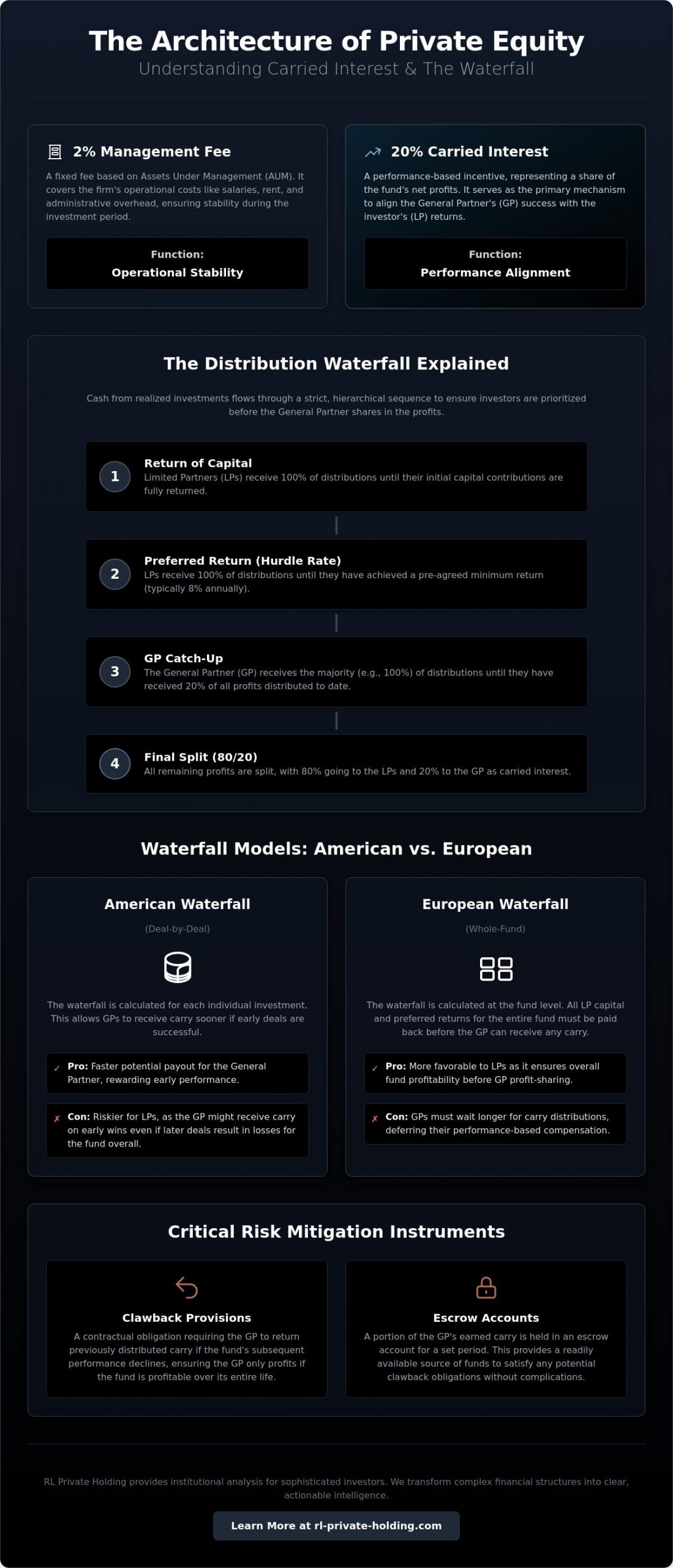
The distribution waterfall is the formal sequence that dictates how cash flows from realized investments are allocated between limited partners and the general partner. This hierarchical structure ensures that capital is returned in a disciplined manner, prioritizing the investor’s principal and a baseline return before any performance-based compensation is triggered. In a standard institutional model, private equity carried interest only becomes relevant once the initial capital contributions and a specific preferred return have been fully satisfied. This sequence is a fundamental component of fund governance, protecting the integrity of the investment vehicle over its entire lifecycle.
The Hurdle Rate: Protecting the Limited Partner
The preferred return, or hurdle rate, serves as a critical safety net by ensuring that the general partner only shares in profits after a minimum return threshold is achieved. An 8% compounded annual return is the standard benchmark for institutional private equity funds. There is a meaningful distinction between a “hard hurdle” and a “soft hurdle” in these agreements. Under a hard hurdle, the general partner only receives carry on profits that exceed the 8% threshold. Conversely, a soft hurdle allows the manager to receive carry on all profits once the 8% mark is reached, typically facilitated through a catch-up provision. If a fund fails to achieve this compounded 8% return over its lifecycle, the general partner is contractually barred from receiving any share of the profits.
The Catch-up Clause: Transitioning to Profit Share
Once the limited partners have received their full capital back plus the 8% preferred return, the distribution enters the catch-up phase. This phase is often the most technical aspect of the Carried Interest Explained framework. During this stage, the general partner typically receives 100% of all subsequent distributions until they’ve received 20% of the total profits distributed to that point. This includes the sum of the preferred return and the catch-up itself. The process follows a specific progression:
- First, 100% of proceeds go to limited partners until their initial capital is returned.
- Second, 100% of proceeds go to limited partners until they achieve their 8% preferred return.
- Third, 100% of proceeds go to the general partner until they’ve “caught up” to their 20% share of total profits.
- Finally, all remaining proceeds are split 80/20 between the limited partners and the general partner.
The catch-up is designed to align total profit distribution to the agreed-upon ratio once the preferred return has been cleared. For investors evaluating these complex governance structures, professional private equity investment management provides the necessary oversight to ensure terms remain competitive and transparent.
The impact of compounding over a typical 10-year fund life is significant. Because the hurdle rate is usually compounded annually, the dollar amount that must be paid to limited partners before the manager sees any private equity carried interest grows substantially over time. This dynamic creates a powerful incentive for managers to realize gains efficiently and avoid holding underperforming assets that continue to accrue preferred return obligations. It’s this temporal pressure that ensures the general partner remains focused on timely exits and disciplined capital recycling.
Waterfall Distributions: Comparing Deal-by-Deal and Fund-Level Models
The timing of profit allocation is as significant as the percentage itself. While the 20% figure is a widely accepted industry benchmark, the specific method of calculation varies across jurisdictions and fund types. The distribution waterfall determines the exact chronology of capital flows, a factor that significantly influences the internal rate of return for both parties. Two dominant frameworks exist in the global market: the American (deal-by-deal) model and the European (whole-of-fund) model. The choice between these structures fundamentally alters the risk profile for the limited partner, as it dictates when the general partner begins to realize private equity carried interest. Understanding these nuances is essential for institutional investors who must balance managerial incentives with capital protection.
The American Model: Deal-by-Deal Incentives
The American model is characterized by its deal-by-deal approach to distributions. Under this framework, the general partner is entitled to receive carry as soon as an individual investment is exited at a profit, provided the initial capital for that specific deal and its associated hurdle have been returned. This structure is frequently utilized by venture capital firms and smaller private equity managers because it provides immediate rewards to specific deal teams. However, it introduces the risk of “early carry” payments. If a fund realizes significant gains on its first three exits but suffers losses on the remaining portfolio, the limited partners may find they’ve paid performance fees on a fund that, in aggregate, underperformed. This scenario necessitates robust clawback provisions to ensure the final distribution reflects the fund’s total performance.
The European Model: The Institutional Standard
The European model represents the institutional standard for large-scale funds and is the prevalent structure for entities domiciled in Luxembourg. This “whole-of-fund” approach requires that limited partners receive all contributed capital plus the aggregate preferred return across the entire fund before the general partner receives any private equity carried interest. This model is widely regarded as more investor-friendly because it eliminates the risk of overpayment during the early stages of the fund’s life. It ensures that the manager’s performance is measured against the total portfolio’s health rather than isolated successes.
For institutional portfolios focusing on risk mitigation, the European waterfall provides a superior level of structural security. Its dominance in Luxembourg-based structures reflects the region’s commitment to transparent and disciplined fund governance, making it the preferred choice for sophisticated global investors. Navigating the regulatory complexity that defines institutional asset management Europe — including directives such as AIFMD II and the tax efficiency advantages of Luxembourg structures — is essential for managers seeking to optimize both governance and returns. By requiring the return of all capital before profit sharing begins, the European model aligns the manager’s exit strategy with the long-term solvency and profitability of the entire fund vehicle.
Risk Mitigation and Governance: Clawbacks and Vesting
Structural integrity in a fund’s lifecycle depends on robust governance mechanisms that address the potential for over-distribution of profits. A primary concern for limited partners is the scenario where a general partner receives private equity carried interest based on early successful exits, only for the remaining portfolio to underperform. To mitigate this risk, institutional agreements incorporate specific protective measures, such as clawback provisions and escrow accounts, which ensure the final profit allocation aligns with the fund’s aggregate performance. These tools serve as a mandatory safeguard, maintaining the intended 80/20 profit split across the entire duration of the investment vehicle.
Clawback Provisions: Ensuring Long-Term Fairness
A clawback provision is a contractual obligation requiring the general partner to return previously distributed carry if the fund’s total returns fall below the agreed-upon thresholds. This calculation is typically performed on a “net of tax” basis, meaning the manager is only required to return the portion of the carry they actually retained after satisfying their tax obligations. These triggers are usually activated at the point of fund liquidation, though sophisticated limited partners often insist on interim clawback tests during the fund’s life. In many institutional structures, a portion of all carry payments is held in an escrow account, often ranging from 20% to 30%, to ensure that funds are readily available should a clawback be necessary. For institutions seeking disciplined oversight of these complex governance structures, our private equity investment management services provide the necessary framework for long-term alignment.
Vesting and Retention: Aligning Personnel with Performance
While the fund as an entity earns profit, the actual private equity carried interest is distributed to the individual professionals responsible for the portfolio’s success. To ensure these individuals remain committed throughout the entire value-creation cycle, firms utilize vesting schedules that typically span five to six years. This temporal requirement prevents key personnel from departing shortly after a successful exit, which would jeopardize the management of the remaining assets. These agreements are further governed by “Good Leaver” and “Bad Leaver” clauses. A Good Leaver, such as someone retiring or departing due to health reasons, may retain a portion of their vested carry. Conversely, a Bad Leaver, who might be terminated for cause or leave to join a direct competitor, often forfeits all unvested and, in some cases, vested points. This rigorous personnel governance ensures that the deal team’s personal financial outcomes remain inextricably linked to the fund’s long-term stability.
Strategic Implications for Institutional Portfolios
The strategic evaluation of incentive structures represents the final, critical stage of the asset allocation process. Institutional investors must look beyond the headline 20% figure to understand how the underlying mechanics influence a manager’s behavior over a decade-long horizon. While management fees provide the necessary capital for institutional operations, private equity carried interest serves as the definitive indicator of a firm’s commitment to alpha. A disciplined approach to reviewing these terms ensures that the partnership remains resilient across various market cycles and economic conditions. Transparency in fee and incentive reporting is not merely a regulatory requirement; it’s a foundational element of institutional trust.
Due Diligence: Evaluating the Fee-to-Incentive Ratio
A fundamental objective of private equity due diligence is identifying the precise balance between fixed and variable compensation. Funds that maintain high management fees relative to their performance incentives may be categorized as “fee-driven” vehicles. This structure potentially dilutes the urgency for high-quality exits and strategic value creation. Sophisticated allocators carefully review the historical application of carry in previous vintages to assess how managers have handled past distributions and clawback obligations. This forensic analysis reveals the manager’s operational discipline and their adherence to the spirit of the partnership agreement during periods of market volatility.
The Future of Performance Fees in 2026
As the industry moves through 2026, new complexities are emerging in the structuring of private equity carried interest. Tiered carry models are becoming more prevalent in top-tier funds. In these structures, the profit share increases as certain IRR thresholds are surpassed, which further incentivizes outsized returns. There is also a growing trend toward ESG-linked performance hurdles, where a portion of the carry is contingent upon meeting specific sustainability or governance criteria. Despite these evolving trends, the fundamental necessity of carry as a tool for attracting and retaining elite managerial talent remains unchanged. RL Private Holding maintains a disciplined focus on performance-based incentive structures that prioritize the long-term success of our global partners. Explore RL Private Holding’s institutional investment strategies to understand how we navigate these complex governance frameworks.
Advancing Institutional Alignment Through Structural Discipline
The structural design of a fund’s incentive model is the ultimate arbiter of its long-term success. By prioritizing the European waterfall and implementing rigorous clawback provisions, institutional allocators ensure that the general partner’s rewards are strictly commensurate with realized value. Mastering the technical nuances of private equity carried interest transforms a complex financial obligation into a powerful tool for governance and performance. This clarity allows for the creation of partnerships that remain resilient across diverse market cycles and economic shifts.
RL Private Holding maintains a disciplined approach to private equity and venture capital, focusing on long-term value creation and institutional ROI. Our global scale and specialized Luxembourg-based expertise provide the necessary foundation for building and managing sophisticated investment vehicles. We invite you to Consult with RL Private Holding on Institutional Investment Structures to refine your approach to performance alignment and fund governance. We look forward to supporting your strategic objectives in the evolving global private markets.
Frequently Asked Questions
What is the standard percentage for private equity carried interest?
The institutional standard for private equity carried interest is 20% of the fund’s net capital gains. This percentage is calculated after the return of all contributed capital and the satisfaction of the preferred return. While some top-tier funds may negotiate higher rates or tiered structures, the 20% model remains the global benchmark for aligning managerial incentives with investor outcomes. It ensures the manager’s reward is proportional to the value created.
How does a hurdle rate affect the payment of carried interest?
A hurdle rate serves as a mandatory performance floor that must be achieved before the general partner is entitled to any profit share. Typically set at 8% compounded annually, this mechanism ensures that investors receive a baseline return on their capital before any performance fees are triggered. It effectively shifts the risk of underperformance onto the manager; failure to clear the hurdle results in zero carry for the general partner.
What is the difference between a hard hurdle and a soft hurdle in PE?
A hard hurdle restricts the general partner to receiving carry only on the profits that exceed the 8% threshold. In contrast, a soft hurdle allows the manager to receive their full 20% share of all fund profits once the 8% mark is reached. This is usually accomplished through a catch-up provision that rebalances the distribution ratio in favor of the manager until the contractually agreed-upon split is achieved.
Why do European and American waterfalls differ in their distribution timing?
The difference in timing stems from whether performance is calculated on an individual deal basis or across the entire fund. The American waterfall allows for carry payments as individual investments are exited, which provides earlier liquidity to managers. The European waterfall requires all capital and hurdles across the entire fund to be returned first. This makes the European model more conservative and investor-friendly; it’s the dominant structure in Luxembourg-domiciled institutional funds.
Can carried interest be clawed back if a fund underperforms later?
Yes, clawback provisions are a standard governance tool designed to reclaim over-distributed carry if a fund underperforms in its later years. If early successful exits are followed by later portfolio losses, the general partner must return the excess payments to the limited partners at fund liquidation. This ensures that the final distribution of profits adheres to the contractually agreed-upon ratio, regardless of the specific timing of individual exits.
Is carried interest taxed as capital gains or ordinary income in Europe?
Taxation for carried interest in Europe varies significantly by jurisdiction and the specific holding period of the fund’s assets. In the United Kingdom, as of April 6, 2026, all carried interest is taxed as trading profits at rates up to 47%. However, a qualifying rate of approximately 34.1% is available for funds with a weighted average holding period of at least 40 months. Other European jurisdictions maintain their own distinct regimes based on local tax laws.
How does vesting work for individual managers receiving carry?
Individual managers typically earn their share of private equity carried interest through a vesting schedule that spans five to six years. This structure ensures that key personnel remain committed to the portfolio through the entire value-creation and exit cycle. It prevents managers from departing shortly after a successful realization. If a manager departs before the schedule is complete, they often forfeit a significant portion of their unvested interest to the remaining team.
What happens to carry if a general partner is removed from the fund?
The treatment of carry upon a general partner’s removal is dictated by specific “Good Leaver” and “Bad Leaver” provisions in the partnership agreement. A manager removed for cause or leaving to join a competitor is usually classified as a Bad Leaver and forfeits their interest. Conversely, a Good Leaver, such as someone retiring, may retain a pro-rata portion of their vested carry based on their tenure with the fund and the timing of their departure.