

Selecting the correct Luxembourg investment fund structures is no longer a matter of administrative preference; it is a critical strategic decision that determines a fund’s global distribution potential and operational agility. Institutional investors and fund managers often find the Luxembourg regulatory landscape increasingly difficult to navigate, particularly following the April 2026 implementation of AIFMD II and UCITS VI. The choice between regulated and unregulated vehicles remains a primary concern for those balancing speed-to-market against the necessity of institutional-grade compliance.
This guide provides a comprehensive analysis of the primary investment vehicles within the Luxembourg financial ecosystem, offering clarity on their strategic applications for global investors. We examine the specific frameworks of the Reserved Alternative Investment Fund (RAIF), the Specialized Investment Fund (SIF), and the SOPARFI to establish a clear selection methodology based on investor profile and asset class. By understanding these structures as strategic assets rather than mere legal requirements, firms can better leverage the jurisdiction’s €6.436 trillion ecosystem to enhance portfolio governance and long-term performance.
Key Takeaways
- Understand why Luxembourg’s political stability and AAA credit rating maintain its position as the premier global hub for cross-border investment distribution.
- Evaluate the technical differences between various Luxembourg investment fund structures to determine the most efficient vehicle for your specific regulatory and speed-to-market requirements.
- Establish a clear framework for aligning fund vehicles with the unique liquidity profiles of alternative asset classes, including private equity and real estate.
- Identify the strategic advantages of utilizing holding companies to balance high-level operational control with institutional-grade compliance standards.
- Develop a methodology for optimizing long-term wealth preservation through robust governance and strategic portfolio structuring within the European ecosystem.
The Strategic Significance of the Luxembourg Investment Ecosystem
Luxembourg has solidified its position as the preeminent global hub for cross-border investment fund distribution. As of April 2026, the total net assets of undertakings for collective investment in the jurisdiction reached €6.436 trillion. This scale is not merely a reflection of volume but a testament to a decades-long commitment to institutional stability and fiscal discipline. The nation’s consistent AAA credit rating provides a foundational layer of security for global capital, acting as a critical risk-mitigation factor in an increasingly volatile financial landscape.
The jurisdiction’s success is built upon a highly specialized service provider ecosystem. This includes a dense concentration of international custodians, specialized auditors, and experienced fund managers who understand the technical nuances of global asset management. This infrastructure ensures that complex Luxembourg investment fund structures operate with a level of efficiency and transparency that institutional investors expect. The presence of these experts allows for the seamless execution of sophisticated strategies across diverse asset classes, from private equity to global real estate.
The Regulatory Framework and CSSF Oversight
The Commission de Surveillance du Secteur Financier (CSSF) provides a rigorous yet pragmatic supervisory environment that balances investor protection with the need for flexible structuring. Luxembourg law has continuously evolved to accommodate alternative investment strategies, ensuring the framework remains relevant to modern market demands. Recent updates, including the modernization of the regulatory framework for the Specialized Investment Fund (SIF) through Circular 25/901, demonstrate this proactive approach. This regulatory agility allows managers to deploy capital quickly while maintaining the high standards of governance required by institutional limited partners.
Global Distribution and Passporting Rights
A primary strategic advantage of the Luxembourg ecosystem is the access it provides to the European Union market through established passporting rights. Under the AIFMD and UCITS frameworks, fund managers can market their products across the entire European Economic Area from a single point of entry. This eliminates the need for multiple registrations in individual member states, significantly reducing compliance costs and time-to-market.
Luxembourg’s reputation extends far beyond Europe. Institutional investors in Asia and the Americas view the jurisdiction as the gold standard for cross-border compliance. By utilizing Luxembourg investment fund structures, global managers gain a “quality label” that facilitates capital raising in diverse international markets. The April 2026 implementation of AIFMD II further enhances this position by introducing updated requirements for liquidity risk management and transparency, ensuring the jurisdiction remains at the forefront of global fund governance. For a comprehensive technical overview of the current financial ecosystem and the structural benefits available to global asset managers, the detailed analysis of institutional investment opportunities in Luxembourg provides an authoritative 2026 strategic reference.
Core Luxembourg Investment Vehicles: A Comprehensive Roundup
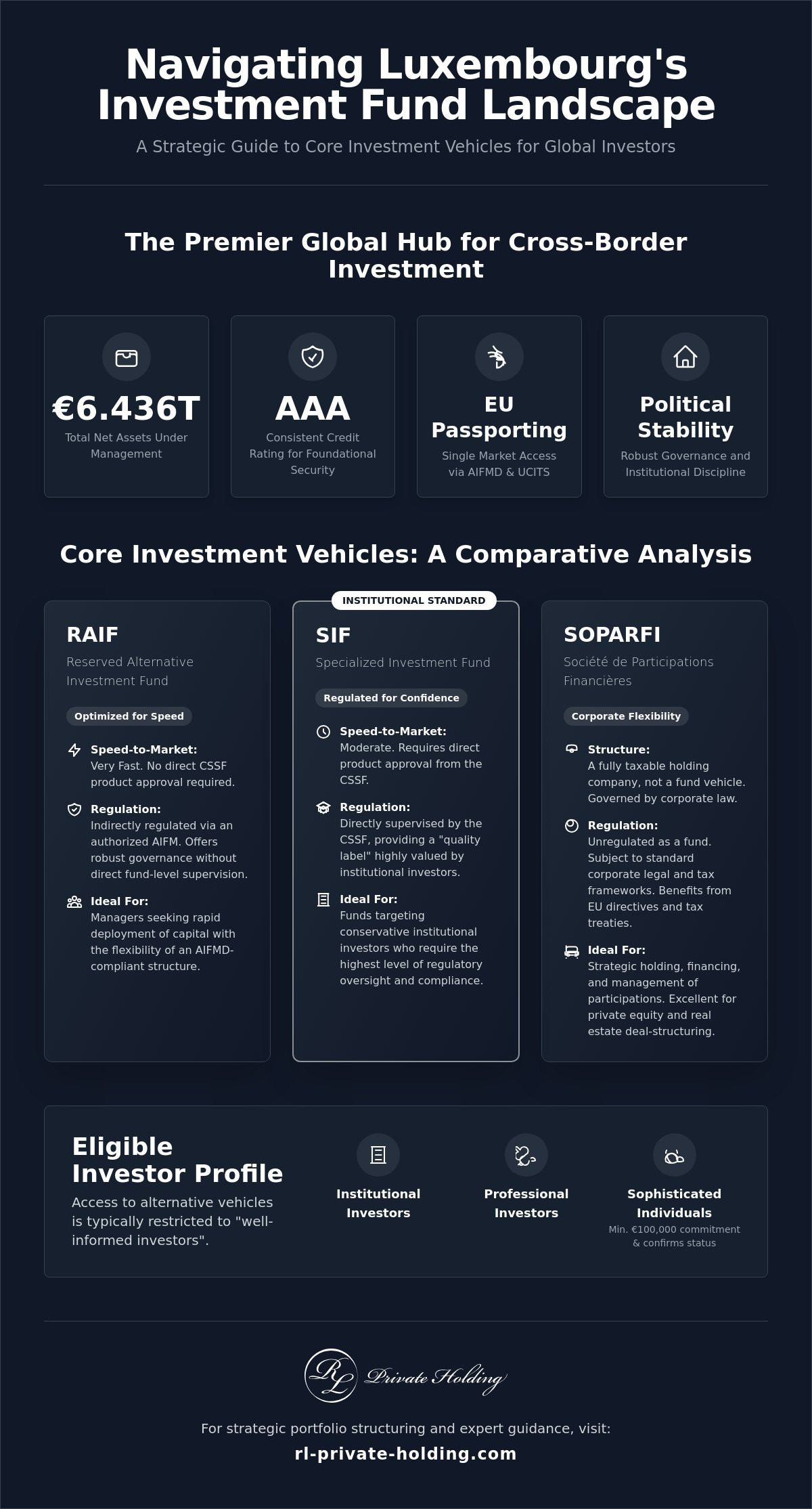
The diversity of Luxembourg’s investment fund ecosystem allows for highly tailored solutions. Selecting among the various Luxembourg investment fund structures requires a precise understanding of the regulatory burden versus operational speed. One must distinguish between regulated and indirectly regulated vehicles. Regulated structures like the SIF and SICAR undergo direct product approval by the CSSF. Conversely, the RAIF is regulated indirectly through its manager. This distinction is vital for determining the appropriate oversight level and investor onboarding requirements.
Access to these alternative vehicles is generally restricted to “well-informed investors.” This category includes institutional investors, professional investors, and individuals who confirm their sophisticated status and commit a minimum of €100,000. These structures provide essential tax transparency and access to Luxembourg’s extensive network of double tax treaties, which is critical for global capital allocation.
The Reserved Alternative Investment Fund (RAIF)
The Reserved Alternative Investment Fund (RAIF) serves as an efficient solution for rapid time-to-market. It doesn’t require direct CSSF product approval, allowing for quicker deployment. The structure supports umbrella arrangements with multiple sub-funds, providing significant operational flexibility. However, it mandates the appointment of an external authorized AIFM, ensuring a high standard of professional management. This makes it a preferred choice for growth-stage investments where speed is a competitive advantage.
The Specialised Investment Fund (SIF)
The Specialized Investment Fund (SIF) remains a cornerstone for institutional portfolios. It accommodates a vast range of asset classes, including real estate and private equity. Because the CSSF directly supervises the product, it offers a layer of comfort to investors who prioritize external regulatory validation. The SIF is particularly suitable for complex strategies that require the specific governance oversight provided by a directly regulated regime.
The SICAR: Investment Company in Risk Capital
The Investment Company in Risk Capital (SICAR) is purpose-built for private equity and venture capital. It requires a commitment to “risk capital” investments. This focus unlocks specific tax advantages, such as exemptions on capital gains and dividend distributions. Managers seeking to optimize private equity investment management often find the SICAR’s specialized framework aligns perfectly with their long-term objectives. It provides a robust legal environment for high-stakes venture capital funding while maintaining a clear focus on risk-capital assets.
Navigating Regulated vs. Unregulated Holding Structures
Strategic asset management requires a sophisticated layering of entities to manage risk and optimize capital flow. While fund vehicles aggregate investor capital, holding structures serve as the operational anchors for specific participations. Choosing between regulated and unregulated Luxembourg investment fund structures involves a careful assessment of the desired level of direct oversight versus the need for structural agility. This balance is particularly relevant for institutional investors who require robust governance without the administrative burden of direct product regulation for every underlying asset.
Transparency remains a cornerstone of the jurisdiction’s integrity. All entities, whether regulated or unregulated, must adhere to the requirements of the Register of Beneficial Owners (RBE). This ensures that while investors benefit from structural flexibility, the ecosystem remains compliant with international anti-money laundering standards. For a detailed technical breakdown of these requirements, the EY Guide to Luxembourg Investment Funds provides an authoritative reference on the evolving regulatory expectations for holding entities and their management.
The SOPARFI: The Classic Luxembourg Holding Company
The Société de Participations Financières, or SOPARFI, is the most utilized unregulated vehicle in the jurisdiction. It is not an investment fund in the legal sense but a fully taxable commercial company. Its primary strategic use lies in private equity and wealth management services, where it acts as a vehicle for holding and financing participations. The SOPARFI provides access to Luxembourg’s extensive double tax treaty network, making it an essential tool for cross-border diversification. It’s particularly effective for long-term capital preservation, as it allows for the segregation of distinct asset classes within a single global portfolio.
Unregulated Limited Partnerships (SCS and SCSp)
The Special Limited Partnership (SCSp) has become a preferred vehicle for private equity and venture capital managers. Unlike the common limited partnership (SCS), the SCSp doesn’t possess a separate legal personality. This creates a highly flexible, contract-based framework that allows partners to define their governance and economic rights with precision. International institutional investors favor these partnerships for their tax transparency, as the entity is generally treated as “look-through” for tax purposes. These vehicles are often utilized for co-investment structures or as carry vehicles to align the interests of fund managers with their limited partners. Their simplicity and the absence of direct CSSF supervision allow for rapid setup, provided the overarching manager maintains the necessary authorizations under the AIFMD framework.
Structure Selection Based on Asset Class and Investor Profile
The selection of specific Luxembourg investment fund structures depends on the alignment between the legal vehicle and the investment strategy’s liquidity profile. A fundamental mismatch between an asset’s exit timeline and a fund’s redemption terms can lead to significant operational friction. While open-ended structures are appropriate for liquid market strategies, closed-ended vehicles are essential for illiquid holdings like private equity, infrastructure, or private debt. This strategic mapping ensures that the fund can meet capital distribution schedules without compromising the integrity of the underlying portfolio.
Family offices and Ultra-High-Net-Worth Individuals (UHNWIs) increasingly utilize these structures to achieve long-term wealth preservation. By segregating distinct asset classes into specialized sub-funds or compartments, they manage risk with clinical precision. This organizational discipline protects core capital while allowing for targeted exposure to alternative markets. For those seeking institutional-grade oversight, our firm offers professional real estate asset management to ensure every vehicle is optimized for both performance and regulatory compliance.
Private Equity and Venture Capital Alignment
The Reserved Alternative Investment Fund (RAIF) and the Special Limited Partnership (SCSp) are the preferred choices for growth-stage technology and venture investments. These vehicles provide the speed-to-market required to secure high-value deals in competitive global landscapes. Under the modernized 2026 carried interest regime, Luxembourg has enhanced its attractiveness for fund managers. Contractual carried interest is now taxed at one-quarter of the global personal income tax rate, while participation-linked carried interest may be fully exempt if held for more than six months. These incentives, combined with flexible distribution waterfalls and sophisticated capital call mechanisms, provide a robust framework for professional venture capital funding.
Real Estate and Infrastructure Considerations
Institutional real estate and infrastructure strategies often utilize the SIF or RAIF structures to manage large-scale real assets. These vehicles facilitate efficient cross-border acquisitions and management across the European Union. Regulatory requirements for valuation and asset custody remain stringent under the AIFMD framework, which ensures transparency for limited partners. Managers must appoint an independent valuer and a depositary to oversee the verification of asset ownership. This level of institutional governance is particularly appealing to sovereign wealth funds and pension schemes that require a steady hand in the background of major investments. The implementation of AIFMD II in April 2026 further strengthens these requirements, particularly concerning liquidity risk management for loan-originating funds.
Optimising Portfolio Management through Strategic Structuring
The establishment of a legal vehicle is only the initial phase of a successful investment strategy. Long-term success depends on robust institutional governance and the ability to maintain fund integrity across market cycles. While Luxembourg investment fund structures provide the necessary flexibility, their true value is realized through disciplined oversight and a structured approach to portfolio management. This organizational rigour ensures that every sub-fund operates within its defined risk parameters while remaining compliant with international reporting standards.
Future-proofing these structures requires a proactive stance toward evolving regulations, particularly regarding ESG disclosures and transparency. The integration of sustainable finance frameworks is no longer elective. It’s a core component of institutional governance. As regulatory bodies streamline ESG-related disclosures, managers must ensure their structures are capable of providing the granular data required by institutional stakeholders. This commitment to transparency reinforces the jurisdiction’s reputation as a secure and well-ordered financial hub.
The Role of Professional Asset Management
Professional management provides the steady hand necessary to oversee complex global portfolios. At RL Private Holding, we approach the management of diverse asset classes with a methodical, global perspective. Our focus remains on the structural integrity of the business, utilizing a hierarchical framework to move from general firm identity to specific sector focus. Through our expertise in Private Equity Investment Management and Wealth Management Services, we ensure that every participation is aligned with the broader strategic objectives of the portfolio. This disciplined allocation of capital across private markets allows for the preservation of wealth while maintaining the high formality register expected by sophisticated investors.
Long-Term Strategic Outlook for 2026
The Luxembourg financial landscape is entering a period of significant modernization. The transposition of AIFMD II and UCITS VI into national law, generally effective as of April 16, 2026, introduces enhanced requirements for liquidity risk management and delegation. These shifts are designed to increase investor protection and market transparency. Despite these changes, the jurisdiction remains a stable anchor for global capital. Sector analysts project that Luxembourg’s fund assets could reach $10.4 trillion by 2030, reflecting continued confidence in the nation’s AAA-rated ecosystem.
Institutional portfolios are expected to show an increasing concentration in technology and real estate. These sectors require the specialized governance provided by the Reserved Alternative Investment Fund and other sophisticated Luxembourg investment fund structures. By maintaining a clear plan and high level of internal discipline, investors can leverage these vehicles to navigate the complexities of the global financial landscape. Luxembourg’s enduring position as a premier hub for cross-border distribution remains secure, providing a reliable foundation for long-term wealth preservation and strategic growth.
Strategic Alignment in the Global Investment Landscape
The selection of appropriate Luxembourg investment fund structures serves as a fundamental pillar for institutional governance and cross-border capital distribution. As the financial ecosystem adapts to the regulatory requirements of 2026, the ability to align specific vehicles with the liquidity profiles of alternative assets remains a primary differentiator for successful managers. Whether utilizing the operational agility of a RAIF or the direct supervision of a SIF, the objective remains the preservation of capital and the optimization of global portfolios.
Headquartered in the Luxembourg global financial hub, RL Private Holding maintains a disciplined approach to managing a diversified portfolio across technology, real estate, and private equity. Our global investment management expertise ensures that every structure is managed with the transparency and rigour required by sophisticated stakeholders. This methodical focus on structural integrity provides a reliable foundation for long-term wealth preservation.
Explore RL Private Holding’s Strategic Investment Portfolio to see how institutional-grade management facilitates stable growth in a complex global market. We invite you to leverage our steady hand and strategic focus for your long-term investment objectives.
Frequently Asked Questions
What is the most common investment fund structure in Luxembourg for private equity?
The Reserved Alternative Investment Fund (RAIF) and the Special Limited Partnership (SCSp) are currently the most prevalent choices for private equity. The RAIF provides a regulated framework without the delay of direct product approval, while the SCSp offers a flexible, contract-based structure that mimics the partnership models found in the US and UK. These vehicles allow managers to deploy capital efficiently while maintaining the institutional standards required by global limited partners.
How long does it typically take to set up a RAIF in Luxembourg?
A RAIF can typically be established within a timeframe of four to six weeks. Since this vehicle doesn’t require direct authorization from the CSSF at the product level, the setup speed is largely dependent on the onboarding of the depositary and the AIFM. This rapid time-to-market is a significant strategic advantage for managers who need to capitalize on immediate investment opportunities in the private equity or venture capital sectors.
Does a Luxembourg SOPARFI require approval from the CSSF?
No, a SOPARFI does not require approval or supervision from the CSSF. As an unregulated commercial holding company, it’s governed by general corporate law. This lack of direct regulatory oversight provides high operational flexibility for holding participations. However, the entity remains subject to standard transparency requirements, including registration with the Register of Beneficial Owners (RBE) and adherence to international anti-money laundering standards.
What are the main differences between a SIF and a RAIF?
The distinction between a SIF and a RAIF centers on the method of regulation. A Specialized Investment Fund (SIF) is directly authorized and supervised by the CSSF. In contrast, a RAIF is regulated indirectly through its authorized Alternative Investment Fund Manager (AIFM). While both structures offer similar flexibility regarding asset classes and sub-fund compartments, the RAIF is often preferred for its accelerated setup process and reduced administrative burden during the launch phase.
Can retail investors access Luxembourg alternative investment funds?
Access for retail investors is generally limited. Most Luxembourg alternative investment funds are reserved for well-informed investors who meet specific sophistication criteria or commit a minimum of €100,000. However, the European Long-Term Investment Fund (ELTIF 2.0) framework has introduced a path for retail participation in private markets. This structure allows smaller investors to access illiquid assets like infrastructure and private equity through a regulated, pan-European vehicle.
What is a Special Limited Partnership (SCSp) and why is it popular?
The Special Limited Partnership (SCSp) is a partnership that lacks a separate legal personality. It’s popular because it offers a high degree of contractual freedom, allowing partners to define governance and profit-sharing arrangements as they see fit. Its tax-transparent nature is particularly attractive to international institutional investors, as it prevents double taxation and aligns with the partnership structures commonly utilized in major global financial centers.
How does Luxembourg’s tax treaty network benefit investment structures?
Luxembourg’s extensive network of over 80 double tax treaties significantly enhances the efficiency of Luxembourg investment fund structures. These treaties mitigate the impact of withholding taxes on dividends, interest, and capital gains received from foreign investments. By reducing tax leakage at the fund level, these structures ensure that a higher proportion of investment returns is preserved for distribution to the fund’s global stakeholders.
What are the substance requirements for a Luxembourg holding company?
Substance requirements mandate that an entity has a genuine economic presence in Luxembourg. This typically involves maintaining a physical office, employing local staff, and ensuring that the majority of the board of directors are Luxembourg residents. Key strategic decisions must be documented as having taken place within the jurisdiction. These measures are necessary to ensure the entity is recognized as a tax resident and can legitimately access treaty benefits.