

The most sophisticated institutional investors no longer view the Luxembourg special limited partnership as a mere legal entity; they treat it as a bespoke contractual framework designed for the complexities of 2026. As the implementation of AIFMD II and the new ESG Ratings Regulation approaches this June, the demand for flexible, tax-transparent vehicles has never been more acute. You likely recognize that as cross-border fund regulations tighten, the administrative burden of traditional regulated structures often outweighs their operational benefits. Managing tax transparency across multi-jurisdictional portfolios remains a persistent challenge for asset managers seeking to maintain a competitive edge.
This article provides a comprehensive technical overview of the SCSp structure, detailing its regulatory advantages and its strategic role in institutional private market allocations. You’ll gain a clear understanding of the legal framework and the specific tax advantages offered by the 2026 carried interest regime, which clarifies treatment for contractual carried interest at a maximum of 11.45%. By the end of this analysis, you’ll be able to determine if the SCSp is the appropriate vehicle for your specific investment strategy and organizational requirements.
Key Takeaways
- Comprehend the legal foundations of the SCSp under the Law of 10 August 1915 and the structural implications of its lack of separate legal personality.
- Analyze the tax transparency and confidentiality benefits that distinguish the Luxembourg special limited partnership within institutional asset management frameworks.
- Identify strategic applications for the structure, ranging from private equity feeder vehicles to direct real estate holding entities.
- Evaluate the governance requirements and liability protections for partners, including the specific limitations of the “no management” rule.
- Review the essential steps for establishing a durable investment infrastructure and the critical role of the Limited Partnership Agreement.
Understanding the Luxembourg Special Limited Partnership (SCSp) Framework
The Luxembourg special limited partnership (SCSp) represents a critical evolution in the European alternative investment landscape. Established under the Law of 10 August 1915, this vehicle serves as the primary choice for managers familiar with Anglo-Saxon partnership structures. It provides a flexible, contractual framework that mirrors the functionality of Delaware or Cayman Islands limited partnerships while maintaining the benefits of a premier European jurisdiction. Understanding the Luxembourg Special Limited Partnership (SCSp) Framework requires recognizing that its design prioritizes the autonomy of the parties involved. Unlike the common limited partnership (SCS), the SCSp lacks a separate legal personality, which simplifies administrative processes and enhances tax transparency.
Contractual freedom remains the primary pillar of this structure. The partnership agreement (LPA) defines the rules for governance, profit allocation, and operational conduct. This high degree of flexibility allows institutional investors to tailor the vehicle to specific mandates in private equity, venture capital, or real estate. Because the law doesn’t impose rigid corporate requirements, the SCSp has become the gold standard for fund management in Europe, particularly for those seeking a familiar and efficient legal environment.
Legal Personality and Asset Segregation
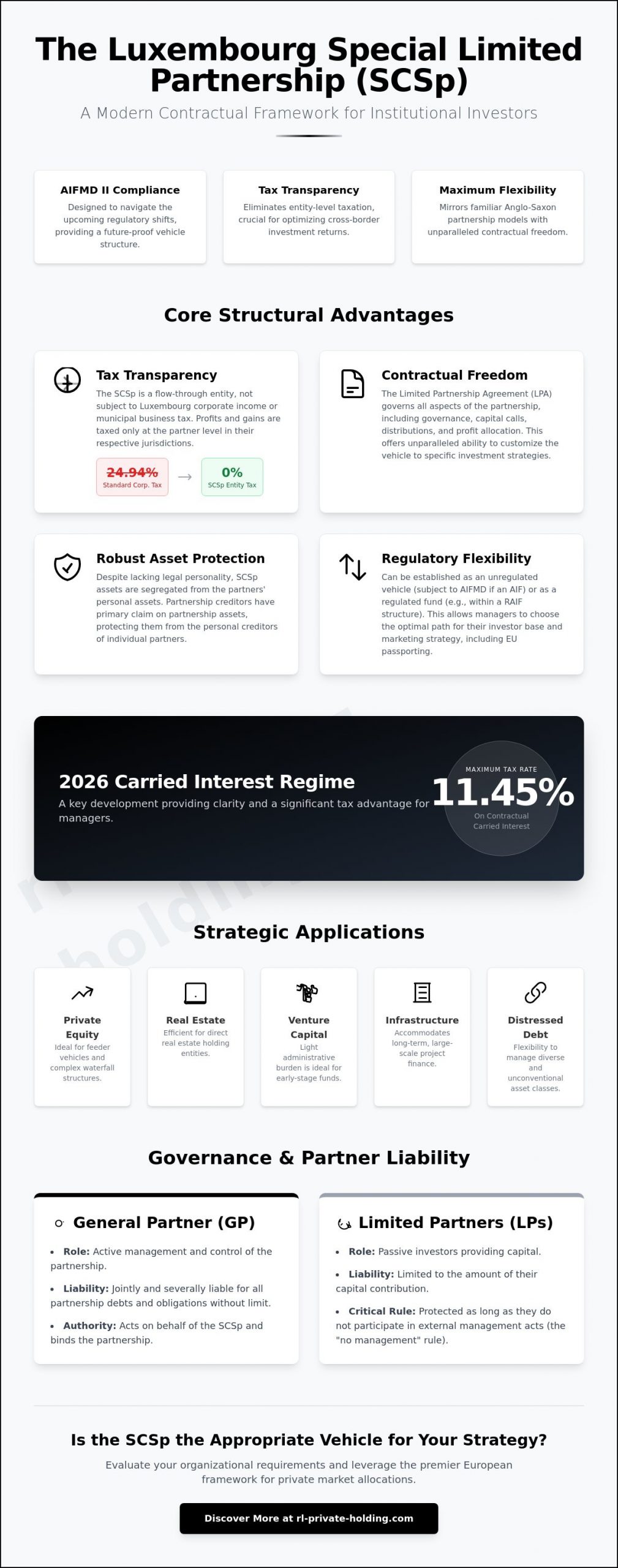
The SCSp is a contractual arrangement between a General Partner and Limited Partners. Even though it doesn’t have a distinct legal personality, it can hold assets and be registered as the owner in public records. This unique feature ensures that assets contributed to the partnership are segregated from the personal assets of the partners. Creditors of the partnership have a primary claim on these assets; meanwhile, the personal creditors of a partner cannot seize partnership property to satisfy individual debts. This segregation provides a robust layer of protection for institutional allocations and clarifies the rights of creditors within the partnership’s specific scope.
Regulatory Flexibility and AIFMD Compliance
Managers can choose between regulated and unregulated SCSp structures based on their specific investor base and distribution goals. An unregulated Luxembourg special limited partnership doesn’t require direct supervision from the CSSF, though it must still comply with the Alternative Investment Fund Managers Directive (AIFMD) if it qualifies as an Alternative Investment Fund (AIF). Many institutional managers utilize the SCSp within the Reserved Alternative Investment Fund (RAIF) regime. This allows for a fast-to-market launch while ensuring the vehicle is managed by a licensed AIFM, providing the regulatory substance and compliance oversight required for EU-wide marketing passports.
Core Structural Advantages for Institutional Asset Management
Asset managers prioritize structures that minimize administrative friction while maximizing fiscal neutrality. The Luxembourg special limited partnership achieves this through a lean operational model that favors contractual autonomy over rigid corporate formalities. This vehicle accommodates a diverse range of eligible asset classes, including liquid securities, distressed debt, and infrastructure projects. It’s particularly effective for modeling complex “carried interest” arrangements, allowing sponsors to align incentives with precision. Institutional managers frequently leverage these features for Strategic Applications in Private Equity, where capital calls and distributions require a high degree of operational agility.
Tax Transparency and Treaty Access
The SCSp operates as a tax-transparent entity for Luxembourg corporate income tax and municipal business tax purposes. This means the partnership isn’t subject to the standard aggregate tax rate of 24.94% typically applied to corporate entities in Luxembourg City. Instead, income and gains flow directly to the partners, who are taxed according to the rules of their respective jurisdictions. For managers, the new carried interest regime effective from the 2026 tax year is a significant development. It clarifies that contractual carried interest is taxed at a maximum of 11.45%, which is a quarter of the progressive income tax rate. While the SCSp itself is transparent, it still benefits from Luxembourg’s extensive network of 94 double tax treaties, providing a robust framework for cross-border investment without the burden of double taxation.
Operational Efficiency and Confidentiality
Speed to market is a defining characteristic of the Luxembourg special limited partnership. Unlike a public limited company (SA), an SCSp can be established via a private deed, known as a sous seing privé, without the mandatory involvement of a notary. This significantly reduces the formation timeline and associated costs. Confidentiality remains a primary pillar of the structure; while the partnership must be registered with the Trade and Companies Register (RCS), the identity of the limited partners and their specific contributions aren’t required for public disclosure. The partnership maintains an internal register of partners, ensuring privacy while meeting modern transparency standards. For firms refining their private equity investment management strategies, the SCSp provides a secure and discreet infrastructure for large-scale capital allocations.
The administrative burden is further reduced by simplified reporting requirements. Luxembourg offers the lowest standard VAT rate in the European Union at 17%, and certain management services provided to the partnership may qualify for exemptions. This combination of fiscal efficiency and operational discretion makes the SCSp a superior choice for multi-jurisdictional portfolios.
Strategic Applications in Private Equity and Real Estate Portfolios
The functional versatility of the Luxembourg special limited partnership allows it to serve as a cornerstone for diverse investment strategies. It functions effectively as a feeder vehicle within global private equity structures, bridging international capital into European target assets. Institutional managers utilize the SCSp to streamline capital calls and distributions, benefiting from the contractual clarity provided by the Limited Partnership Agreement. This structure is particularly advantageous for technology-focused venture capital Luxembourg, where multi-stage funding rounds require a vehicle that can adapt to changing equity compositions and governance requirements.
Private Equity and Venture Capital Deployment
In growth-stage technology investments, the SCSp facilitates efficient capital deployment through its flexible governance model. Managers can structure performance-based incentives and carried interest with high precision. The 2026 carried interest regime clarifies the tax treatment for these arrangements, with contractual carried interest taxed at a maximum of 11.45%. This provides a stable environment for fund managers to align their interests with limited partners. The SCSp also supports the integration of ESG factors, which is essential as the ESG Ratings Regulation begins applying in June 2026. This alignment ensures that venture capital funds remain compliant with evolving European standards while pursuing growth targets.
Real Estate and Infrastructure Holding
For cross-border real estate portfolio management Luxembourg, the SCSp offers a robust framework for direct asset holding and management. It allows for the segregation of liabilities across different real estate assets, protecting the broader portfolio from risks associated with specific properties. This is often achieved through sub-fund like structures within the partnership framework. The SCSp’s transparency and treaty access make it an ideal vehicle for infrastructure projects that require long-term capital stability and efficient income distribution.
Wealth management services also utilize the SCSp to create bespoke co-investment vehicles for sophisticated family offices. These structures allow for the aggregation of capital for specific private market opportunities, providing a level of exclusivity and control that traditional fund structures may lack. By integrating with broader wealth management strategies, the SCSp supports long-term asset preservation and strategic succession planning for global portfolios. The enactment of the European Single Access Point (ESAP) legislation in March 2026 further enhances the transparency of these vehicles for institutional participants. For a comprehensive overview of the broader ecosystem in which these vehicles operate, the institutional investment opportunities Luxembourg strategic reference provides detailed analysis of the jurisdiction’s €7.6 trillion fund landscape and the structural options available to global asset managers.
Governance, Liability, and the Role of the General Partner
The governance of a Luxembourg special limited partnership is primarily dictated by the Limited Partnership Agreement (LPA), which functions as the partnership’s governing constitution. This document provides the necessary latitude for sponsors to establish advisory committees and investor boards, ensuring that institutional standards of oversight are maintained. While the structure is highly flexible, it relies on a clear demarcation between the General Partner (GP), who manages the assets, and the Limited Partners (LPs), who provide the capital. The LPA defines the specific voting rights and control mechanisms that allow for a disciplined management approach while protecting the interests of all participants.
The General Partner (GP) Structure
A General Partner in an SCSp holds unlimited liability for the partnership’s debts and obligations. To manage this exposure, sophisticated managers almost exclusively utilize a Luxembourg Société à responsabilité limitée (S.à r.l.) to act as the GP. This corporate wrapper ensures that any liability remains within the S.à r.l., protecting the parent firm’s broader assets. The GP is responsible for the day-to-day administration and investment management, typically earning a management fee for these services. To comply with AIFMD II requirements and local tax standards, the GP must maintain adequate substance in Luxembourg, which includes having local directors and a physical office. This institutional presence is vital for establishing the vehicle’s legitimacy and operational residence within the European Union.
Limited Partner (LP) Protections
Limited Partners enjoy the benefit of liability capped at their total capital commitment. This protection is contingent upon the “no management” rule, which prohibits LPs from performing acts of management in relation to third parties. It’s essential to define these boundaries within the LPA to prevent accidental loss of limited liability. Safe harbor provisions in the 2026 regulatory environment allow LPs to participate in significant structural decisions, such as amendments to the LPA or the removal of the GP for cause, without being deemed managers. LPs also retain robust rights to information and periodic inspections of the partnership’s accounts. For institutional investors seeking to optimize their private equity investment management, understanding these governance nuances is critical for long-term risk mitigation.
Internal governance often includes the formation of a Limited Partner Advisory Committee (LPAC). This body provides a forum for LPs to review conflicts of interest and approve specific transactions, adding an extra layer of transparency to the partnership’s operations. These mechanisms ensure that while the GP retains executive control, the LPs have a structured path to influence the strategic direction of the partnership without compromising their liability status. This balance of power is a hallmark of the Luxembourg special limited partnership, making it a preferred choice for large-scale institutional capital.
Establishing a Durable Investment Infrastructure in Luxembourg
Establishing a Luxembourg special limited partnership requires a methodical approach to selection and implementation. The process begins with the drafting of the Limited Partnership Agreement (LPA), which serves as the governing constitution for the entity. This document must be robust enough to withstand the scrutiny of institutional limited partners while maintaining the flexibility required for the General Partner’s investment mandate. RL Private Holding views the SCSp not merely as a legal vehicle but as a strategic asset that provides the necessary infrastructure for long-term capital deployment. It’s the foundation of a disciplined investment strategy.
Formation Logistics and Professional Support
The timeline for launching an unregulated SCSp is remarkably efficient. It often takes only a few weeks from the finalization of the LPA. If the partnership is structured as a Reserved Alternative Investment Fund (RAIF), it benefits from an accelerated market entry without prior CSSF approval, provided an authorized AIFM is appointed. Essential service providers include central administrators for bookkeeping, depositaries for asset safekeeping, and independent auditors. For 2026, KYC and AML compliance remains a primary focus. Partners must provide comprehensive documentation to satisfy the strict transparency standards anchored by the European Single Access Point (ESAP) legislation enacted in March 2026. A fixed registration fee of EUR 75 is due upon incorporation, and the partnership must be registered with the Trade and Companies Register (RCS).
Strategic Conclusion: The SCSp as a Long-term Partner
Structural stability is paramount for successful private equity investment and real estate asset management. Luxembourg’s position as a stable, AAA-rated global financial center provides a secure backdrop for the SCSp. This ensures that the vehicle remains viable throughout the typical ten-year fund lifecycle. Future-proofing the structure involves active adaptation to evolving EU regulations, such as AIFMD II, which applies from April 2026, and the ESG Ratings Regulation starting in June 2026. These frameworks enhance the institutional gravity of the jurisdiction. They make it an ideal choice for sophisticated managers who value reliability over transient trends.
The SCSp provides a neutral, transparent, and highly efficient platform for global capital. By aligning with a jurisdiction that prioritizes regulatory clarity and fiscal precision, managers can focus on generating alpha rather than navigating administrative hurdles. For those seeking to optimize their fund architecture, it’s advisable to consult with RL Private Holding on institutional investment structures to ensure the chosen framework fits the specific requirements of the underlying asset class and investor base. This strategic alignment is essential for maintaining a competitive edge in the 2026 private market landscape.
Optimizing Institutional Allocations for 2026
The Luxembourg special limited partnership remains a cornerstone of European fund management because it balances operational flexibility with rigorous regulatory substance. By prioritizing contractual freedom and tax transparency, asset managers can navigate the implementation of AIFMD II and the ESG Ratings Regulation with institutional confidence. This structure provides the necessary infrastructure to manage diverse portfolios across multi-jurisdictional landscapes while maintaining a lean administrative profile.
As a privately held investment holding company with a global portfolio spanning technology and real estate, RL Private Holding possesses deep expertise in Luxembourg institutional structures. Our firm is dedicated to providing the stability and strategic focus required for long-term capital preservation in an evolving financial environment. We invite you to Explore our Private Equity and Venture Capital Management Services to determine how these frameworks can support your specific investment mandates. Establishing a robust foundation today ensures your allocations are well-positioned for the strategic opportunities of the coming years.
Frequently Asked Questions
Does a Luxembourg SCSp have a legal personality?
A Luxembourg special limited partnership does not possess a legal personality distinct from its partners. It’s a contractual arrangement established under the Law of 10 August 1915, which allows for significant operational flexibility and tax transparency. Despite this lack of separate personality, the partnership can hold assets, enter into contracts, and be registered as the owner of property in public records.
What is the minimum capital requirement for an SCSp?
There is no statutory minimum capital requirement for an SCSp in Luxembourg. Partners are free to determine their contribution amounts and the timing of capital calls within the Limited Partnership Agreement. This absence of a capital threshold, combined with the ability to contribute assets other than cash, makes it a highly efficient vehicle for various investment strategies.
How is an SCSp taxed in Luxembourg for non-resident investors?
The SCSp is treated as a tax-transparent entity for Luxembourg corporate income tax and municipal business tax purposes. Income and capital gains flow through to the partners, who are taxed according to the rules of their respective jurisdictions. Non-resident investors typically face no Luxembourg tax on their share of the profits, provided the partnership doesn’t engage in commercial activities that would cause it to be “commercially tainted.”
Can a limited partner participate in the management of an SCSp?
Limited partners are strictly prohibited from performing any acts of management toward third parties. If a limited partner involves themselves in the external management of the Luxembourg special limited partnership, they risk losing their limited liability protection and may become indefinitely liable for the partnership’s debts. However, they can still participate in internal governance, such as voting on amendments to the partnership agreement.
What is the difference between an SCS and an SCSp?
The fundamental difference is that a common limited partnership (SCS) has a distinct legal personality, while the SCSp does not. This distinction makes the SCSp more aligned with the partnership structures found in the United States and the United Kingdom. Additionally, the SCSp offers greater confidentiality, as the identity of its limited partners and their specific contributions aren’t required to be published in the Trade and Companies Register.
Is an SCSp required to appoint an independent auditor?
An unregulated SCSp isn’t legally required to appoint an independent auditor under Luxembourg law. However, if the partnership is structured as a Reserved Alternative Investment Fund (RAIF) or another regulated vehicle, an audit becomes mandatory. Many institutional investors also require an independent audit as a standard governance requirement within the partnership agreement to ensure transparency and financial accuracy.
How long does it take to set up an unregulated SCSp in Luxembourg?
The setup process for an unregulated SCSp is remarkably efficient and can often be completed within two to three weeks. Since the entity is established via a private deed rather than a notarial act, the administrative burden is significantly reduced. This rapid timeline allows managers to respond quickly to market opportunities while maintaining a robust legal infrastructure in a premier financial center.
Can an SCSp be used as a RAIF?
An SCSp can be structured as a Reserved Alternative Investment Fund (RAIF), combining contractual flexibility with a recognized regulatory regime. This allows the partnership to benefit from the RAIF’s “regulated by manager” status, providing an EU marketing passport without the need for direct CSSF approval of the fund itself. It’s a preferred choice for institutional managers seeking a balance between speed to market and regulatory substance.