

The era of passive, siloed private banking is yielding to a more disciplined model where institutional-grade governance and alternative asset integration are the primary drivers of capital preservation. Investors often find that traditional wealth management Luxembourg structures struggle to bridge the gap between liquid portfolios and the complexities of private equity or real estate. You’ve likely observed that fragmented cross-border regulations and high fee structures often erode the value they’re intended to protect, especially as the regulatory density in the EU continues to increase.
This article provides a comprehensive analysis of the current landscape, focusing on how sophisticated holding structures can unify diverse asset classes under a single framework. We’ll examine the practical implications of the 2026 carried interest regime and the AIFMD II implementation that began in April. By the end of this review, you’ll understand how to leverage Luxembourg’s financial infrastructure to maintain strategic exposure to venture capital and private equity while ensuring rigorous asset preservation through institutional-grade governance.
Key Takeaways
- Analyze the transition of Luxembourg into a premier onshore hub where wealth management is treated as a sophisticated, multi-sector discipline.
- Examine how modern wealth management Luxembourg strategies incorporate private equity and venture capital to enhance long-term capital preservation.
- Assess the evolving CSSF regulatory landscape and the implications of AIFMD II for institutional fund governance and fee management.
- Develop a disciplined investment policy statement to facilitate tactical asset allocation across diverse sectors including real estate and technology.
- Adopt an institutional-grade framework for managing global portfolios that emphasizes stability, exclusivity, and professional distance.
The Evolution of Wealth Management in Luxembourg’s Institutional Landscape
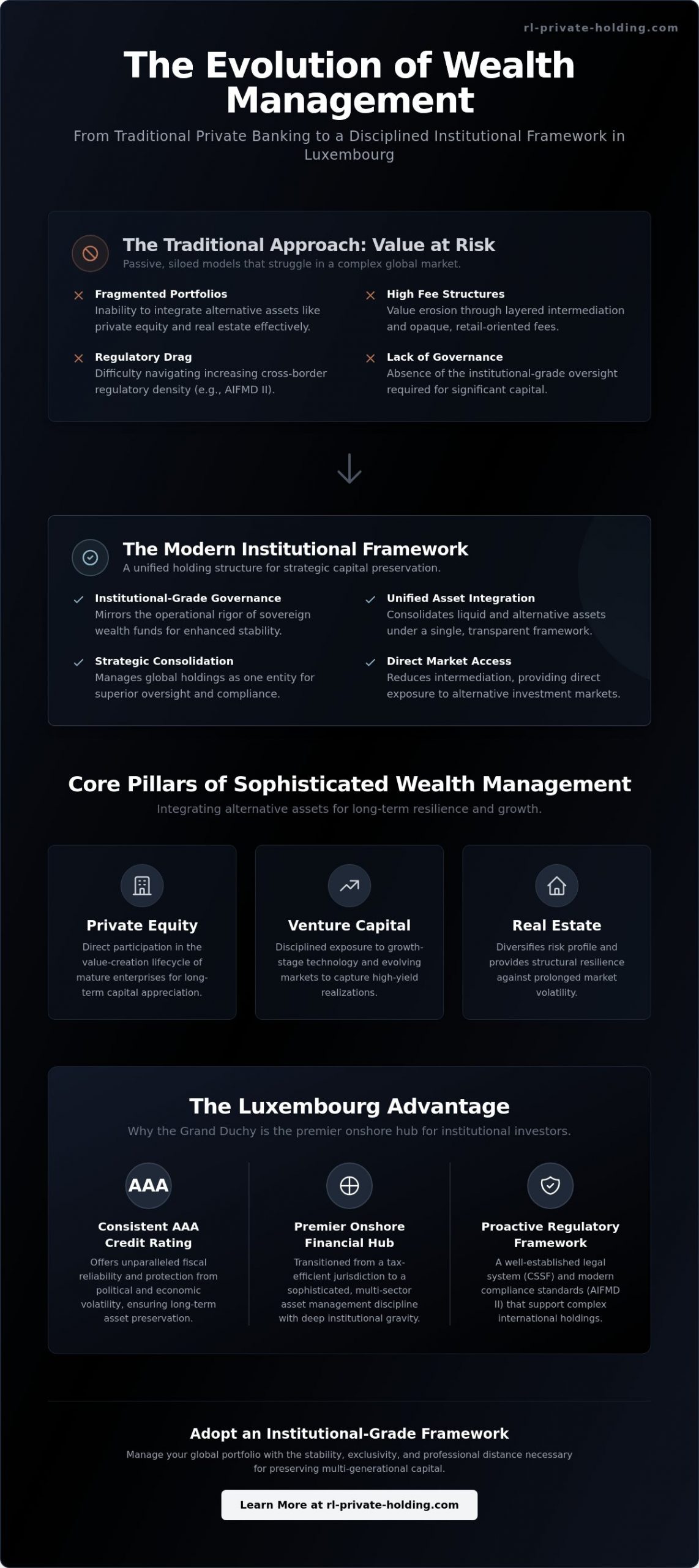
Luxembourg’s role in the global financial system has transitioned from its historical perception as a tax-efficient jurisdiction to its current reality as a premier onshore investment hub. This shift has redefined wealth management Luxembourg as a sophisticated, multi-sector asset management discipline. It’s no longer sufficient to view wealth through the narrow lens of liquid securities. Instead, the Grand Duchy facilitates a broader integration of private equity, real estate, and venture capital within a single, cohesive framework. This institutional gravity provides a necessary alternative to traditional private banking models, which often lack the structural depth required for complex, global portfolios.
Luxembourg as a Global Financial Pillar
The structural advantages of the Luxembourg financial center are deeply integrated with the broader Economy of Luxembourg. As one of the few jurisdictions to consistently maintain a AAA credit rating, the country offers a level of fiscal reliability that is rare in the current global climate. This stability is the cornerstone of long-term asset preservation. Sophisticated investors don’t just look for growth; they prioritize a jurisdiction that protects capital from political and economic volatility. The Luxembourg framework provides this security through a well-established legal system and a proactive regulatory environment that supports international holdings with precision.
The Shift Toward Institutional Asset Management
The market is witnessing a decisive move away from retail-oriented private banking toward bespoke institutional frameworks. Traditional models often suffer from high fee structures and a lack of integration between different asset classes. In contrast, an investment holding company structure provides a more disciplined and transparent approach to wealth. This model allows for:
- Enhanced institutional-grade governance that mirrors the operations of major pension funds or sovereign wealth funds.
- Strategic consolidation of global holdings into a single, manageable entity.
- Increased transparency in reporting, which is essential for meeting modern compliance requirements.
- Direct access to alternative investment markets without the layers of intermediation found in retail banking.
This transition ensures that wealth management is treated with the same rigor and technical precision as institutional asset management. By moving away from fragmented retail services, investors can establish a more permanent and strategic presence in the global market. The result is a governance structure that values stability and professional distance, aligning with the needs of those managing significant, multi-generational capital.
Core Pillars of Sophisticated Wealth Management: Integrating Alternative Assets
The integration of alternative assets is no longer a peripheral strategy but a central requirement for institutional capital preservation. While traditional liquid portfolios provide necessary flexibility, they often lack the structural resilience needed to withstand prolonged market volatility. Sophisticated wealth management Luxembourg strategies prioritize the inclusion of private equity, venture capital, and real estate to drive alpha and ensure a diversified risk profile. By consolidating these disparate sectors under a single holding entity, investors achieve a level of governance and oversight that fragmented retail models cannot replicate.
Private Equity and Venture Capital Integration
Growth-stage technology portfolios require a disciplined approach to Venture Capital Funding to capture value in rapidly evolving markets. Private Equity Investment Management serves as a critical tool for long-term capital appreciation, allowing for direct participation in the value-creation lifecycle of mature enterprises. Managing these assets requires a technical understanding of the J-curve, where initial capital outlays and management fees precede the realization of significant returns. A well-structured holding company facilitates the necessary liquidity planning to bridge these periods, ensuring that the broader portfolio remains stable while waiting for high-yield realizations. This methodical approach to alternative asset classes allows for strategic exposure without compromising the entity’s overall financial integrity. Investors seeking to deepen their understanding of how non-correlated assets protect capital during volatile cycles should examine the principles of private equity wealth preservation as a foundational component of institutional strategy.
Real Estate Asset Management as a Portfolio Foundation
Real estate remains a foundational hedge against inflationary pressures and market instability. Within a Luxembourg framework, investors can choose between direct ownership of high-value assets or indirect participation through specialized fund structures. The synergy between private equity and Real Estate Asset Management is particularly evident when physical assets are managed with the same operational rigor as corporate investments. Luxembourg’s financial regulatory authority provides the oversight necessary to ensure these structures remain compliant with evolving cross-border standards. Risk mitigation is achieved through deliberate geographical and sector diversification, moving beyond local markets to secure institutional-grade properties in global hubs. Those seeking to refine their approach to these complex asset classes often benefit from the Wealth Management Services provided by established institutional partners.
The ultimate efficacy of a diversified portfolio depends on the balance between immediate liquidity and long-term, illiquid holdings. Tactical asset allocation ensures that the capital remains productive throughout various market cycles. By maintaining a clear distinction between core preservation assets and high-growth alternative investments, an organization can achieve steady growth while protecting its principal. This disciplined focus on structural integrity and sector diversity defines the modern institutional approach to managing significant global wealth.
Navigating Regulatory Frameworks and Fee Structures in Luxembourg
The regulatory environment managed by the Commission de Surveillance du Secteur Financier (CSSF) is often perceived as a barrier to entry due to its perceived complexity. However, for institutional-grade wealth management Luxembourg, this framework actually provides the necessary legal certainty required for cross-border operations. The implementation of the Digital Operational Resilience Act (DORA) in January 2025 and the operational launch of the Anti-Money Laundering Authority (AMLA) in July 2025 have further harmonized the standards for financial entities. These regulations ensure that risk management and due diligence are not merely administrative tasks but core components of fund governance. A well-ordered organization views these requirements as a blueprint for stability rather than a burden.
Luxembourg Investment Structures: SOPARFI and Beyond
The SOPARFI (Société de Participations Financières) remains a preferred vehicle for establishing a stable holding structure for international investments. Unlike regulated fund vehicles, the SOPARFI offers flexibility for commercial and financial activities while maintaining a high standard of corporate governance. For investors requiring more specialized frameworks, the Reserved Alternative Investment Fund (RAIF) and the Specialized Investment Fund (SIF) provide alternative paths. The RAIF has gained significant traction because it does not require direct CSSF authorization at the fund level, provided it’s managed by an authorized Alternative Investment Fund Manager. This efficiency is critical when managing the diverse sectors of private equity in Luxembourg. Maintaining institutional-grade compliance within these structures requires a disciplined approach to internal reporting and board-level oversight.
Transparency in Investment Management Fees
Management fees are typically calculated as a percentage of total assets under management (AUM), providing a predictable cost structure for the holding entity. In the context of alternative assets, performance-based incentives play a vital role in aligning the interests of the manager with those of the investor. As of January 1, 2026, Luxembourg’s new carried interest tax regime has introduced a clear distinction between contractual carried interest, taxed at a maximum of 11.45%, and participation-linked carried interest. This reform provides a transparent framework for motivating successful investment exits and long-term value creation. While fee structures vary based on the complexity of the mandate, the focus remains on ensuring that costs are proportional to the governance and expertise provided. Fee transparency serves as the foundational element that transforms a service provider relationship into a long-term institutional partnership based on mutual trust.
The misconception that these structures are prohibitively complex often stems from a lack of experience with the Luxembourgish legal system. In reality, the jurisdiction’s proactive approach to transposing EU directives, such as the AIFMD II amendments adopted in February 2026, creates a predictable environment for global capital. By choosing a structure that aligns with their specific risk appetite and investment horizon, institutional investors can achieve a level of operational discipline that is difficult to replicate in less regulated markets. This methodical focus on regulatory alignment is what secures Luxembourg’s position as a steady hand in the global financial landscape.
Strategic Portfolio Construction for Long-Term Capital Preservation
Establishing a disciplined investment policy statement (IPS) is the foundational step for any institutional-grade portfolio. This document moves beyond asset selection to define the specific parameters of risk, liquidity, and return expectations that govern the entire holding structure. In the context of wealth management Luxembourg, a well-defined IPS ensures that tactical decisions remain aligned with the overarching goal of capital preservation. This methodical approach prevents emotional reactions to market volatility and provides a clear framework for evaluating new opportunities in technology, real estate, and private equity.
Tactical asset allocation requires a global perspective that transcends local market trends. Identifying high-potential venture capital opportunities, for instance, often involves looking toward emerging tech hubs while utilizing Luxembourg’s robust legal framework for deal execution. The Luxembourg law of December 19, 2025, introduced a 20% income tax credit for private investment in young, innovative start-ups. This specific regulatory incentive demonstrates how the jurisdiction actively supports strategic exposure to growth-stage companies within a disciplined investment strategy.
Diversification Beyond Public Markets
Institutional portfolios increasingly rely on alternative assets to reduce correlation with public equity markets. While liquid securities provide necessary cash flow, they’re often subject to systemic shocks that alternative investments can mitigate. Managing this diversification requires a technical focus on:
- Technology Venture Capital: Capturing growth trajectories in sectors like fintech and AI through direct participation or specialized funds.
- Currency and Geographic Risk: Utilizing the multi-currency capabilities of Luxembourg structures to hedge against regional economic shifts.
- Private Equity Investment Management: Utilizing long-term lock-up periods to capture the illiquidity premium and drive alpha, a strategy closely aligned with disciplined private equity wealth preservation frameworks designed for volatile economic cycles.
Governance and Succession in Wealth Management
The transition from individual wealth to institutionalized management often occurs through the establishment of a family office or a dedicated holding company. This shift ensures that the organizational framework remains stable across generations. Continuity is not just about asset transfer; it’s about maintaining the same level of professional governance and strategic focus over decades. Integrating legacy planning into the investment holding structure allows for a seamless transition of control while protecting the core mission of the entity. For those requiring a partner to oversee these complex structures, we invite you to explore our Private Equity Investment Management services, which prioritize long-term stability and discreet expertise.
Risk management protocols must be as sophisticated as the investments they protect. This involves regular stress testing of the portfolio and a clear understanding of the ICT risk management requirements mandated by the Digital Operational Resilience Act (DORA). By treating wealth management as a disciplined corporate function, investors can achieve a level of permanence that traditional private banking models rarely offer. This institutional gravity is what defines a truly resilient global portfolio.
RL Private Holding: An Institutional Approach to Global Wealth Management
RL Private Holding operates as a discreet partner for those requiring institutional-grade management of complex global portfolios. While many retail-focused entities prioritize volume and visibility, our firm emphasizes professional distance and a sober, factual approach to asset management. Headquartered in Luxembourg, we utilize the jurisdiction’s robust financial infrastructure to maintain a global operational scale. This commitment to professional discipline ensures that every investment decision is rooted in the principles of capital preservation and long-term stability. It’s this quiet authority that allows us to act as a steady hand in the background of significant international investments.
A Diversified Global Portfolio
The firm manages a wide-ranging spectrum of business interests across multiple continents, ensuring that wealth management Luxembourg remains a truly global endeavor. Our methodology for identifying high-potential real estate assets focuses on structural value and long-term yield rather than speculative trends. There’s a deliberate synergy between our venture capital and private equity divisions. This integration allows us to support a company’s lifecycle from its initial growth stages through to institutional maturity. By maintaining a presence in diverse sectors like technology and real estate, we ensure the portfolio remains resilient against sector-specific downturns and regional economic shifts. This diversified approach is managed through a methodical and hierarchical organizational structure.
Partnering for Long-Term Growth
A core component of our strategy involves providing Venture Capital Funding to growth-stage firms that demonstrate significant innovative potential. This support goes beyond capital; it’s about providing a stable, institutional framework that allows these companies to scale effectively. Our Private Equity Investment Management approach is characterized by a high degree of alignment between the manager and the investor. We utilize a performance-based carried interest model that reflects the 2026 regulatory reforms, ensuring that incentives are directly linked to successful investment exits and sustained value creation. This disciplined focus on results ensures that the interests of all stakeholders are protected within a transparent and well-ordered environment.
For entities seeking a partner that values transparency and organizational hierarchy, the choice of a Luxembourg-based holding structure is a strategic one. The firm’s focus on Wealth Management Services is designed for those who prioritize a steady hand and a clear plan over disruptive innovation. We operate with a sense of institutional permanence, appearing more as a disciplined global partner than a bold innovator. We invite you to explore the strategic investment framework of RL Private Holding to understand how our disciplined approach can support your long-term financial objectives. Every aspect of our operation is designed to provide the stability and exclusivity required for high-stakes asset management.
Securing the Future of Institutional Capital
The transition toward institutional-grade holding structures represents a fundamental evolution in how capital is preserved across generations. By integrating alternative assets such as private equity and real estate within a transparent regulatory framework, investors achieve a level of structural resilience that traditional banking models often don’t provide. Modern wealth management Luxembourg relies on this disciplined, multi-sector approach to navigate increasing regulatory density while maintaining strategic exposure to high-growth opportunities. It’s this focus on structural integrity that ensures a portfolio can withstand systemic shifts.
RL Private Holding operates as a Luxembourg-headquartered global investment holding with a diversified portfolio spanning technology, real estate, and private equity. Our methodology prioritizes institutional-grade capital preservation and professional discipline above all else. We invite you to discover the institutional asset management approach of RL Private Holding and explore how a structured framework provides the stability your global portfolio requires. Establishing a permanent and well-ordered entity remains the most effective way to ensure long-term security in an increasingly complex financial landscape.
Frequently Asked Questions
Why is Luxembourg considered a leading center for wealth management?
Luxembourg’s AAA credit rating and political stability provide a foundational security for global capital. The jurisdiction offers a sophisticated legal framework and a proactive regulatory environment that facilitates cross-border investment structures. This combination of fiscal reliability and technical expertise makes it the primary hub for institutional investors seeking to consolidate diverse global holdings under a single, well-ordered jurisdiction.
What are the main benefits of a Luxembourg SOPARFI for wealth preservation?
The SOPARFI structure provides a flexible and stable vehicle for holding and financing international participations. It offers significant advantages for capital preservation by allowing for the strategic consolidation of various asset classes within a single corporate entity. This structure ensures institutional-grade governance and provides a clear framework for managing global assets while maintaining a high standard of transparency and compliance with international standards.
How does private equity integration improve a wealth management portfolio?
Integrating private equity allows for direct participation in value creation and offers a higher potential for alpha compared to traditional liquid markets. This asset class serves as a critical driver for long-term growth and portfolio resilience. By including Private Equity Investment Management within a wealth management Luxembourg strategy, investors can capture illiquidity premiums and reduce the overall correlation of their holdings to volatile public equity markets.
What is the typical management fee structure for Luxembourg investment holdings?
Management fees are generally structured as a percentage of assets under management (AUM) to ensure cost predictability for the holding entity. These recurring fees cover the governance, reporting, and technical oversight required for institutional-grade portfolios. Performance-based incentives, such as carried interest, are often utilized to align the interests of the manager with the investor’s long-term objectives. This ensures that the cost of management remains proportional to the expertise provided.
Can institutional investors access venture capital funding through Luxembourg structures?
Institutional investors can effectively utilize Luxembourg structures to facilitate Venture Capital Funding for growth-stage technology firms. The jurisdiction provides specialized fund vehicles and corporate structures that are designed to manage the specific risks and liquidity profiles associated with venture investments. These frameworks allow for strategic exposure to innovative sectors while maintaining the rigorous governance standards expected by institutional-grade partners and family offices.
How does RL Private Holding manage risk across its diversified portfolio?
RL Private Holding employs a methodical risk management framework that prioritizes capital preservation and structural integrity. Risk is mitigated through deliberate sector diversification across technology, real estate, and private equity, as well as geographical spread. The firm adheres to strict ICT risk management protocols under the Digital Operational Resilience Act (DORA) and maintains a disciplined investment policy statement that governs all tactical asset allocation decisions across the global portfolio.
Is the Luxembourg regulatory environment (CSSF) suitable for global asset management?
The CSSF regulatory environment is designed to provide the legal certainty and transparency required for complex global operations. While the framework is robust, it offers the necessary protection for institutional investors and ensures that all entities operate within a harmonized EU standard. This proactive regulatory stance, including the early adoption of directives like AIFMD II, confirms that wealth management Luxembourg remains at the forefront of international compliance and fund governance.
What role does real estate play in a sophisticated Luxembourg wealth strategy?
Real estate serves as a foundational hedge against inflationary pressures and provides a steady yield within a diversified portfolio. Sophisticated strategies utilize Real Estate Asset Management to balance the higher volatility of growth-oriented investments like venture capital. By incorporating physical assets or specialized real estate funds, investors can achieve a more resilient risk-return profile. This sector remains a cornerstone of institutional-grade asset preservation due to its tangible value and long-term stability.