

The conventional classification of property as a secondary, passive asset class isn’t sustainable within a sophisticated financial ecosystem. Effective real estate asset management Luxembourg strategies now demand the same level of institutional discipline and structural precision typically reserved for private equity. Many market participants find that the increasing complexity of AIFMD II and UCITS VI frameworks, alongside new ESG compliance requirements, necessitates a more integrated management approach.
This analysis provides a thorough examination of institutional real estate strategies designed to deliver stable, long-term returns. We detail the technical nuances of tax-efficient holding structures and the professional risk mitigation protocols required to navigate the current regulatory environment. The following sections outline how a disciplined, PE-style framework can optimize portfolio performance while ensuring full alignment with the latest CSSF directives.
Key Takeaways
- Analyze the current macroeconomic landscape of the 2026 Luxembourg market, focusing on interest rate stabilization and evolving liquidity trends.
- Evaluate the strategic utility of the SOPARFI and other institutional vehicles within the Luxembourg toolbox for efficient asset holding.
- Implement private equity methodologies, including rigorous due diligence and structured exit strategies, to enhance real estate asset management Luxembourg performance.
- Apply a five-step framework for value creation that leverages ESG compliance to secure favorable financing and increase long-term asset valuation.
- Understand the role of real estate as a disciplined asset class within a broader global portfolio encompassing private equity and technology sectors.
Navigating the Luxembourg Real Estate Investment Environment in 2026
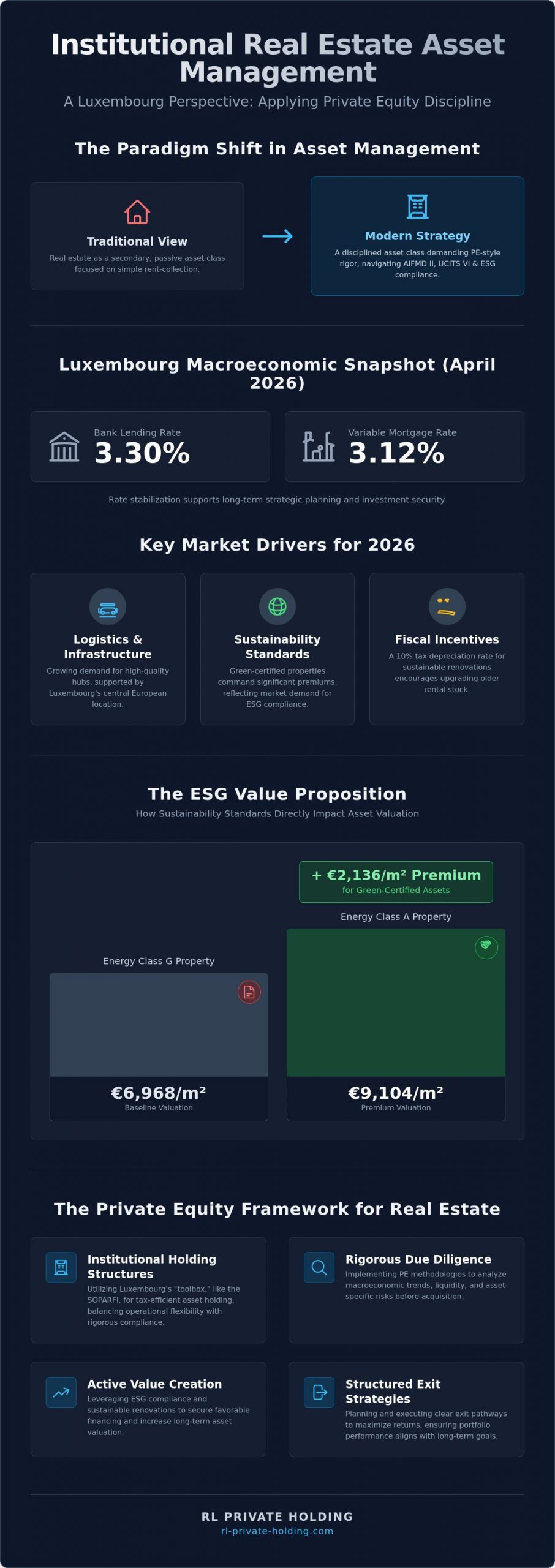
Luxembourg’s position as a global financial hub provides a unique foundation for institutional real estate asset management Luxembourg. This discipline involves the strategic oversight of property portfolios to maximize value and mitigate risk through structured financial vehicles. The broader Economy of Luxembourg remains a primary driver for this activity, offering a stable environment where capital preservation is prioritized alongside growth. In 2026, the market has moved beyond the volatility seen in previous years. Data from April 2026 shows a bank lending rate of 3.30% and a variable mortgage rate of 3.12%, indicating a stabilization that supports long-term planning.
The current environment marks a distinct shift from passive ownership toward active, strategic management. Institutional investors no longer view real estate as a simple rent-collection exercise. It’s treated as a complex asset class requiring rigorous financial engineering and operational oversight. This transition is essential for navigating the structural housing shortage and the specific demands of international talent residing in the Grand Duchy. Investors are increasingly seeking integrated solutions that combine local market knowledge with global institutional standards.
The Evolution of Asset Management in Luxembourg
The sector has evolved from basic property management into a sophisticated field of financial expertise. The implementation of AIFMD II and UCITS VI in 2026 has reshaped how funds are governed, placing a greater emphasis on liquidity management and risk transparency. This regulatory rigor ensures that Luxembourg remains the preferred jurisdiction for cross-border real estate holdings. It provides a standardized framework that global investors trust, facilitating the movement of capital across European borders with high levels of structural integrity.
Key Market Drivers for 2026
Several factors influence the performance of real estate as an inflation hedge in the current year. Institutional demand remains high for assets that demonstrate resilient cash flows and clear value-creation potential. The market is increasingly segmented by performance metrics and sustainability credentials.
- Logistics and Infrastructure: The demand for high-quality logistics hubs continues to grow, supported by Luxembourg’s central European location and its role in global supply chains.
- Sustainability Standards: Green-certified office spaces now command a significant premium. For instance, energy class A properties average €9,104/m², which is approximately €2,136/m² higher than class G properties.
- Fiscal Incentives: The increased tax depreciation rate for sustainable renovations, now at 10% as of January 2026, encourages the upgrading of older rental stock to meet modern efficiency requirements.
These drivers reflect a market that values quality and regulatory compliance over speculative gains. Investors who adopt a disciplined approach to real estate asset management Luxembourg are well-positioned to achieve stable returns while navigating the complexities of a modernizing financial ecosystem.
Institutional Structures for Real Estate Asset Management in Luxembourg
The selection of an appropriate investment vehicle is a critical component of institutional real estate asset management Luxembourg. The Grand Duchy provides a versatile “toolbox” of structures designed to accommodate the specific requirements of global investors. These vehicles are characterized by their adaptability to various asset types and their alignment with international tax and regulatory standards. Effective management begins with choosing a structure that balances operational flexibility with rigorous compliance.
One of the most utilized structures within this ecosystem is the SOPARFI. While it’s a fully taxable commercial company, it benefits from the participation exemption regime, which can provide significant tax efficiencies for real estate income and capital gains under specific conditions. This vehicle is particularly effective for large-scale acquisitions that require complex financing arrangements. The IMF Country Report on Luxembourg’s Housing Market highlights the structural challenges of the local market, making the choice of a robust holding vehicle like the SOPARFI even more essential for mitigating risk.
The SOPARFI as a Real Estate Holding Vehicle
The SOPARFI offers institutional investors a high degree of flexibility in financing and capital structuring. It allows for the integration of debt and equity instruments that can be tailored to the specific cash flow profiles of the underlying properties. Governance requirements for these vehicles have become more stringent, necessitating a clear demonstration of substance in Luxembourg. This involves maintaining a qualified local board and ensuring that key strategic decisions are documented within the jurisdiction.
Alternative Investment Fund (AIF) Frameworks
For funds targeting a broader institutional investor base, the Alternative Investment Fund (AIF) frameworks offer more specialized oversight. The Reserved Alternative Investment Fund (RAIF) has become a preferred choice due to its speed-to-market advantages. Unlike the Specialized Investment Fund (SIF), the RAIF doesn’t require direct authorization from the CSSF at the product level, provided it’s managed by an authorized AIFM. This structure allows institutional partners to deploy capital more efficiently while maintaining high standards of corporate governance.
Maintaining institutional-grade substance is no longer optional in the 2026 regulatory landscape. The CSSF requires clear evidence of local decision-making and operational presence. Organizations that prioritize these governance standards find they’re better positioned to navigate the complexities of global investment. For those seeking a partner with a disciplined approach to these structures, RL Private Holding maintains a focused expertise in managing diversified real estate assets within these institutional frameworks.
The interaction between the AIFM and the underlying real estate assets is governed by strict reporting requirements. Under the latest CSSF guidelines, managers must provide detailed data on liquidity, leverage, and valuation methodologies to ensure effective real estate asset management Luxembourg. This level of transparency reinforces Luxembourg’s status as a secure jurisdiction for institutional capital. By integrating these structures into a broader strategic plan, investors can ensure their portfolios are both resilient and compliant with evolving EU-wide directives.
Strategic Integration of Private Equity and Real Estate Portfolios
The convergence of private equity and real estate is a defining trend within the Luxembourg asset management sector. Institutional investors are increasingly applying the same rigorous methodologies to property portfolios that they traditionally reserved for corporate acquisitions. This shift facilitates a more disciplined approach to real estate asset management Luxembourg, where assets are evaluated based on their potential for operational improvement rather than just capital appreciation. It’s no longer sufficient to rely on passive market growth; instead, managers utilize private equity-style due diligence to identify structural opportunities early in the investment cycle.
Portfolio diversification is often achieved through mixed-asset holding companies that combine real estate with other alternative asset classes. This integration allows for a more holistic view of risk and return. Performance benchmarking has also evolved. Managers now frequently apply internal rate of return (IRR) targets that mirror those found in private equity. These targets are supported by exit strategies that are planned with the same precision as a corporate divestment, ensuring that liquidity events are timed to maximize institutional value. Investors seeking to deepen their understanding of these methodologies can explore advanced real estate portfolio management techniques in Luxembourg that outline the institutional frameworks required to integrate property into a broader wealth strategy.
Value-Add and Opportunistic Real Estate Strategies
Active management is the primary driver of alpha in the 2026 market. Value-add strategies focus on underperforming assets where operational changes can lead to significant valuation increases. In Q1 2026, the rental market saw an average increase of 6.4% year-on-year, reaching €31.6/m². Managers who can optimize occupancy and lease terms in this environment can achieve superior returns. There’s also a growing synergy between technology venture capital and real estate. PropTech solutions are being integrated into asset management frameworks to improve data analysis and predict market performance. This is essential for managing older apartments that currently average €7,908/m², where modernizing facilities can bridge the gap toward the €9,540/m² seen in new builds.
Carried Interest and Performance Fee Structures
Alignment between asset managers and institutional investors is maintained through structured performance incentives. These typically involve hurdle rates and waterfalls that ensure investors receive a preferred return before the manager participates in the upside. This carried interest model encourages a long-term perspective and disciplined risk management. Transparency in these fee disclosures is a fundamental requirement in 2026. It builds the necessary trust for institutional partners who are allocating capital to complex holdings. Clear reporting on how performance fees are calculated is essential for effective real estate asset management Luxembourg, providing a foundation for stable, professional partnerships.
Advanced Value Creation and Risk Mitigation in Asset Management
Effective real estate asset management Luxembourg requires a transition from defensive posturing to proactive value creation. In the 2026 market, achieving alpha depends on a structured approach that integrates operational excellence with regulatory foresight. We utilize a five-step framework to ensure that institutional portfolios remain resilient and competitive. This methodical process begins with structural alignment, ensuring the holding vehicle is optimized for the specific asset class. It moves into data integration, where AI is deployed to enhance predictive modeling for portfolio performance. The subsequent steps include asset enhancement through sustainability retrofits, revenue optimization via active lease management, and disciplined liquidity planning to meet internal rate of return benchmarks.
Digital transformation has become a prerequisite for sophisticated oversight. Artificial intelligence is no longer a conceptual tool; it’s actively used to analyze market trends and predict tenant behavior with high precision. This technology allows managers to identify potential risks in cross-border portfolios before they impact valuations. By leveraging these data-driven insights, institutional partners can make informed decisions regarding capital allocation and divestment timing, ensuring that every asset within the portfolio serves a specific strategic purpose.
ESG Integration as a Value Driver
ESG compliance isn’t merely a regulatory hurdle. It’s a fundamental driver of asset liquidity and financing eligibility. The EU Taxonomy and SFDR have created a permanent distinction between “green” and “brown” assets. Portfolios that fail to address energy efficiency face significant “brown discounts” during valuation. Managers can mitigate this risk by utilizing the 10% tax depreciation rate for sustainable renovations that came into effect in January 2026. This incentive allows for the retrofitting of older stock, such as class G properties, to meet the high energy standards now demanded by institutional tenants. Measuring the ROI of these initiatives is essential for maintaining transparent reporting to stakeholders.
Risk Management and Regulatory Compliance
Navigating the complex AML/CFT landscape is critical for maintaining the integrity of Luxembourg-based structures. Sophisticated risk management protocols must include regular independent valuations and comprehensive audits to ensure compliance with the latest CSSF circulars. Hedging strategies for interest rate and currency risk are also vital for global portfolios, especially as market dynamics stabilize following the corrections of previous years. For institutional partners seeking to implement these rigorous standards, RL Private Holding provides the disciplined expertise required for high-stakes asset oversight.
Maintaining institutional integrity requires a steady hand and a commitment to transparency. The role of independent valuation is particularly important in a market where energy class A properties command a premium of over €2,000 per square meter compared to lower-rated assets. By ensuring that risk mitigation is woven into the fabric of the management strategy, investors can protect their capital while positioning themselves for stable, long-term growth within the Grand Duchy’s financial ecosystem.
RL Private Holding: Disciplined Management of Global Real Estate Assets
RL Private Holding approaches real estate asset management Luxembourg through a lens of institutional gravity and long-term strategic focus. We view real property not as a standalone investment but as a critical component of a diversified global portfolio. This perspective allows for the application of rigorous private equity methodologies to physical assets; it ensures every acquisition aligns with broader wealth preservation objectives. By utilizing Luxembourg’s sophisticated financial infrastructure, the firm manages complex holdings with a level of precision that meets the highest international standards.
A Disciplined Investment Philosophy
Our philosophy is rooted in the principle of stability. As a privately held entity, RL Private Holding possesses the structural advantage of operating without the pressure of short-term market fluctuations. This allows for the execution of multi-year value-creation plans that prioritize sustainable growth over speculative gains. We integrate real estate holdings into a wider multi-sector strategy that encompasses private equity and technology ventures. This cross-sector expertise provides a comprehensive understanding of market cycles. It allows for more effective risk mitigation across the entire organizational framework.
The firm’s presence in Luxembourg facilitates access to a world-class regulatory and legal environment. We leverage these local advantages to provide oversight for assets situated in major global markets. This centralized management model ensures that governance standards remain consistent, regardless of the geographic location of the underlying property. Our commitment to professional distance and objective analysis ensures that every decision is based on factual performance data and structural integrity. It’s this focus that maintains the firm’s position as a steady hand in the background of major investments.
Engagement and Next Steps
Professionalism and discretion are the hallmarks of our engagement model. We provide institutional-grade oversight for complex portfolios that require a steady hand and a long-term vision. Our approach to real estate asset management Luxembourg is designed for partners who value transparency, discipline, and a methodical path to value creation. We focus on maintaining the “quiet authority” that comes from an established global presence and a proven track record in alternative asset classes.
Strategic partnership and capital allocation opportunities are evaluated with the same level of due diligence applied to our internal investments. We invite inquiries from institutional entities and sophisticated partners who seek a disciplined approach to global asset management. By maintaining a clear focus on structural excellence and professional risk mitigation, RL Private Holding continues to act as a reliable partner in the background of major global investments.
Advancing Institutional Real Estate Strategies in a Global Context
The transition toward more sophisticated management frameworks is essential for maintaining portfolio resilience in the 2026 market. Successful real estate asset management Luxembourg now depends on the seamless integration of private equity methodologies and rigorous ESG compliance. By utilizing established institutional structures like the SOPARFI and RAIF, investors can achieve the transparency and tax efficiency required for long-term wealth preservation. These strategies ensure that property assets are treated with the same analytical precision as corporate equity; this allows for professional risk mitigation across diverse jurisdictions.
RL Private Holding operates as a global scale holding company with deep expertise across private equity, venture capital, and real estate. Headquartered within the Luxembourg financial center, the firm provides a steady hand for partners seeking disciplined oversight and strategic growth. Organizations that prioritize structural integrity and operational excellence are well-positioned to navigate the evolving complexities of the global investment landscape. We remain committed to providing the institutional gravity required for high-stakes asset oversight.
Explore Strategic Real Estate Asset Management with RL Private Holding
Frequently Asked Questions
What are the primary benefits of managing real estate assets through a Luxembourg SOPARFI?
A Luxembourg SOPARFI offers institutional investors high levels of operational flexibility and access to a robust participation exemption regime for real estate income. This structure is particularly effective for managing large-scale, cross-border acquisitions where complex financing and capital structures are required. It allows for the efficient integration of debt and equity instruments while maintaining a fully taxable commercial status that aligns with international tax standards and extensive double tax treaty networks.
How has the RAIF structure changed real estate asset management in Luxembourg?
The Reserved Alternative Investment Fund (RAIF) has significantly accelerated the speed-to-market for institutional real estate asset management Luxembourg initiatives. By removing the requirement for direct CSSF authorization at the product level, it allows managers to deploy capital more efficiently. This structure maintains high governance standards by requiring an authorized external Alternative Investment Fund Manager (AIFM), providing a balanced framework that combines regulatory rigor with necessary institutional agility for global investors.
What role does the AIFM play in real estate portfolio oversight?
The Alternative Investment Fund Manager (AIFM) provides essential regulatory oversight and risk management for the property portfolio. This includes ensuring compliance with AIFMD II guidelines regarding liquidity management, leverage limits, and valuation methodologies. The AIFM acts as a central governing body that monitors the performance of the underlying assets. It ensures that the fund’s operational activities remain strictly aligned with its stated investment strategy and the expectations of its institutional partners.
How will ESG regulations affect Luxembourg real estate valuations in 2026?
ESG regulations will create a clear valuation divide between energy-efficient assets and those requiring significant retrofitting. As of 2026, energy class A properties already command a significant price premium, averaging over €2,000 per square meter more than class G properties. Assets that fail to meet EU Taxonomy or SFDR standards face “brown discounts,” as institutional investors increasingly prioritize sustainability to secure favorable financing and ensure long-term liquidity in the European market.
What is the difference between direct and indirect real estate asset management in Luxembourg?
Direct asset management involves the operational oversight of physical property titles held by a Luxembourg entity. In contrast, indirect management focuses on holding interests in underlying property companies or specialized real estate funds. Indirect structures are often preferred by institutional investors for their ability to pool capital and access diverse portfolios through a single holding vehicle, such as a SOPARFI, while benefiting from the Grand Duchy’s strategic position as a global financial hub.
How do private equity performance fees work in a real estate context?
Performance fees in real estate private equity are structured to align the interests of the manager with those of the institutional partners. These typically utilize a “waterfall” mechanism where investors receive a preferred return, often referred to as a hurdle rate, before the manager participates in the upside through carried interest. This model encourages disciplined risk management and a focus on long-term value creation, ensuring that performance incentives are only triggered upon achieving specific, documented return benchmarks.
What are the substance requirements for a Luxembourg real estate holding company?
Substance requirements necessitate that a holding company demonstrates a genuine economic presence and local decision-making authority within the Grand Duchy. This includes maintaining a qualified local board of directors and ensuring that key strategic meetings are physically held in Luxembourg. Accurate documentation of these activities is essential for complying with international anti-tax avoidance directives. It ensures the structure’s integrity during rigorous audits by the CSSF or relevant tax authorities.
Why is Luxembourg considered a leading hub for real estate fund structuring?
Luxembourg is the leading hub for real estate fund structuring due to its stable political environment and its comprehensive toolbox of investment vehicles. The jurisdiction provides a sophisticated ecosystem of legal, tax, and administrative experts who understand the nuances of global asset classes. Its status as a premier financial center ensures that institutional investors have access to the regulatory frameworks and structural flexibility required to manage complex, multi-jurisdictional portfolios with a high degree of precision.