

The traditional model of passive property ownership is no longer sufficient to preserve capital in an increasingly complex fiscal environment. To maintain the integrity of a high-value collection, investors must adopt a private-equity-style discipline that prioritizes structural transparency and strategic alignment. Effective real estate portfolio management Luxembourg now requires a sophisticated understanding of the evolving regulatory landscape, including the 2026 updates to AIFMD and the nuances of the 17.12% corporate income tax rate for non-resident companies.
You likely recognize that fragmented reporting and opaque performance tracking often lead to missed opportunities and unnecessary risk. By implementing institutional-grade governance and active management techniques, you can transform these holdings into a diversified and resilient asset class. This article outlines the frameworks required to integrate real estate into a broader wealth strategy, ensuring long-term value preservation through rigorous oversight. We’ll review the essential structures, from RAIFs to specialized holding companies, that define the modern standard for professional asset management.
Key Takeaways
- Understand the transition from passive yield models to active asset management strategies required for portfolio resilience in the current market.
- Establish institutional-grade valuation and risk management protocols to achieve superior real estate portfolio management Luxembourg standards.
- Learn to view real estate through a private equity lens to better align property holdings with broader wealth management and capital preservation objectives.
- Evaluate the strategic advantages of SOPARFIs and Reserved Alternative Investment Funds (RAIFs) for rapid capital deployment and structural flexibility.
- Implement disciplined governance and transparent reporting frameworks to ensure real estate assets meet the same performance criteria as other institutional asset classes.
The Shift in Real Estate Portfolio Management in Luxembourg
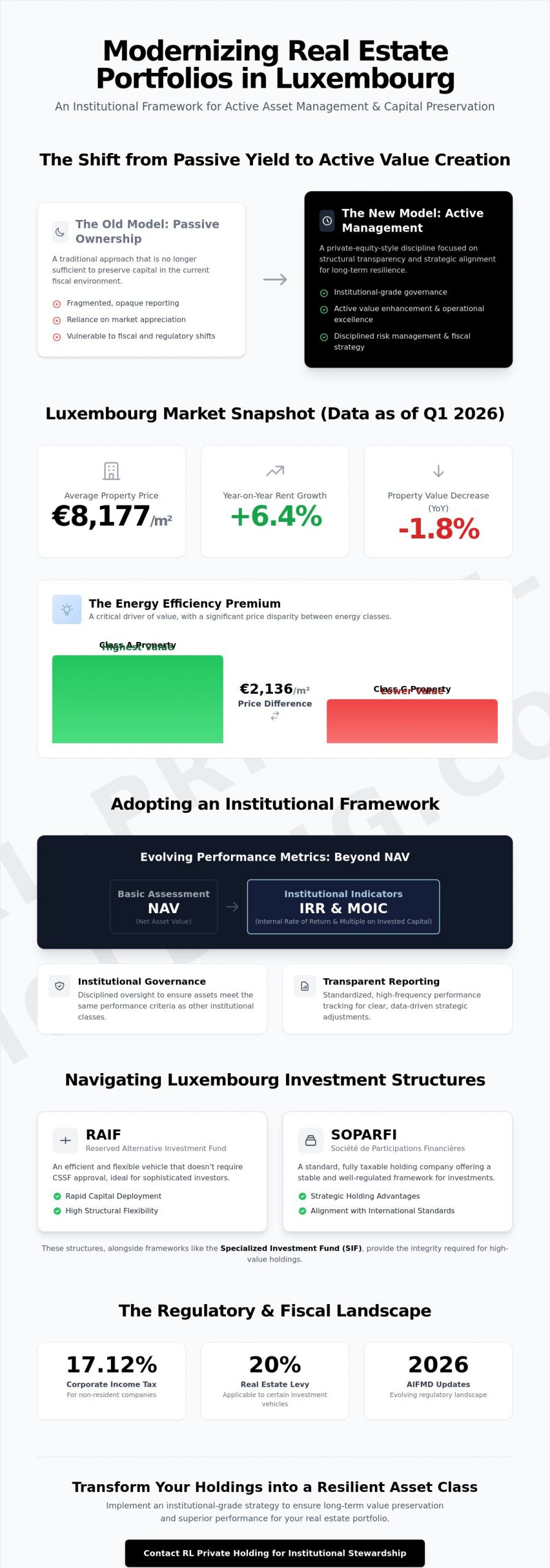
The real estate market in the Grand Duchy has entered a phase of stabilization as of the first quarter of 2026. With average property prices recorded at €8,177 per square meter, the aggressive volatility of previous years has transitioned into a more nuanced investment environment. For institutional actors, this shift marks the end of an era where passive ownership alone could guarantee capital appreciation. Success in the current landscape depends on professional real estate portfolio management Luxembourg that prioritizes active asset optimization and rigorous fiscal discipline. Investors are increasingly viewing their holdings through a private equity lens, focusing on properties that offer clear paths for value enhancement through operational excellence.
The core drivers of long-term value have become more technical and data-dependent. For example, the energy efficiency premium has reached a significant threshold, with a €2,136 per square meter price difference between Class A and Class G properties in early 2026. This disparity highlights the necessity of professional stewardship. Management must now account for rising rents, which grew by 6.4% year-on-year in Q1 2026, while simultaneously navigating the 20% real estate levy applicable to certain investment vehicles. Only through active intervention can a portfolio remain resilient against these shifting economic and regulatory pressures.
From Passive Yield to Active Value Creation
Active management involves the systematic oversight of property performance to maximize net operating income and ensure long-term viability. It’s no longer enough to collect rent; managers must integrate ESG standards and implement sophisticated cost-control measures at the property level. In the 2026 market, active stewardship is defined as the disciplined application of operational and financial strategies to ensure asset resilience against fluctuating interest rates and evolving environmental mandates.
Luxembourg as a Global Hub for Real Estate Expertise
The concentration of specialized, multilingual service providers in the country offers a distinct advantage for cross-border investors. The national regulatory framework, including Luxembourg’s Specialized Investment Fund (SIF) regime, provides the structural integrity required for high-value holdings. This ecosystem ensures that real estate portfolio management Luxembourg aligns with international institutional standards. The synergy between local legal expertise and global asset allocation strategies creates a stable foundation for capital preservation, allowing sophisticated investors to manage complex portfolios with a high degree of transparency and confidence.
Institutional Frameworks for Real Estate Asset Management
The implementation of a rigorous operational framework is the primary differentiator between speculative activity and institutional investment. As the Luxembourg market matures, the necessity for standardized, high-frequency reporting has become paramount. Professional real estate portfolio management Luxembourg requires a transition from basic accounting to sophisticated performance tracking that accounts for the 1.8 percent decrease in property values observed in early 2026. This environment demands a focus on cash flow stability and structural integrity to ensure that high-value assets remain resilient against broader economic shifts.
Valuation and Performance Metrics
Institutional investors are increasingly moving beyond simple Net Asset Value (NAV) assessments. In the current fiscal climate, Internal Rate of Return (IRR) and Multiple of Invested Capital (MOIC) serve as more accurate indicators of long-term success. These metrics allow for a clearer comparison between real estate and other asset classes, such as private equity or venture capital. Benchmarking Luxembourg assets against global indices ensures that the portfolio remains competitive on an international scale. Regular, transparent reporting provides the clarity needed to adjust strategies in response to the 6.4 percent increase in average rents recorded in the first quarter of 2026.
Risk Mitigation and Diversification
Effective risk management involves more than simple geographic spread. It requires a deep analysis of sector-specific trends and debt structuring. With the 20 percent real estate levy impacting certain investment vehicles, managers must optimize the tax efficiency of their holdings. Diversifying across residential and commercial sectors helps mitigate the impact of price corrections in specific sub-markets. Sophisticated investors often seek Real Estate Asset Management partners who provide this level of institutional oversight and disciplined risk assessment. Liquidity buffers serve as a critical defense mechanism against capital calls and operational shortfalls during periods of market correction.
The integration of Environmental, Social, and Governance (ESG) criteria is no longer optional for institutional portfolios. Data from 2026 indicates a price gap of €2,136 per square meter between energy-efficient Class A properties and less efficient Class G buildings. Leveraging data analytics allows managers to predict asset performance and identify necessary capital expenditures before they impact the bottom line. By prioritizing these advanced frameworks, investors can preserve the long-term value of their national holdings while maintaining alignment with global institutional standards.
Integrating Real Estate with Private Equity and Wealth Strategies
Sophisticated investors increasingly treat property as a dynamic component of a broader capital structure rather than a static yield play. A unified investment holding company approach enables the seamless integration of various asset classes, allowing for a more disciplined execution of real estate portfolio management Luxembourg. By viewing real estate through a private equity lens, managers can apply rigorous performance benchmarks and clear exit timelines that align with the overall fund lifecycle. This integration is particularly valuable in the 2026 economic climate, where real estate serves as a tangible stabilizer against the inherent volatility of venture capital and other higher-risk private equity allocations.
The synergy between wealth management and real estate asset allocation provides a robust defense against inflationary pressures. With average rents in the Grand Duchy rising by 6.4 percent in early 2026, high-quality property holdings offer a natural hedge that preserves purchasing power over long horizons. Integrating these assets into a single holding structure simplifies governance and provides a clearer overview of the total risk exposure across the entire investment spectrum.
The Private Equity Approach to Real Estate
Applying ‘Value-Add’ and ‘Opportunistic’ strategies requires a level of operational expertise typically found in the private equity sector. This involves identifying underperforming assets and implementing capital improvement programs to drive net operating income. Exit strategy planning is equally critical; disposals must be timed to coincide with broader fund cycles or market peaks to maximize the Multiple of Invested Capital (MOIC). The 2026 tax regime for carried interest, which offers a reduced rate of 11.45 percent for eligible individuals working with Alternative Investment Funds (AIFs), further incentivizes this disciplined, performance-driven management style.
Wealth Preservation and Long-Term Stability
Real estate remains a cornerstone of the ‘Core’ and ‘Core Plus’ segments of institutional wealth strategies. These assets provide the steady cash flow and capital preservation required for legacy planning and the intergenerational transfer of wealth. Utilizing a Luxembourg holding structure allows for the efficient movement of capital between asset classes while maintaining a stable legal framework for long-term ownership. This methodical approach ensures that real estate doesn’t just exist as a standalone investment but functions as a foundational element of a resilient, diversified financial legacy.
Navigating Luxembourg Investment Structures for Real Estate
The selection of an appropriate legal vehicle is a strategic decision that dictates the long-term efficiency of real estate portfolio management Luxembourg. With the revised AIFMD framework becoming effective in April 2026, institutional investors must ensure their chosen structures meet updated governance and liquidity management requirements. Luxembourg provides a sophisticated toolkit of regulated and unregulated vehicles, each designed to accommodate specific investor profiles, risk appetites, and capital deployment timelines. These structures serve as the foundation for institutional-grade reporting and cross-border tax optimization.
SOPARFI: The Classic Holding Structure
The Société de Participations Financières (SOPARFI) remains the most versatile vehicle for holding high-value real estate assets. It functions as a fully taxable commercial company but benefits from Luxembourg’s extensive double tax treaty network and the participation exemption regime. This regime can effectively eliminate taxes on dividends and capital gains, provided specific holding periods and ownership thresholds are met. Following the legislative updates of December 2025, the flexibility of these corporate structures has been further enhanced. The SOPARFI is particularly suited for private investors and family offices who require a robust corporate framework without the operational complexity of a regulated fund structure. It offers significant flexibility in debt structuring and financing, which is essential for managing the interest rate risks prevalent in 2026.
RAIF and Specialized Vehicles
For professional investors and institutional partners, the Reserved Alternative Investment Fund (RAIF) has emerged as the preferred vehicle for rapid capital deployment. The RAIF’s primary advantage lies in its indirect supervision; it doesn’t require prior authorization from the CSSF, as it’s overseen through its authorized Alternative Investment Fund Manager (AIFM). This structure allows for the creation of multiple compartments, enabling investors to ring-fence different real estate sectors or geographic locations within a single legal entity. While the SIF requires direct regulatory approval for each sub-fund, the RAIF offers comparable tax benefits with a streamlined launch process managed through an authorized AIFM. This speed to market is critical for capturing opportunistic real estate acquisitions in a stabilizing market.
Specialized Investment Funds (SIFs) continue to serve investors who prioritize direct regulatory oversight and the prestige of a CSSF-regulated product. Since the 2023 adjustment to the “knowledgeable investor” threshold, which was lowered to €100,000, access to these specialized vehicles has broadened slightly for sophisticated private clients. Regardless of the chosen vehicle, compliance now requires a disciplined focus on ESG transparency and liquidity risk management. For entities seeking to align their property holdings with institutional standards, partnering with a firm specializing in real estate investment management Luxembourg provides the necessary structural expertise and regulatory foresight to maintain a resilient portfolio.
RL Private Holding: Institutional Stewardship of Real Estate Assets
RL Private Holding operates as a disciplined global partner, applying the same level of analytical rigor to property as it does to its private equity and venture capital interests. This methodology ensures that real estate portfolio management Luxembourg transcends traditional property management to become a strategic exercise in capital optimization. By integrating diverse sectors under a single organizational framework, the firm provides a stable environment for asset growth and value preservation. The focus remains on maintaining institutional gravity while executing complex investment strategies across the European financial landscape. This approach is rooted in a commitment to transparency and a methodical adherence to the high-stakes requirements of modern asset management.
A Diversified Global Perspective
The firm’s expertise across technology, private equity, and growth-stage sectors allows it to identify resilient asset classes that align with contemporary economic trends. As a privately held investment holding company, RL Private Holding prioritizes long-term strategic focus over short-term market sentiment. This structural independence facilitates a methodical approach to asset allocation, ensuring that each property within the portfolio meets stringent performance and governance criteria. The integration of Private Equity Investment Management principles ensures that every real estate asset is managed with a clear focus on operational excellence and structural integrity. This worldly perspective allows the firm to act as a steady hand in the background of major investments, providing the stability required for institutional-grade success.
The Institutional Partner for Sophisticated Investors
The firm provides bespoke Wealth Management Services that recognize the unique requirements of high-value, multi-asset portfolios. This approach ensures that real estate holdings aren’t isolated but are instead integrated into a comprehensive wealth strategy that accounts for global market dynamics. Partners benefit from a commitment to rigorous governance and a disciplined adherence to regulatory compliance, which is essential given the evolving legal environment of 2026. By choosing a partner with a worldly perspective and a steady hand, investors gain access to a framework designed for long-term value creation and capital preservation.
The integration of Venture Capital Funding insights further enhances the firm’s ability to identify emerging opportunities within the real estate sector, particularly those driven by technological advancement and sustainable development. This multifaceted expertise creates a unique synergy that benefits the entire investment lifecycle. Those seeking to optimize their holdings through professional Real Estate Asset Management are invited to contact RL Private Holding to discuss a consultation tailored to their specific strategic objectives and long-term wealth preservation goals.
Securing Institutional Value in an Evolving Market
The transition toward a more disciplined investment landscape necessitates a shift from passive ownership to active, strategic stewardship. Investors who prioritize structural transparency and operational excellence are better positioned to maintain the long-term integrity of their holdings. Effective real estate portfolio management Luxembourg now depends on the precise integration of institutional-grade reporting and the selection of versatile investment vehicles such as the RAIF or SOPARFI. These frameworks provide the necessary resilience to navigate shifting fiscal requirements and market corrections.
RL Private Holding applies a rigorous private-equity-style discipline to the management of diversified global portfolios. Headquartered in the Luxembourg global financial centre, the firm maintains a steady focus across Private Equity, Venture Capital, and Real Estate to preserve capital and ensure strategic alignment. You are invited to Explore Strategic Real Estate Asset Management with RL Private Holding to establish a professional foundation for your property assets. Implementing these sophisticated techniques ensures your portfolio remains a stable and productive component of a broader wealth strategy.
Frequently Asked Questions
What are the primary benefits of managing a real estate portfolio through a Luxembourg holding company?
A Luxembourg holding company provides a robust framework for tax optimization through the participation exemption regime and access to an extensive double tax treaty network. These structures offer legal certainty and operational flexibility for managing cross-border real estate assets. By centralizing holdings in a stable jurisdiction, investors can streamline governance and facilitate the efficient movement of capital between different asset classes while maintaining a high degree of confidentiality and structural integrity.
How does the RAIF structure benefit institutional real estate investors?
The Reserved Alternative Investment Fund (RAIF) provides institutional investors with an accelerated path to capital deployment because it doesn’t require direct authorization from the CSSF. This structure offers significant flexibility through the use of multiple compartments, allowing for the segregation of assets by sector or geography within a single legal entity. It maintains the same tax advantages as regulated funds while reducing administrative lead times, which is essential for executing time-sensitive investment strategies.
Can real estate be integrated into a broader private equity investment strategy?
Real estate can be integrated into a broader private equity strategy to provide a tangible hedge against the volatility of higher-risk sectors like venture capital. Sophisticated real estate portfolio management Luxembourg involves applying private equity disciplines, such as rigorous exit planning and operational value-add strategies, to property assets. This integration allows for a more balanced risk-return profile across the entire investment holding company, ensuring long-term capital preservation and steady cash flow.
What is the role of an investment holding company in real estate asset management?
An investment holding company functions as the central entity for strategic alignment, governance, and capital allocation across various real estate holdings. It provides the necessary infrastructure for consolidated reporting and risk assessment, ensuring that each asset performs in accordance with the firm’s broader investment objectives. This structural approach simplifies the management of complex, multi-asset portfolios and enhances the transparency of the entire investment chain, allowing for more disciplined oversight.
How does RL Private Holding approach risk management in real estate portfolios?
RL Private Holding approaches risk management through a disciplined, data-driven methodology that prioritizes structural integrity and long-term stability. The firm utilizes advanced analytics to monitor asset performance and identify potential vulnerabilities before they impact the bottom line. By integrating ESG criteria and maintaining healthy liquidity buffers, the firm ensures that portfolios remain resilient against market corrections and the evolving regulatory requirements observed in the 2026 financial landscape.
What are the expected reporting standards for institutional real estate management in Luxembourg?
Institutional reporting in Luxembourg is characterized by high frequency and a focus on transparency, utilizing metrics such as Internal Rate of Return (IRR) and Multiple of Invested Capital (MOIC). Managers are expected to provide detailed disclosures regarding valuation methodologies, risk exposure, and ESG compliance. These standards ensure that investors have a clear and accurate overview of portfolio performance, facilitating informed decision-making and maintaining the high-stakes requirements of global asset management.
Is a SOPARFI suitable for individual private real estate investors?
The SOPARFI is highly suitable for individual private investors and family offices who require a professional corporate framework for their real estate holdings. It offers the same tax efficiencies and participation exemptions as institutional structures without the operational complexity of a regulated fund. This vehicle provides a high degree of flexibility in financing and governance, making it an ideal choice for the long-term management and intergenerational transfer of private property collections.
How does active asset management improve the ROI of a real estate portfolio?
Active asset management improves ROI by focusing on operational excellence and the systematic enhancement of property-level performance. This involves implementing cost-control measures, optimizing rental yields, and executing capital improvement programs that drive net operating income. In a market where energy efficiency carries a significant premium, active real estate portfolio management Luxembourg is essential for preserving asset value and achieving superior risk-adjusted returns compared to traditional passive ownership models.