

What if a family office’s greatest risk in 2026 is treating each pressure as a separate problem? Investment uncertainty affects liquidity planning; more complex portfolios increase oversight demands; and technology decisions bring governance, privacy and cybersecurity considerations. The challenges for family offices in 2026 are connected, so a decision in one area can change the priorities in another.
Family offices understand the need to preserve wealth across market cycles and generations. The harder task is deciding what deserves attention first, given the office’s mandate, structure and resources. A broad response can use up capacity without addressing the most material exposures. Delaying action, meanwhile, can leave important decisions unresolved.
This guide sets out practical ways to prioritise investment and liquidity decisions, strengthen governance, assess technology and cybersecurity, and build operational resilience. It compares internal, external and hybrid approaches to oversight, including for complex and private-market investments. Use the framework to sequence decisions and reviews in light of the office’s activities and cross-border interests.
Key Takeaways
- Assess the challenges for family offices in 2026 as connected decisions, distinguishing persistent structural pressures from developments that need monitoring.
- Review investment resilience, governance, technology and operating capacity together. Treat liquidity and valuation uncertainty as planning considerations, not predicted outcomes.
- Compare internal ownership, external specialist support and hybrid oversight to decide where capabilities should sit.
- Use a consistent process to map exposures, assess materiality, assign ownership, choose responses and set review points.
- Build a rolling agenda with proportionate controls and clear decision records suited to the office’s activities and risk exposure.
Why Family Office Challenges in 2026 Are Becoming More Interconnected
Investment, governance and operating decisions increasingly affect one another. A change in the valuation or timing of a private-market investment may alter liquidity assumptions, prompt a review of capital commitments and require clearer reporting to decision-makers. Technology choices also affect how quickly portfolio information can be consolidated and who is responsible for controlling access. The challenges for family offices in 2026 are best assessed as connected exposures, not as a list of independent trends.
Some pressures are structural: complex portfolios, long investment horizons, family decision-making and continuity across generations. Other developments, including shifts in market conditions, technology and cross-border activity, call for monitoring rather than an automatic strategy change. Distinguishing the two helps an office focus on decisions that matter to its mandate.
What makes the 2026 environment different for family offices?
Uncertainty across private markets, technology and international operations can make planning more demanding, but it does not establish a particular market outcome. An office with private equity, real estate and venture capital exposure, for example, may need to account for different valuation schedules when consolidating reports and planning liquidity. The office’s activities and jurisdictions matter too: broad trends may affect many investors, while legal and regulatory obligations depend on the entity, its structure and where it operates.
The functions of a family office can span investment oversight, administration and family matters. That breadth helps explain why an operational decision in one area can have consequences elsewhere. For an office with cross-border interests, distinguish general strategic considerations from requirements that apply to its specific arrangements.
Which challenges deserve attention first?
There is no universal ranking. Assess each issue against three criteria: its materiality to the office, how soon a decision is needed, and its potential effect on the portfolio or the office’s ability to operate. A near-term cash requirement may need attention before a technology change that can be planned over a longer period. A planned succession or significant change in investment mandate, however, may make governance the immediate priority.
Family priorities, ownership structure and investment horizons should shape the sequence. A long-term investor may assess private-market uncertainty differently from a family preparing for a generational transition. Identify which exposures require action now, which need an owner and regular monitoring, and which are less relevant to the current mandate.
Interconnected risks require coordinated oversight: assess each material decision for its implications across investments, governance and operations.
This section offers strategic trend analysis, not legal, tax or investment advice. The following sections examine the main challenge areas and provide a practical method for comparing responses and assigning oversight.
The Main Investment, Governance and Technology Challenges for Family Offices
The main challenges for family offices in 2026 fall into four connected areas: investment resilience, governance, technology and operating capacity. A decision about private-market exposure can affect cash-flow planning and reporting. A new digital tool can raise questions about data access, accountability and oversight. The right response depends on the office’s portfolio, mandate and resources, rather than a universal checklist.
Investment and liquidity pressures across private markets
Private-market portfolios may require closer attention to concentration, valuation visibility, exit timing and liquidity. These are planning considerations, not evidence that a valuation will fall or an exit will be delayed. Test how different scenarios could affect the ability to meet commitments, fund distributions or rebalance the portfolio. For example, compare expected cash needs with available liquidity under different assumptions about investment timing and distributions. Commitment pacing should reflect both the family’s investment horizon and the liquidity available across assets.
For further context on allocation decisions, review these venture capital investment frameworks. Harvard Business School Executive Education also discusses the broader relationship between governance, structure, and investment challenges.
Technology, cybersecurity and governance demands
AI adoption is a governance question as much as a technology decision. Define permitted use cases, name who is accountable for outputs, set rules for using sensitive data and require human review when decisions have material consequences. Cybersecurity measures should be proportionate to the office’s systems and exposure. Review access controls, incident readiness and dependencies on external technology providers, rather than treating cybersecurity as a one-time software purchase.
Regulatory monitoring also needs a defined scope. Cross-border activity, entity structure and the nature of an office’s operations can affect which rules are relevant. General trends can signal areas for review, but specific obligations and their interpretation depend on the applicable jurisdiction and activities.
Governance and operating continuity
Clear decision rights, reliable reporting and documented processes help family members and investment teams oversee complex portfolios. Talent gaps, succession and loss of institutional knowledge can weaken continuity when key responsibilities remain informal or concentrated in a few individuals. Assign an owner to each critical process and record material decisions, including the rationale and any assumptions. This makes it easier to retain context through personnel or generational transitions.
A risk signal warrants assessment; a confirmed exposure requires an assigned response proportionate to its likely impact. For families considering private-market allocations, RL Private Holding’s long-term investment perspective offers a cross-sector reference point.
Centralised, Outsourced or Hybrid: Comparing Family Office Responses
A family office does not need to build every capability in-house to maintain effective oversight. The choice is not simply between full internal control and handing responsibility to external specialists. Each model involves trade-offs in expertise, continuity, coordination and implementation effort. The challenges for family offices in 2026 are best addressed by matching those trade-offs to the office’s complexity, scale, confidentiality requirements and existing governance.
Internal ownership: Offers direct control and helps develop institutional knowledge. It can support recurring decisions that are central to the mandate, but depends on the office’s ability to sustain the required expertise and oversight capacity.
External specialist support: Provides access to focused expertise without requiring every capability to be maintained internally. It can address specific needs, but coordination, information-sharing and continuity require clear arrangements.
Hybrid oversight: Retains internal decision authority while drawing on external expertise where needed. It can balance control and capability, but responsibilities and reporting lines must be explicit to avoid gaps or duplicated work.
When does an in-house capability make sense?
Internal ownership can suit activities that recur frequently, sit at the centre of the investment mandate or require close knowledge of the family’s objectives. The case is stronger when the office can preserve expertise, document decisions and maintain oversight if key personnel change. Control alone is not enough: an internal function needs the capacity and authority to perform its role. A larger team does not automatically create clearer governance.
How can external and hybrid support address capability gaps?
External specialists can supplement legal, technology, investment or risk expertise when a need is occasional or highly specialised. A hybrid model can keep priorities, approvals and final decisions within the office while bringing in focused support for defined tasks. This works best when responsibilities, information flows and escalation routes are agreed in advance. Families considering allocation choices can also review these family office investment strategies in Luxembourg.
Compare the models against five practical considerations:
- Control: Internal ownership is direct; outsourced work needs defined oversight; hybrid models divide responsibility.
- Expertise: Internal capability builds familiarity; specialists bring focused knowledge; hybrid arrangements combine internal context with external skills.
- Continuity: Every model needs documented processes and clear responsibility to retain institutional knowledge.
- Coordination: Outsourced and hybrid structures require deliberate information-sharing and reporting.
- Implementation burden: Internal functions require ongoing management; external support requires integration and oversight.
No model is inherently superior. A family office with a focused mandate may prioritise deep internal knowledge, while a more complex portfolio may need several specialised capabilities. Consider confidentiality, available oversight and whether the capability is central to the office’s long-term responsibilities.
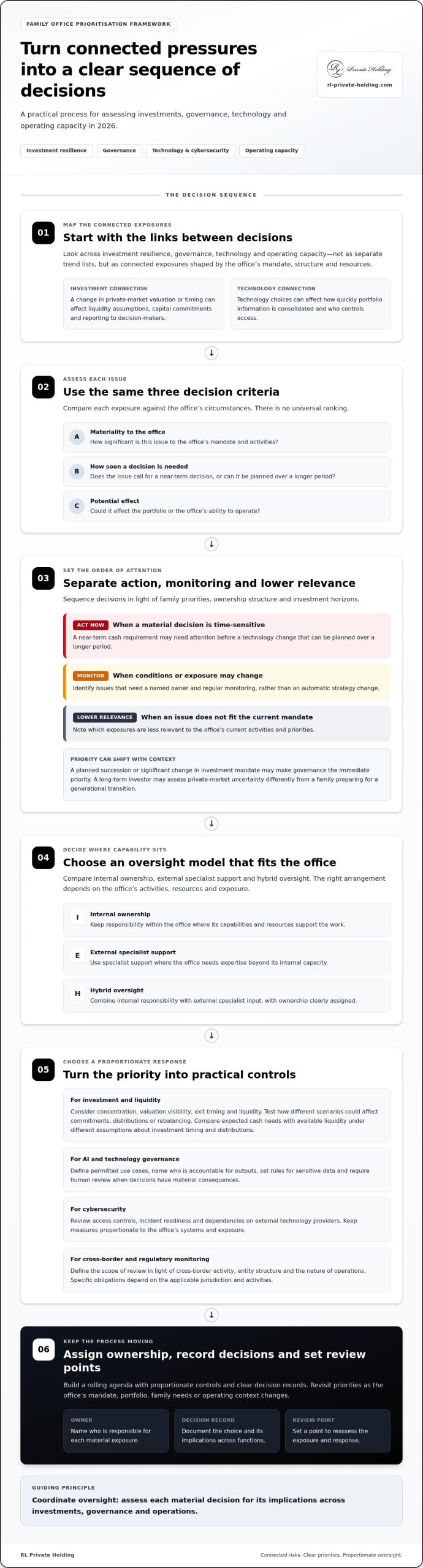
A Practical Framework for Prioritising Family Office Challenges in 2026
A repeatable assessment turns the challenges for family offices in 2026 into decisions with clear ownership and review points. Apply the steps below across portfolio, governance, technology and operating exposures, then tailor them to the office’s mandate and structure.
- Map exposures. Identify dependencies that could affect stated objectives, including investments, decision-making, information systems and continuity.
- Assess materiality. Rate each exposure using consistent definitions for impact, likelihood, time horizon and controllability.
- Assign ownership. Name the role responsible for assessment, escalation and reporting.
- Select a response. Decide whether to introduce a control, start a strategic project or monitor the issue until there is more evidence.
- Review. Set a decision date and a trigger for reassessment, such as a material portfolio change, governance transition or change in operating arrangements.
How should a family office assess its exposure?
Compare exposures with the office’s objectives and existing controls. Keep evidence, assumptions and unknowns distinct: a documented commitment is not the same as a forecast, and an emerging signal is not proof of a current exposure. Record material gaps for review rather than treating estimates as established facts.
Impact: Low means a limited effect on objectives; medium means a meaningful but manageable effect; high means a material threat to objectives or continuity.
Likelihood: Low means limited supporting evidence; medium means a plausible scenario; high means current evidence makes the event more probable. Record the evidence behind the rating.
Time horizon: Near-term means the issue needs attention within the current planning cycle; medium-term means a scheduled decision is needed; long-term means it can remain on the strategic agenda.
Controllability: High means the office can materially influence the exposure; medium means it can mitigate some effects; low means it has limited influence and should focus on monitoring and resilience.
Ratings are most useful when applied consistently across issues, not treated as precise forecasts. A high-impact, near-term exposure combined with a material control gap may warrant an immediate control. A longer-term matter may call for a strategic project, while a developing signal with limited evidence may remain under monitoring.
How can priorities become a reviewable plan?
For every priority, record an accountable role, decision date, evidence source and review trigger. Use scenario discussions to test how the office would respond to changes in liquidity needs, governance continuity or operational resilience. Where private-market oversight is a priority, these private equity investment management principles provide related context.
Clear risk ownership turns a broad challenge into an actionable priority. RL Private Holding’s investment management perspective provides further context on disciplined portfolio oversight.
Building a Resilient Family Office Agenda Beyond 2026
A prioritisation exercise is most useful when it becomes a rolling agenda. Record each material exposure, its accountable owner, the next review point and the evidence behind the decision. When priorities change, keep a decision record so family members and future decision-makers can see what shifted and why. This turns the challenges for family offices in 2026 into ongoing oversight rather than a one-time review.
Governance should be proportionate to the office’s activities, structure and risk exposure. An office with a focused portfolio may need different controls from one overseeing multiple entities, asset classes and cross-border operations. The objective is not to add process for its own sake. It is to clarify responsibilities and ensure significant decisions receive appropriate scrutiny.
What should a family office review regularly?
Set review intervals for investment assumptions, liquidity needs, governance responsibilities and continuity planning. Reassess technology and third-party dependencies when systems, providers or data use change materially. Check that existing controls still match the office’s actual activities. When a priority moves up or down the agenda, record the reason, such as new evidence, a change in mandate or a revised time horizon.
How does investment discipline support long-term resilience?
Clear investment mandates connect portfolio construction with oversight. Consider diversification choices, liquidity assumptions and monitoring arrangements together, particularly when exposure spans private markets and real assets. RL Private Holding manages a diversified portfolio across technology, real estate, asset management, private equity and venture capital, providing a cross-sector perspective on portfolio oversight.
For families assessing real-asset exposure, real estate asset management in Luxembourg offers related context. More broadly, connect each allocation with a defined rationale, an appropriate oversight process and a review point that reflects the investment horizon.
A practical next step is to identify one material exposure, name the role responsible for it and set its first review date. This gives a longer-term agenda a clear starting point. Details of RL Private Holding’s investment and wealth-management activities are available through the firm’s investment approach.
Turn Priorities Into a Disciplined Long-Term Agenda
The challenges for family offices in 2026 are connected, so effective oversight starts by assessing investment, governance, technology and operational exposures together. Set priorities according to the family’s mandate and time horizon, with clear owners, review points and records of material decisions. A proportionate approach helps distinguish actions that need attention now from issues best monitored over time.
Investment discipline also depends on understanding how portfolio activities and incentives fit together. RL Private Holding’s diversified focus across technology, real estate, asset management, private equity and venture capital offers a cross-sector perspective on portfolio oversight. Its investment management model includes recurring management fees and performance-based carried interest, linking ongoing asset management with investment outcomes.
Family offices can begin with one practical step: select a material exposure and assign responsibility for its first review. From there, a rolling agenda can support consistent decisions as circumstances and priorities evolve. Explore RL Private Holding’s investment and wealth-management activities to learn more about its approach.
Frequently Asked Questions
What are the biggest challenges for family offices in 2026?
The biggest challenges for family offices in 2026 generally concern investment resilience, governance, technology and operating capacity, but their relative importance depends on each office’s circumstances. Private-market liquidity and valuation visibility can complicate planning, while cyber exposure, data governance, succession and specialist talent can affect oversight and continuity. These issues are connected. A portfolio change, for example, may alter reporting needs, liquidity assumptions or decision responsibilities.
How can family offices manage investment and liquidity risks in 2026?
Review exposures, commitments and expected cash needs against the office’s investment horizon. Scenario analysis can test how different assumptions about exit timing, valuation or distributions might affect liquidity without treating any scenario as a forecast. Clear commitment pacing, documented assumptions and regular portfolio monitoring help decision-makers understand possible funding requirements and identify when a review or adjustment may be warranted.
Why is cybersecurity a growing concern for family offices?
Family offices may hold sensitive financial, personal and investment information across internal systems and external providers, making access management and data handling important oversight areas. Phishing, compromised credentials, insecure data sharing or weaknesses in a third-party system can disrupt operations or expose confidential information. Each office’s exposure differs. Reviewing access permissions, provider dependencies, incident procedures and staff practices helps align cybersecurity controls with the office’s systems and operating model.
Can family offices use AI safely in investment and operations?
Family offices can use AI more responsibly by defining permitted tasks, assigning accountability and requiring human review for outputs that could affect investment or operational decisions. Consider what information may be entered into a tool, how outputs are checked and whether its use creates confidentiality or data-governance concerns. Start with bounded, lower-risk applications, document controls and review them as tools, data use or business processes change.
Should a family office build capabilities in-house or outsource them?
The appropriate model depends on the capability, its importance to the mandate and the office’s oversight capacity. Recurring, mandate-critical decisions may benefit from internal ownership and retained institutional knowledge. External specialists can provide focused expertise for occasional or highly specific needs. A hybrid model keeps decision authority within the office while drawing on external support. Clear responsibilities, reporting and information-sharing arrangements are essential in each structure.
How can a family office prioritise its most important risks?
Map material exposures across investments, governance, technology and continuity. Assess each consistently for impact, likelihood, time horizon and the office’s ability to control or mitigate it. Keep verified evidence separate from assumptions, then compare existing controls with identified exposures. Assign a responsible role, decision date and review trigger to each priority. This distinguishes immediate actions from longer-term projects and issues that need monitoring.
What should a family office include in its 2026 governance review?
A governance review should consider whether the investment mandate, decision rights, reporting and escalation processes remain aligned with the office’s activities and ownership structure. It can also examine succession and continuity arrangements, technology and third-party oversight, and how significant decisions are recorded. For offices with cross-border activities, applicable legal and regulatory considerations depend on the entity and its activities; obtain expert review where specific interpretation is needed.