

What if the investor offering the most capital is not the right partner for your company’s future? Choosing a VC partner for long-term growth takes more than comparing valuations or reputations. The relationship may last for years, and a partner’s incentives, decision-making approach, and investment horizon can shape the company’s options as it develops.
Capital matters, but promises of strategic support can be difficult to assess, and term-sheet provisions may have consequences beyond the immediate financing. The challenge is to determine whether a partner’s claims, expectations, and working practices align with your company’s plans.
This guide offers a practical way to compare potential investors using consistent criteria. It covers fund incentives and time horizons, how to verify support through references, and governance rights to review before signing. It also suggests questions that can reveal misalignment, including how a partner responds when a business encounters setbacks or needs to change course.
Assessing these factors together can help you make a more informed decision about the financing relationship that suits your long-term growth plan.
Key Takeaways
- Assess both the individual partner and the fund’s decision-making structure, since each can influence financing and governance.
- Compare investors using the same criteria, and ask for evidence of relevant experience and support rather than relying on sector labels.
- Clarify expectations around growth, reporting, and returns to distinguish ordinary differences in goals from meaningful misalignment.
- Use a structured diligence process, including a careful review of final terms, to assess each candidate consistently.
- Choosing a VC partner for long-term growth means weighing evidence, working fit, fund incentives, and company objectives, not relying on a universal ranking.
Choosing a VC Partner for Long-Term Growth Starts With Alignment
A venture capital partner is both a person you work with and a representative of a fund with its own decision-making structure. The individual may lead discussions and participate in company decisions, while colleagues may influence approvals, reserves, or later investments. Venture capital (VC) combines investment with a fund structure, so assess both layers before treating a promising conversation as a durable partnership.
Investor fit is the degree to which a fund’s incentives, decision-making, and working relationship support a company’s intended growth path, not simply its willingness to provide capital. This distinction matters because capital, expertise, governance rights, and the possibility of future financing can affect a company well beyond its first round. Rapport and a strong reputation may be positive signals, but neither proves that expectations will remain compatible when plans change or results fall short.
What does a long-term VC partnership involve?
The investor provides capital in exchange for an ownership interest under agreed terms. The relationship may also include governance participation and strategic input, but the extent of that support varies by firm, partner, mandate, and portfolio capacity. Assess the prospective partner’s judgment and availability, as well as the firm’s ability to make decisions and support the company over time.
Ask for concrete examples of how the partner handled relevant business challenges, then verify those accounts with founders who have worked with them. Consider the whole firm, not only the person leading the deal. Decision processes, internal alignment, and follow-on investment decisions may involve colleagues who are not part of the initial discussions.
Whose interests does a VC partner represent?
A VC partner works within a fund that has investors, objectives, and a defined investment mandate. Those obligations shape investment decisions, but they do not guarantee that the fund and a particular founder will agree on timing, risk, or the preferred outcome. Look beyond assurances of “smart money” and consider how the fund’s incentives fit the company’s plans.
Clarify the factors that could affect that fit:
- Fund duration: What is the fund’s expected time horizon, and how does it compare with the company’s plans?
- Reserves and follow-on decisions: How are later investments considered, and who makes those decisions? Do not treat future funding as assured unless it is explicitly committed.
- Exit expectations: What outcomes and timing does the fund generally seek, and how might those differ from the founder’s objectives?
Compare the answers with your own plans, including your intended pace of expansion and possible need for later financing. RL Private Holding lists venture capital funding among its offerings, so founders exploring potential fit can ask about its current criteria and mandate directly.
Evaluate VC Partner Fit Across Expertise, Support, and Fund Horizon
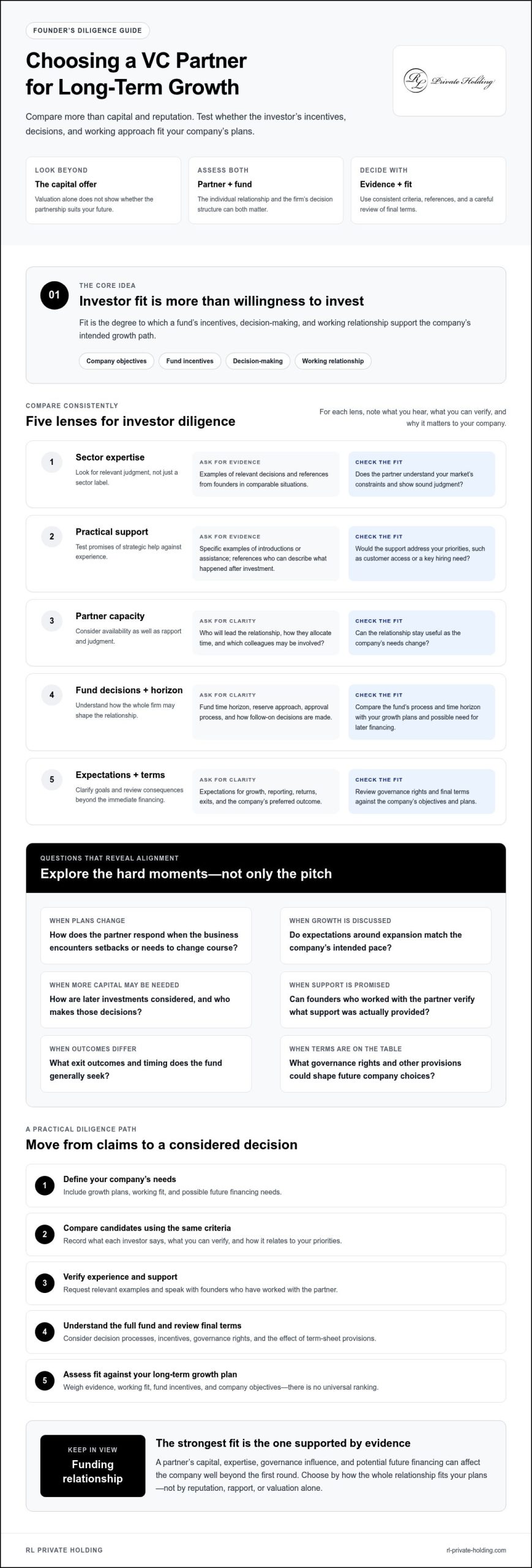
A consistent scorecard helps you compare evidence instead of relying on presentation quality or personal chemistry. For each criterion, record what the investor says, what you can verify, and how it relates to your company’s needs. Treat the categories as diligence prompts rather than a universal ranking. Their importance depends on your strategy and financing plans.
| Criterion | Evidence to request | Founder-specific relevance |
|---|---|---|
| Sector expertise | Examples of relevant decisions and experience, plus references from founders in comparable situations. | Tests whether the partner understands your market’s constraints and can exercise sound judgment, rather than simply displaying a sector label. |
| Practical support | Specific examples of introductions or strategic assistance, followed by references who can describe what happened after investment. | Shows whether proposed support addresses your priorities, such as customer access or a key hiring need. |
| Partner capacity | Who will lead the relationship, how they allocate time, and which colleagues may be involved. | Helps assess whether the relationship can remain useful as the company’s needs change. |
| Fund decisions and horizon | Decision-making process, fund time horizon, reserve approach, and how follow-on decisions are made. | Allows comparison with likely financing needs and potential liquidity paths. Do not assume future participation unless it is committed. |
| Governance and terms | Proposed rights, obligations, reporting expectations, and the consequences of key provisions. | Clarifies how financing may affect control and company decisions. Have qualified legal counsel review proposed terms before signing. |
How can founders test a VC’s value beyond capital?
Ask for a specific example of a relevant introduction or strategic contribution, including the context and outcome. Then speak with founder references about the partner’s responsiveness, judgment, and conduct when plans changed or the business faced difficulty. A broad claim about a network does not establish that the investor can or will help with your priorities. Separate verifiable examples from general promises of mentorship.
Which fund and partnership factors affect long-term fit?
Clarify who participates in investment decisions and whether the person leading your financing will remain involved in later discussions. Ask how the fund considers reserves and follow-on investments, and treat future financing as uncertain unless contractually committed. Compare the fund’s stated horizon with your company’s likely capital requirements and possible liquidity options. This makes choosing a VC partner for long-term growth more specific to your plans and grounded in evidence.
Founders assessing venture capital funding can review RL Private Holding’s investment information and confirm current criteria and investment fit directly.
Address the Biggest Risk: Misaligned Incentives and Founder Expectations
VC funding can provide capital and access to expertise, but it also brings expectations. An investor may seek governance participation, regular reporting, and a return within the fund’s investment horizon. A founder may prioritize independence, reinvestment, or a longer path to liquidity. These differences do not automatically make a partnership unsuitable, but they should be understood before the parties commit.
Partner alignment depends on comparing stated goals with contractual rights: intentions describe expectations, while signed terms define important parts of the relationship. When choosing a VC partner for long-term growth, assess whether the investor’s approach suits your plans and whether the proposed documents reflect what has been discussed.
How should founders examine a term sheet’s long-term implications?
Review the provisions as a connected set rather than treating each clause as an isolated detail. Consider which decisions require investor approval, how board composition may affect oversight, and how proceeds might be distributed in a sale or other liquidity event. Terms governing later financings may also influence the company’s options and existing ownership.
- Board composition: Identify who may hold seats or observer roles, and how the proposed structure affects company oversight.
- Consent rights: Clarify which company actions may require investor approval and whether those decisions could affect ordinary operations or strategic changes.
- Liquidation preferences: Understand how investors may receive proceeds in a sale or wind-down relative to other shareholders under the proposed terms.
- Future financing provisions: Ask how the terms may affect later fundraising, including the consequences if the company needs capital on different terms.
These are general explanations, not legal advice. The effect of a provision depends on the full documents and applicable law. Have qualified counsel review the proposed terms and how the clauses interact before agreeing to them.
What warning signs deserve closer scrutiny?
Inconsistency is a reason to investigate, not an automatic verdict. Compare what the partner says with available fund documents, reference conversations, and proposed terms. If a partner promises support, ask for a specific example and speak with founders who can describe the assistance they received. Ask how investment decisions are made, who holds authority, and what conditions may shape later decisions.
Resolve unclear answers before proceeding. If an explanation conflicts with the documents, request clarification in writing and discuss the discrepancy with counsel. Pressure to sign before you have adequate time to review is a reason to pause and seek advice. A disciplined process helps distinguish ordinary differences in commercial objectives from terms or conduct that may not suit your plans.
Use a Structured VC Due Diligence Process Before Choosing
A repeatable process makes comparisons more reliable and reduces the influence of personal chemistry. Apply the same questions and evidence standards to every candidate. Record what is confirmed, what remains unclear, and which issues matter most to your company. This gives you a decision record to revisit before agreeing to final terms.
Use this sequence:
- 1. Define your priorities. Set out the company’s financing needs, growth objectives, preferred level of investor involvement, and non-negotiable expectations.
- 2. Establish common criteria. Compare sector judgment, practical support, partner availability, fund decision-making, follow-on approach, investment horizon, governance, and proposed terms.
- 3. Interview the prospective partner. Ask how they would contribute during your next material growth challenges. Explore how the firm handles difficult investment decisions, internal disagreements, and changes in partner involvement. Clarify what could affect follow-on support.
- 4. Test claims with references. Speak with founders at different company stages, including those with positive experiences and those who faced challenges. Ask about responsiveness, consistency of decisions, board conduct, and support during setbacks.
- 5. Verify firm-level information. Confirm who participates in investment decisions, how responsibilities may be shared, and whether the firm’s stated horizon and approach fit your plans. Review relevant documents and flag mismatches between explanations and written terms.
- 6. Review terms with professional advice. Have qualified counsel assess the proposed documents, including how governance and financing provisions interact, before signing.
Build a comparison matrix from evidence
For each candidate, record the same four items: evidence supporting a claim, unresolved questions, risks or trade-offs, and founder priorities affected. For example, if a partner cites customer introductions as a strength, note relevant examples, reference feedback, and whether those connections address a current company need. Keep unverified commitments as open questions, not established benefits.
For broader context on investment approaches, review this venture capital strategy framework. A consistent record makes choosing a VC partner for long-term growth a reasoned decision rather than one driven by a polished meeting or an impressive brand.
Founders considering venture capital funding can also discuss investment fit with RL Private Holding. Confirm current criteria and mandate directly; no specific investment stage, terms, or founder-support commitments are stated here.
Choose a VC Partner Whose Investment Approach Fits Your Growth Plan
The final decision should reflect the whole relationship, not one attractive feature. Weigh the evidence, proposed terms, working relationship, fund incentives, and company objectives together. A partner may offer relevant expertise but have a time horizon that conflicts with your plans. Another may offer fewer strategic benefits but terms and decision-making that better suit your needs. No universal ranking of firms can replace this company-specific assessment.
How should founders make the final comparison?
Rank your criteria by importance to the next phase of growth. For a company preparing to enter a new market, relevant sector judgment may carry greater weight; for one with complex financing needs, governance terms and the fund’s approach to later investment may matter more. Record each candidate’s confirmed strengths, unresolved questions, and material trade-offs rather than reducing the assessment to a single impression.
Revisit the comparison after legal and financial review. Check whether the final documents reflect the expectations discussed and whether any outstanding issue changes the balance of benefits and risks. If an important answer remains uncertain, include that uncertainty in your decision rather than assuming it will resolve after closing. This makes choosing a VC partner for long-term growth a considered commitment, not simply an acceptance of available capital.
What is a useful next step for exploring investment fit?
Prepare a concise account of your company’s objectives, financing needs, intended use of capital, and desired outcomes. This gives prospective investors a clear basis for discussing fit and helps you compare responses consistently. For a broader investor perspective, consult the family office investment strategies framework, while keeping your company’s financing objectives central to the assessment.
RL Private Holding is headquartered in Luxembourg, operates globally, and lists venture capital funding among its offerings. This provides context for an exploratory discussion, not confirmation that a particular company, stage, or financing need meets its current investment criteria. Founders can explore RL Private Holding’s investment focus and verify current criteria directly. The aim is to establish whether there is a basis for further discussion, without presuming a fit or funding outcome.
Make Your Next Financing Decision With Clarity
Choosing a VC partner for long-term growth means assessing more than the capital on offer. Compare each candidate’s incentives and investment horizon with your company’s objectives, and verify claims about expertise and support through evidence and founder references. Review governance rights and proposed terms with qualified advisers before making a commitment.
The right choice depends on your company’s needs, priorities, and likely path ahead, not a universal ranking of investors. A structured comparison can help identify where expectations align, where questions remain, and which trade-offs you are prepared to accept.
RL Private Holding is headquartered in Luxembourg, operates globally, and lists venture capital funding among its offerings. Its diversified portfolio spans stated sectors including technology, real estate, asset management, private equity, and venture capital. These facts offer context for an exploratory discussion, but current investment criteria and fit should be confirmed directly.
Explore RL Private Holding’s investment focus and discuss whether it aligns with your company’s plans.
Frequently Asked Questions
How do I choose a VC partner for long-term growth?
Start by defining your company’s growth objectives, then compare investors on relevant experience, decision-making, available support, fund incentives, and investment horizon. Ask for specific evidence rather than relying on reputation or rapport, and speak with portfolio founders about their experience. Before deciding, have qualified counsel review proposed terms and record unresolved questions. The right partner is the one whose demonstrated approach and incentives fit your company’s needs.
What should founders look for in a venture capital partner?
Look for relevant judgment, clear communication, reliable decision processes, and a realistic understanding of your company’s requirements. Assess both the individual partner and the wider firm, including who participates in investment decisions and how support may change over time. Request specific examples and verify claims through founder references. Sector familiarity or a prominent network can be useful, but neither proves that an investor will provide support relevant to your business.
How can I tell if a VC is a good long-term fit?
Compare the investor’s stated horizon and return expectations with your company’s plans. Ask how the partner approaches setbacks, disagreements, and follow-on decisions, then test those answers against references and written terms. Choosing a VC partner for long-term growth means assessing whether incentives, expectations, and working practices are compatible. Fit does not guarantee future capital or constant involvement; it provides a reasoned basis for deciding whether the relationship suits your company.
What questions should I ask a potential VC partner?
Ask how the firm makes investment decisions, who will represent it, and what support the partner can realistically provide. Clarify the fund’s approach to follow-on financing, its investment horizon, and its governance expectations. Discuss how disagreements are handled and what could affect the partner’s involvement. Request examples connected to your company’s needs, then check them with portfolio founders. Specific, consistent answers are easier to compare with other investors and assess alongside proposed documents.
Can a VC partner help beyond providing capital?
Some investors may contribute relevant experience, introductions, or strategic perspective, but support varies by firm, partner, and portfolio capacity. Ask what assistance may be available, who would provide it, and how founders can access it. Speak with portfolio companies to establish whether claimed support reflects their experience. Treat broad network or mentorship statements as claims to verify, not commitments, and review material expectations or rights in the investment documents.
What are red flags when choosing a VC partner?
Inconsistent explanations, unclear decision authority, unsupported commitments, or pressure to sign before adequate review merit closer scrutiny. A mismatch between the fund’s incentives and your company’s plans also deserves careful discussion. None of these signals alone determines the outcome, but each raises questions to resolve. Request clarification, speak with portfolio founders, compare statements with written terms, and seek independent legal advice before deciding whether to proceed.
How important are term-sheet rights when choosing an investor?
Term-sheet rights matter because they can affect governance, future financing, ownership, and how company decisions are made. Board arrangements, consent rights, and liquidation preferences should be considered in the context of the complete proposed documents, not in isolation. General online explanations cannot determine the effect of a specific offer. Ask qualified counsel to review the terms, explain how provisions interact, and clarify their practical implications before signing.