

A portfolio can hold more asset classes and still be poorly diversified. For investors considering diversifying beyond public markets, the central question is not how many investments to add, but whether each exposure serves the portfolio’s objectives, time horizon, and liquidity needs.
Private equity, venture capital, private credit, real estate, and infrastructure can offer different sources of risk and return, but they are not straightforward substitutes for listed investments. Valuations may be less frequent, access and exit terms can be restrictive, and fees and governance arrangements need careful review. Those practical differences matter as much as the asset category itself.
This guide explains how private markets and real assets may complement public holdings and offers a framework for assessing portfolio fit. It covers liquidity, valuation, risk, fees, and governance, then outlines steps for reviewing an allocation against long-term objectives. The aim is a disciplined portfolio-design process, not an asset-class checklist or an assurance of returns.
Key Takeaways
- Define what you want diversification to achieve before selecting private-market or real-asset exposures.
- Assess underlying risks and return drivers rather than assuming different asset labels mean different portfolio behaviour.
- Compare investments by liquidity, valuation frequency, holding period, fees, and governance to understand their practical differences.
- Map future liabilities and liquidity needs before considering less liquid holdings as part of diversifying beyond public markets.
- RL Private Holding’s focus includes private equity, venture capital, and real estate, areas that illustrate why portfolio fit depends on more than an asset label.
What Diversifying Beyond Public Markets Means for a Portfolio
Diversifying beyond public markets means adding exposures other than listed stocks or bonds, then assessing whether they bring genuinely different sources of risk and potential return. The distinction matters: owning several types of assets does not automatically diversify a portfolio if they respond to the same economic forces.
Asset allocation determines how capital is distributed among investment categories; diversification considers whether the underlying exposures behave differently across relevant conditions. This distinction builds on the broader principle of Diversification: spreading exposure can help manage concentration, but it cannot eliminate investment risk or assure superior performance.
Which investments sit outside public markets?
Private equity involves investment in businesses that are not publicly listed, while venture capital focuses on financing early-stage or growing companies. Real estate provides exposure to property and its associated income and value drivers. Infrastructure and hedge funds are broader examples of investments beyond conventional listed stocks and bonds. They are distinct categories, not interchangeable portfolio components.
Private-market investments can differ from listed assets in structure, liquidity, and valuation practices. Their interests may not trade on a public exchange, and valuations may rely on periodic assessments rather than continuous market pricing. The specific terms and risks depend on the investment.
Why consider exposures beyond listed stocks and bonds?
Start with the investor’s objectives, investment horizon, and current portfolio. An allocation may be relevant if it supports a defined long-term goal and the investor can accommodate its liquidity and governance requirements. It should not be added simply because it carries an alternative label.
Potential return drivers vary by category. A private equity investment may depend on a company’s operations and strategic development; venture capital may be shaped by a young company’s ability to grow; and real estate may be affected by property income, occupancy, financing conditions, and asset values. These drivers can differ from those of listed securities, but they do not guarantee low correlation or protection during market stress.
Look for overlap beneath the category names. A private company and listed shares may both be exposed to the same industry or economic cycle. Property and publicly traded real estate companies may also respond to common interest-rate or demand conditions. Diversification depends on the portfolio’s combined exposures, not the number of labels it contains.
How Private Markets and Real Assets Can Change Portfolio Exposures
Private investments change more than the categories shown in a portfolio statement. Listed stocks and bonds are generally priced through active markets, with prices visible as trading occurs. Private investments may instead be held for extended periods, valued periodically, and subject to transfer or exit conditions set by their structure. Reported values can therefore appear less responsive to daily market movements, without removing the underlying economic risks.
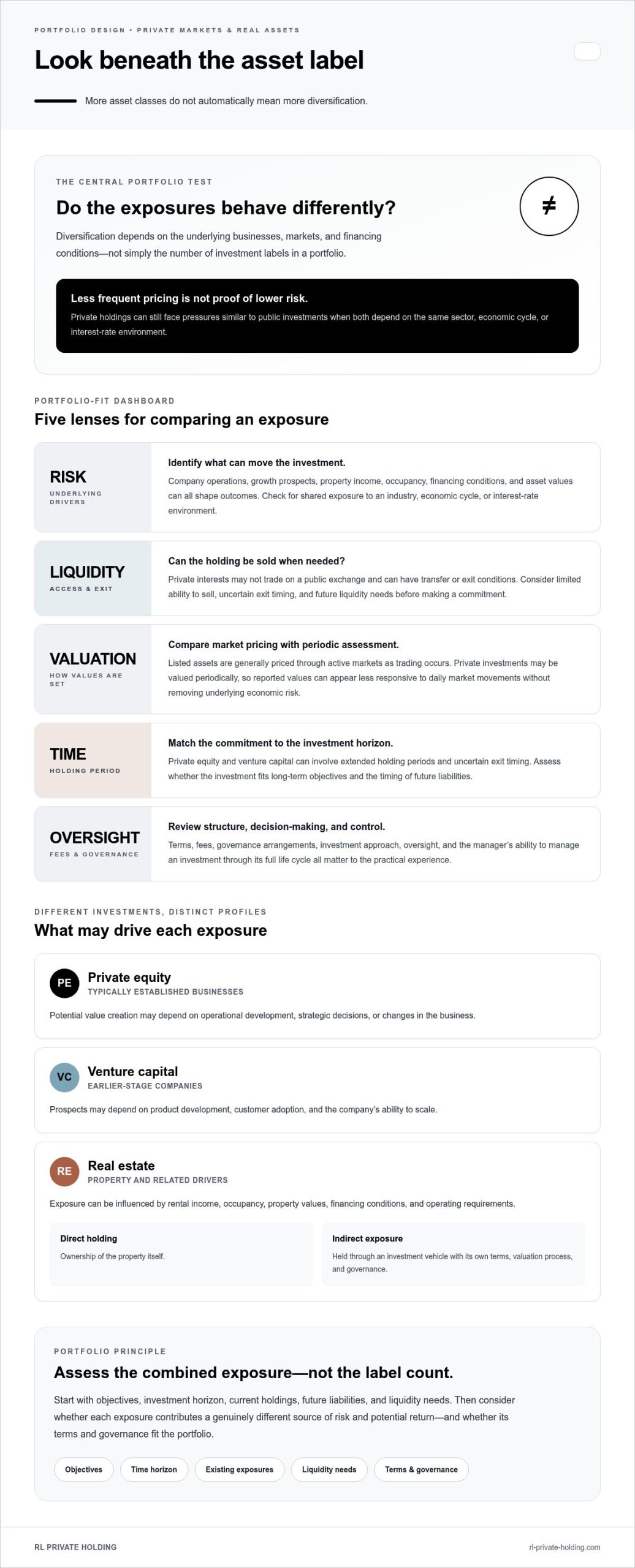
An asset-class label does not establish low correlation; the underlying businesses, markets, and financing conditions determine how exposures may behave together. A private holding can face pressures similar to public investments if both depend on the same sector, economic cycle, or interest-rate environment. Diversifying beyond public markets requires examining those shared drivers, not treating less frequent pricing as evidence of lower risk.
Private equity and venture capital have different investment profiles
Private equity typically involves established businesses, where potential value creation may depend on operational development, strategic decisions, or changes in the business. Venture capital generally finances earlier-stage companies, whose prospects can depend on product development, customer adoption, and the ability to scale. These are distinct investment profiles and should not be assessed as a single exposure.
Both can involve long holding periods and uncertain exit timing. An investor may have limited ability to sell an interest when desired, so the commitment should be considered alongside liquidity needs. Manager selection also matters: investment approach, decision-making, oversight, and the capacity to manage an investment through its full life cycle can shape the experience. Past or projected outcomes should not substitute for understanding these factors.
Real estate adds asset-specific factors to portfolio analysis
Property exposure can be influenced by rental income, occupancy, property values, financing conditions, and operating requirements. These factors vary by asset and market. A direct property holding involves ownership of the asset, while indirect exposure may be held through an investment vehicle with its own terms, valuation process, and governance. The structures can therefore produce different liquidity and control considerations, even when both are described as real estate.
For a focused discussion of property investment oversight, see the real estate asset management overview. In portfolio analysis, compare each exposure with existing holdings: a property investment and listed securities may still share sensitivity to financing costs or economic demand. RL Private Holding’s wealth management services form part of its broader investment offering.
How to Compare Public and Private Investments Beyond the Asset-Class Label
A useful comparison looks at how an investment operates, not just whether it is public or private. Public holdings often have observable market prices and may be traded during market hours. Private investments are commonly valued at intervals set by their structure and may have restrictions on transfers or exits. Those differences affect how an investor can monitor, rebalance, or access capital.
The framework below is a starting point, not a universal rule. Terms vary by investment structure, and the evidence available to assess risk, valuation, and governance may differ.
| Criterion | Public investments | Private investments |
|---|---|---|
| Liquidity | Often traded on an exchange, subject to market conditions. | May involve redemption limits, transfer restrictions, or an exit process. |
| Valuation frequency | Market prices can update continuously during trading. | Valuations may be reported periodically and may not reflect current conditions in real time. |
| Holding period | Investors can generally sell during trading, though the sale price is uncertain. | Capital may be committed for an extended period, with exit timing uncertain. |
| Fees and expenses | Costs depend on the security and account structure. | May include management fees, performance incentives, and underlying expenses; terms vary. |
| Governance | Disclosure and investor rights depend on the instrument and applicable rules. | Oversight, reporting, decision-making, and investor rights depend on governing documents. |
Which liquidity and valuation questions matter most?
Start by listing cash needs across the full investment horizon. Identify when funds may be required for planned expenses or liabilities, then compare that timing with redemption terms, exit provisions, and limits on transferring an interest. A long horizon does not remove the need for liquidity planning, because needs can change.
Understand who determines valuations, what information supports them, and how often they are updated. A private investment’s reported value may not change as frequently as a listed price. This can make reported volatility appear lower, but it does not establish that the underlying asset has less economic risk or is safer.
How should fees, governance, and risk be assessed?
Review management fees, performance incentives, and other expenses together, and consider their effect on net outcomes over the expected holding period. Examine reporting frequency, oversight arrangements, conflicts of interest, and who has authority to make investment decisions. These terms shape both the investor’s visibility and the manager’s responsibilities.
For additional context on oversight and private-equity structures, see the private equity investment management framework. Use the same questions across potential investments: what drives value, when can capital be accessed, what are the total costs, and who makes and oversees investment decisions? This keeps diversifying beyond public markets grounded in liquidity, evidence, and accountability, rather than category labels alone.
A Practical Framework for Adding Exposure Beyond Public Markets
A disciplined allocation review starts with the purpose of the portfolio, not a target percentage for alternatives. The right role for an investment depends on the investor’s objectives, time horizon, existing exposures, and ability to tolerate limited access to capital. Use the following sequence to assess whether an allocation fits and how it should be monitored.
- 1. Define objectives and constraints. Set out what the portfolio needs to support, the investment horizon, and any liquidity, income, or capital-preservation requirements. Record constraints that could affect the ability to hold an investment through its full term.
- 2. Map current exposures. Review holdings by economic driver, geography, sector, and investment structure, rather than relying only on asset-class labels. This helps identify concentrations and overlaps before adding another category.
- 3. Match liquidity to liabilities. Map expected cash needs and liabilities across the investment horizon. Consider when capital may be needed, how distributions or exits work, and whether transfer or redemption limits could conflict with those needs. Assess less liquid holdings only after this review.
- 4. Assess the investment and its manager together. Consider the manager’s decision-making responsibilities, investment approach, reporting, oversight, and conflicts of interest. Review the structure and governing documents alongside the potential investment risks.
- 5. Evaluate total costs and concentration. Examine management fees, performance incentives, and other expenses, and consider their effect on net outcomes. Then assess whether the exposure adds a distinct risk and return driver or increases an existing concentration.
- 6. Establish monitoring and review practices. Decide how performance, valuations, cash flows, and risks will be reviewed. Consider how less frequent valuations and extended holding periods may affect portfolio reporting and rebalancing. Set review triggers in advance, while avoiding assumptions that an investment can be sold or adjusted immediately.
Review the allocation over time
An allocation decision is not complete at purchase. Objectives, liabilities, market conditions, and the portfolio itself can change, while private investment exit timing may remain uncertain. Schedule reviews that consider both the investment’s progress and its continuing fit with the broader portfolio. Reassess concentration and liquidity as circumstances evolve rather than relying on the original allocation rationale.
Checklist: Define the objective, map exposures, match liquidity to liabilities, assess the manager and structure, account for costs and governance, then monitor and review. Diversification requires ongoing assessment; it is not established by a one-time allocation or a label.
For a measured discussion of portfolio objectives and investment allocation, explore RL Private Holding’s wealth management services.
How RL Private Holding Approaches Diversification Beyond Public Markets
RL Private Holding manages a diversified global portfolio of businesses and focuses on private equity, venture capital, and real estate, among other sectors. The firm also provides wealth management and private equity investment management services. These activities offer a practical context for considering how investments beyond listed markets fit within a broader portfolio. They are not a recommended allocation for every investor, and they do not establish that any portfolio will be diversified or achieve a particular result.
A multi-sector investment perspective
RL Private Holding’s stated areas of focus include technology, real estate, asset management, private equity, and venture capital. Each represents a different field of activity, but the category alone does not reveal how an investment may behave. The underlying business, its financing, its operating conditions, and its investment structure all matter. For example, exposure to a technology business may also carry risks tied to the broader economic cycle or financing environment.
This is why diversifying beyond public markets is best approached as a portfolio-design question. Consider whether an exposure has a clear role, how its risks interact with existing holdings, and whether its liquidity and governance terms suit the portfolio’s needs. A range of sectors can provide a broad investment perspective, but sector count alone does not establish distinct return drivers or reduce risk.
For investors, the relevant lesson is methodological rather than prescriptive. Assess each potential allocation against objectives, liabilities, time horizon, liquidity capacity, and concentration. Then consider how the manager’s responsibilities, investment structure, reporting, and oversight affect the exposure. This keeps the decision connected to the investor’s circumstances instead of treating a multi-sector portfolio as a template to replicate.
Further reading and considered next steps
Venture capital presents its own considerations because investment in earlier-stage businesses involves different business-development and financing questions from those associated with established companies or property. RL Private Holding provides venture capital funding as part of its investment focus.
Before changing portfolio exposures, revisit objectives, map expected liquidity needs and liabilities, and assess governance and oversight alongside potential risk and return drivers. Review the role of each holding over time, since a portfolio’s needs and the investments themselves can change. A considered allocation is grounded in fit and ongoing review, not in the assumption that private-market exposure automatically improves diversification.
Explore RL Private Holding’s investment focus to learn more about its activity across private equity, venture capital, and real estate.
Make the Next Allocation Decision Deliberately
Diversifying beyond public markets is a portfolio-design decision, not a checklist of alternative asset classes. Private equity, venture capital, and real estate may introduce different investment drivers, but their labels alone do not establish lower risk or stronger diversification. Liquidity, valuation processes, costs, and governance also shape how they fit.
A disciplined review begins with objectives, time horizon, existing exposures, and future liquidity needs. From there, assess how each proposed investment interacts with the portfolio, how it is structured, and how it will be monitored over time. There is no universal allocation that suits every investor, and no category removes the possibility of loss.
RL Private Holding manages a diversified global portfolio of businesses, with investment focus across technology, real estate, private equity, and venture capital. This provides a multi-sector perspective, not a prescribed portfolio model or promise of results. Explore RL Private Holding’s investment focus to learn more.
With clear objectives and regular review, investors can make allocation decisions that remain aligned with their long-term needs.
Frequently Asked Questions
What does diversifying beyond public markets mean?
Diversifying beyond public markets means adding investments outside listed stocks and bonds, such as private equity, venture capital, or real estate. The purpose is to assess whether these investments contribute different underlying risk and return drivers, not simply to increase the number of asset categories. Their structures, liquidity, valuations, and governance can differ from listed holdings. Diversification may help manage concentration, but it cannot eliminate losses or guarantee stronger performance.
Can private markets diversify a portfolio of public stocks and bonds?
Private markets can add exposures with different characteristics, but whether they diversify a portfolio depends on what the investments own and how they respond to economic conditions. For example, a private company and public shares may both be affected by the same industry downturn or financing pressures. Assessing diversifying beyond public markets therefore requires looking through asset labels to underlying businesses, sectors, financing, liquidity, and other shared risks.
How do private equity and venture capital differ from public-market investments?
Private equity generally invests in established businesses that are not publicly listed, while venture capital typically finances earlier-stage companies. Unlike listed shares, these investments may not have continuous exchange trading or readily observable prices. Investors may face longer holding periods and uncertain exit timing. Outcomes can depend on the company’s development and the manager’s decisions, so assess the investment structure, governance, reporting, and liquidity terms rather than assuming either category behaves uniformly.
What are the main risks of investing beyond public markets?
Key risks can include loss of capital, limited liquidity, uncertain exit timing, valuation uncertainty, concentration, fees, and governance or conflicts of interest. The relative importance of each depends on the investment and its structure. A portfolio can also retain exposure to familiar market risks if private holdings depend on the same sectors, economic conditions, or financing environment as its public assets. Review these risks together with objectives, liabilities, and time horizon.
Are private investments less volatile than publicly traded investments?
Not necessarily. Private investments may be valued less frequently than listed securities, so reported values can change less often and may appear smoother. That reporting pattern does not establish lower underlying economic risk or greater safety. Changes in business conditions, property markets, or financing can still affect value, even if those changes are not reflected in a reported valuation immediately. Compare valuation methods and timing as well as investment fundamentals.
How should investors assess liquidity before investing in private markets?
Start by mapping planned expenses, liabilities, and potential cash needs across the full investment horizon. Then review the investment’s holding period, redemption or exit terms, transfer restrictions, and how distributions are expected to work. Consider whether access to capital could be limited when funds are needed, including if circumstances change. Liquidity needs can evolve, so reassess the fit over time rather than relying only on the initial investment plan.
What role can real estate play in a diversified investment portfolio?
Real estate can provide exposure to property-related income and changes in asset values, with results also influenced by financing, occupancy, and operating conditions. Direct ownership and indirect investment vehicles have different structures, control, liquidity, and valuation processes. Property exposure should be assessed alongside existing holdings because real estate and other investments may share sensitivities, such as changes in financing conditions or economic demand. Its role depends on the investor’s objectives and constraints.
Explore RL Private Holding’s wealth management, private equity investment management, venture capital funding, and real estate asset management services to learn more about its investment focus.