

A technology can reshape an industry and still prove to be a poor investment. For readers considering how to invest in emerging tech trends 2026, the central task is to look beyond technical progress and assess whether a durable business opportunity is taking shape.
Forecasts can highlight momentum without showing which companies may capture value. Public and private investment routes also differ in access, liquidity and risk. Rapid development makes it harder to distinguish early promise from commercial adoption, so a disciplined assessment starts with evidence, not headlines.
This guide offers a practical framework for evaluating emerging technologies, the businesses and ecosystems around them, and their commercial maturity, capital requirements, valuation and risk. It compares public-market exposure with private-market routes such as venture capital and private equity at a high level. The aim is to help you distinguish technological significance from investable potential, then monitor a thesis as evidence changes. This is general educational information, not individualized investment advice.
Key Takeaways
- Separate technical novelty from adoption, revenue creation and potential investor returns to assess whether a technology is becoming commercially relevant.
- Compare exposure across infrastructure, platforms, applications and enabling services, while weighing the distinct characteristics of public and private markets.
- Use a four-part thesis test covering technology maturity, customer evidence, competitive position and valuation before committing capital.
- Apply a repeatable process to how to invest in emerging tech trends 2026: define exposure, research, compare, size and monitor against clear evidence and downside conditions.
- Align technology exposure with investment mandates, governance, time horizons and risk capacity. Private capital’s active ownership potential comes with illiquidity and execution risks.
Invest in 2026 Tech: The Technology-to-Value Chain
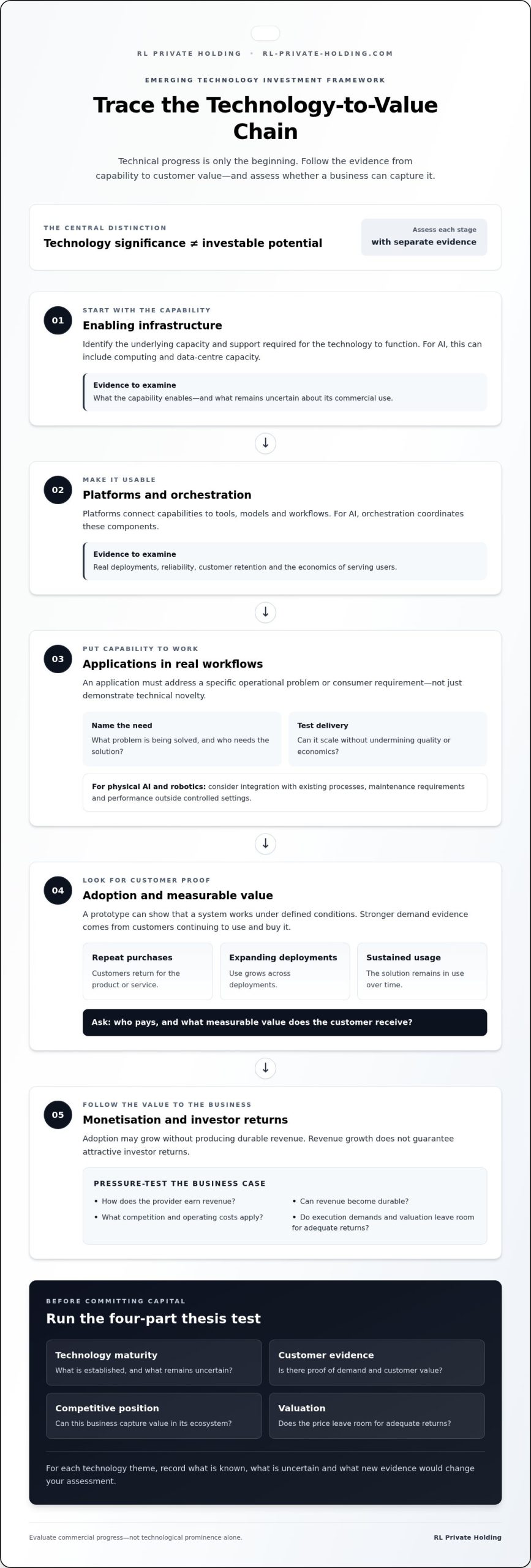
An emerging technology trend is a developing capability with potential commercial applications. That describes possibility, not investment merit. A system may demonstrate technical novelty without being ready for routine enterprise use. Adoption may grow without producing durable revenue, and revenue growth does not guarantee attractive investor returns. Each stage requires separate evidence.
A useful analysis follows the chain from enabling infrastructure to platforms and applications, then to customers and monetisation. An AI application, for example, depends on computing capacity and supporting software. Its investment case also depends on whether organisations use it in recurring workflows, what benefit they receive, and how the provider earns revenue. A consequential technology can still be a weak investment if competition, operating costs, execution demands or valuation leave little room for adequate returns.
The broad Emerging Technologies Overview offers context on developing capabilities. For investment analysis, trace each capability through the value chain instead of treating the technology label as a conclusion.
What makes a technology trend investable?
Start with the need. Identify the operational problem or consumer requirement the technology addresses, then establish who pays and what measurable value the customer receives. That value might involve greater productivity, improved reliability or a new service. Make it specific enough to test rather than assuming it from a compelling demonstration.
Next, distinguish proof of function from proof of demand. A prototype can show that a system works under defined conditions. Repeat purchases, expanding deployments or sustained usage provide stronger evidence that customers see sufficient value. Assess whether delivery can scale without undermining quality or economics. These questions are central to how to invest in emerging tech trends 2026 because they expose different points where anticipated value may fail to materialise.
Which 2026 technology themes merit investigation?
AI infrastructure and orchestration merit examination as connected layers. Infrastructure supplies computing and data-centre capacity, while orchestration coordinates models, tools and workflows. Assess maturity by reviewing real deployments, customer retention, reliability and the economics of serving users. A prominent role in the technology ecosystem alone does not establish that a particular business can capture value.
Physical AI and robotics combine software, hardware and deployment. Account for the full operating environment, including integration with existing processes, maintenance requirements and performance outside controlled settings. Commercial evidence depends on practical use, not technical capability alone.
Post-quantum security and advanced computing are appropriate research themes, but they should not be treated as return forecasts. Examine the problem addressed, the pathway to adoption and evidence that customers are allocating resources to solutions. For each theme, record what is established, what remains uncertain and what new evidence would change your assessment. This keeps the research grounded in commercial progress rather than technological prominence.
How Emerging Technology Trends Create Different Investment Routes
A technology theme does not correspond to a single investment route. Exposure can come from a company developing the core capability, a supplier supporting its deployment or a diversified vehicle with interests across multiple businesses. Each route offers a different relationship to the technology’s commercial development, with distinct considerations around liquidity, information and time horizon.
Public-market exposure generally involves shares in listed companies, which may be bought or sold through market mechanisms, subject to market conditions. Public companies also operate within disclosure requirements, giving investors access to regular financial and corporate information. However, a company’s technology exposure may be only one part of its business, and its valuation can reflect factors beyond that trend.
Private-market investment, including venture capital and private equity, involves different access and governance considerations. Participation may depend on eligibility, access to a fund or transaction, and the ability to commit capital for a longer period. Information may be shared privately and on different terms from public-company disclosures. Private investment can allow more direct engagement with a business, but limited liquidity and execution risk matter. Neither route guarantees access to companies that ultimately succeed.
Public-market exposure versus private-market investment
Compare routes against your liquidity needs, time horizon and capacity to assess available information. Public-market exposure can provide more frequent pricing, but that does not eliminate volatility or concentration risk. Private-market interests may be less readily transferable and require a longer investment horizon. Venture capital typically focuses on earlier-stage company development, while private equity investment management can involve investment in and governance of established businesses. Their selection processes, ownership roles and risk profiles differ.
Investing across the technology ecosystem
Map the layers before deciding what kind of business exposure is relevant. In an AI ecosystem, semiconductor suppliers and data-centre operators support computing infrastructure; cloud and data providers supply foundational services; software businesses develop platforms and applications; and integrators help organisations deploy systems. Robotics follows a related structure, spanning components, control software, machines and implementation in operating environments.
At each layer, ask whether the company captures value through a defensible product or service, or primarily enables others to do so. Infrastructure providers may benefit from broad demand across applications, but can also face capital intensity, competition and dependence on customer investment. Application businesses may address a specific use case, while their ability to retain customers and sustain revenue depends on adoption and differentiation. Ecosystem position is not a substitute for company-level analysis.
When considering how to invest in emerging tech trends 2026, define the intended exposure, then test how its route aligns with liquidity requirements, information access, concentration limits and the time available for the thesis to develop. A venture capital investment framework can help structure questions around selection and stewardship. For a broader institutional perspective on capital allocation, explore RL Private Holding’s investment approach.
How to Test an Emerging Tech Investment Thesis Before Committing Capital
A compelling technology narrative is a starting point for diligence, not a substitute for it. Before committing capital, test the thesis across four areas: commercial maturity, customer evidence, competitive position and valuation. Consider each separately, then examine how they interact. Strong customer interest, for example, may not translate into durable revenue if deployment is expensive or the company cannot deliver reliably.
Keep market-level assumptions distinct from company-specific evidence. A growing addressable market does not establish that a particular business can win customers, scale operations or earn sustainable margins. Assess execution capacity alongside product quality, including access to talent, infrastructure, capital and distribution. The relevance of each factor varies by technology and business model.
Assess commercial maturity and customer demand
Look for evidence that use extends beyond announcements and controlled pilots. Examine whether customers return, expand deployments or rely on a product in recurring operations. Where possible, connect reported customer benefits to measurable outcomes such as reduced processing time, improved reliability or lower resource use, and check how those outcomes are calculated.
Technical feasibility shows that a technology can work; proven commercial adoption shows that customers use it repeatedly and are willing to pay for its value. A pilot can be a useful signal, but it does not establish scaled demand. Identify the steps between trial and broader deployment, including integration, training, procurement approval and ongoing support. These barriers can affect the pace and cost of adoption.
Examine competition, valuation and downside scenarios
Assess direct competitors and substitutes. A new product may compete with an established technology, an internal solution or a different way of addressing the same need. Consider switching costs, intellectual property, access to critical infrastructure and the durability of any advantage. Examine dependencies on suppliers, platforms, data sources or distribution partners too. A single point of reliance can constrain growth or bargaining power.
Then test the valuation against company-specific evidence. Identify the assumptions embedded in expectations for adoption, revenue growth, margins and market position. Would the case still hold if adoption takes longer, a competitor lowers prices or the company needs additional capital? If the valuation depends on rapid uptake or sustained leadership, state what evidence supports those conditions and what could invalidate them.
- Maturity: What is operational today, and what remains developmental?
- Customer evidence: Is use recurring, expanding and tied to a clear customer benefit?
- Competitive position: Can the business retain customers and execute despite substitutes and dependencies?
- Valuation: Do expectations leave room for delays, margin pressure, dilution or technological obsolescence?
For anyone assessing how to invest in emerging tech trends 2026, this framework turns broad optimism into specific, revisable questions. Consider adoption barriers, capital intensity, regulation and security risks where they are relevant to the business. Valuation is time-sensitive, and investment suitability depends on an individual’s objectives, horizon, liquidity needs and capacity for loss. This general framework supports research; it is not individualized investment advice.
A Practical 2026 Process for Researching and Monitoring Tech Investments
A repeatable process keeps research anchored to evidence as technologies and market conditions change. Work through five stages: define the exposure, research the case, compare alternatives, determine an appropriate position size, and monitor the thesis. This creates a record of why an investment is under consideration and what would justify revising that view.
Build a research plan around evidence
Begin by defining the exposure precisely. Is the focus a technology, a business model, a particular company or a layer of the wider ecosystem? Write the investment question in one sentence. Record supporting evidence, the strongest counterarguments and assumptions that remain unproven. Use dated evidence from independent sources where possible, and distinguish company statements from externally corroborated information.
Set an evidence threshold before reviewing new developments. Depending on the business, useful indicators might include repeat customer use, deployment expansion, product reliability, customer retention, revenue quality or progress toward sustainable unit economics. Choose indicators that genuinely test the thesis. A rising market estimate, for example, may say little about whether a specific company can acquire and retain customers.
Set the time horizon and downside conditions in writing. Specify what would weaken or invalidate the thesis, such as slower adoption, missed product milestones, a change in competitive position or difficulty securing necessary financing. For claims about maturity, customer uptake or financial performance in 2026, use current, dated sources and verify that they support the precise claim being made.
Monitor the thesis without chasing headlines
Compare new evidence with the original thesis at planned review points and after material developments. Changes in customer behaviour, product delivery, competitive dynamics or financing conditions may warrant reassessment. A shift in media attention or market sentiment alone does not establish that the underlying business case has changed. Ask whether the event affects adoption, the company’s ability to execute or the assumptions supporting valuation.
Keep a brief decision log: what changed, which evidence supports the change, and whether the thesis or only the market narrative moved. This helps separate a temporary change in attention from a genuine deterioration in fundamentals. It also makes it easier to identify when the original assumptions no longer fit the evidence.
Review exposure in portfolio context, not in isolation. Several investments may depend on the same infrastructure, supplier, customer group or financing conditions, creating concentration even when their technology labels differ. Consider how a proposed position interacts with existing exposures, liquidity needs, time horizon and capacity for loss. Position sizing should reflect uncertainty as well as conviction. A promising thesis is not a reason to let one technology narrative dominate allocation decisions.
For investors considering how to invest in emerging tech trends 2026, disciplined documentation makes research easier to update without reacting to every headline. A private equity portfolio management framework offers relevant context on monitoring investments at portfolio level. Read about RL Private Holding’s private equity investment management to understand how this activity fits the firm’s investment approach.
How Institutional Capital Can Approach Emerging Technology in 2026
Institutional investment in emerging technology begins with mandate, not momentum. An institution’s objectives, governance arrangements, time horizon and capacity to absorb risk determine what forms of exposure may be appropriate. A long-term mandate may accommodate extended development periods, while liquidity obligations or limits on concentration can narrow the range of suitable investments. Technology analysis should inform capital allocation within the portfolio, rather than operate as a standalone forecast.
Governance helps translate that mandate into consistent decisions. Investment committees can define approval responsibilities, evidence standards and conditions for review before committing capital. These controls matter when technologies, business models and commercial adoption are changing quickly. They also create a clear record of how uncertainty, potential loss and competing uses of capital were considered.
Where venture capital and private equity may fit
Venture capital and private equity are distinct private-market approaches, not interchangeable routes to technology exposure. Venture capital may suit companies seeking capital to develop a product or scale an emerging business. Private equity investment management may involve established businesses where ownership, governance and operational development form part of the investment approach. The company’s stage, capital requirements and governance needs inform the structure and diligence process.
Private capital can offer the potential for more active ownership and closer engagement with a company’s development. That involvement does not remove uncertainty. Investments may be difficult to sell, require a longer holding period and depend on management execution, market adoption and the availability of further capital. Active ownership can support oversight, but it cannot assure commercial success or investment returns. A family office investment strategy framework provides further context for considering private investments within broader objectives and portfolio governance.
RL Private Holding is a Luxembourg-headquartered investment holding company with a global portfolio. Its activities include venture capital funding and private equity investment management. This institutional perspective places emerging technology within questions of capital allocation, ownership and portfolio context, without treating a technology trend as evidence of a particular investment outcome.
A disciplined next step for investors
Before assessing a route, define the objectives an investment should serve, the constraints it must respect, the liquidity required and the level of risk that can be borne. Consider how the exposure relates to existing assets and obligations, and whether the intended time horizon allows the underlying business to develop. For private-market routes, include the potential duration and limited liquidity of the commitment in that assessment.
For readers considering how to invest in emerging tech trends 2026, institutional discipline means weighing a technology thesis against mandate and portfolio resilience, not simply forecasting which theme will attract attention. These considerations are general education, not individualized investment advice. Read about RL Private Holding’s approach to venture capital and private equity.
Turn Technology Research Into a Long-Term Discipline
Make your research actionable by recording the questions that matter to your investment decisions, the evidence you still need and the conditions that would change your view. Revisit those assumptions as companies report progress and customer behaviour develops. This creates a consistent basis for decisions, even as attention shifts between technologies.
A considered approach to how to invest in emerging tech trends 2026 also requires a broader perspective than any single forecast. RL Private Holding manages a global portfolio across several investment and business sectors, with activities that include venture capital funding and private equity investment management. Assess opportunities in relation to capital allocation and long-term objectives without presuming a particular outcome.
Explore RL Private Holding’s investment activities to learn about the firm’s approach to venture capital and private equity.
Frequently Asked Questions
What are the most important emerging technology trends to research in 2026?
Consider AI infrastructure, orchestration, physical AI, post-quantum cryptography, neuromorphic computing and next-generation infrastructure as research themes, not a ranked investment list. Priorities depend on the problems you want to understand and the evidence available for each application. Compare a security use case with an industrial automation use case on its own commercial conditions. Verify current 2026 claims against dated, reliable sources before relying on them.
Can an emerging technology be important but still be a poor investment?
Yes. A technology can have meaningful long-term applications while a particular business struggles to capture value. A useful product may face high development costs, established substitutes or customers unwilling to pay enough to support sustainable operations. Examine the company’s business model, financing needs and competitive environment separately from the technology’s significance. Even a company with sound execution may be unattractively valued if expectations are too high.
How can investors distinguish a real technology trend from hype?
Look beyond launch announcements and demonstrations for signals such as customers renewing contracts, expanding use or integrating a product into core operations. Check whether reported benefits are measurable and whether independent sources corroborate company claims. Compare the stated use case with observed customer behaviour: are users paying, continuing to use the product and recommending it internally? Strategic attention alone does not demonstrate durable demand or commercial viability.
Is venture capital the only way to invest in emerging technology?
No. Depending on access and circumstances, exposure may come through listed businesses, private companies, investment funds or suppliers of technology infrastructure and services. Each route differs in liquidity, disclosure, time horizon and risk, and none assures participation in a successful company. When considering how to invest in emerging tech trends 2026, distinguish general market access from eligibility or transaction-specific requirements. This overview is educational, not an offer or individualized investment recommendation.
What happens if an emerging technology takes longer to become commercially viable?
Slow adoption can delay revenue, increase a company’s need for financing and make its original operating plan harder to achieve. It may also give competing technologies or established alternatives time to improve. Consider what happens if customer conversion is slower than expected or implementation takes longer. Set milestones that reflect real business progress, and decide in advance what evidence would require revising or abandoning the thesis.
How much of a portfolio should be allocated to emerging technology?
There is no single allocation appropriate for every investor. The decision depends on objectives, capacity for loss, liquidity requirements, existing exposures and the time available for an investment thesis to develop. A portfolio already exposed to technology suppliers, for example, may have more concentration than its company names suggest. Review underlying dependencies as well as sector labels, and seek appropriately qualified professional advice where needed for individual circumstances.
How often should an investor review an emerging technology thesis?
Set review intervals that reflect the investment’s time horizon and how quickly relevant evidence can change. Reassess sooner after material developments, such as a major customer loss, product failure, new substitute or change in financing access. Keep dated notes on what changed and how it affects the thesis. This helps separate ordinary market volatility from evidence that the company’s prospects or original assumptions have materially shifted.