

A private equity fund can report a strong IRR while returning relatively little cash to investors. That apparent contradiction is one reason how to measure private equity fund performance cannot be answered with a single headline figure. The value of investments that have not been sold, the timing of capital calls and distributions, and fees can all affect how results appear.
Conflicting return figures can make fund comparisons difficult, especially when measures use different assumptions or reporting periods. A clearer assessment starts with understanding what each metric captures, what it leaves out, and whether figures are calculated on a consistent basis.
This guide explains IRR, TVPI, DPI, and RVPI, including how unrealized value and subscription credit lines can influence interpretation. It also covers fees, cash-flow timing, and benchmark comparisons, so you can assess reported performance in context. Together, these measures help frame questions during manager evaluation and ongoing reporting, without treating any one figure as a complete account of investment results.
Key Takeaways
- IRR, TVPI, DPI, and RVPI each describe a different aspect of fund results, so interpret them together.
- Use consistent net or gross return bases, reporting dates, and cash-flow definitions to make fund comparisons more meaningful.
- Consider vintage year and investment strategy when deciding whether peer benchmarks are relevant.
- Review cash-flow records, valuation dates, and fee treatment to identify questions for further due diligence.
- Separate realized cash returns from remaining unrealized value when assessing private equity fund performance.
What Private Equity Fund Performance Measures: Why One Return Figure Is Not Enough
Private equity performance cannot be captured by a single return figure. A fund may have returned some capital to investors while still holding portfolio companies whose value has not been realized through a sale. A reported result therefore combines cash flows that have occurred with estimates of value that may change before an exit.
Private equity fund performance is an assessment of investment returns, cash distributed, remaining portfolio value, and associated risk, interpreted in light of the fund’s cash-flow history and reporting context. Each component answers a different question. When assessing how to measure private equity fund performance, distinguish reported value from proceeds investors have actually received.
Why private equity returns are difficult to compare
Private equity capital is typically drawn over time as investments and expenses require funding, rather than invested in full on the fund’s start date. Distributions also occur irregularly, often after portfolio companies are sold or recapitalized. As a result, two funds with similar underlying investment outcomes can report different annualized returns because the timing of their capital calls and distributions differs.
Interim portfolio valuations create another distinction. Realized proceeds come from completed transactions and may be distributed to investors or held at the fund level. Unrealized value is an estimate of investments that remain in the portfolio. It is not equivalent to cash an investor has received, and it depends on valuation inputs and assumptions. Fair comparisons require aligned reporting dates, consistent definitions, and clarity on whether figures are net or gross of fees and expenses.
What a performance measure should help an investor assess
Start with three separate questions: How much capital has been returned? What is the fund’s total realized and unrealized value relative to contributed capital? How quickly have investment cash flows occurred? DPI, TVPI, and IRR address these questions differently, so an attractive result on one measure does not settle the others.
Review net performance alongside gross investment performance. Gross figures help assess investments before fund-level fees and expenses; net figures indicate the outcome after applicable costs and carry, subject to the reporting definition used. Confirm which cash flows and charges are included rather than assuming that managers use consistent labels.
Also consider whether the benchmark is relevant to the fund’s strategy and investment period. A public-market comparison, such as a Public Market Equivalent (PME), can provide context, but its usefulness depends on the selected index and comparison method. Review the basis and date of unrealized marks separately, and treat neither a benchmark nor a valuation as a standalone score of fund quality.
How to Measure Private Equity Fund Performance With IRR, TVPI, DPI, and RVPI
To understand how to measure private equity fund performance, read its return measures as complementary views, not interchangeable scores. IRR captures the timing of cash flows, while TVPI, DPI, and RVPI express value relative to capital paid in. Before comparing them, confirm whether the figures are net or gross and how the fund defines each input.
IRR and the effect of cash-flow timing
Internal rate of return (IRR) is the annualized discount rate that makes the net present value of a series of dated cash flows equal to zero. Investor contributions are generally treated as outflows and distributions as inflows. For an interim calculation, the fund’s remaining value may also be included as an estimated ending cash flow, so the result depends partly on unrealized valuations.
Because IRR is sensitive to when cash moves, funds with similar total value can report different IRRs if their calls and distributions occur on different schedules. Check the calculation period, cash-flow dates, and treatment of any remaining value. The standard metrics for private equity returns are useful only when their definitions and reporting basis are clear.
TVPI, DPI, and RVPI as value and realization measures
These multiples compare fund value with paid-in capital. On a common fund-reporting basis, their basic relationships are:
- TVPI = (distributions + residual value) ÷ paid-in capital
- DPI = distributions ÷ paid-in capital
- RVPI = residual value ÷ paid-in capital
Here, distributions are value returned to investors, residual value is the reported value of investments still held, and paid-in capital is capital contributed to the fund. Conventions can vary, so verify whether figures are calculated at fund or investor level and how fees, expenses, and other cash flows are treated. Under matching definitions, TVPI equals DPI plus RVPI.
DPI reflects distributed value; RVPI reflects residual value that remains unrealized. DPI indicates how much value has been returned, while RVPI depends on valuations that have not yet been confirmed through exit proceeds. Neither multiple describes the timing of returns, which is why IRR adds a distinct perspective.
| Metric | What it measures | Key limitation |
|---|---|---|
| IRR | Annualized return from dated cash flows, and interim residual value where included | Sensitive to timing and valuation assumptions |
| TVPI | Total distributions and residual value relative to paid-in capital | Combines realized and unrealized value |
| DPI | Distributions relative to paid-in capital | Does not show the value still held or timing by itself |
| RVPI | Residual value relative to paid-in capital | Depends on estimates until assets are realized |
For a disciplined manager review, compare these measures with the fund’s definitions and reporting materials, including those associated with private equity investment management.
How to Compare Private Equity Fund Results Without Misreading the Numbers
A comparison is meaningful only when figures are prepared on a consistent basis. Before ranking funds, align the reporting date, return definition, and treatment of cash flows. Confirm whether results are net to investors or gross at the investment level, and check which fees, expenses, and carried interest are reflected. Differences in definitions can make headline figures look comparable when they are not.
A benchmark is useful only when its strategy and measurement period are relevant to the fund being assessed. This applies to private equity peer groups and public-market comparisons. No single benchmark adjustment establishes manager skill on its own.
Vintage year, strategy, and peer-group comparability
Vintage year indicates when a fund began investing. It helps frame the market conditions under which the fund deployed capital and pursued exits. Funds launched in different periods may have faced different valuation environments, financing conditions, and exit opportunities. Their results can reflect both investment decisions and the circumstances of their investment cycles.
Compare funds with similar strategies, investment stages, geographies, and reporting periods. A buyout fund and a venture capital fund, for example, may have different investment profiles and expected holding periods, limiting the usefulness of a direct ranking. Peer-group data also has limits. If coverage is incomplete or definitions vary, identify that constraint rather than filling gaps with assumptions.
Gross returns, net returns, and public-market comparisons
Gross performance generally describes investments before fund-level expenses and investor-specific charges. Net performance reflects the investor’s return after applicable fund expenses and carry, according to the stated calculation convention. Both views can be informative: gross results help assess investment outcomes, while net figures show what remains for investors. They answer different questions and should not be compared as if they were the same measure.
Public Market Equivalent (PME) approaches provide context by comparing private-fund cash flows with a selected public-market index over a corresponding period. Methodologies vary, and results depend on the index, cash-flow treatment, and measurement dates. A PME is not another name for a fund’s IRR or value multiple; it offers a relative comparison under a defined method. Check that the public-market reference is relevant to the fund’s strategy and currency exposure, and review the assumptions used.
In practice, compare like with like, document differences, and interpret results alongside the fund’s investment strategy and valuation information. Measuring private equity fund performance is a matter of disciplined comparison, not selecting whichever headline figure appears most favorable.
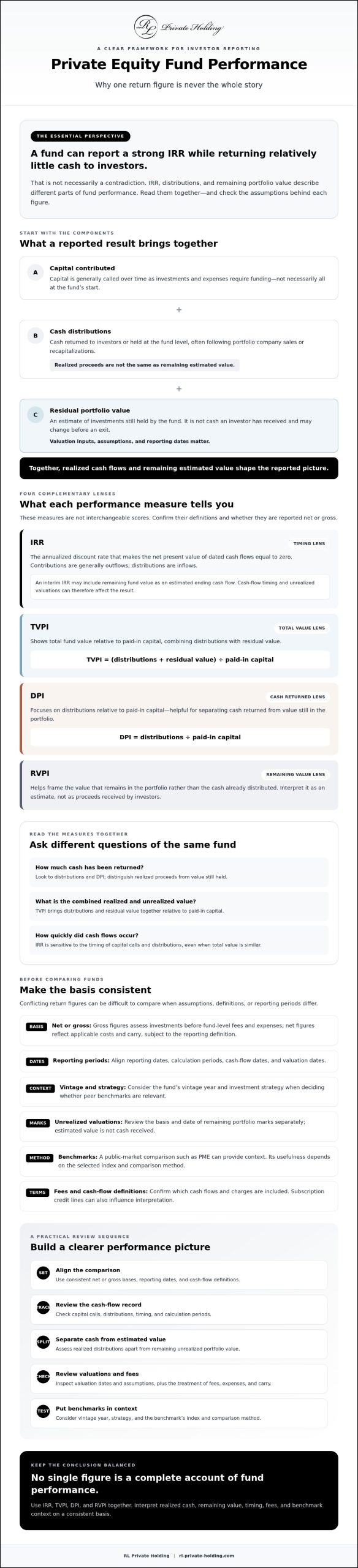
A Practical Due-Diligence Workflow for Reviewing Private Equity Performance
A disciplined review moves from source documents to interpretation rather than beginning with a headline return. Use the steps below to check how reported figures were assembled, identify assumptions that need clarification, and frame follow-up questions. This process can help investors understand results, but it cannot guarantee future performance.
- Establish the reporting basis. Record the reporting period and fund inception date, and confirm whether each figure is gross or net. Check the definitions used for paid-in capital, distributions, residual value, fees, and expenses. If the report presents several metrics, verify that they use a consistent basis.
- Review dated cash flows. Compare capital-call and distribution records with the fund’s reporting materials. Check that dates and amounts reconcile with the stated paid-in capital and distributions, and ask how any differences are treated in performance calculations. This provides a practical check on the inputs behind reported return measures.
- Reconcile the value multiples. Review how reported DPI and TVPI were calculated from contributed capital, distributions, and remaining value. Confirm that the figures follow the definitions stated in the report. If an amount cannot be reconciled from the available materials, request an explanation rather than infer the calculation.
- Examine unrealized holdings. Identify the valuation date for each remaining investment and the basis used to estimate its value. Compare valuations across reporting periods, paying attention to write-downs, write-ups, and changes in assumptions. Ask what evidence supports material changes and whether the valuation information is current as of the report date.
- Test comparisons and interpretation. Check whether peer funds and benchmarks reflect a relevant strategy, vintage, and measurement period. Review realized proceeds separately from unrealized value before drawing conclusions about performance. For wider portfolio context, see these private equity investment management frameworks.
Use the review to form specific follow-up questions: Which reported values are realized, which remain estimates, and what definitions or assumptions explain the reported result? If source data or peer information is incomplete, record the limitation clearly. This helps prevent uncertain inputs from being treated as established facts.
For further context on private equity investment management, explore RL Private Holding’s investment management approach.
Using Performance Measures in Private Equity Investor Reporting and Evaluation
Clear reporting makes performance measures useful for ongoing evaluation. IRR, TVPI, DPI, and RVPI should appear together with their calculation definitions, reporting dates, cash-flow coverage, and net or gross basis. Consistent presentation helps investors distinguish a movement in underlying results from a change in reporting method or period.
Build a clear and consistent performance dashboard
A practical dashboard should show each metric beside the information needed to interpret it. State whether figures are measured at fund or investor level, identify the valuation date for remaining holdings, and explain how fees and expenses are treated. Keep those conventions consistent from one report to the next, or disclose changes so comparisons across periods remain meaningful.
Present realized and unrealized performance distinctly. Distributions and proceeds from completed exits represent realized value; residual portfolio valuations remain estimates until investments are sold. Fund-level results should also be separated from portfolio-company examples, since a selected company outcome does not by itself describe the fund as a whole.
- Show IRR, TVPI, DPI, and RVPI with clear definitions and the same reporting cut-off.
- Identify the cash flows included and whether figures are net or gross.
- Separate realized proceeds from unrealized valuations, including the valuation date and status.
Turn performance data into informed investor questions
Use changes between reports to guide discussion, not to reach conclusions from a single figure. Ask what changed in capital calls and distributions, which holdings were realized, and what drove valuation adjustments. If residual values moved, request information about the assumptions and evidence behind those changes. For benchmark comparisons, clarify whether the selected index and measurement period remain appropriate.
Strategy also matters. Venture investments may have different risk and exit profiles from buyout funds, so consider their performance in an appropriate context. Investors reviewing that strategy separately can consult these venture capital investment frameworks. Consistent reporting supports better questions, but it cannot remove uncertainty from valuations or predict future results.
RL Private Holding provides private equity investment management and wealth management services to institutional and private investors. To learn more about the firm’s approach, explore RL Private Holding’s investment management approach.
Make Performance Review Part of a Disciplined Investment Process
Sound evaluation depends on reading performance figures in context. IRR, TVPI, DPI, and RVPI each illuminate a different aspect of fund results, while consistent definitions, reporting dates, and net or gross treatment help make comparisons more reliable. Reviewing realized proceeds separately from estimated remaining value also clarifies what has been returned and what remains subject to valuation.
Use these practices to make measuring private equity fund performance a repeatable part of manager evaluation, rather than a decision driven by one headline return. Identify assumptions, gaps in reporting, and focused questions for further discussion. No metric can remove investment uncertainty, but careful interpretation can support more informed decisions.
RL Private Holding manages a diversified global portfolio across several investment sectors and provides private equity investment management and wealth management services. To learn more about the firm’s approach, explore RL Private Holding’s investment management approach.
With consistent analysis and thoughtful follow-up, investors can approach fund evaluation with greater clarity and confidence.
Frequently Asked Questions
How is private equity fund performance measured?
Private equity fund performance is measured by reviewing several complementary metrics rather than relying on one return figure. IRR reflects the timing of cash flows, while TVPI compares total value with paid-in capital. DPI shows distributions returned, and RVPI captures the reported value still held in the portfolio. To understand how to measure private equity fund performance, check the calculation definitions, reporting date, net or gross basis, and whether value is realized or estimated.
What is the difference between IRR and TVPI?
IRR is a time-sensitive measure based on the dates and amounts of fund cash flows, usually expressed as an annualized rate. TVPI is a multiple comparing distributions plus remaining portfolio value with paid-in capital. IRR describes the pace of returns, while TVPI shows total value relative to contributed capital without expressing how quickly that value arose. Compare both on the same reporting date and confirm how interim valuations are included.
What do DPI and RVPI mean in private equity?
DPI means Distributed to Paid-in Capital. It compares value distributed to investors with capital they contributed, providing a view of returned value. RVPI means Residual Value to Paid-in Capital and compares the fund’s remaining reported value with paid-in capital. DPI is based on distributions, while RVPI depends on valuations of investments that have not yet been realized. Under consistent calculation conventions, DPI plus RVPI equals TVPI.
Can a private equity fund have a high IRR but a low DPI?
Yes. A fund can report a high interim IRR while having a low DPI if its reported return reflects strong estimated residual values or the timing of cash flows, but relatively little value has been distributed. The IRR may therefore include unrealized performance, while DPI records distributions made to investors. Review the fund’s cash-flow schedule, valuation assumptions, and calculation basis before interpreting the difference as evidence of realized success.
How should investors compare private equity funds from different vintage years?
Compare vintage years with care because funds launched in different periods may have invested and exited under different market conditions. Consider whether the funds share a similar strategy, investment stage, geography, and reporting period, and compare net with net or gross with gross. Use relevant peer groups and state any data limitations. A vintage-year comparison provides context, but it does not isolate manager skill or make different strategies directly comparable.
What is a Public Market Equivalent in private equity?
A Public Market Equivalent (PME) compares the timing of a private equity fund’s cash flows with the performance of a selected public-market index. It offers a way to assess private-market results against a public-market reference over a corresponding period. PME approaches differ in methodology, so investors should identify the index, cash-flow treatment, and measurement dates. PME supplements fund metrics such as IRR and TVPI; it does not replace them.
Are private equity returns reported gross or net of fees?
Private equity returns may be reported on either a gross or net basis, so investors should confirm the definition in each report. Gross figures generally describe investment performance before fund-level fees and expenses. Net figures reflect returns after applicable costs and carry, according to the stated convention. These measures answer different questions. For a fair comparison, check which charges are included, whether results are presented at fund or investor level, and whether both funds use the same basis.