

What makes a pre-seed company ready for investment often depends less on having a finished product and more on showing why the next step is worth financing. The pre-seed investment criteria for tech companies vary by investor, but founders often face the same uncertainty: whether a prototype, early customer interest, or an incomplete team is enough to make a credible case.
That uncertainty is understandable. Pre-seed investors may assess a company before revenue provides a clear signal, and expectations differ across funds, sectors, and development stages. An idea alone may not be persuasive, but a company doesn’t necessarily need a fully launched product or a complete founding team to begin investor conversations.
This guide explains the main factors investors commonly consider, without treating any single checklist as universal. It covers how to communicate the problem and market opportunity, demonstrate technical progress and customer validation, and align your funding case with the company’s stage. The aim is to help technology founders distinguish useful evidence from assumptions and present a focused, credible account of what investment would enable.
Key Takeaways
- Use the pre-seed investment criteria for tech companies as a flexible framework, not a universal checklist or fixed maturity threshold.
- Connect founder expertise and market understanding to a clear explanation of the problem, customer alternatives, and adoption barriers.
- Compare validation evidence by what it demonstrates, from prototype tests and customer interviews to pilots and repeat usage.
- Build a concise investment case that links customer need, technical progress, unresolved risks, and measurable funding milestones.
- Assess investor fit across sector, stage, geography, and mandate before deciding on the next fundraising step.
What Pre-Seed Investment Criteria Mean for Technology Companies
Pre-seed describes an early financing stage, not a fixed level of product maturity. A company may be testing a core technical assumption, building an initial product, or validating a defined customer problem. The pre-seed investment criteria for tech companies are therefore best understood as assessment themes, not a universal pass-or-fail checklist. Investors can consider the quality of the opportunity and the founders’ progress even when revenue is absent.
At this stage, evidence needs context. A working prototype may show that a technical concept functions, while customer interviews may help establish whether the problem is urgent enough to address. Neither proves a business model on its own. A credible account explains what has been tested, what was learned, and which uncertainty remains. This reflects the broader role of venture capital in financing companies with growth potential, as outlined in Understanding Venture Capital.
How pre-seed differs from seed and Series A
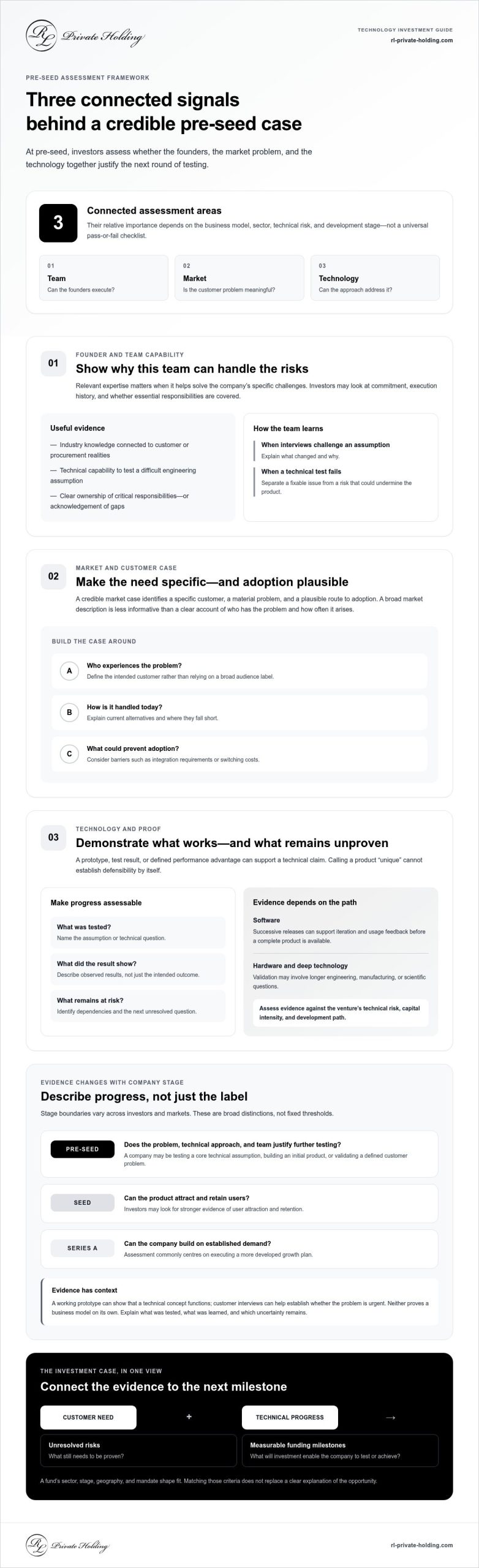
Stage labels offer a general sense of maturity, but their boundaries vary across investors and markets. At pre-seed, the central question is often whether the problem, technical approach, and founding team justify further testing. At seed, investors may look for stronger evidence that a product can attract and retain users. By Series A, assessment commonly centres on whether the company can build on established demand and execute a more developed growth plan. These are broad distinctions, not fixed thresholds.
Describe your position through evidence rather than relying on a label alone. Explain which product components exist, what users have done with them, and what the next test will establish. This makes progress easier to assess, even when two investors classify the same company differently.
Why criteria vary across technology businesses
Software products can often be revised and tested through successive releases, allowing teams to gather usage feedback before a complete product is available. Hardware and deep technology ventures may face longer validation paths, including engineering, manufacturing, or scientific questions. Their timelines and evidence will differ. Capital intensity and technical risk also affect what counts as a meaningful milestone, so assess evidence against the company’s specific development path.
Common assessment themes describe what investors may examine; each investor’s mandate determines which sectors, geographies, stages, and opportunities fit its scope. These are separate considerations. A company may present credible technical progress and customer learning yet fall outside a particular fund’s investment focus. Conversely, matching a fund’s stated sector or stage does not replace the need to explain the opportunity clearly.
Make progress assessable by recording the assumptions tested, the results observed, and how those results shaped product or market decisions. For example, a team without sales might show that a prototype completed a critical task and that intended users returned for further testing. This does not guarantee investment, but it gives investors a basis for evaluating learning, technical feasibility, and the next unresolved risk.
The Core Pre-Seed Investment Criteria: Team, Market, and Technology
Investors commonly examine three connected parts of a young technology company: whether the founders can execute, whether a meaningful market problem exists, and whether the technology can address it. The pre-seed investment criteria for tech companies are not a fixed checklist. Their relative importance depends on the business model, sector, technical risk, and development stage. A software venture may need to demonstrate rapid product iteration, while a scientific technology company may need to establish technical feasibility before customer adoption can be tested.
Founder and team capability
Relevant expertise matters when it helps the team address the company’s specific risks. A founder with experience in the target industry may understand procurement constraints, while a technical founder may be equipped to test a difficult engineering assumption. Investors also assess commitment, execution history, and whether essential responsibilities are covered. No single team size fits every venture; the key question is whether critical capabilities are present or whether gaps are clearly recognised.
How founders respond to evidence is equally revealing. If customer interviews contradict an initial assumption, a thoughtful team can explain what it changed and why. If a technical test fails, founders should be able to distinguish a fixable issue from a risk that could undermine the product.
Market and technology case
A credible market case identifies a specific customer, a material problem, and a plausible route to adoption. Understand how customers address the problem today, why existing alternatives fall short, and what could prevent adoption, such as integration requirements or switching costs. A broad market description is less informative than a clear account of who experiences the problem and how often it arises.
Technical differentiation also needs evidence. A prototype, test result, or defined performance advantage can support a claim; describing a product as “unique” cannot establish defensibility by itself. Explain what the technology enables, what remains unproven, and which dependencies could affect delivery.
Investors can assess these areas together rather than as isolated boxes. For example, a team building specialised software might show that its founders understand a customer workflow, that users have tested a prototype, and that the product addresses a costly limitation in existing tools. The case is more credible when the founders also identify barriers, such as data access or integration, and explain how they will investigate them.
Investment readiness depends on evidence proportionate to the company’s stage, not on claims that exceed what has been tested. Make your case easier to assess by organising evidence around three questions:
- Team: Which capabilities address the venture’s most important execution risks?
- Market: Who has the problem, what alternatives do they use, and what could limit adoption?
- Technology: What has been demonstrated, what remains uncertain, and what must work for the product to succeed?
This framework helps founders separate broadly relevant assessment themes from any individual investor’s sector or investment mandate. For further context on how technology and venture capital intersect, explore RL Private Holding’s focus on technology and venture capital.
What Counts as Pre-Seed Traction Without Significant Revenue?
Revenue is one form of evidence, but it is not the only way to show progress before a technology product is commercially established. Ask what each signal demonstrates and which uncertainty it leaves unresolved. A prototype can support technical feasibility; customer use can indicate demand; repeated use or a paid pilot may provide stronger evidence of value. None proves every part of the business case, and no signal guarantees an investor’s decision. Apply the pre-seed investment criteria for tech companies in light of the company’s risks and stage.
Technical validation and product evidence
A prototype is informative when tested against a defined requirement, such as completing a core task or meeting a stated performance threshold. Record the test conditions, results, limitations, and next validation milestone. A demonstration under controlled conditions can establish that a function works in that setting, but it does not necessarily show that the product can be manufactured reliably, deployed at scale, or maintained in customer environments. This distinction helps investors understand both progress and remaining technical risk.
Customer validation before revenue
Customer interviews can reveal how often a problem occurs, current workarounds, purchasing constraints, and the language customers use to describe their needs. They are most useful when founders speak with people who experience the problem and test assumptions with specific questions. Positive opinions alone are weak evidence: interest in a concept does not establish willingness to change behaviour, allocate budget, or adopt a new product.
Other validation signals indicate different levels of engagement:
- Design partners contribute feedback during product development. This can clarify requirements, but participation does not necessarily indicate a future purchase.
- Letters of intent record stated interest or an intention to explore a relationship. Their value depends on the detail and commitment expressed; they should not be represented as contracted revenue.
- Pilots put a product into a defined customer setting. A pilot can test workflow fit and practical outcomes, but a limited trial does not by itself establish repeatable sales.
- Repeat usage can show that users return to a product for an ongoing need. Its significance depends on who uses it, how often, and whether usage reflects the target customer’s normal workflow.
These signals are not a universal ranking. A hardware prototype may be central to assessing technical feasibility, while recurring use may be more relevant for a software product. Separate three questions in your evidence: can the technology work, do customers want the solution, and can the company deliver and sell it repeatedly? Progress on one does not automatically resolve the others.
Present evidence with its limits. State who participated, what was tested, what outcome was observed, and what remains uncertain. This makes early traction credible without overstating it as product-market fit or assuming that every investor will weigh the same signal equally.
How to Prepare a Credible Pre-Seed Investment Case
A credible investment case connects the customer problem to the proposed solution, the evidence gathered so far, and the risks that remain. It should help an investor understand not only what the company intends to build, but why the team believes it matters and what it needs to learn next. The pre-seed investment criteria for tech companies are easier to assess when claims in the pitch deck link to specific tests, customer feedback, or documented decisions.
Keep the narrative concise and candid. State the customer segment and problem, explain how the product addresses it, then identify what has been validated and what remains an assumption. Include material dependencies, such as access to data, specialist suppliers, or integration with existing systems. Explain what could happen if a key assumption proves wrong and how the team would respond. This demonstrates that the founders understand the execution path without diminishing the opportunity.
Assemble the evidence and diligence materials
Organise product demonstrations, technical test results, customer conversations, and pilot documentation so that each supports a specific claim. Provide context for results, including test conditions and limitations. Prepare a clear account of intellectual property ownership and material dependencies. Keep the pitch deck consistent with its supporting materials, and distinguish observed results from projections or plans.
Connect capital deployment to milestones
For each proposed use of funds, explain the activity it supports, the observable milestone it is intended to reach, and what the milestone should help the team learn. A product engineering allocation, for example, could support a defined integration test; customer discovery could aim to clarify workflow requirements. Set milestones that match the company’s stage, and explain the assumptions behind any projections rather than presenting them as established outcomes.
A simple evidence map can make the relationship between current progress and future work clear:
| Evidence available | Investor question | Next milestone |
|---|---|---|
| Prototype test results | Does the core function meet the required performance? | Repeat the test under a more representative operating condition. |
| Customer interviews | Is the problem important within the intended segment? | Test the most consequential workflow or purchasing assumption. |
| Pilot feedback | Can the product fit into a customer’s process? | Assess usage, outcomes, and requirements for continued deployment. |
| Technical dependency identified | Could an external system or supplier constrain delivery? | Validate access, compatibility, or an alternative approach. |
Use this map to show a logical progression, not to imply certainty. A milestone is useful when its result can change a decision: continue, revise the product, test a different customer segment, or address a technical constraint. Forecasts should follow from explicit assumptions about adoption, delivery, and capacity. If those assumptions are uncertain, state that plainly and show how the proposed work will test them.
For founders developing an investor case around technology and venture capital, explore RL Private Holding’s venture capital focus.
Assessing Investor Fit and Choosing the Next Step
A strong company may still fall outside a particular fund’s scope. Investor fit is separate from company quality and should be assessed through alignment among sector, stage, geography, and investment mandate. For founders applying pre-seed investment criteria for tech companies, this distinction helps prevent one investor’s published rules from being mistaken for a universal standard.
Evaluate mandate fit without treating criteria as universal
Review each prospective investor’s stated focus, then compare it with the company’s sector, development stage, location, and current evidence. A fund focused on a different technology area or later-stage ventures may not be aligned, even if the business has a credible case. Published eligibility rules describe that investor’s approach; broader market conventions are reference points, not guarantees of interest.
A simple fit assessment can keep outreach focused:
- Sector: Does the investor state an interest in the company’s technology or market?
- Stage: Does its investment focus include companies at this level of development?
- Geography: Does its stated mandate include the company’s location or target markets?
- Evidence: Does the company’s current progress address the questions relevant to that stage?
This assessment is a prioritisation tool, not a prediction of an investment decision. A close match may make a conversation more relevant, but it does not establish that an investor will proceed. A mismatch can reflect the mandate rather than a negative judgement about the company. Broader perspectives on venture capital investment frameworks can help founders place individual funding discussions within a wider investment context.
A measured next step for founders
Before approaching prospective capital partners, refine the investment narrative and ensure its central claims are supported by evidence. Identify the company’s principal unresolved risk, then define the next proof point that would materially reduce it. That may involve testing a technical dependency, demonstrating continued use in a relevant workflow, or clarifying a customer adoption assumption. The appropriate milestone depends on the venture, not on a standard timetable.
Use that proof point to make the next decision practical. If results support the current direction, explain how further capital would advance the next milestone. If results challenge an assumption, show how the team will adapt. This approach links fundraising readiness to disciplined learning rather than to a fixed revenue threshold or a checklist copied from another investor.
Capital allocation is also shaped by the investor’s broader objectives and mandate. For context on that wider perspective, review family office investment strategies. To explore RL Private Holding’s stated focus on technology and venture capital, read its venture capital investment framework.
Make the Next Funding Decision with Greater Clarity
Your first investment case is a working document, not a permanent verdict on the company. As new technical or customer evidence emerges, record how it changes your assumptions and priorities. That discipline helps founders decide whether to deepen validation, adjust direction, or begin investor discussions, while keeping the case aligned with the company’s actual progress. It also makes the pre-seed investment criteria for tech companies more useful as a framework for reflection than as a checklist to satisfy.
RL Private Holding focuses on technology and venture capital and publishes guidance on European Series A fundraising and investor scrutiny of VC pitch decks. These perspectives can provide relevant context as you refine your funding approach.
Explore RL Private Holding’s venture capital funding and develop a clear, evidence-led case for your company’s next stage. Thoughtful preparation can make the path ahead more deliberate, whatever decision you take next.
Frequently Asked Questions
Is pre-seed funding the same as angel investment?
No. Pre-seed refers to a company’s financing stage, while angel investment describes a type of investor. An angel may invest at pre-seed, but capital can also come from venture funds, accelerators, or other sources. For example, a founder can be raising pre-seed funding while speaking with both individual angels and an institutional fund. Assess the company’s stage separately from each investor’s mandate and preferred investment approach.
Can public grants be combined with pre-seed venture capital?
In some cases, founders combine non-dilutive funding with equity investment, but a grant’s terms determine which costs it can support and what obligations apply. Keep award documents, conditions, and spending records organised alongside investment materials. For example, if a grant funds research, distinguish that work from milestones supported by equity capital. A grant award is evidence of funding, not proof that customers want or use the product.
How much equity do pre-seed investors usually receive?
There is no universal ownership percentage for a pre-seed investment. The result depends on the instrument, valuation or conversion terms, round structure, and negotiations. Founders should model how the proposed financing could affect ownership under more than one plausible future financing scenario, including any instruments that may convert later. Before agreeing to terms, obtain qualified legal and financial advice suited to the company’s circumstances rather than relying on a market benchmark.
What happens if a startup misses a pre-seed milestone?
Missing a milestone does not automatically make a startup uninvestable. Identify the cause, such as a technical delay, a changed customer assumption, or an execution issue, then explain what the team learned and how the plan has changed. A concise update can compare the original target with the outcome, describe the revised timeline, and state what evidence will guide the next decision. Clear reporting supports informed discussion.
Is a SAFE the same as an equity investment?
No. A SAFE is a financing instrument that may convert into equity under specified conditions; it is not the same as issuing shares immediately. Its effects depend on the document’s terms and the company’s jurisdiction. Before signing, understand the conversion triggers, how the instrument could affect ownership, and how it may interact with later financing documents. Qualified legal advice can help assess the specific terms rather than relying on a generic template.
Can a technology startup raise pre-seed funding before building an MVP?
Yes, some investors may consider a company before it has a complete MVP, depending on the technology, risks, and their mandate. In that situation, founders can explain why building the full product is not yet the right test. For example, they might present results from a technical experiment or documented customer discovery, then define what the next funding would validate. Expectations differ, so the evidence should fit the company’s principal uncertainty.
What should founders do if their startup does not fit one investor’s criteria?
Treat one investor’s decision as information about fit, not a universal verdict on the company. Identify whether the gap concerns stage, sector, geography, or the evidence presented, then refine outreach toward investors whose stated focus is more relevant. If feedback points to an untested assumption, prioritise a specific validation step before approaching others. This is a practical way to apply the pre-seed investment criteria for tech companies without mistaking one mandate for a market-wide rule.