

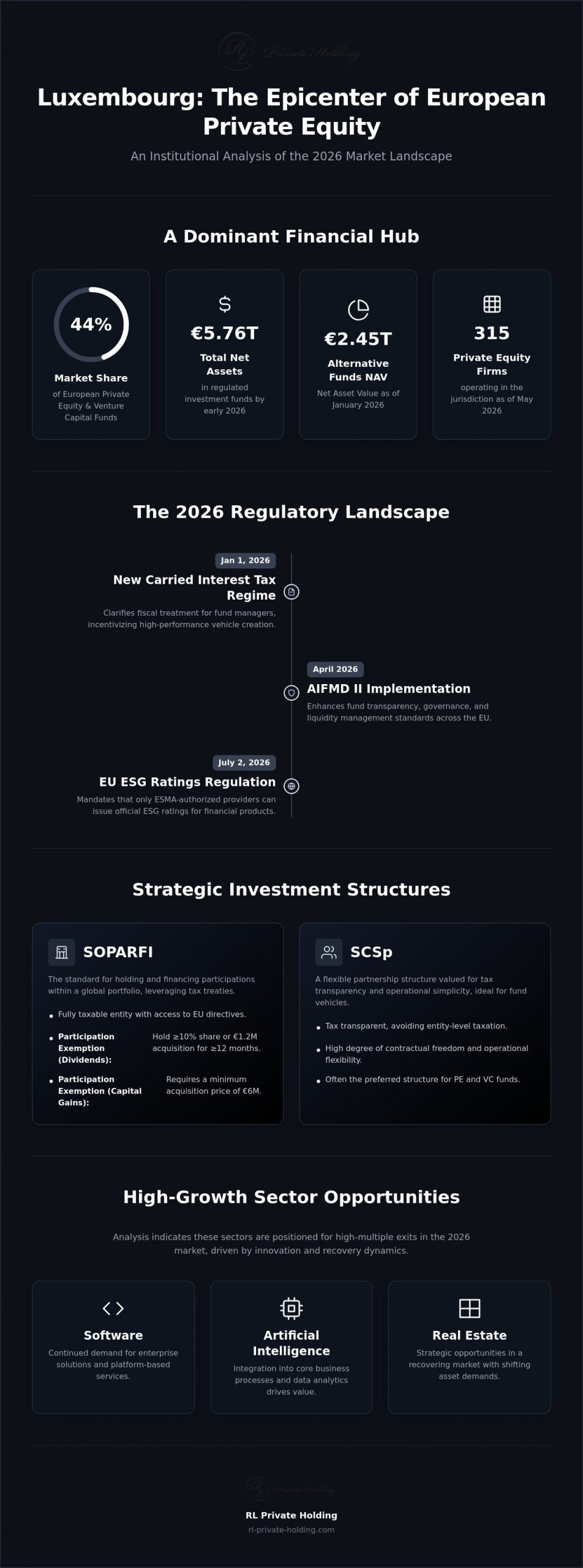
Luxembourg currently commands a 44% share of all European private equity and venture capital funds, with total net assets in regulated investment funds exceeding €5.765 trillion by early 2026. This dominant market position underscores the institutional confidence in the Grand Duchy, yet the landscape for private equity investment opportunities in Luxembourg has become increasingly sophisticated. Professional investors recognize that capital allocation now requires more than just domicile; it demands a precise understanding of the new AIFMD II framework and the revised carried interest tax regime that became effective on January 1, 2026.
You likely recognize that managing regulatory complexity while identifying high-growth technology exits is a persistent challenge. It’s a task that requires both technical precision and sector-specific agility. This article provides an institutional-grade analysis of the current market, identifying specific sector opportunities within software, AI, and the recovering real estate market. We’ll evaluate the optimal legal structures for your objectives, specifically benchmarking the Special Limited Partnership (SCSp) against the traditional SOPARFI. Our overview concludes with a framework for benchmarking investment management partners to ensure long-term strategic alignment and disciplined risk management in this evolving environment.
Key Takeaways
- Analyze the structural distinctions between SOPARFI and SCSp vehicles to select the optimal framework for tax transparency and operational flexibility.
- Identify specific high-growth sectors, including technology and real estate, that are positioned for high-multiple exits in the 2026 market.
- Evaluate the most viable private equity investment opportunities in Luxembourg by applying a disciplined analysis of the post-AIFMD II regulatory environment.
- Apply a comprehensive due diligence framework to benchmark investment management partners based on historical performance and fee alignment.
- Explore the strategic benefits of integrating private equity allocations within a broader wealth management and diversified global portfolio strategy.
The Evolution of Private Equity Investment Opportunities in Luxembourg
Luxembourg has solidified its position as the preeminent European jurisdiction for alternative investment funds (AIFs). As of mid-2026, the Grand Duchy manages a 44% share of all European private equity and venture capital funds. This concentration of capital isn’t an accident; it’s the result of decades of structural refinement and a proactive approach to regulatory alignment. The introduction of AIFMD II in April 2026 has further enhanced the transparency and liquidity management of these vehicles, ensuring that private equity investment opportunities in Luxembourg remain attractive to sophisticated global limited partners.
The regulatory framework, overseen by the Commission de Surveillance du Secteur Financier (CSSF), provides a predictable environment for fund managers. Investors have shifted their focus from broad, diversified allocations toward more targeted, sector-specific strategies. This transition is supported by the new EU ESG Ratings Regulation, effective July 2, 2026, which mandates that only ESMA-authorized providers can issue ESG ratings. Additionally, the new carried interest tax regime implemented on January 1, 2026, has clarified the fiscal treatment for fund managers, further incentivizing the creation of high-performance vehicles. These measures have reduced information asymmetry and heightened the institutional gravity of the local ecosystem.
Luxembourg as a Global Financial Center in 2026
The Economy of Luxembourg is fundamentally defined by its financial services sector, which provides a stable foundation for global asset management. The Net Asset Value of alternative funds domiciled here reached €2.45 trillion in January 2026, reflecting the massive scale of capital under management. The local ecosystem benefits from a highly specialized, multilingual workforce capable of navigating the complexities of cross-border fund administration. For investors entering the European market, the jurisdiction offers an unparalleled gateway that combines political neutrality with deep technical expertise. The presence of 315 private equity firms as of May 2026 demonstrates the scale of this established network.
Key Drivers for Private Equity Growth
Institutional appetite for non-listed assets continues to expand as investors seek higher alpha in a global economy characterized by public market volatility. The expansion of private equity investment opportunities in Luxembourg is increasingly driven by the growth of private credit funds and the integration of advanced data analytics into fund reporting. Technology has become central to this growth, with firms using AI to meet the enhanced governance requirements of AIFMD II. This digital transformation allows for more precise monitoring of portfolio company performance and risk metrics. The 2026 Luxembourg private equity landscape represents a unique nexus of institutional stability and structural innovation.
Strategic Investment Structures: SOPARFI and SCSp Frameworks
Selecting the correct vehicle is a foundational step in capturing private equity investment opportunities in Luxembourg. The jurisdiction’s versatility allows for a tailored approach based on the investor’s tax profile and the nature of the underlying assets. As the market moves through 2026, the choice between a corporate holding company and a transparent partnership has become a matter of strategic precision rather than mere administrative preference. Both structures must now account for the enhanced substance requirements and the AIFMD II regulatory framework that governs fund operations across the European Union.
The SOPARFI Structure for Global Holdings
The SOPARFI remains the standard for holding and financing participations within a global portfolio. It is a fully taxable entity, which grants it access to Luxembourg’s extensive double tax treaty network and the EU Parent-Subsidiary Directive. To benefit from the participation exemption on dividends, the SOPARFI must hold at least 10% of a subsidiary’s share capital or a participation with an acquisition cost of at least €1.2 million for a minimum of 12 months. For capital gains, the acquisition price threshold increases to €6 million. This structure is particularly effective for institutional capital seeking to consolidate international assets while maintaining high governance standards and a genuine local presence.
Utilising the SCSp for Private Equity and VC
For fund managers and US-based sponsors, the Luxembourg special limited partnership (SCSp) has become the preferred choice for private equity investment opportunities in Luxembourg. The SCSp lacks legal personality and is tax transparent, meaning the partners are generally taxed in their home jurisdictions. This contractual flexibility allows for bespoke arrangements regarding management control and confidentiality. It is particularly well-suited for managing the new carried interest tax regime that took effect on January 1, 2026, where contractual carry is taxed at a maximum effective rate of approximately 11.45%. This transparency simplifies the allocation of returns in complex, multi-jurisdictional fund structures.
Compliance in 2026 requires strict adherence to the new EU ESG Ratings Regulation and the liquidity management tools mandated by AIFMD II. As highlighted in the 2025 Private Markets Outlook, the shift toward these specialized structures reflects a broader institutional move toward operational clarity. Managing these requirements effectively requires a strategic partner for asset management who understands the intersection of legal structure and market performance. By aligning the choice of vehicle with the specific needs of the asset class, investors can ensure their portfolios remain both resilient and efficient.
High-Growth Sectors: Technology and Real Estate Private Equity
The allocation of capital within the Grand Duchy has moved beyond broad market exposure toward highly specialized, vertical-specific strategies. Investors seeking private equity investment opportunities in Luxembourg are increasingly focused on sectors where structural tailwinds align with the jurisdiction’s regulatory strengths. The Luxembourg private equity environment provides a unique infrastructure for scaling growth-stage companies while maintaining the rigorous governance standards expected by institutional limited partners. In the 2026 market, the most resilient returns are being generated at the intersection of technological innovation and sophisticated real estate management.
Success in this landscape requires a transition from passive capital deployment to active, value-added management. This is particularly evident in how venture capital funding is now integrated into broader private equity frameworks to capture high-multiple exits. By leveraging the country’s status as a gateway for global scaling, managers can identify and nurture enterprises that are positioned to disrupt established European industries. This strategic focus ensures that portfolios remain robust even as global economic conditions fluctuate.
The Technology Venture Capital Landscape
Growth-stage technology investments have become a primary driver of alpha within the European ecosystem. In 2026, the focus has narrowed to three core niches: FinTech, SaaS, and GreenTech. The latter has seen a significant uptick in institutional interest following the implementation of the EU ESG Ratings Regulation on July 2, 2026. This regulation has standardized how sustainable technologies are assessed, providing much-needed clarity for investors. Luxembourg acts as a critical hub for these companies, offering the necessary fund administration and regulatory support to scale operations across the continent. Institutional venture capital allocation in these sectors is no longer viewed as speculative but as a fundamental component of a diversified private equity strategy.
Institutional Real Estate Investment Strategies
Real estate remains a cornerstone of the Luxembourg market, though the focus has shifted toward institutional-grade assets with strong ESG credentials. Effective real estate asset management Luxembourg now involves a dual approach: maintaining stable yield from commercial holdings while pursuing value-creation strategies in underserved urban centers. While the sector faced headwinds in previous years, the 2026 outlook is characterized by a recovery driven by professionalized management and the integration of smart-building technologies. Investors are increasingly utilizing private equity structures to manage these assets, allowing for greater flexibility in financing and exit timing. This professionalization of real estate management ensures that private equity investment opportunities in Luxembourg continue to offer a compelling risk-reward profile for sophisticated global partners.
Evaluating Private Equity Firms: A Due Diligence Framework
Due diligence is the primary safeguard for institutional capital. When assessing private equity investment opportunities in Luxembourg, investors must look beyond top-line returns to evaluate the underlying operational framework. The complexity of modern fund structures requires a systematic approach to benchmarking management teams. This involves a granular analysis of how a firm manages its internal controls and its alignment with limited partners. A robust due diligence process accounts for the firm’s ability to navigate the 2026 regulatory environment, particularly regarding the implementation of liquidity management tools and ESG reporting standards.
Institutional investors don’t simply buy into a strategy; they invest in the stability of the management entity. This requires verifying that a firm possesses the technical infrastructure to meet the enhanced reporting requirements of AIFMD II. Without a disciplined approach to governance, even the most promising sector-specific strategy can be undermined by operational inefficiencies or regulatory lapses. The evaluation must therefore prioritize firms that demonstrate a clear, documented history of compliance and structural transparency.
Performance and Fee Transparency
The traditional “2 and 20” fee structure remains a benchmark, but its application has evolved. Sophisticated investors now prioritize firms that offer co-investment opportunities, which serve as a tangible demonstration of a manager’s confidence in their own strategy. Benchmarking assets under management (AUM) fees is essential to ensure that the cost of administration doesn’t erode the net alpha. With the new carried interest tax regime in effect since January 1, 2026, understanding the fiscal efficiency of the carry structure is now a mandatory component of any performance evaluation. Contractual carry arrangements must be scrutinized to ensure they align with the 11.45% effective tax rate while incentivizing long-term value creation.
Governance and Reporting Standards
Institutional private equity investment management requires a commitment to high-frequency, transparent reporting. In the Luxembourg ecosystem, the role of independent auditors and administrative support is critical for maintaining regulatory compliance under AIFMD II. High-quality firms provide clear visibility into their risk management protocols and exit strategies, ensuring that limited partners aren’t left with illiquid positions during market shifts. This level of transparency is vital for benchmarking historical performance against current market conditions. The ideal private equity partner is one who prioritizes structural integrity over short-term gains.
Investors seeking to optimize their allocations should partner with firms that demonstrate a disciplined approach to global asset management. For an institutional-grade assessment of your current portfolio, you may consult our private equity specialists to discuss strategic alignment and portfolio optimization.
RL Private Holding: Institutional Excellence in Portfolio Management
The Grand Duchy’s role as a global financial hub is mirrored in the operational philosophy of RL Private Holding. We provide a bridge between sophisticated capital and high-growth assets across the globe. Our firm specializes in identifying private equity investment opportunities in Luxembourg that meet our criteria for institutional-grade stability. By maintaining a sober and factual approach to asset management, we ensure that our partners receive clear, objective analysis of their allocations. It’s this commitment to transparency that defines our role as a disciplined global partner in an increasingly complex market.
Our firm integrates private equity investment management with specialized wealth management services to provide a holistic framework for sophisticated portfolios. This ensures that capital is not merely deployed but is strategically managed to meet the rigorous ROI requirements of institutional partners. We prioritize the structural integrity of every investment vehicle, ensuring that our operations align with the latest 2026 regulatory standards, including AIFMD II and the new ESG Ratings Regulation.
A Disciplined Approach to Asset Management
Our investment strategy is rooted in a deep understanding of sector-specific nuances. In technology, we focus on identifying SaaS and FinTech enterprises that have moved beyond the initial proof-of-concept phase and are ready for institutional scaling. Our real estate asset management involves a methodical evaluation of commercial properties, ensuring they meet the enhanced sustainability requirements of the 2026 market. We don’t chase trendy industry buzzwords; instead, we prioritize assets with proven structural integrity and long-term value potential. This rigorous approach to asset selection is supported by our internal risk management protocols, which are designed to protect capital across diverse economic cycles. Every venture capital funding decision is backed by a commitment to identifying enterprises positioned for high-multiple exits within the European ecosystem.
Luxembourg as a Strategic Partner Base
Sophisticated investors require a partner that offers both global reach and local expertise. RL Private Holding utilizes the Grand Duchy’s robust financial infrastructure to manage complex cross-border investments with precision. We present ourselves as a “silent giant,” focusing on the structural components of global asset management rather than aggressive self-promotion. This allows our partners to benefit from a secure and organized framework that prioritizes professional distance and strategic focus. As the 2026 landscape for private equity investment opportunities in Luxembourg continues to evolve, our firm remains committed to providing the institutional excellence required to navigate this complexity. Investors seeking to optimize their allocations within a broader wealth management context will find that our firm provides the necessary institutional gravity to ensure long-term success.
Strategic Alignment for the 2026 Private Equity Landscape
The Grand Duchy’s financial ecosystem has matured into a jurisdiction defined by structural precision and regulatory clarity. Success in capturing private equity investment opportunities in Luxembourg now requires a sophisticated understanding of how to align legal vehicles like the SCSp with high-growth sectors such as SaaS and institutional real estate. As the market moves through 2026, the implementation of AIFMD II and new ESG standards has raised the threshold for operational excellence and transparency. Professional investors must prioritize these governance standards to ensure long-term portfolio resilience.
RL Private Holding maintains a disciplined focus on institutional-grade asset management from our headquarters in the world’s leading financial hub. We manage a diversified global portfolio with the quiet authority and technical expertise required by sophisticated partners. Our team remains committed to identifying high-value exits while maintaining the professional distance and strategic focus our clients expect. We invite you to Explore Strategic Investment Opportunities with RL Private Holding to learn how our structural approach can enhance your capital allocation strategy. We look forward to supporting your institutional objectives in this evolving market.
Frequently Asked Questions
What makes Luxembourg a preferred jurisdiction for private equity in 2026?
Luxembourg remains a preferred jurisdiction due to its political stability and its role as the primary European hub for alternative investment funds. The Grand Duchy offers a sophisticated legal framework that includes the AIFMD II directive and the new ESG Ratings Regulation. These elements create a predictable environment for global capital. The concentration of specialized service providers further enhances the efficiency of fund administration for international managers.
How does a SOPARFI structure benefit international private equity investors?
The SOPARFI structure provides international investors with access to an extensive double tax treaty network and the EU Parent-Subsidiary Directive. It is an ideal vehicle for holding and financing participations while benefiting from exemptions on dividends and capital gains. To qualify, an entity must hold at least 10% of a subsidiary’s share capital for 12 months. This structure ensures fiscal efficiency for cross-border private equity investment opportunities in Luxembourg.
What are the key differences between SCSp and other Luxembourg fund vehicles?
The SCSp differs from corporate structures by its lack of legal personality and its inherent tax transparency. This vehicle allows for significant contractual flexibility, enabling fund managers to tailor management control and profit-sharing arrangements. Unlike regulated funds, the SCSp is governed primarily by the limited partnership agreement. It is particularly effective for sponsors who require a structure that aligns with their specific domestic tax requirements.
Which sectors are currently driving private equity returns in Luxembourg?
Returns are currently driven by technology niches such as SaaS and FinTech, alongside institutional real estate managed within a private equity framework. The implementation of the EU ESG Ratings Regulation on July 2, 2026, has also increased the visibility of GreenTech assets. These sectors benefit from structural tailwinds and a professionalized management approach. Investors often target growth-stage enterprises that are positioned for high-multiple exits within the European market.
How should institutional investors evaluate private equity management fees?
Institutional investors should benchmark management fees against the net alpha generated and the level of operational support provided. While the traditional fee model is a standard reference, the focus has shifted toward the alignment of interest through co-investment opportunities. It’s essential to scrutinize the carry structure in light of the 2026 tax regime. This ensures that the fee model incentivizes long-term value creation rather than short-term volume.
What is the role of the CSSF in regulating Luxembourg private equity?
The Commission de Surveillance du Secteur Financier (CSSF) is responsible for the prudential supervision of the financial sector and the regulation of fund managers. It ensures that firms comply with AIFMD II requirements, including liquidity management and transparency obligations. The CSSF’s proactive approach to oversight provides a layer of institutional security that attracts global capital. This regulatory presence is a cornerstone of the jurisdiction’s reputation for stability.
How does RL Private Holding approach risk management in its portfolio?
RL Private Holding utilizes a disciplined approach to risk management that integrates rigorous due diligence with a diversified portfolio strategy. We focus on assets with proven structural integrity, particularly in the technology and real estate sectors. Our process involves a methodical evaluation of market cycles and regulatory shifts to protect partner capital. This institutional-grade framework ensures that every allocation is aligned with the long-term strategic objectives of our investors.
Can private individuals access private equity opportunities in Luxembourg?
Private equity investment opportunities in Luxembourg are primarily accessible to institutional and well-informed investors. This classification typically requires a minimum investment of €125,000 or a professional certification of financial expertise. These requirements ensure that participants have the necessary sophistication to manage the risks associated with non-listed assets. Individual access is often managed through specialized wealth management services that provide curated exposure to private markets.