

A diligence report can identify risk, but it cannot manage it throughout an investment. Risk mitigation in private equity investments starts before commitment and continues as conditions change. Incomplete information, interacting country, currency, governance, and company exposures, and a long holding period make a one-time review insufficient.
Investors need a disciplined process that turns uncertainty into decisions, rather than assuming every risk can be eliminated. This guide sets out a repeatable framework for identifying and evaluating exposure, deciding which risks can be influenced, and documenting the risks that remain. It also explains how to set decision gates and escalation triggers so new information can prompt timely action.
The discussion follows the investment lifecycle, from screening and due diligence through ownership and exit. It gives particular attention to emerging markets, where country conditions can interact with company fundamentals and currency exposure. It also shows how company-level assessments fit within portfolio oversight, so investors can see shared risks without treating every investment as the same.
Key Takeaways
- Use decision gates to keep risk review active from initial screening through exit preparation.
- Assess how operational, capital structure, governance, market, and exit exposures may interact within a deal.
- Match each risk control to the decision it supports, and record the exposure it cannot remove.
- Apply risk mitigation in private equity investments through defined evidence requirements, accountable owners, and escalation triggers.
- Connect deal-level findings to portfolio concentration reviews while preserving visibility into distinct exposures.
Why Risk Mitigation in Private Equity Investments Must Continue After Due Diligence
Due diligence provides an informed basis for an investment decision, not certainty about what happens next. In private equity, risk mitigation in private equity investments means using informed decisions and ongoing oversight to reduce the likelihood or potential impact of adverse outcomes. It does not eliminate uncertainty or guarantee a result. This distinction matters because operating performance, financing, governance, and market conditions can all change during ownership.
Separate exposure into three levels. Company-specific risks arise from a business’s operations, customers, leadership, or financial position. Portfolio-wide risks emerge when several investments share a vulnerability, such as reliance on the same sector or economic driver. External risks include factors outside an individual company’s control, such as changes in market conditions or political developments. Keeping these categories distinct helps show whether an issue is isolated or could affect multiple holdings.
Private equity’s structure makes this distinction especially important. Investments are generally less liquid than publicly traded securities, information may be unevenly available between owners and company management, and a longer holding period gives assumptions more time to be tested by events. The Private Equity Overview describes key features and strategies of the asset class. These characteristics help explain why review must continue after commitment: investors may have limited ability to exit quickly, and changes in performance or financing conditions can alter the original risk assessment.
What risk mitigation means in a private equity context
Risk mitigation is a cycle of identification, assessment, response, and review. First, specify what could impair value. Then assess its likelihood and potential consequences, choose a proportionate response, and revisit the assessment as evidence changes. In short, private equity risk mitigation is the ongoing process of identifying and assessing investment risks, taking steps to reduce their likelihood or impact, and reviewing the remaining exposure. Controls can reduce exposure, but they cannot assure an outcome.
Why one-time diligence is not enough
Ownership changes the information available to investors. Operating results may diverge from projections, financing conditions may shift, and governance arrangements may prove less effective than expected. Monitoring tests the assumptions formed during diligence against current company and market information. It continues diligence rather than replacing investment judgment: new evidence should inform decisions, and the rationale for taking action or retaining exposure should be explicit.
Emerging-market exposure calls for context, not a blanket risk label. Examine how local operating conditions, currency movements, governance practices, and the company’s revenue base relate to one another. For example, depreciation may affect a company differently depending on whether its costs, revenues, and obligations are denominated in local or foreign currencies. The relevant question is how these factors interact in the specific investment. A disciplined review separates risks investors may influence through ownership decisions from residual exposures that require monitoring throughout the holding period.
Map the Private Equity Risks That Can Compound Across a Deal
A useful risk map shows not only what could go wrong, but also how one exposure could intensify another. Group risks into company operations, capital structure, governance, market conditions, and dependence on a successful exit. This makes it easier to distinguish issues investors may influence through ownership or financing decisions from external conditions that call for scenario planning, risk limits, or acceptance.
Company, financial, and governance exposures
At company level, assess execution against the business plan, reliance on a small group of customers, the quality and timeliness of reporting, and dependence on key individuals. Consider how these risks might combine. A senior manager’s departure, for instance, may disrupt operations at the same time a major customer reduces orders. Liquidity and leverage add financial sensitivity: a company with limited cash flexibility may have less capacity to absorb weaker trading or tighter financing conditions.
Governance affects how quickly investors can understand and respond to these pressures. Board oversight, management incentives, reporting controls, and escalation procedures shape both the information available and the ability to act on it. Investors may influence these arrangements but cannot control every decision or outcome. Valuation uncertainty also deserves attention. Incomplete information can make estimates less reliable, so consistent valuation practices and documented assumptions help distinguish changes in business performance from changes in measurement.
Country and cross-border exposures in emerging markets
Country-level analysis should examine political and regulatory developments, currency movements, the ability to transfer or repatriate proceeds, and local-market conditions. These factors vary and should be assessed in the context of the specific investment. Review applicable legal and regulatory information for the relevant jurisdiction and date instead of relying on unsupported rankings or assumptions.
Then consider how those conditions interact with the company’s fundamentals and management capability. Currency depreciation, for example, may pressure a business that earns revenue in local currency but has foreign-currency obligations or imported costs. The effect depends on actual revenues, costs, financing, and the company’s ability to adjust. Country analysis describes the external setting; it does not establish whether a particular company can operate effectively within it.
Risk mitigation in private equity investments requires investors to distinguish influence from dependence. Operational priorities, governance arrangements, reporting expectations, and capital structure may be addressed through ownership decisions. Political shifts, market-wide financing changes, or currency volatility generally call for scenarios and an explicit assessment of residual exposure. The Comprehensive Risk Management Framework provides a fund-level reference for considering market, liquidity, and cash-flow risks together. Concentration can amplify portfolio exposure: if several holdings depend on the same market, customer segment, currency, or exit route, a common shock may affect them at the same time.
Mapping is most useful when it connects each company assessment to the portfolio’s shared dependencies. RL Private Holding’s global investment perspective provides context for considering company-level exposures alongside a diversified portfolio.
Compare Private Equity Risk Controls by Exposure and Decision
A control is useful when it addresses a defined exposure and informs a specific decision. Due diligence improves the evidence available before commitment; active ownership supports intervention during the holding period; contractual protections allocate rights and remedies; diversification manages concentration; and hedging can reduce selected financial exposures. Each control has costs and limitations, and none addresses every risk. The comparison below shows what each can support and what may remain.
| Exposure | Control | Decision use | Residual risk |
|---|---|---|---|
| Execution, customer concentration, or reporting weakness | Diligence, reporting requirements, board oversight, and performance monitoring | Set operating priorities and escalation thresholds | Management may not execute as planned; new information may remain incomplete |
| Governance or transaction-specific obligations | Contractual protections and defined governance rights | Allocate responsibilities and determine available remedies | Enforceability and practical recovery can vary by terms and jurisdiction |
| Concentration across investments | Portfolio diversification and exposure limits | Assess shared dependencies and avoid unintended portfolio concentration | Company-specific weaknesses and broad market shocks remain |
| Currency exposure | Scenario analysis and, where suitable, hedging | Evaluate sensitivity and manage a defined currency exposure | Business, political, and operational risks are not hedged away |
| Valuation uncertainty | Consistent valuation practices and documented assumptions | Review investment marks and compare changes over time | Estimates remain sensitive to available information and assumptions |
Match the control to the exposure
Operational risks call for more than an initial review. Reporting cadence, board oversight, management incentives, and performance indicators can help surface deviations early and support decisions about corrective action. For currency or country exposure, scenario analysis can test how different conditions affect a company’s cash flows and obligations. Hedging may suit a defined currency sensitivity, but it should follow an assessment of the underlying exposure rather than serve as a general safeguard.
Valuation controls also need a clear reference point. The International Private Equity and Venture Capital Valuation Guidelines (IPEV Guidelines), updated on December 11, 2025, are effective for reporting periods beginning on or after April 1, 2026. Investors should verify the applicable edition and reporting context when applying them. Consistent methods and documented assumptions support comparison, but do not remove uncertainty from private asset valuations.
Assess trade-offs and residual risk
Contractual protections can define rights, obligations, and remedies, but their practical value depends on the wording, counterparties, circumstances, and relevant jurisdiction. A right that is difficult to exercise may provide less protection than its terms suggest. Diversification can reduce reliance on a single company or market, but it cannot correct weak performance at an individual holding or neutralise a systemic shock affecting multiple investments.
Risk reduction lowers the likelihood or impact of an adverse outcome, risk transfer reallocates specified consequences to another party, and risk acceptance retains exposure when further action is not proportionate or available. These choices have different implications and should be recorded distinctly. For risk mitigation in private equity investments, the decision record should state the control selected, its purpose and limitations, and the residual exposure the investor is prepared to retain.
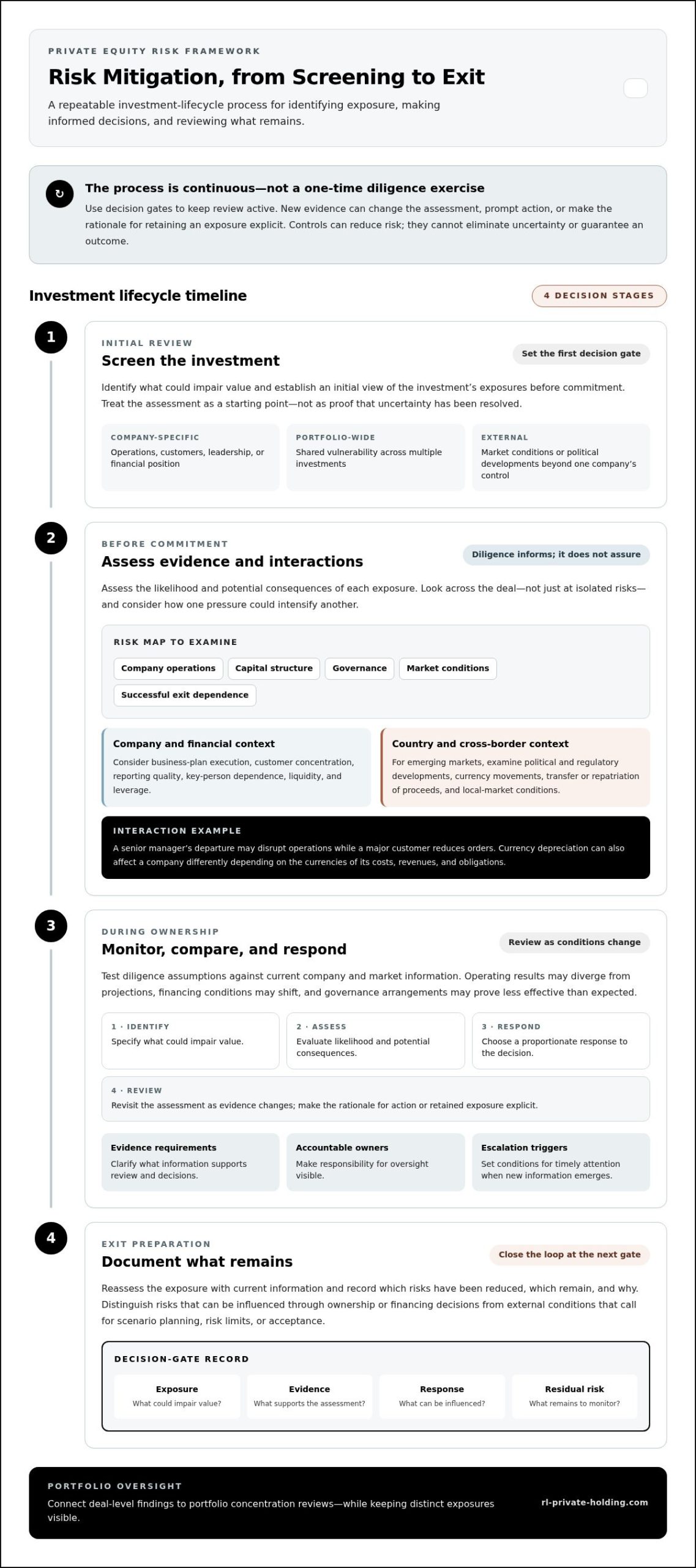
Apply a Repeatable Risk-Mitigation Process from Screening to Exit
A lifecycle process makes risk findings useful at each decision point. For risk mitigation in private equity investments, every gate should specify the evidence required, who is accountable for the recommendation, the approval route, and the rationale to record. This creates continuity: assumptions made during screening can be compared with actual results during ownership and reconsidered as exit preparation develops.
Set decision gates before committing capital
Define screening criteria before reviewing opportunities in detail. These criteria should identify exposures that could make an investment unsuitable, require further analysis, or warrant specific conditions. At each later gate, distinguish evidence from assumptions and unresolved questions. Scenario analysis should test downside cases, including changes in operating performance, financing availability, and relevant external conditions, without treating forecasts as certain.
- Screen the opportunity. The deal lead owns the initial recommendation, supported by available information on the business model, market, capital needs, governance, and material country or currency exposure. Record why the opportunity proceeds, is declined, or requires clarification.
- Complete focused diligence. Relevant investment and subject-matter leads assess company operations, financial information, management, governance, and external exposures. The evidence set should include diligence findings, key assumptions, proposed mitigants, and unresolved issues. Document how each material finding affects the investment case.
- Approve the commitment. The designated investment decision-makers review the full case, downside scenarios, remaining exposures, and any conditions or monitoring requirements. Record who approved the investment and why, including why residual risks are acceptable or require escalation before commitment.
- Establish ownership oversight. Assign an accountable investment owner and agree with relevant company leadership on indicators tied to the identified risks. Examples include customer concentration, cash generation, delivery against operating plans, reporting quality, or currency sensitivity. Set reporting frequency in proportion to materiality.
- Review and prepare for exit. The investment owner compares actual information with the approved case, documents changes, and escalates breaches of agreed tolerances through the established governance route. Review exit readiness throughout ownership, including information quality, unresolved matters, and dependencies that could affect timing or available options.
Monitor ownership-period triggers and prepare for exit
Triggers should be specific enough to prompt a decision, not merely describe a concern. A material departure from the operating plan, delayed reporting, a change in key leadership, or deterioration in a defined currency assumption may require reassessment. Set thresholds using the investment’s facts rather than generic benchmarks. The escalation route should identify who reviews the issue, what additional evidence is needed, and which decisions may need reconsideration.
For a related perspective on connecting deal review with portfolio oversight, see RL Private Holding’s private equity investment management framework. The firm’s investment approach also outlines its investment perspective.
Integrate Risk Mitigation into a Disciplined Private Equity Portfolio
A deal can appear manageable on its own while adding to a vulnerability already present elsewhere in a portfolio. Portfolio oversight should connect investment-level findings with shared exposures, including sector, geography, financing conditions, currencies, and counterparties. The aim is not to treat distinct investments as interchangeable, but to identify common drivers that could affect several holdings at once.
Connect deal-level controls with portfolio oversight
Translate material deal findings into a portfolio view. If several companies depend on the same market, rely on similar funding conditions, or generate revenue in currencies affected by the same external factors, review the combined exposure. Exposure limits and concentration reviews help decision-makers assess whether a proposed investment fits the portfolio’s risk parameters or warrants additional analysis, mitigation, or a different allocation.
Consistent reporting makes comparisons possible. Use shared categories for key risks, changes in assumptions, control status, and escalation items across investments. This structure can reveal patterns across holdings while preserving the context behind each finding. A currency risk, for example, may have different implications for two companies depending on their costs, revenues, financing, and ability to adapt. Aggregated reports should show where to investigate, not replace company-specific judgment.
Coordinated oversight can also include adjacent investment exposures, such as venture capital, technology, and real estate, where relevant to the portfolio. Broader family office investment strategies can provide useful allocation context, but portfolio-wide reporting has limits: it cannot make unlike assets directly comparable or eliminate uncertainty in underlying valuations.
Turn the framework into an investment discussion
A disciplined portfolio review links each decision gate to the next. Screening identifies exposures that may affect fit; diligence tests the investment case; approval records the rationale and accepted residual risks; ownership monitoring tracks changes against assumptions; and exit preparation considers remaining dependencies without presuming a particular route or result. Consistent documentation helps decision-makers understand what changed, who is accountable, and when escalation is appropriate.
For risk mitigation in private equity investments, this portfolio perspective is useful when company-level controls must be considered alongside concentration and exposure limits. RL Private Holding manages a diversified global portfolio, with investment interests spanning private equity, venture capital, technology, real estate, and asset management. These areas make disciplined oversight relevant, but do not imply a particular investment outcome or guarantee against loss.
To learn more about RL Private Holding’s investment focus, explore RL Private Holding.
Make Risk Review Part of Every Investment Decision
Make risk review a standing part of investment governance, rather than a document revisited only when conditions deteriorate. Assign a clear owner to each material exposure, define what evidence will prompt reassessment, and preserve the reasoning behind decisions to act, wait, or retain residual risk. This creates an institutional record that can inform future investment discussions and support discipline as priorities and market conditions evolve.
Effective risk mitigation in private equity investments does not depend on predicting every adverse event. It depends on recognising change, testing assumptions, and responding in a considered manner. A consistent process also gives investment teams a common basis for discussing how individual decisions fit within broader oversight.
RL Private Holding’s investment perspective reflects a global portfolio and interests across private equity, venture capital, technology, real estate, and asset management. For an overview of that focus, explore RL Private Holding’s investment approach. Use the framework in this guide to make risk review a clear part of each investment decision.
Frequently Asked Questions
Can risk mitigation eliminate the risk of loss in private equity?
No. Risk mitigation can reduce the likelihood or potential impact of adverse events, but it cannot remove uncertainty or assure a positive return. A company may miss forecasts despite careful review, or external conditions may change unexpectedly. Investors can make remaining exposure clearer by documenting assumptions, downside scenarios, and decision triggers. This helps them judge whether the potential risk remains acceptable as new information emerges.
How does currency risk affect private equity investments in emerging markets?
Currency movements can change the euro value of an investment’s cash flows, operating costs, debt, or eventual proceeds. For example, a company may earn revenue in local currency but owe debt in euros, making repayment harder if the local currency weakens. Model these exposures separately and examine possible natural offsets, such as local costs that move with local revenue. Currency analysis does not capture every country or business risk.
Is diversification enough to reduce private equity investment risk?
No. Diversification can reduce dependence on a single company or economic driver, but it cannot prevent a particular business from underperforming or shield a portfolio from a broad shock. A portfolio spread across sectors may still share exposures to financing conditions, supply chains, or a common exit market. Review diversification by underlying risk drivers, not just by the number of holdings or their sector labels.
What is residual risk after private equity controls are applied?
Residual risk is the exposure that remains after selected controls have been implemented. For example, stronger reporting may help identify declining customer demand earlier, but it cannot ensure customers remain or prevent the resulting revenue loss. Record residual risks alongside the control, the assumptions behind it, and the person responsible for review. Reassess them if circumstances change or the control proves less effective than expected.
Can political risk insurance protect a private equity investment?
Political risk insurance may cover specified events under the terms of a particular policy, but it should not be treated as protection against every loss linked to a country. Coverage depends on the insured risks, exclusions, limits, claim conditions, and other policy wording. It also does not directly resolve weak company performance, currency mismatches, or governance problems. Assess proposed coverage against the specific exposure and the loss it is intended to address.
How can investors assess leverage-related downside in private equity?
Test whether the company can service and refinance its debt under weaker operating assumptions. Model lower revenue or margins alongside higher interest expense, delayed cash collection, and reduced access to new financing. Review debt maturity dates, repayment schedules, covenant terms, and available liquidity. A downside case should show which assumption creates the greatest pressure and what decision or escalation would follow if performance approaches that point.
Should environmental and social factors be included in private equity risk analysis?
Yes, where they may affect the company’s operations, obligations, reputation, or long-term value. Consider exposures such as resource use, workplace practices, product impacts, and relationships with local communities, then assess their materiality to the business. For example, unresolved environmental liabilities could affect future cash needs, while workforce issues could disrupt operations. Integrate relevant findings into investment assumptions and ownership reviews rather than treating them as a separate checklist.