

Recurring revenue can still conceal a fragile investment. A sound SaaS private equity investment thesis looks beyond growth headlines to assess retention, customer economics and the durability of cash generation. Recurring contracts can support predictable revenue, but investors need to determine whether that revenue is high quality and whether the assumptions behind the growth case are achievable.
This framework explains how to define an investable SaaS profile, set clear exclusion criteria and connect financial and operating evidence to underwriting assumptions. It also shows how diligence findings can inform ownership priorities, with practical review triggers for when performance departs from the investment case. The analysis moves from revenue quality and retention to customer economics, execution risks and post-investment action. RL Private Holding, headquartered in Luxembourg, focuses on technology and private equity and provides private equity investment management and venture capital funding. Disciplined SaaS underwriting offers a structured way to assess opportunities without relying on a growth narrative alone.
Key Takeaways
- Define an investable SaaS profile with explicit inclusion and exclusion criteria, rather than relying on a broad company description.
- Use the SaaS private equity investment thesis to connect recurring-revenue evidence with clear, testable underwriting assumptions.
- Assess retention, expansion, contraction and churn separately, then examine how contract terms and customer concentration shape revenue quality.
- Compare investment fit by company maturity, growth, cash generation and operational complexity to clarify the ownership approach required.
- Turn diligence findings into focused ownership priorities and review triggers tied to the assumptions that matter most.
What a SaaS Private Equity Investment Thesis Defines, and What It Does Not
A SaaS private equity investment thesis is a testable rationale for selecting a software business and deciding how ownership could support its development. It sets out what must be true about the company, its customers and its economics for the investment case to hold. It is neither a prediction of future performance nor a description of a company’s products.
A useful thesis separates three elements. First, it defines the target profile, including business maturity, customer type and evidence of demand. Second, it states underwriting assumptions, such as whether customer relationships and recurring revenue can be sustained. Third, it identifies ownership priorities: the areas where focused investor involvement may strengthen the business. Keeping these elements distinct makes it easier to test the rationale against evidence and revise it when facts change.
Private equity ownership generally involves investing in more established businesses with a defined plan for active oversight and value creation over an ownership horizon. Early-stage venture investing typically centres on companies with less operating history, where capital supports development and expansion amid greater uncertainty. Neither approach guarantees an outcome. The Private Equity Overview provides background on private equity strategies and their development.
Which SaaS companies fit a private equity thesis?
Fit depends on operating evidence, not simply the “SaaS” label. A company may serve small businesses or large organisations, sell a broad platform or a specialist tool, and be at different stages of maturity. The relevant questions are whether customers have a sustained need, whether the service is embedded in their workflows, and whether the commercial model can support the investment rationale.
Make the parameters explicit and reviewable. For example, define the customer profile and maturity the strategy seeks, then specify evidence that would rule a company out, such as demand concentrated in a narrow use case or a business model dependent on a small number of relationships. These are illustrative tests, not universal thresholds. Set the criteria before a compelling presentation or growth story influences the decision.
- Include: businesses whose customer use and commercial evidence align with the investment rationale.
- Exclude: businesses that depend on assumptions the diligence process cannot substantiate.
How a thesis differs from a SaaS business plan
A business plan sets company objectives and describes how management intends to pursue them. An investment thesis guides the investor’s selection decision: it explains why this market and company may fit the investment approach, what assumptions require validation, and where ownership attention could be directed. The thesis should connect market rationale to company-specific evidence, not substitute industry optimism for proof.
That distinction makes the thesis reviewable. If the case depends on a particular customer profile, recurring demand or operating improvement, state those assumptions in a form that diligence can test. The conclusion may be to proceed, revise the case or decline. A thesis is a disciplined decision framework, not a forecast or a promise of investment performance. For investors evaluating technology opportunities, this separation supports a consistent assessment of company-specific evidence and ownership priorities.
Underwrite SaaS Revenue Quality Before Growth Narratives
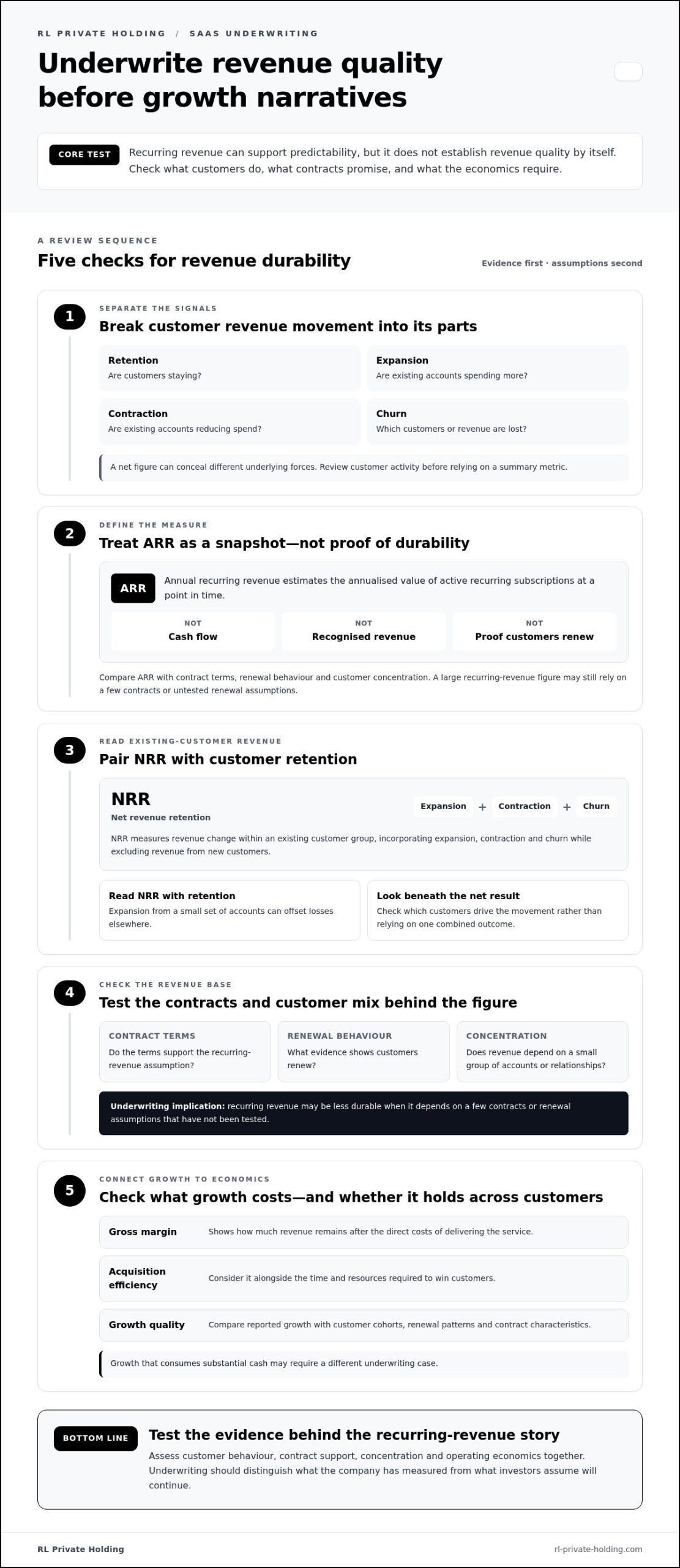
Recurring revenue is an important feature of a SaaS model, but it does not establish revenue quality on its own. A business can report subscription revenue while facing weak renewals, customer losses, discounting or dependence on a small group of accounts. Underwriting should distinguish what the company has measured from what investors assume will continue.
Assess retention, expansion, contraction and churn as separate signals. Retention shows whether customers remain; expansion indicates whether existing accounts spend more; contraction captures reduced spend; and churn records lost customers or revenue. A net figure can conceal these different forces, so review the underlying customer activity before relying on a summary metric.
Which SaaS metrics test revenue durability?
Annual recurring revenue (ARR) estimates the annualised value of active recurring subscriptions at a point in time. It is not cash flow, recognised revenue or evidence that customers will renew. Compare ARR with contract terms, renewal behaviour and customer concentration. A high recurring-revenue figure may still depend on a few contracts or renewal assumptions that have not been tested.
Net revenue retention (NRR) measures revenue change within an existing customer group, incorporating expansion, contraction and churn while excluding new-customer revenue. Read it alongside customer retention: expansion from a small set of accounts can offset losses elsewhere. Gross margin shows how much revenue remains after the direct costs of delivering the service. Consider it alongside acquisition efficiency and the time and resources required to win customers, since growth that consumes substantial cash may require a different underwriting case.
How to test growth quality and operating assumptions
Compare reported growth with customer cohorts, renewal patterns and contract characteristics. For example, group customers by start date and examine whether later periods show continued use, expansion or declining revenue. Check whether reported recurring revenue reflects signed terms and observed behaviour. Do not treat pipeline, anticipated renewals or proposed pricing changes as realised performance.
Keep historical evidence distinct from management’s forward assumptions. A model may assume improved retention, lower acquisition costs or increased expansion, but state each assumption explicitly and test it against available operating evidence. Identify the assumptions that materially affect the case, then consider how the conclusion changes if they do not hold.
The Rule of 40 can provide a high-level lens on the trade-off between growth and profitability, commonly by considering revenue growth alongside a profit margin measure. It is not a substitute for examining margin quality, cash needs, customer economics or the drivers of growth. Use consistent definitions and calculation choices when comparing businesses.
For a practical review, record each metric, its source, the period covered and its underwriting implication. This makes discrepancies visible and gives the investment team a basis for follow-up diligence. Investors applying this discipline across technology opportunities can explore private equity investment management as part of a broader approach to investment decisions.
Compare SaaS Investment Fit, Ownership Needs and Downside Cases
Two SaaS businesses with similar recurring-revenue models may require different investment approaches. One may be reinvesting in expansion while another has established demand and is focused on cash generation. A useful comparison considers maturity alongside growth, cash generation and the complexity of the operating changes the thesis depends on. Subscription revenue does not remove customer, product or execution risk: customers can leave, products can lose relevance, and planned improvements may not be delivered.
The comparison below is a screening tool, not a ranking. A company’s maturity label alone cannot establish fit. Assess whether adoption and customer behaviour support the proposed strategy, then test the investment rationale under a base case and a downside case.
When growth, profitability and maturity point to different strategies
Expansion-oriented businesses may suit a thesis that can support investment in product, sales or market development, provided adoption evidence supports continued demand. Businesses prioritising cash generation may better fit an approach centred on operational discipline and sustainable performance. In either case, ask whether the proposed strategy aligns with customer behaviour and the resources available to execute it.
| Investment dimension | Expansion-oriented profile | Cash-generation profile |
|---|---|---|
| Maturity | Developing operating model or broader market reach | More established processes and customer base |
| Growth profile | Growth investment is central to the case | Growth is assessed alongside efficiency and durability |
| Cash generation | May require resources to pursue planned expansion | Emphasis on operating discipline and cash conversion |
| Operational complexity | May involve scaling teams, systems or go-to-market activity | May involve improving execution across existing operations |
These profiles are not mutually exclusive. Use evidence of product adoption and customer retention to assess whether the company can support its chosen path, rather than relying on labels such as “scale-up” or “mature”.
How ownership scope changes the investment case
Clarify whether the thesis depends on control, minority participation or a defined partnership role. The ownership position should correspond to the involvement required. A case built around substantial operational change may require more governance influence and management capacity than one based on supporting an established plan. If rights, decision-making processes or leadership resources do not match the proposed priorities, treat the ownership plan itself as an assumption to examine.
For broader portfolio context, the private equity investment management framework considers how investment decisions fit within portfolio strategy.
Make downside analysis specific. In the base case, state the operating conditions required for the thesis to hold. In the downside case, test weaker customer adoption, slower growth, pressure on margins or delayed execution. Then vary one assumption at a time, such as renewal performance or acquisition efficiency, to see which changes most affect the case. The SaaS private equity investment thesis is more decision-useful when it identifies those sensitivities before ownership begins, rather than treating subscription revenue as protection against underperformance.
Validate the SaaS Thesis Through Focused Diligence and Falsifiable Tests
Diligence should establish whether the evidence supports the investment rationale, not simply assemble material in its favour. For each critical assumption, identify the source that could verify it, the evidence that could challenge it and the decision affected if it proves wrong. This makes the SaaS private equity investment thesis a basis for a decision, rather than a narrative that becomes harder to question as the process advances.
An investment thesis becomes testable when each critical assumption is paired with evidence that could disprove it.
Which commercial and product evidence can challenge the thesis?
Review customer references alongside renewal records, contract documentation and customer-level revenue data. A reference can describe perceived value, while renewal behaviour shows whether customers act on that value. Compare both with the growth assumptions, and examine whether revenue depends on a limited number of accounts or contracts. Concentration is not automatically disqualifying, but it can make the case more sensitive to a single customer decision.
Product diligence should examine the capabilities customers rely on, the technical dependencies required to deliver them and the consequences if a core component becomes difficult to maintain or replace. Record evidence that weakens the case as carefully as evidence that supports it. A balanced record makes unresolved concerns visible to decision-makers.
How to turn thesis assumptions into decision gates
Use a sequenced process that moves from the original rationale to evidence and then to an explicit investment implication:
- State the assumption. For example, identify whether the case depends on customers renewing because the product remains important to their workflows.
- Name the evidence. Specify the records needed, such as renewal histories, executed contracts, customer-level revenue and reference discussions.
- Assess the source. Label each finding as verified documentary evidence, a management representation, an independent customer perspective or an unresolved assumption.
- Test the sensitivity. Consider how the case changes if renewal behaviour weakens, a concentrated customer leaves or a product dependency requires substantial attention.
- Set the decision gate. Decide in advance which findings require a revised valuation, different transaction terms, further investigation or a decision not to proceed.
Decision gates should be specific to the underwriting case, not generic diligence milestones. If customer concentration is central, define what evidence would demonstrate its effect on revenue durability. If the thesis depends on product differentiation, establish what customer and technical findings would support that claim. When available evidence cannot resolve a material assumption, preserve it as uncertainty rather than presenting it as fact.
This discipline also clarifies how diligence findings affect ownership planning. A concern that can be addressed through a defined operational priority differs from a weakness that undermines the investment rationale itself. The private equity investment management link provides further context on disciplined investment review and management.
Translate the SaaS Thesis into Ownership Priorities and a Reviewable Investment Case
A thesis becomes operational when each material underwriting assumption connects to a company-specific priority, a responsible owner and a way to assess progress. The objective is not to impose a standard SaaS playbook. Direct attention to the few actions that matter to this business, and distinguish actions intended to create value from indicators that show whether the investment case remains on track.
How thesis assumptions inform post-investment priorities
Map each central assumption to an operating response. If the case depends on improving customer retention, the priority might be to identify preventable reasons for non-renewal, with a management owner responsible for the work. If it assumes expansion within existing accounts, define the customer segments and product adoption patterns that support that opportunity. Set priorities based on the evidence established during diligence, not a generic list of software initiatives.
For each priority, record the assumption, action, accountable owner, relevant measure and review point. Keep initiatives distinct from monitoring conditions. Improving onboarding is an initiative; a change in renewal behaviour is a signal to monitor. Both matter, but they serve different purposes: one guides execution, while the other indicates whether the thesis may need reconsideration.
- Assumption: Customer adoption can deepen in a defined segment.
- Priority: Address the product or implementation barriers identified in that segment.
- Accountability: Assign responsibility within the company’s management structure.
- Review: Track the agreed adoption evidence and its effect on the original case.
When to revisit the thesis and investment decision
Review triggers should respond to material evidence, not only scheduled reporting. A sustained deterioration in retention, growth or profitability may challenge an assumption directly. A missed target in one period may instead reflect timing or a temporary execution issue. Compare the variance with prior performance, customer-level evidence and the original underwriting rationale before deciding whether it changes the investment case.
Set a clear process for recording the variance, identifying its cause and assessing its implications. If the original assumption still holds, document why and continue monitoring. If evidence points to a lasting change, revise the operating priorities and reassess the investment rationale. A reviewable case preserves the initial assumptions alongside subsequent evidence, so decisions remain grounded in what was known and what has changed.
RL Private Holding identifies technology and private equity among its focus areas and manages a diversified portfolio of businesses. A disciplined, evidence-led approach helps connect investment rationale to accountable priorities and defined review triggers. A well-formed SaaS private equity investment thesis should remain useful after acquisition by keeping those priorities tied to the assumptions that matter.
Explore RL Private Holding’s investment management approach for broader context on its investment focus.
Carry the Investment Case into the Next Decision
A disciplined SaaS private equity investment thesis should remain useful as evidence accumulates. Treat it as a living decision record: preserve the original rationale, document material changes and use each review to determine whether the ownership priorities still address the assumptions that matter. This creates a clearer basis for choosing where to focus management attention and when the investment case warrants reconsideration.
For investors, the next step is to apply that discipline consistently across opportunities, aligning each decision with the intended ownership role and broader investment objectives. RL Private Holding lists technology and private equity among its business focus areas and provides private equity investment management and venture capital funding.
Explore RL Private Holding’s investment management approach to learn more about its investment activities. A clear, reviewable case gives investors a sounder foundation for making considered decisions as circumstances evolve.
Frequently Asked Questions
Is a SaaS investment thesis the same as a SaaS business plan?
No. A business plan describes how company leadership intends to operate and pursue objectives; an investment thesis helps investors decide whether the company fits their mandate and what ownership role is appropriate. In practice, compare the plan’s milestones with the assumptions in the investment case. If management expects expansion through a new customer segment, the thesis should assess whether the opportunity and required resources support that strategy.
Can private equity invest in bootstrapped SaaS companies?
Yes. A bootstrapped company can fit a private equity investment if its operating maturity, customer evidence, financial profile and ownership needs align with the investor’s mandate. The absence of institutional funding is not, by itself, evidence of quality or weakness. For example, assess whether the founder-built sales process can support the proposed scale and whether key customer or product knowledge is concentrated in a few individuals.
What does the Rule of 40 tell investors about a SaaS company?
The Rule of 40 offers a high-level comparison of revenue growth and profitability, often by adding a growth rate to a profit margin. It can indicate how a company balances expansion with earnings, but the result depends on which growth and margin measures are used. Treat it as a screening lens, then examine the sources of growth, cash conversion and cost structure before drawing conclusions about performance.
Why can recurring SaaS revenue still be unpredictable?
Recurring billing does not mean every customer renews or pays on the same schedule. Revenue may vary with renewal timing, contract clauses, customer budgets or usage-based charges. For example, annual contracts can create uneven renewal periods, while a usage component may fluctuate with customer activity. Review the revenue calendar and contract mechanics to understand how reported recurring revenue translates into expected receipts and renewal exposure.
How often should investors review a SaaS investment thesis?
Review it on a regular reporting cadence and whenever material evidence changes. A quarterly review may suit a company with quarterly management reporting, while a material customer departure or leadership change may require an earlier assessment. Keep the SaaS private equity investment thesis available as a reference point, so investors can distinguish ordinary operating variation from a change that affects the rationale or ownership plan.
What happens if a SaaS company misses its growth targets?
A missed target should prompt investigation, not an automatic decision to abandon the investment. Identify whether the gap reflects timing, weaker demand, sales execution, customer losses or an assumption that no longer holds. Then update the forecast and assess implications for resources, priorities and the investment case. A repeated shortfall with evidence of deteriorating demand may call for a more fundamental reassessment than a delayed contract close.