

Preserving assets is not the same as preparing them to endure. Securing family wealth for future generations takes more than investment decisions: it calls for shared principles, clear governance and thoughtful succession planning. Without these connections, differences in expectations about risk, responsibility and inheritance can weaken continuity. Concentrated holdings or investments that are difficult to sell may also limit future choices.
Families often focus on protecting what they have built, and rightly so. The challenge is to align that goal with changing needs and future stewardship. This guide explains how family governance, long-term investment choices and succession planning can work together to support wealth continuity. It also covers practical ways to establish shared principles, assess portfolio risks and prepare younger family members to take part in informed decisions.
Each element, from diversified investment management to a gradual transfer of responsibility, has a role in a coherent wealth framework. Private equity, venture capital and real estate can be considered as investment categories within a broader portfolio, in light of the family’s objectives and risk capacity. RL Private Holding provides wealth management and investment services, including private equity investment management, venture capital funding and real estate asset management. Legal and tax matters remain important parts of the wider succession process.
Key Takeaways
- Securing family wealth for future generations means protecting purchasing power, liquidity and the family’s ability to make informed decisions, not simply preserving nominal asset values.
- Translate shared family objectives into clear investment principles, decision rights and oversight responsibilities. Let governance reflect the family’s circumstances.
- Assess investments by their liquidity, time horizon, control and valuation considerations. Use diversification to manage concentration, not to assume risk has been eliminated.
- Follow a practical sequence: clarify objectives, map assets, establish governance, align allocation and review progress. Document assumptions and responsibilities along the way.
- Consider how diversified investment management, including private equity, venture capital and real estate, may fit within a broader framework for long-term wealth continuity.
What Does Securing Family Wealth for Future Generations Involve?
Securing family wealth for future generations is a practice of stewardship: preserving the capacity of wealth to serve family objectives and transferring it alongside the knowledge and responsibilities needed to manage it. The focus is broader than the value of assets on a statement. Purchasing power can change, holdings may be difficult to sell when funds are needed, and unclear decision-making can prevent a family from acting together.
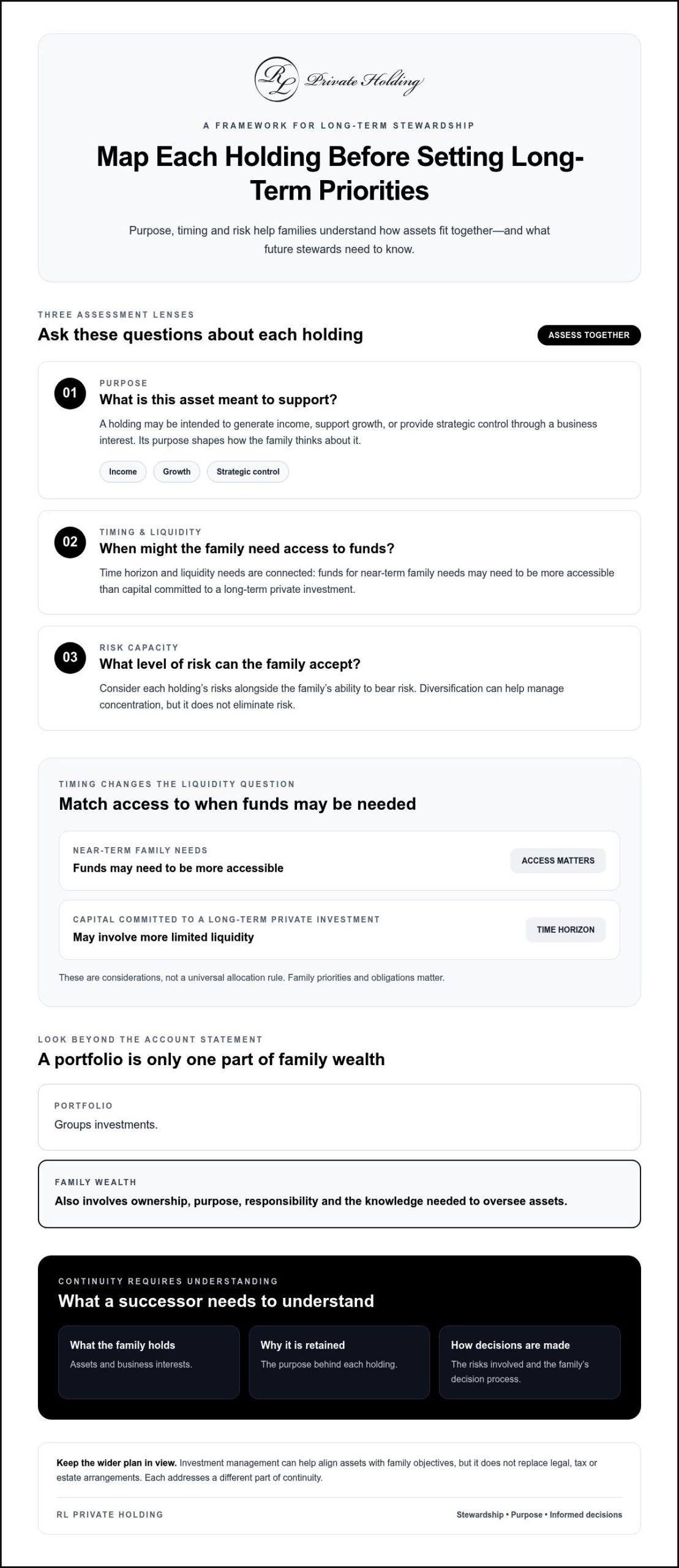
Continuity involves financial assets and business interests, as well as the responsibilities attached to ownership and the knowledge needed to oversee them. A successor needs to understand not only what the family holds, but why particular assets are retained, what risks they carry and how decisions are made. A Family office is one possible structure for coordinating aspects of family wealth management. The right governance arrangements depend on the family’s objectives and circumstances.
Investment management can help align assets with those objectives, but it does not replace legal, tax or estate arrangements. Each addresses a different part of continuity, so investment choices should be considered alongside the family’s broader plans. Legal and tax questions require appropriate specialist consideration.
How is family wealth different from a portfolio?
A portfolio groups investments. Family wealth also involves ownership, purpose and responsibility. One holding may be intended to generate income, another to support growth, while a business interest may carry strategic control as well as financial value. Each purpose can imply a different time horizon and tolerance for limited liquidity.
For example, funds intended for near-term family needs may need to be more accessible than capital committed to a long-term private investment. To assess how holdings fit together, consider their purpose, when funds may be needed and the family’s capacity to accept risk. These factors do not point to one universal allocation or ownership structure. Family priorities and obligations matter.
What does wealth preservation mean across generations?
Preservation involves balancing exposure to loss with the need to maintain real value, meet liquidity needs and pursue long-term family objectives. Investment returns and purchasing power are uncertain, so no portfolio can guarantee continuity. A sound approach makes those uncertainties visible and connects investment decisions to the family’s ability to bear risk.
Wealth preservation is the stewardship of assets, responsibilities and knowledge so each generation can make informed decisions and transfer them in line with shared family objectives. This definition places informed participation alongside capital. Continuity depends not only on what passes to the next generation, but also on its understanding of what it receives.
Build Family Governance Before Setting Long-Term Investment Priorities
Investment priorities are more durable when they follow a shared understanding of what family wealth is meant to support. Family members may differ in their expectations for income, growth, liquidity or risk. Governance gives them a way to discuss these differences and translate agreed objectives into investment principles. It does not require every member to hold the same view on every decision.
A governance framework should clarify who can make decisions, who provides oversight and how material changes are communicated. It may be formal or flexible, depending on the family’s circumstances. Its value is practical: responsibilities are understood, and important decisions are less likely to depend on assumptions known only to a few people.
Investment management alone cannot resolve questions of ownership or transfer. A portfolio strategy does not determine who legally owns an asset, who may inherit it or how it should pass between generations. Governance can help a family identify these issues and coordinate investment priorities with wider arrangements. Legal, tax and estate matters require their own appropriate planning.
Which family decisions should be documented?
A written record can capture the principles that guide investment oversight without attempting to replace detailed legal documents or jurisdiction-specific advice. It may set out:
- The family’s objectives and what its wealth is expected to support.
- Shared views on risk, investment time horizons and liquidity needs.
- Who monitors investments, reviews decisions and communicates material developments.
Clear records limit ambiguity when family circumstances, responsibilities or participants change. They also give family members a reference point for assessing whether a decision remains consistent with agreed priorities, rather than relying on memory or informal expectations.
How can the next generation take part responsibly?
Participation can develop in stages, in keeping with the family’s governance arrangements and each person’s preparation. Discussions might begin with financial literacy and the reasons behind existing holdings, then progress to observing reviews or contributing to defined decisions. Age alone does not establish readiness or authority. Understanding, responsibility and clearly assigned decision rights matter.
Regular review keeps governance relevant as family needs and circumstances evolve. A change in liquidity requirements, business interests or family responsibilities may call for a reconsideration of priorities, roles or communication practices. Make room for discussion while keeping clear who holds authority and how oversight is exercised.
For families aligning investment oversight with long-term objectives, RL Private Holding’s wealth management services can support portfolio considerations as one part of a broader continuity framework.
Align Diversification, Liquidity and Private Investments With Family Goals
Portfolio construction should reflect the family’s objectives, time horizons and capacity to tolerate risk. Diversification can help manage concentration across assets, sectors or business interests, but it does not eliminate market, liquidity or valuation risk. A portfolio with several investments may still be concentrated in one industry, geography or source of income. Assess what drives the portfolio’s exposure, not just how many holdings it contains.
Publicly traded investments can generally be bought or sold through established markets, although liquidity and market prices vary. Private equity, venture capital and real estate offer different forms of exposure, control or strategic involvement, but can involve longer commitments and less frequent valuations. Assess each category against the family’s objectives rather than treating any as a universal recommendation.
| Investment category | Liquidity considerations | Typical time horizon | Oversight and valuation |
|---|---|---|---|
| Public investments | Often more readily traded, subject to market conditions and the characteristics of the holding. | Can vary according to the family’s purpose and investment plan. | Market prices provide frequent reference points; ongoing monitoring remains necessary. |
| Private equity | Capital may be committed for an extended period and may not be readily accessible. | Generally considered with a longer-term investment horizon. | Requires attention to underlying businesses, governance and less frequent valuation updates. |
| Venture capital | Access to invested capital may be limited during the investment period. | Long-term in nature, with outcomes and timing uncertain. | Oversight includes assessing early-stage business progress and valuation uncertainty. |
| Real estate | Sale or transfer can take time, and property is not equivalent to cash. | Depends on the asset, its role and the family’s objectives. | Requires consideration of asset-level factors, management and valuation assumptions. |
How should liquidity needs shape a multigenerational portfolio?
Separate funds that may be needed for near-term family obligations from capital intended for longer investment horizons. Before committing to less-liquid holdings, consider expected cash needs, existing commitments and how the family would respond if circumstances changed. There is no fixed liquidity percentage that suits every family. The assessment should reflect its obligations and resources.
What role can private markets play in family wealth?
Private equity may provide exposure to established businesses, venture capital to earlier-stage companies, and real estate to property-related assets. Each can require patience, informed oversight and acceptance that valuations may not update as frequently as public market prices. Weigh these characteristics against the investment’s intended role and the family’s ability to hold it over time. For further context, explore private equity investment management.
Create a Practical Framework for Intergenerational Wealth Continuity
A repeatable process helps families connect investment decisions with changing priorities. Use these five steps as a working framework, adapting each to the family’s assets, responsibilities and circumstances:
- Clarify objectives. Agree on what wealth should support, such as long-term growth, family needs or continuity of business interests.
- Map assets. Create a consolidated view of holdings, ownership, obligations, liquidity and investment horizons.
- Set governance. Define decision responsibilities, oversight and how material changes will be communicated.
- Align allocation. Compare existing holdings with objectives, risk considerations, concentration and liquidity needs.
- Review progress. Assess whether assumptions and priorities remain relevant, and record decisions or revisions.
Document the reasoning behind the framework, not only its conclusions. Record assumptions, expected cash-flow needs, risk considerations, investment time horizons and who is responsible for oversight. Scenario reviews can help test how the plan might respond to a change in family needs, a shift in business interests or different market conditions. They do not predict outcomes, but can make trade-offs and potential funding pressures clearer.
Keep investment-policy decisions distinct from the legal, tax and estate arrangements that govern ownership and transfer. The investment framework can identify questions that need coordination, but it does not replace legal documentation or jurisdiction-specific advice. For governance and oversight context, see family office investment strategies.
How can a family begin an investment-policy review?
Start with a consolidated view of assets, obligations, ownership and investment horizons. Then compare current holdings with the family’s agreed objectives. Note where concentration may create exposure to a particular business or asset, and consider whether accessible resources match anticipated needs. This gives the family a practical basis for discussing questions before changing investment priorities.
How often should family wealth plans be reviewed?
Set a review rhythm that suits the family’s circumstances and investment arrangements, then revisit the framework after material family, business or financial changes. A significant change in responsibilities or liquidity needs may warrant attention before the next scheduled review. There is no universal interval, and reviews cannot guarantee a particular result. Their purpose is to keep decisions and assumptions under consideration as conditions evolve.
RL Private Holding provides wealth management services for families considering long-term portfolio priorities as part of a broader continuity framework.
How RL Private Holding Approaches Long-Term Family Wealth Management
RL Private Holding is an investment holding company headquartered in Luxembourg that manages a diversified global portfolio across several investment sectors. The firm provides wealth management and private equity investment management, as well as venture capital funding and real estate asset management. These services bring an investment perspective to long-term portfolio considerations, including how holdings relate to objectives, risk capacity and liquidity needs.
Investment management is one component of a wider family wealth continuity framework. It can inform portfolio decisions, but it does not determine ownership, resolve family decision rights or replace legal, tax and estate arrangements. For families focused on securing family wealth for future generations, connecting these elements helps keep investment choices within the context of succession plans and governance.
How can investment management support wealth continuity?
A diversified portfolio can be assessed in relation to a family’s objectives and ability to bear risk, while taking account of concentration, liquidity and time horizon. Private equity, venture capital and real estate are among the investment categories that may be relevant to portfolio discussions. Their suitability depends on the family’s circumstances and the role each holding is intended to serve. No allocation can guarantee preservation, growth or a successful transfer.
Disciplined management also involves understanding what a holding requires: the time commitment, oversight and liquidity considerations associated with it. A long-term investment may sit alongside assets intended to meet nearer-term needs, but the balance should reflect the family’s obligations and plans. Portfolio review can help assess whether those choices remain consistent with agreed objectives as circumstances change.
What should families take forward from this framework?
Continuity rests on more than asset selection. Families can connect clear governance with portfolio alignment, liquidity awareness and regular review, then consider how investment decisions fit with wider succession arrangements. Documenting objectives and decision responsibilities gives participants a common reference point. Planned reviews provide an opportunity to revisit assumptions as family or business circumstances evolve.
RL Private Holding’s investment services form one part of this broader view of stewardship, alongside a family’s governance and transfer arrangements. To explore family wealth management and the firm’s investment services, review its long-term portfolio approach.
Build Continuity Through Deliberate Stewardship
Securing family wealth for future generations depends on more than selecting investments. Shared governance, clear decision responsibilities and regular reviews help families connect portfolio choices with their objectives and changing needs. Liquidity and concentration also deserve ongoing attention, particularly when holdings have different time horizons or oversight requirements.
Investment management is one part of a broader succession framework. RL Private Holding manages a diversified global portfolio across multiple investment sectors and provides services in private equity, venture capital, real estate asset management and wealth management. These categories can inform long-term portfolio considerations, but their role should reflect each family’s objectives and risk capacity. Investment decisions work best alongside appropriate governance and ownership-transfer arrangements.
A considered approach can give family members a clearer basis for participating in wealth stewardship over time. Explore RL Private Holding’s wealth management services to learn about its long-term portfolio approach. Shared principles and disciplined review can help families take constructive steps toward continuity across generations.
Frequently Asked Questions
What does securing family wealth for future generations mean?
Securing family wealth for future generations means stewarding assets and responsibilities so they can support family objectives and be transferred with informed consideration. It brings investment decisions into line with long-term priorities while recognizing that ownership and succession arrangements also matter. It does not promise that wealth will grow or remain unchanged. Markets shift, purchasing power changes and family needs evolve over time.
How can a family preserve wealth across generations?
Families can support wealth continuity by agreeing shared objectives, understanding risk, diversifying exposures, planning for liquidity and establishing clear governance. For example, distinguish resources needed for near-term obligations from capital intended for longer horizons, then review whether holdings and decision responsibilities reflect those purposes. Diversification can limit reliance on a single asset or business, but it cannot remove investment risk. Results depend on family circumstances and market conditions.
Can investment management alone secure generational wealth?
Investment management alone cannot secure generational wealth because it addresses portfolio choices, not every dimension of continuity. It can help align holdings, liquidity and risk with family objectives, but it does not establish who owns assets, how they transfer or which succession arrangements apply. Legal and tax matters require separate consideration, alongside governance and estate arrangements. Coordinate these areas without treating an investment policy as a substitute for them.
What role does diversification play in protecting family wealth?
Diversification helps manage concentration by spreading exposure across relevant asset categories, businesses or sectors. A family can assess whether too much of its wealth depends on one company, property holding or investment theme, then consider how holdings relate to shared objectives and risk capacity. Diversification does not eliminate market or liquidity risk, and a broader range of assets does not ensure returns. Its purpose is to manage exposures, not remove uncertainty.
How can the next generation prepare to manage family wealth?
The next generation can prepare through financial education and gradual participation suited to the family’s governance arrangements. Discussions may cover basic financial literacy, the rationale behind investments, associated risks and the responsibilities attached to ownership. Participation might develop from observing reviews to contributing to defined decisions. Age alone does not determine readiness or authority. Clear decision rights, shared investment principles and ongoing communication help make involvement informed and appropriately structured.
Can private equity or real estate support a long-term family portfolio?
Private equity or real estate may have a role in a long-term family portfolio, depending on its objectives, risk capacity and existing exposures. Each category requires consideration of investment duration, liquidity and valuation, including the possibility that capital may not be readily accessible. Private equity and property holdings can also call for informed oversight. Neither category suits every family, and inclusion does not guarantee preservation, growth or a particular investment outcome.
How often should a family review its wealth strategy?
Families should schedule reviews and reassess their strategy after material changes in family needs, business interests or financial circumstances. A review can test whether objectives, liquidity assumptions, investment risks and decision responsibilities remain aligned. The appropriate timing depends on the family’s situation and investment arrangements, so there is no universal interval. Reviews support informed adjustments as circumstances evolve, but cannot guarantee investment performance or wealth continuity.