

The perception of the Grand Duchy as merely a tax-efficient jurisdiction overlooks its primary strength: the sophisticated convergence of private equity governance and real estate asset permanence. For institutional managers, the private equity real estate Luxembourg market represents a gold standard for structural integrity and regulatory stability. You’re likely familiar with the persistent challenge of balancing investor privacy against the rigorous transparency demands of modern cross-border mandates. It’s a delicate equilibrium, particularly when trying to reconcile the inherent illiquidity of real estate with the agile governance required in private equity structures.
This analysis provides a sober, institutional-grade examination of the current PERE landscape, focusing on how recent shifts like the 2026 AIFMD II transposition have refined structural efficiency. We’ll explore the strategic alignment of tangible assets within sophisticated holding frameworks and the impact of the new carried interest tax regime effective since January 2026. This overview will clarify the selection of optimal investment vehicles and the necessity of a disciplined holding partner to ensure long-term portfolio stability.
Key Takeaways
- Examine the evolution of the private equity real estate Luxembourg landscape and the strategic shift toward structured investment vehicles in the 2026 regulatory environment.
- Distinguish between regulated and unregulated frameworks, such as the RAIF and SCSp, to determine the optimal structure for diverse real estate portfolios.
- Analyze the impact of AIFMD II on cross-border marketing and how these directives enhance transparency for institutional asset managers.
- Address the complexities of regulatory compliance and governance to mitigate risks associated with long-term real estate holdings.
- Understand the benefits of integrating a disciplined holding partner to provide institutional permanence and strategic alignment for global investments.
The Convergence of Private Equity and Real Estate in Luxembourg
The 2026 financial landscape marks a definitive maturation of the private equity real estate Luxembourg sector. It’s no longer sufficient to view real estate as a passive asset class; instead, it’s increasingly managed through the rigorous lens of private equity governance. This convergence enables institutional investors to apply sophisticated risk management and performance metrics to tangible assets. The shift from traditional direct ownership toward structured private equity vehicles reflects a desire for enhanced liquidity, tax efficiency, and structural transparency. This evolution ensures that high-value assets are protected from localized volatility while benefiting from the oversight typical of private equity mandates.
The Evolution of the PERE Asset Class
Asset managers have moved beyond core real estate strategies to embrace value-add and opportunistic approaches. This transition requires operational oversight that mirrors private equity standards to ensure portfolio transparency. By utilizing frameworks like Luxembourg’s Specialized Investment Fund (SIF), managers align real estate holdings with private equity real estate Luxembourg governance standards. The current interest rate cycle, with inflation stabilizing at 3.1% in late 2025, encourages a return to opportunistic structuring. These vehicles provide the agility needed to capitalize on market dislocations while maintaining institutional-grade reporting.
Luxembourg as a Global Financial Epicentre
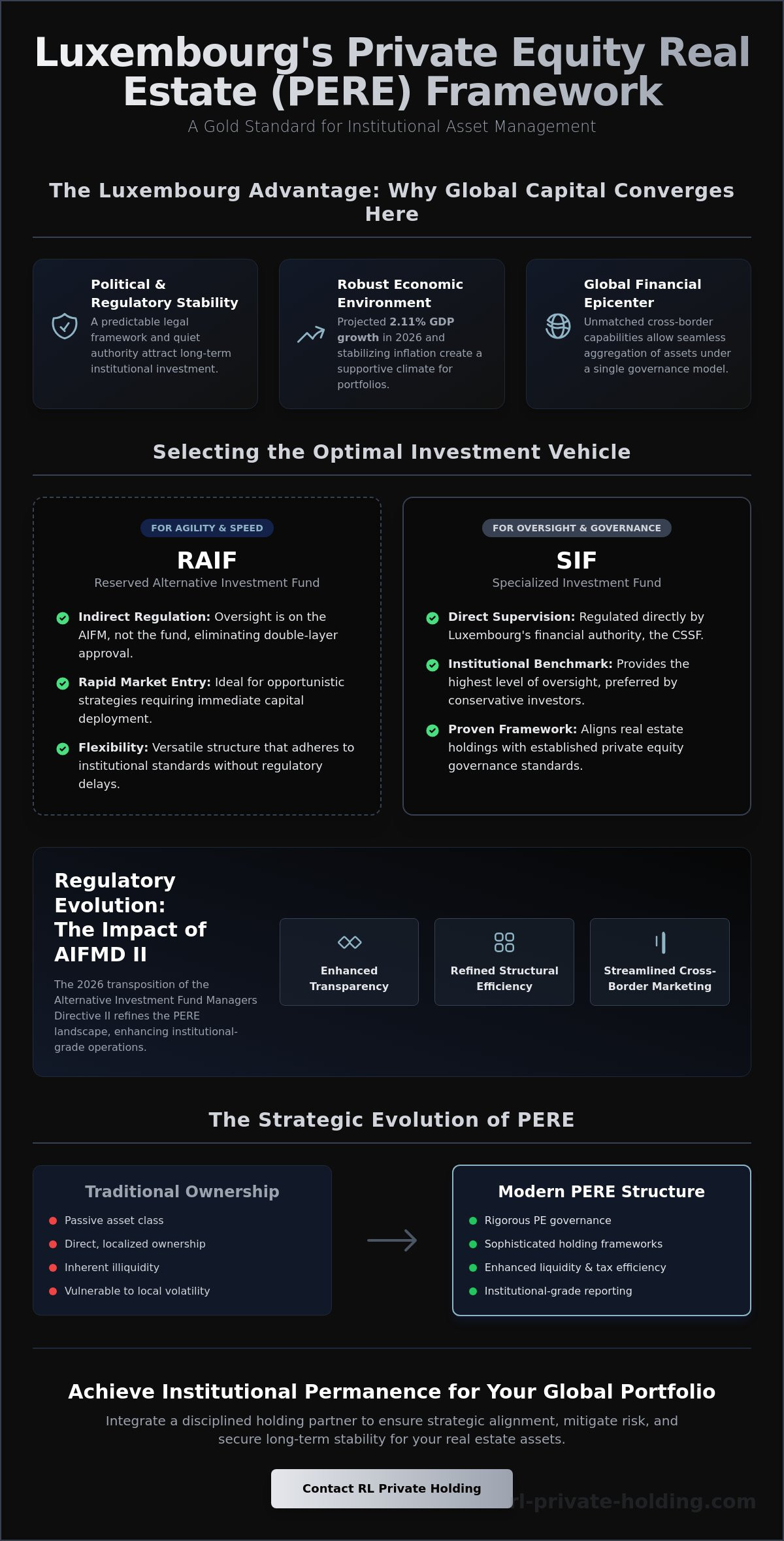
Luxembourg’s position as a primary hub for global capital is built on its reputation for quiet authority and political stability. Institutional investors prioritize jurisdictions offering predictable legal frameworks and expert ecosystems for long-term asset holding. With a projected GDP growth of 2.11% in 2026, the economy supports a robust environment for real estate portfolios. The jurisdiction’s cross-border capabilities are essential for multi-jurisdictional holdings, allowing for the seamless aggregation of assets under a single governance model. This structural integrity is a prerequisite for firms seeking to manage high-value assets across diverse European markets.
The integration of real estate into private equity structures is a strategic response to the complexities of global markets. It transforms a physical asset into a sophisticated financial instrument, ensuring that capital allocation is driven by data and disciplined management rather than speculative trends. By centralizing these assets in a stable environment, firms achieve a level of operational excellence that traditional ownership models can’t match. This approach provides the institutional permanence required for multi-generational wealth preservation and global portfolio expansion. It positions the asset class as a cornerstone of a well-ordered, transparent investment strategy.
Structural Frameworks for Luxembourg PERE Portfolios
Selecting the appropriate vehicle is a fundamental step in establishing a sustainable Luxembourg Private Equity Legal Framework for real estate assets. The distinction between regulated and unregulated structures hinges on the level of oversight required by the investor base and the complexity of the underlying assets. While the Specialized Investment Fund (SIF) offers direct supervision by the CSSF, many institutional managers now favor the speed and flexibility of the Reserved Alternative Investment Fund (RAIF). The Reserved Alternative Investment Fund (RAIF) serves as a versatile, indirectly regulated vehicle that allows for rapid market entry while adhering to institutional governance standards through its appointed manager. This choice is critical when managing private equity real estate Luxembourg portfolios that require immediate capital deployment in a competitive environment.
The RAIF: Efficiency for Institutional Portfolios
The RAIF eliminates the need for double-layer regulation by placing oversight responsibilities on the authorized Alternative Investment Fund Manager (AIFM). This structure ensures that the fund maintains institutional standards without the delays associated with direct product approval from the regulator. Growth-stage real estate firms benefit from this efficiency, especially following the May 2021 and 2026 implementations of AIFMD II. These directives introduce enhanced requirements for liquidity risk management and reporting, which the AIFM must integrate into the fund’s operational framework. By centralizing compliance at the manager level, the RAIF provides a robust yet agile solution for sophisticated capital allocation.
The SCSp: Transparency and Flexibility
The Special Limited Partnership (SCSp) provides an unregulated, flexible alternative for bespoke investment mandates. It’s particularly effective for international investors due to its tax transparency, which ensures that the tax burden is managed at the investor level rather than the fund level. This transparency is a vital tool for navigating the reverse hybrid mismatch rules established by ATAD 2. Managers can structure carried interest and management fees with precision, taking advantage of the new carried interest tax regime effective since January 1, 2026. This regime clarifies the taxation of contractual and equity-linked carried interest, providing the legal certainty required for long-term planning within private equity real estate Luxembourg structures.
Effective structuring requires a deep understanding of how these frameworks interact with broader financial objectives and jurisdictional requirements. For those seeking to align their real estate assets with a disciplined governance model, exploring a diversified investment holding structure can provide the necessary institutional permanence and strategic focus. Balancing speed-to-market with rigorous regulatory adherence remains the hallmark of a well-organized PERE portfolio. This methodical approach ensures that the chosen vehicle supports the long-term stability and growth of the investment mandate.
Strategic Advantages of the Luxembourg PERE Model
The competitive advantage of the Luxembourg PERE model lies in its ability to provide a stable, institutional ecosystem that other jurisdictions struggle to replicate. While offshore centers may offer tax neutrality, they often lack the regulatory depth and EU passporting rights essential for cross-border capital raising. The private equity real estate Luxembourg market benefits from a unique combination of political stability and specialized expertise. This environment is particularly conducive to managing the inherent illiquidity of real estate through the disciplined governance of private equity. Investors prioritize this jurisdiction because it offers a predictable path for both asset acquisition and eventual divestment within a transparent legal framework.
Institutional Governance and AIFMD Compliance
The “Luxembourg Brand” serves as a hallmark of quality in global financial markets. It provides a level of assurance that facilitates institutional ROI by strictly adhering to AIFMD standards. The transposition of AIFMD II and UCITS VI into national law in May 2026 has further refined these requirements, introducing enhanced transparency for delegation and liquidity risk management. These protocols aren’t merely administrative burdens; they’re essential tools for risk mitigation. By standardizing reporting across global real estate assets, managers ensure that sophisticated investors receive the granular data required for informed decision-making. This level of oversight is a prerequisite for any firm managing high-value, multi-jurisdictional portfolios.
Capital Efficiency and Portfolio Diversification
Optimizing the capital stack for large-scale acquisitions requires a sophisticated holding structure. Managers frequently utilize the SOPARFI (Société de participations financières) for underlying asset holding due to its flexibility and integration with Luxembourg’s extensive double tax treaty network. This structure allows for efficient capital flow and the clear segregation of liabilities across diverse properties. Modern real estate management also benefits from integrating insights from related sectors, such as venture capital. By applying data-driven protocols common in Venture Capital Funding, PERE managers can identify PropTech efficiencies that enhance the operational value of their holdings. This cross-pollination of strategies ensures that real estate assets remain competitive in a rapidly evolving digital economy.
Liquidity management remains a primary focus for institutional funds, especially as regulators mandate more robust Liquidity Management Tools (LMTs) under CSSF Circular 25/901. These tools allow managers to handle redemption pressures without forcing the premature sale of underlying real estate. It’s a methodical approach that protects the long-term value of the portfolio while providing necessary flexibility for participants. This balance between asset permanence and operational agility is what defines the Luxembourg model. It creates a resilient framework that can withstand market fluctuations, such as the 3.1% inflation rate recorded in late 2025, while continuing to deliver stable, long-term performance for global partners.
Risk Management and Governance in PERE Asset Management
The rigorous regulatory environment in the Grand Duchy is frequently misinterpreted as a barrier to entry. In reality, it provides the institutional gravity required for sophisticated capital management. Establishing a robust private equity real estate Luxembourg mandate requires a shift from reactive compliance to proactive governance. This disciplined approach ensures that every structural layer, from the holding vehicle to the underlying asset, adheres to a unified risk mitigation strategy. By viewing Luxembourg’s oversight as a framework for stability, managers can provide global partners with the transparency they demand in an increasingly complex financial landscape. It’s this methodical adherence to high standards that protects the portfolio from localized market shocks and jurisdictional volatility.
Due Diligence Protocols for Real Estate Assets
Technical and financial due diligence within a private equity context must extend beyond simple property inspections. It involves a granular analysis of the underlying asset manager’s operational capabilities and the asset’s long-term viability within a diversified portfolio. Risk mitigation is achieved through a deliberate sector allocation strategy, balancing the stability of residential holdings with the yield potential of commercial real estate. With transaction volumes having surged by 49% in 2024, the ability to identify value while navigating the 20% levy on Specialized Investment Funds (SIFs) for Luxembourg-based assets is critical. Managers must evaluate the capital stack with precision to ensure that debt levels remain sustainable throughout the asset’s lifecycle.
ESG and Sustainability in 2026 PERE
Environmental, Social, and Governance (ESG) standards have evolved from a reporting requirement into a core value-creation strategy. In the 2026 landscape, SFDR and EU Taxonomy regulations directly impact real estate valuations. Implementing green building standards is no longer an optional descriptor; it’s a fundamental component of a private equity value-add mandate. These improvements enhance the asset’s marketability and operational efficiency, directly contributing to long-term wealth preservation. Governance serves as the third pillar, ensuring that the management of these tangible assets remains aligned with institutional principles of transparency and professional distance. This strategic focus transforms regulatory burdens into a competitive advantage for global holdings.
Maintaining institutional permanence requires a partner capable of executing these complex mandates with quiet authority and technical precision. For firms seeking to align their portfolios with these high-level governance standards, our expertise in Real Estate Asset Management provides a steady hand in the background of major investments. A well-ordered governance framework doesn’t just manage risk; it defines the firm’s commitment to long-term stability and strategic focus. By integrating these protocols into the daily management of real estate assets, we ensure that every investment remains a disciplined component of a broader global strategy.
RL Private Holding: Sophisticated Management for Global Portfolios
RL Private Holding operates as a disciplined global partner, providing the structural oversight necessary for complex capital allocation. Our presence in the Grand Duchy allows us to leverage the sophisticated legal frameworks discussed previously, ensuring that every investment is managed with institutional gravity. The integration of private equity real estate Luxembourg mandates requires more than legal compliance; it demands a steady hand in the background of major acquisitions. We provide a centralized governance model that aligns the interests of institutional partners with the long-term permanence of tangible assets. This approach minimizes administrative fragmentation and prioritizes the strategic integrity of the global portfolio.
A Disciplined Approach to Asset Management
Our methodology is defined by a methodical focus on diverse sectors, including technology, real estate, and venture capital. We manage these portfolios with a high degree of professionalism, ensuring that each asset class benefits from specialized expertise while remaining part of a unified holding structure. There’s a clear synergy between our work in Venture Capital Funding and our real estate innovation strategies. By applying the rigorous due diligence protocols common in private equity to the real estate investment management Luxembourg sector, we identify efficiencies that others might overlook. This “quiet authority” reflects our commitment to professional distance and objective analysis, allowing us to act as a reliable anchor for global capital.
Partnering for Long-Term Value
We offer Wealth Management Services that are specifically tailored to the needs of sophisticated investors who value stability and long-term thinking. Our organizational hierarchy is designed to provide transparency in the management of investment fees and performance incentives, ensuring that all stakeholders are aligned with the portfolio’s growth objectives. The complexity of the 2026 regulatory environment, including the nuances of the new carried interest tax regime, necessitates a partner with deep technical knowledge. We provide this expertise through a worldly and highly organized framework that prioritizes the preservation of capital across multiple jurisdictions.
For institutional partners seeking to establish a secure position in the private equity real estate Luxembourg market, the choice of a holding partner is a critical decision. A well-ordered organization provides the discipline required to navigate market fluctuations while maintaining a clear focus on strategic goals. We invite you to explore how our institutional-grade analysis and asset management protocols can support your investment objectives. To begin a professional dialogue regarding our services, we encourage an Engagement with RL Private Holding. This methodical approach ensures that your assets are managed with the permanence and precision they require.
Securing Institutional Permanence in the Global PERE Market
The evolution of the private equity real estate Luxembourg sector reflects a broader shift toward institutional governance and structural transparency. By aligning tangible assets with the rigorous standards of private equity, investors achieve a level of risk mitigation that traditional models can’t provide. Success in this landscape requires a disciplined focus on regulatory compliance and the selection of optimal investment vehicles. This methodical approach ensures that every component of the portfolio contributes to long-term stability and growth.
RL Private Holding maintains a global operational scale from its headquarters in Luxembourg, managing a diversified portfolio that spans technology, real estate, and venture capital. Our expertise in institutional wealth management and private equity services provides a stable foundation for partners seeking to expand their reach. We invite you to Explore Strategic Investment Management with RL Private Holding to ensure your portfolio benefits from professional distance and strategic focus. We look forward to supporting your long-term investment objectives with the precision and reliability our firm represents.
Frequently Asked Questions
What are the main advantages of a Luxembourg RAIF for real estate investments?
The Reserved Alternative Investment Fund (RAIF) provides a streamlined path for capital deployment by avoiding direct product-level supervision from the CSSF. Instead, it relies on an authorized AIFM to ensure compliance with AIFMD standards. This structure is particularly advantageous for growth-stage portfolios that require rapid market entry while maintaining the institutional governance expected in the private equity real estate Luxembourg market. It offers the flexibility of a SIF without the associated regulatory delays.
How does the Luxembourg SCSp structure differ from a traditional real estate fund?
The Special Limited Partnership (SCSp) differs from traditional vehicles through its high degree of contractual flexibility and tax transparency. Unlike corporate funds, the SCSp allows partners to define their governance and distribution models within a Limited Partnership Agreement. This makes it an ideal vehicle for private equity-style real estate management, where bespoke arrangements for carried interest and management fees are common. It’s often preferred for its alignment with international partnership standards.
Is a Luxembourg SOPARFI suitable for holding international real estate assets?
A Luxembourg SOPARFI is highly suitable for holding international real estate assets due to the country’s extensive network of double tax treaties. It functions as a fully taxable commercial company that can benefit from the participation exemption regime on dividends and capital gains under specific conditions. This structure provides a stable layer for segregating liabilities across a global portfolio, making it a standard component in multi-jurisdictional real estate holding frameworks.
What are the typical investment management fees for PERE structures in Luxembourg?
Investment management fees in PERE structures are typically structured to align the interests of the manager with those of the institutional partners. These often include a base management fee to cover operational costs and a performance-linked carried interest component. The specific rates depend on the complexity of the asset class and the chosen regulatory vehicle. Since January 2026, Luxembourg has clarified the tax treatment of these incentives to provide greater legal certainty for managers.
How has AIFMD changed the private equity real estate landscape in Europe?
AIFMD has fundamentally reshaped the landscape by introducing a harmonized passporting regime that allows for the cross-border distribution of funds to professional investors. The implementation of AIFMD II in 2026 has further strengthened this framework by introducing mandatory liquidity management tools and enhanced reporting on delegation arrangements. These regulations have increased investor confidence by standardizing risk management and transparency protocols across the European private equity real estate Luxembourg sector.
What is the role of an investment holding company in PERE asset management?
An investment holding company provides a centralized governance framework that ensures strategic alignment across a diverse portfolio of assets. It serves as a steady hand in the background, offering institutional permanence and risk segregation for high-value investments. By centralizing oversight, the holding company can implement uniform due diligence and ESG standards, which are essential for maintaining professional distance and protecting the long-term value of the underlying real estate holdings.
Can private equity real estate structures in Luxembourg be used for venture capital investments?
Luxembourg’s flexible fund regimes, such as the RAIF or SIF, allow for the creation of multi-compartment structures that can house both real estate and venture capital assets. This enables managers to capitalize on synergies between different sectors, such as PropTech or infrastructure technology, within a single legal framework. Such diversification allows for a more resilient investment strategy that integrates the high-growth potential of venture capital with the asset permanence of real estate.
What are the reporting requirements for institutional investors in Luxembourg PERE?
Institutional investors in Luxembourg PERE are subject to rigorous reporting requirements, including the publication of audited annual reports and quarterly Net Asset Value calculations. Under the AIFMD framework, managers must also provide Annex IV reports covering risk profiles and liquidity metrics. Additionally, the 2026 regulatory landscape mandates detailed ESG disclosures under SFDR and the EU Taxonomy, ensuring that investors receive granular data regarding the sustainability and governance of their holdings.