

A polished deck can still weaken an investment case. The red flags in a VC pitch deck are rarely limited to missing traction: unsupported market claims, financial assumptions that do not reconcile, or a funding ask disconnected from milestones can make an opportunity difficult to assess. The key is to distinguish gaps that are normal at an early stage from gaps that undermine credibility. This article explains how to make that distinction and strengthen the evidence behind your case before presenting it to venture capital investors.
Investor scrutiny is holistic: product progress, customer evidence, market sizing, unit economics, team capability, and use of funds need to support one coherent thesis. The sections below cover common warning signs, including top-down market estimates, unsupported projections, vague differentiation, and traction claims without context. They also show how to present assumptions and risks clearly, so readers can see what the company has demonstrated and what remains to be tested.
Key Takeaways
- Distinguish a material credibility concern from uncertainty that is normal at your company’s stage.
- Support market, customer, and competitor claims with attributable evidence, and define the segments you can realistically reach.
- Check that traction, revenue, costs, and forecasts use consistent definitions and assumptions.
- Trace every material claim to a source, calculation, or clearly labelled assumption. Red flags in a VC pitch deck often appear when these elements do not align.
- Address gaps directly by updating evidence, revising assumptions, or narrowing claims rather than obscuring underlying risks.
Red Flags in a VC Pitch Deck: What Counts as a Material Concern?
A red flag is a material inconsistency or unsupported claim that prevents an investor from assessing the opportunity with reasonable clarity. It is a reason to examine the evidence, not an automatic verdict on the company. A missing metric, an untested assumption, or a difficult market condition may be understandable in context. Concern grows when a key claim cannot be traced to evidence or the deck blurs what is known with what is still uncertain.
A company’s stage shapes what it can reasonably demonstrate. A business with a short operating history may not yet have established retention patterns or repeatable sales. That is different from presenting projected retention as if it were already observed. Assess red flags in a VC pitch deck against the company’s development, the importance of each claim, and how clearly the founders explain its evidential basis.
Red flags versus ordinary early-stage uncertainty
Early-stage companies make decisions with incomplete information. Limited customer history, an evolving product, or an untested route to market may reflect the company’s stage rather than poor execution. The deck should distinguish current results from future expectations. For instance, a founder can say that a pricing model is being tested and explain what evidence will inform the next decision.
Confident language becomes a concern when it goes beyond the available support. A small number of early customer conversations, for example, is not proof of broad demand. What counts as relevant traction also depends on the business: a product still in development may have limited revenue, while a company claiming commercial validation should explain the customer activity behind that claim. Context helps investors assess evidence; it does not replace it.
Why consistency matters across the deck
A credible investment case connects the problem, product, market, business model, and funding request. If the company describes a narrowly defined customer problem but uses a market estimate covering a much broader population, explain how that estimate relates to the reachable market. If the product requires a long implementation process, show how the sales and delivery model supports a forecast of rapid customer growth.
Contradictions can also arise between the narrative and supporting materials. One slide may describe revenue as recurring while the underlying figures include one-off implementation work. A deck may claim strong adoption but show activity that does not establish continued use. There may be a reasonable explanation for these differences, but without clear definitions they are difficult to assess.
Examine each discrepancy on its own before treating it as evidence of a broader problem. A cluster of unresolved inconsistencies, however, can indicate that assumptions, metrics, and plans have not been reconciled. Investors do not need a company to claim certainty. They need a coherent account of what has been demonstrated, what is assumed, and how the proposed capital supports the next stage of execution.
Evidence and Market Claims That Can Undermine a VC Pitch Deck
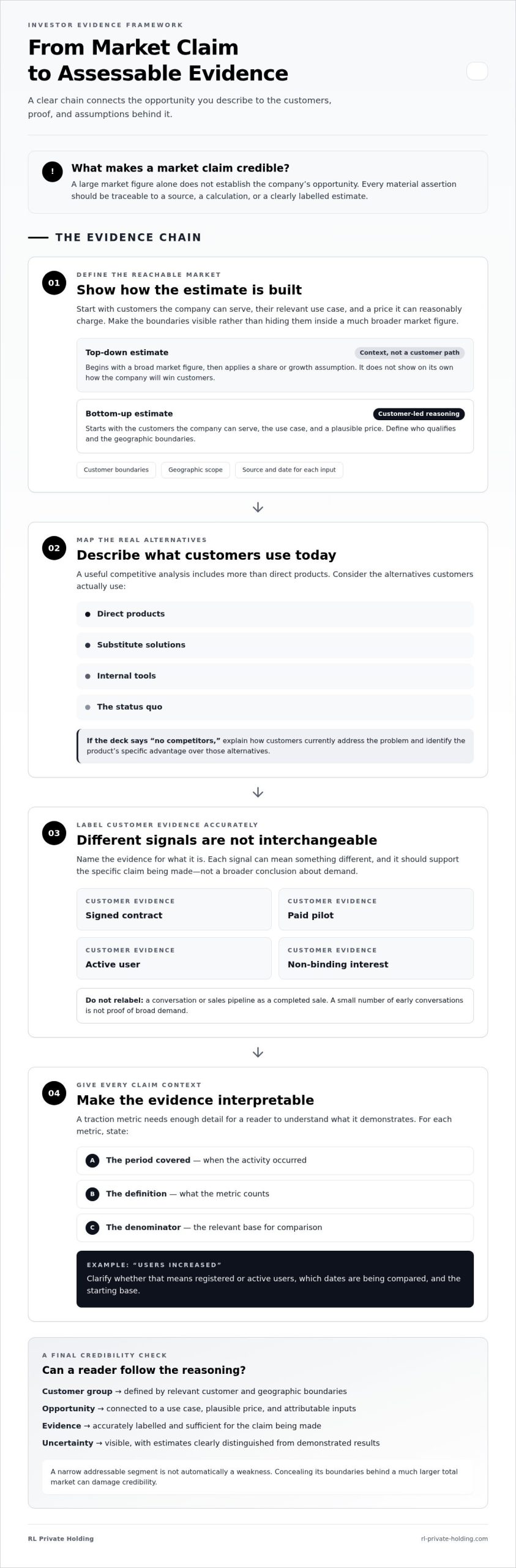
Market and customer claims help investors judge whether a company can build a viable business, not simply whether its sector is large or attracting attention. Make every material assertion traceable to a source, calculation, or clearly labelled estimate. A large market figure without a credible path to reachable customers may describe an industry, but it does not establish the company’s opportunity.
Credible market sizing connects explicit assumptions about customers and pricing to attributable sources and a defined reachable segment. That allows readers to follow how the estimate was constructed, understand where uncertainty remains, and judge whether the company’s plan fits the opportunity.
Market sizing and competitive positioning
A top-down estimate starts with a broad market figure and applies a share or growth assumption. It can provide context, but it does not show how the company will win customers. A bottom-up estimate starts with the customers the company can serve, the relevant use case, and the price it can reasonably charge. Define the customer or geographic boundaries, state what qualifies for inclusion, and record the source and date for each input.
Check that the competitive analysis reflects the alternatives customers actually use. These may include direct products, substitute solutions, internal tools, or the status quo. If the deck says “no competitors,” explain how customers currently address the problem and identify the specific advantage the product offers over those alternatives.
A useful market slide lets the reader follow the reasoning from a defined customer group to a plausible commercial opportunity. A narrow addressable segment is not automatically a weakness. Hiding its boundaries behind a much larger total addressable market can damage credibility.
Customer validation and traction evidence
Customer evidence varies in strength and meaning. A signed contract, a paid pilot, an active user, and a non-binding expression of interest are not interchangeable. Label each accurately, and do not present a conversation or sales pipeline as a completed sale. The evidence should support the specific claim being made, not a broader conclusion about demand.
Give every traction metric enough context to interpret it. State the period covered, the metric’s definition, and the relevant denominator. “Users increased,” for example, is hard to assess without knowing whether that means registered or active users, the dates being compared, and the starting base. A pilot can show willingness to test a product; renewal, repeat usage, or payment may provide different evidence of sustained value.
- Separate current results from forecasts and targets.
- Identify whether customer activity is paid, contracted, active, or exploratory.
- Use consistent periods and definitions across slides.
- Attribute external market-growth claims to a dated, relevant source.
These distinctions prevent a presentation from overstating what the available evidence shows. They also clarify what remains to be proven, helping readers assess the company’s next milestones against its current position. For a broader perspective on the firm’s investment approach, explore RL Private Holding’s venture capital focus.
Financial, Traction, and Execution Inconsistencies Investors May Notice
A financial forecast is persuasive when its assumptions connect to observed performance and a credible execution plan. Investors may compare the revenue narrative with customer activity, delivery capacity, operating costs, and hiring plans. If sales are projected to accelerate but the deck does not explain how the company will acquire or serve customers, the growth path is difficult to assess. Projections always involve uncertainty; the key is whether their drivers are visible and internally consistent.
Financial projections and unit economics
Trace projected revenue back to its commercial or operational drivers. These might include customer numbers, contract size, conversion rates, renewal patterns, or delivery capacity. If a forecast assumes rapid growth, explain which inputs change, why they are expected to change, and what evidence supports that expectation. Label projections as assumptions, not promises, and identify the variables that could materially change the outcome.
Keep definitions consistent across the deck and supporting materials. If “revenue” means contracted but not yet earned amounts on one slide and recognised sales on another, comparisons become unreliable. Apply the same discipline to customer counts, churn, gross margin, and reporting periods. For customer acquisition cost (CAC) and lifetime value (LTV), state the calculation and use comparable inputs. If the business has too little history to estimate LTV reliably, disclose that limitation rather than presenting a precise-looking ratio.
Traction, milestones, and use of funds
Connect the funding request to measurable progress. If the capital supports product development, hiring, or customer acquisition, identify the milestone each use is intended to advance and how progress will be assessed. Hiring plans should match the work required. If a forecast depends on expanding sales capacity, show that dependency and the expected timing of the hires.
Compare each claim with the evidence available and the assumption that remains unresolved. This review can help pinpoint where the story needs clarification:
- Claim: Revenue will grow through new customer sales. Evidence: Current customer activity, sales timing, and a consistent revenue definition. Unresolved assumption: Whether acquisition and conversion rates can scale.
- Claim: A new hire will increase delivery capacity. Evidence: The role, hiring timing, and the work the position enables. Unresolved assumption: Whether recruitment and onboarding align with the milestone.
- Claim: Retention supports recurring revenue. Evidence: The cohort period, retention definition, and observed customer behaviour. Unresolved assumption: Whether current patterns persist as the customer base expands.
These checks help surface red flags in a VC pitch deck without treating every forecast variance as a failure. The central question is whether the company can explain how evidence informs its assumptions and how the proposed plan will test them. State any remaining uncertainty plainly and identify the milestone that would provide a clearer answer.
How to Audit a VC Pitch Deck Before Sending It
A useful audit checks whether the investment case is understandable, supported, and internally consistent. It cannot predict an investor’s decision or guarantee a successful raise. It can help you find red flags in a VC pitch deck while there is still time to correct errors, clarify assumptions, or gather stronger evidence.
Review the deck in four passes. Keep a separate record of each issue, its importance to the case, and whether you can fix it now or need further validation.
- Test the narrative. Read the deck in sequence, from the problem and proposed solution through the market, business model, team, and funding request. Check that each section advances the same investment thesis. If the solution addresses a different problem from the one described, or the funding request does not support the stated plan, make the connection explicit rather than relying on the reader to infer it.
- Trace material claims. For each important number or factual assertion, record its source, calculation, period, and definition. Mark it as observed evidence, an estimate, or a forward-looking assumption. If a claim has no reliable source or calculation, narrow it, qualify it, or identify the evidence still needed.
- Reconcile financial logic. Compare revenue assumptions with customer activity, pricing, costs, and the operational capacity required to deliver. Confirm that each metric means the same thing across slides and supporting materials. Make dependencies visible when growth relies on a future event, such as a hire or product milestone.
- Check presentation accuracy. Review every headline, chart, and visual against the data it represents. Give charts a clear time period and scale, and make sure headlines do not imply more than the figures show. Correct inconsistent labels, dates, units, and definitions so the presentation does not create ambiguity.
Prioritise revisions by their effect on the investment case, not by how noticeable they are on a slide. Correct factual errors and reconcile conflicting figures first. Then clarify assumptions and improve the design. A polished chart cannot fix an unsupported forecast, while a plain slide can still communicate credible evidence clearly.
Separate changes you can make immediately from questions that require more information. You can correct a mislabeled metric or explain how a forecast was calculated. Additional customer data or operating history may be needed to validate a commercial assumption. Do not fill that gap with stronger language. State the risk, describe the next test or mitigation, and explain how the result will inform the plan.
The result should be a clear account of evidence, uncertainty, and execution priorities, not a presentation of certainty. To understand RL Private Holding’s stated investment approach, explore its venture capital investment focus.
Handling Red Flags in Your VC Pitch Deck
When you identify a weakness, determine whether it is a presentation problem or a risk in the business itself. A mislabeled chart, unclear metric definition, or outdated slide can usually be corrected before sharing the deck. Limited retention data, uncertain sales cycles, or dependence on a product milestone may require further validation. Treating both categories as design issues can make the deck look clearer without strengthening the underlying case.
Match your response to the issue. Correct errors promptly. Update a claim when new evidence changes its basis, or narrow its scope when the evidence supports only a more limited conclusion. If a risk remains unresolved, describe it directly and explain what the company is doing to understand or mitigate it. Transparency supports informed assessment, but does not guarantee an investment decision.
Address weaknesses with evidence and a clear plan
Give each material issue an owner, an evidence requirement, and a review point. For example, if repeat usage is not yet established, identify who will monitor it, which customer behaviour would provide useful evidence, and when the team will reassess the assumption. This turns a vague concern into a defined learning priority without implying that the desired result is certain.
State what could change the assessment. If a forecast depends on a sales conversion assumption, explain what observed result would support revising it. If customer feedback is mixed, distinguish the feedback received from the conclusion the company hopes to test. Do not present a mitigation plan as proof that the risk has already been resolved.
Prepare for investor questions without overclaiming
Prepare concise answers about the assumptions most central to the case: customer validation, competitive alternatives, forecast drivers, and allocation of capital. A useful answer identifies the available evidence, the uncertainty that remains, and the next step the company intends to take. Keep source material and calculations consistent with the deck so supporting detail clarifies the claim instead of introducing conflicting definitions.
Before sharing, review unresolved issues from an investor’s perspective. Can the team explain why a metric matters, where it came from, and what its limitations are? Does the use of funds connect to a milestone the company can monitor? Clear answers demonstrate command of the business, even when they include an open question.
A credible deck does not conceal every limitation; it presents the company’s current position and learning priorities with discipline. For broader context on how investment decisions are framed, explore RL Private Holding’s venture capital investment framework.
Make Credibility a Continuing Practice
Make deck preparation the start of a continuing discipline, not a one-time exercise before fundraising. As customer behaviour, product delivery, and commercial assumptions evolve, update the materials that describe them. A deck that reflects the company’s current position gives founders a more reliable basis for investor conversations and helps prevent outdated claims from becoming new red flags in a VC pitch deck.
Set a regular point to review material assumptions and assign responsibility for gathering evidence that is still developing. This keeps the investment case aligned with actual progress while allowing uncertainty to be discussed directly. A clear account of what the company knows, what it is testing, and what it intends to learn can support a substantive discussion without promising a particular funding outcome.
RL Private Holding’s stated investment focus includes venture capital within a diversified global portfolio. Explore RL Private Holding’s venture capital funding and investment focus for broader investment context.
Frequently Asked Questions
Does having no revenue automatically count as a red flag in a VC pitch deck?
No. A lack of revenue can be consistent with a company’s development stage, particularly if the product is still being built or tested. The relevant question is what evidence supports the next commercial step. For example, a pre-revenue company might explain what it has learned from user testing and what must happen before customers can pay. Red flags in a VC pitch deck arise when progress or demand is overstated, not simply because sales have not begun.
Can a large total addressable market claim be a red flag?
Yes, if the figure is broad but its connection to the company’s actual opportunity is unclear. A market estimate that includes customers the product cannot serve, or uses assumptions the founders cannot explain, may overstate the opportunity. Clarify which customers and use cases are included, how the estimate was calculated, and what portion the company can realistically pursue. A smaller, well-supported segment can be more informative than an expansive headline figure.
Is a long pitch deck a red flag for venture capital investors?
Not automatically. Length matters less than whether each slide helps assess the business. A deck may need detail to explain a complex product or business model, but repeated claims and tangential background can make the central case harder to follow. Keep the main presentation focused on the information needed to understand the opportunity, and place supporting detail in an appendix. Check that removing a slide does not leave an important part of the case unexplained.
What if my startup’s projections are based on assumptions rather than historical results?
That is common for companies with limited operating history. Make the assumptions visible and show how they drive the forecast, such as expected customer conversion, pricing, or delivery capacity. Distinguish estimates from recorded results, and consider showing how the outcome changes if a key input is lower or takes longer to achieve. This helps readers assess the logic without suggesting that a forecast is guaranteed.
Should founders include risks in a VC pitch deck?
Yes, address material risks rather than hiding them. Select risks that could affect the company’s ability to execute, such as reliance on a technical milestone or an untested sales process. Explain what is known, what remains uncertain, and how the team plans to monitor or reduce the exposure. A concise, measured treatment shows that founders understand the limits of the current plan. It should not imply that every risk has already been resolved.
Can a pitch deck be too polished and still raise concerns?
Yes. Strong visual design cannot compensate for unsupported claims or numbers that conflict across slides. Concern may also arise if the presentation seems generic and does not reflect the company’s actual product, customers, or strategy. Review the deck’s charts and images for accuracy, and ensure the founders can explain the substance behind every key slide. The objective is clear communication, not polish for its own sake.
Should founders send a revised pitch deck after identifying a material error?
Usually, if the error could affect a reader’s understanding of the business, correct it and provide the accurate version to relevant recipients. Use a clear file name or date to distinguish the revision, and briefly identify the correction without overstating its significance. If the deck is already part of an active discussion, make sure figures and claims in follow-up materials match the revised version. Quietly replacing a material error can create more confusion than acknowledging it.