

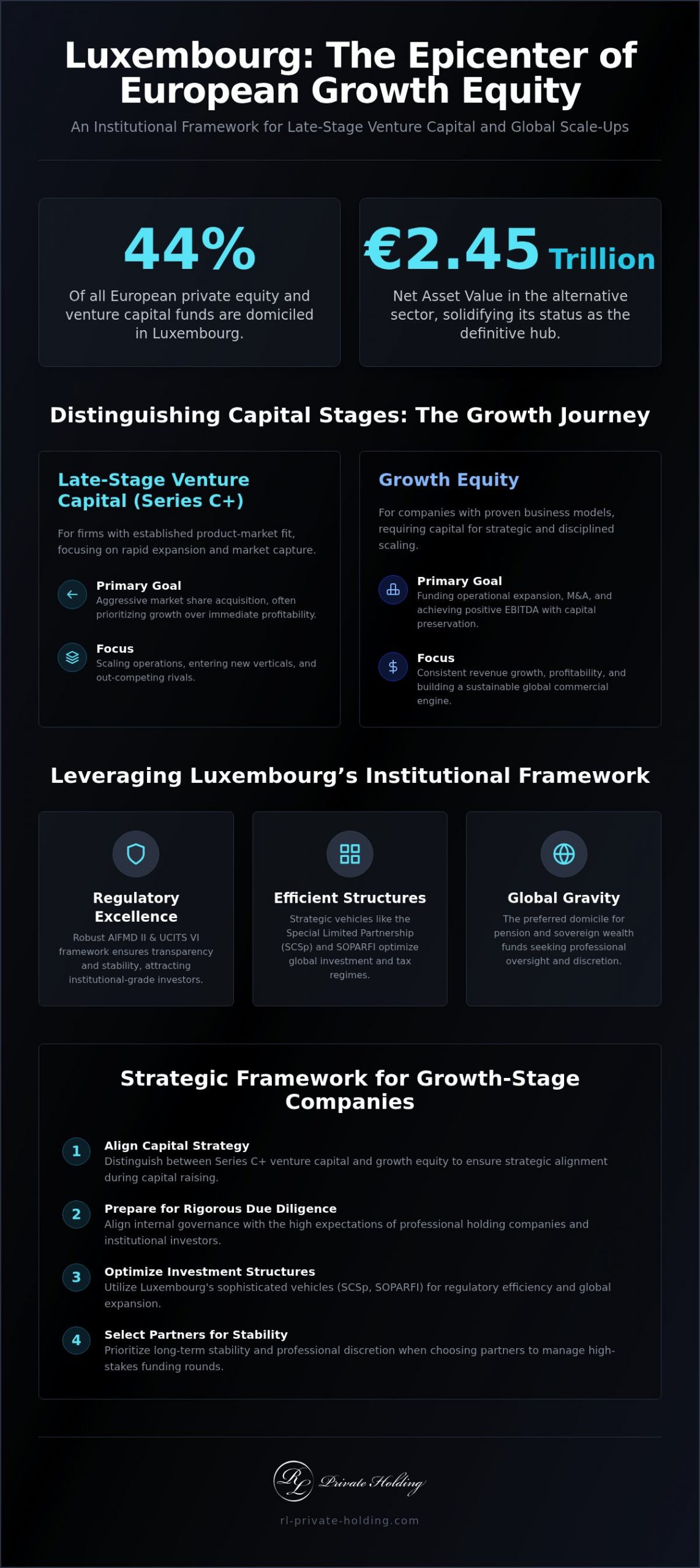
Luxembourg currently domiciles 44% of all European private equity and venture capital funds, representing a total Net Asset Value of €2.45 trillion in the alternative sector as of early 2026. This concentration of capital establishes the Grand Duchy as the definitive hub for late-stage venture capital Luxembourg mandates, especially as institutional investors shift their focus toward deep tech and specialized high-alpha strategies. Sophisticated scale-ups often find the transition from venture to growth equity inherently complex. They frequently encounter challenges regarding inconsistent regulatory alignment across jurisdictions and a lack of discretion during high-stakes funding rounds.
It’s clear that securing significant growth capital requires more than just a liquid partner; it demands the stability of a professional holding company and the structural efficiency provided by the latest AIFMD II transpositions. This article provides an institutional-grade analysis of the 2026 growth equity landscape. You’ll explore a strategic framework designed to align your scaling objectives with Luxembourg’s modernized tax regimes and enhanced liquidity management tools. The following sections detail how to achieve regulatory efficiency while maintaining the institutional gravity necessary for global expansion.
Key Takeaways
- Distinguish between Series C+ venture capital and growth equity to ensure strategic alignment during the capital raising process.
- Navigate the late-stage venture capital Luxembourg landscape by utilizing the Grand Duchy’s robust regulatory environment for secure, institutional-grade scaling.
- Prepare for the increased rigor of growth-stage due diligence by aligning internal governance with the expectations of professional holding companies.
- Optimize global investment structures through the strategic application of Luxembourgish vehicles such as the Special Limited Partnership (SCSp) and SOPARFI.
- Prioritize long-term stability and professional discretion when selecting investment partners to manage the complexities of high-stakes funding rounds.
Defining Late-Stage Venture Capital and Growth Equity in Luxembourg
The maturation of the European private equity ecosystem has positioned Luxembourg as a central node for large-scale capital deployment. While early-stage funding often attracts significant media attention, the institutional weight of the market resides in late-stage venture capital Luxembourg mandates. As of early 2026, Luxembourg domiciles 44% of all European private equity and venture capital funds, representing a total Net Asset Value of €2.45 trillion in the alternative sector. This dominance isn’t accidental. It reflects a deliberate alignment between regulatory transparency and the rigorous requirements of global asset managers.
Understanding the current landscape requires a clear distinction between late-stage venture rounds and dedicated growth equity. Late-stage venture capital generally refers to Series C, D, and subsequent rounds where firms have established product-market fit but may still prioritize market share acquisition over immediate profitability. In contrast, Growth capital targets companies with proven business models that require funding to expand operations, enter new geographic markets, or finance acquisitions. These entities typically demonstrate consistent revenue growth and are moving toward, or have already achieved, positive EBITDA. Institutional investors favor Luxembourg for these large-scale allocations due to the stability of its legal framework and the sophistication of its service provider ecosystem.
The Evolution of Venture Capital in the Luxembourg Market
The Luxembourg market has transitioned from a domiciliation hub for seed funding to a sophisticated ecosystem for growth equity. This shift is accelerated by the implementation of AIFMD II and UCITS VI in March 2026, which introduced more rigorous requirements for delegation and liquidity risk management. Institutional investors now view Luxembourg as a framework that offers structural integrity for diversified portfolios rather than just a tax-neutral jurisdiction. The CSSF’s 2026 supervisory priorities emphasize oversight frameworks, ensuring that late-stage vehicles maintain the professional standards expected by pension funds and sovereign wealth funds. This regulatory maturity allows venture capital to integrate seamlessly into broader institutional asset management strategies.
Growth Equity vs. Traditional Venture Capital
The primary difference between growth equity and traditional venture capital lies in the risk profile and the nature of the underlying business. Traditional venture capital accepts high levels of binary risk in exchange for potential exponential returns. Growth equity, however, prioritizes capital preservation and disciplined scaling. In the 2026 environment, growth-stage technology investments focus on proven scalability in sectors like AI and SaaS. These investments utilize structured instruments to mitigate downside risk while providing the necessary liquidity for global expansion. This methodical approach to risk management is what attracts institutional capital to Luxembourg’s regulated fund structures, providing a steady hand for companies during their most critical expansion phases.
The Strategic Transition from Early-Stage VC to Growth-Stage Capital
Scaling a company beyond its initial market success requires a fundamental shift in capital structure and governance. For many firms, the transition from early-stage venture capital to late-stage venture capital Luxembourg mandates represents a move toward institutional maturity. This phase is characterized by a shift from validating a product to optimizing a global commercial engine. The focus moves away from experimentation toward the disciplined execution of a proven business model. It isn’t just about the size of the investment; it’s about the sophistication of the partnership.
Indicators of Growth-Stage Readiness
Identifying the optimal moment for growth equity allocation depends on consistent financial performance and operational stability. Series C+ benchmarks often require annual recurring revenue (ARR) growth that remains predictable even at scale. Investors look for market penetration metrics that demonstrate a clear path to leadership in a specific vertical. According to the Luxembourg Private Equity & Venture Capital Association, the local ecosystem has seen a significant increase in firms capable of supporting these complex transitions. Operational infrastructure must also evolve. This includes robust financial reporting, a seasoned executive team, and a governance structure that can withstand the scrutiny of institutional due diligence.
Moving from founder-led operations to board-governed structures is often a challenging aspect of this transition. Late-stage partners prioritize transparency and disciplined decision-making. They expect a clear separation between executive management and strategic oversight. This shift ensures that the company can sustain growth without being overly dependent on a single individual. It prepares the entity for the rigor of a potential public listing or a major private equity exit.
Capital Allocation Strategies for Scale-ups
Effective capital allocation is vital when engaging with late-stage venture capital Luxembourg providers. Scale-ups must balance the necessity for significant expansion capital with the desire to manage dilution for existing shareholders. Growth equity is frequently utilized for mergers and acquisitions (M&A) or rapid internationalization efforts that require substantial upfront investment. Professional private equity investment management provides the framework necessary to execute these high-stakes maneuvers with precision. By aligning with a stable investment partner, firms can access the resources needed to navigate international regulatory landscapes and consolidate their market position. Establishing a relationship with a disciplined partner like RL Private Holding can provide the institutional gravity required for this next phase of development.
Leveraging Luxembourg’s Institutional Structures for Global Scale-ups
Luxembourg’s reputation as a global financial center is built upon its ability to provide flexible yet robust legal vehicles. For companies securing late-stage venture capital Luxembourg mandates, the choice of investment vehicle is as critical as the capital itself. These structures don’t just hold assets; they facilitate the complex cross-border flows required for international expansion. The Grand Duchy offers a suite of options that balance transparency with the operational discretion required by sophisticated investors. This structural maturity is a key reason why the region has become the primary gateway for international sponsors from the United States and Asia looking to access the European market.
Structural Efficiency in Late-Stage Funding
The Luxembourg special limited partnership (SCSp) has become the preferred vehicle for growth equity due to its contractual flexibility and tax transparency. Unlike traditional corporate entities, the SCSp allows for a high degree of customization in the partnership agreement, enabling sponsors to align investor interests with the specific needs of a scale-up. This efficiency is bolstered by the oversight of the Commission de Surveillance du Secteur Financier (CSSF). The regulator’s focus on delegation and risk management, particularly following the 2026 implementation of AIFMD II, provides a layer of institutional confidence that early-stage jurisdictions often lack. It ensures that capital isn’t just deployed but managed within a framework of professional accountability.
The Role of Holding Companies in Portfolio Management
Centralizing global operations through a Luxembourg-based holding company, such as a SOPARFI (Société de participations financières), offers significant strategic advantages. For late-stage founders, these structures provide a stable platform for asset protection and wealth preservation. A SOPARFI can serve as the primary entity for global investment holding, streamlining the management of multi-sector portfolios. This centralization reduces administrative complexity and ensures that regulatory compliance is managed from a single, reputable jurisdiction. It’s an essential component for firms that have moved beyond the experimental phase and now require a permanent institutional home.
Institutional governance frameworks within these holding companies are designed to manage the transition from a single-product firm to a diversified global enterprise. By utilizing Luxembourg’s proven structures, scale-ups can achieve the stability necessary to attract even more significant institutional allocations. This approach prioritizes long-term institutional permanence over short-term volatility. It reflects a disciplined strategy where structural integrity supports commercial growth, ensuring that the entity remains resilient as it enters the global stage. Discretion and stability remain the hallmarks of this environment, providing a steady hand in the background of major international investments.
Due Diligence and Selection Criteria for Late-Stage Partners
Selecting a lead partner for late-stage venture capital Luxembourg mandates is a decision that extends far beyond the immediate valuation of a firm. At this stage of maturity, the focus shifts toward institutional gravity and the ability of the partner to support a multi-year scaling trajectory. Scale-ups must evaluate the track record of potential firms not just by their internal rate of return, but by their history of navigating complex regulatory environments and achieving strategic exits. The 2026 rebound in M&A activity has highlighted the importance of partners who possess the sophistication to manage these pathways effectively while maintaining a steady hand during market fluctuations.
Institutional Due Diligence Protocols
Verification of assets under management (AUM) and performance history remains the baseline for any serious evaluation. However, the current regulatory climate under AIFMD II, transposed into Luxembourg law in March 2026, necessitates a deeper review of a firm’s governance and risk management standards. The CSSF’s 2026 supervisory priorities specifically target delegation and oversight frameworks. Consequently, companies should prioritize partners that demonstrate a disciplined approach to third-party risk and operational integrity. Value creation strategies must also be scrutinized. A professional partner should offer more than capital; they must provide sectoral expertise in growth-stage technology and a clear framework for operational improvement that aligns with global standards.
Governance standards are equally critical. A firm’s internal discipline reflects its ability to manage high-stakes funding rounds with the required discretion. Reviewing how a partner has historically managed its portfolio companies through various economic cycles provides insight into their long-term reliability. This institutional rigor ensures that the partnership is built on a foundation of transparency and professional accountability.
Aligning with a Strategic Holding Partner
Partnering with a diversified investment holding company often provides a level of stability that traditional, fund-based venture capital may lack. These entities typically operate with a longer investment horizon, prioritizing sustainable growth over the urgent liquidity requirements of fixed-term funds. This alignment is particularly beneficial for firms in deep tech or AI sectors where the path to market leadership requires patient, institutional backing. Strategic frameworks for venture capital Luxembourg involve a methodical assessment of how an investment fits within a broader global portfolio. This perspective allows for a more collaborative approach to internationalization and market consolidation.
A partner’s ability to provide follow-on capital is essential for maintaining momentum during rapid expansion. Analyzing the institutional backing of an investment firm ensures they possess the liquidity to support future funding rounds without external pressure. Professional discretion in high-stakes environments remains a non-negotiable requirement for global scale-ups. Organizations seeking a disciplined and stable partner for their next growth phase can explore our private equity investment management services to understand how we facilitate long-term institutional success.
RL Private Holding: Providing Institutional Stability for Growth-Stage Firms
RL Private Holding operates as a disciplined partner for entities seeking late-stage venture capital Luxembourg mandates. We focus on companies that have established a clear commercial footprint and now require the institutional gravity of a global holding company. Our strategy is built on the principle of permanent capital. This allows us to prioritize long-term value creation over the artificial timelines often associated with traditional fund structures. Such an approach provides scaling firms with the stability necessary to execute complex internationalization strategies without the pressure of premature exit requirements. It’s a model designed for those who value institutional permanence and professional discretion.
Our firm presents itself as a steady hand in the background of major global investments. We don’t attempt to persuade through excitement; instead, we project stability and exclusivity through a sober, factual presentation of our organizational framework. This sense of quiet authority suggests an established presence that is secure in its position. We appeal to those who value a methodical and deliberate rhythm in asset management, ensuring that every strategic move is backed by rigorous internal discipline and a clear long-term plan.
Our Approach to Growth Equity
We maintain a specialized focus on high-potential technology and asset-rich sectors, including real estate and diversified private equity investment management. This diversification ensures that our portfolio remains resilient across various economic cycles. Management fees and strategic oversight are structured to ensure total alignment between our firm and the entities we support. By leveraging our global presence, we provide local scale-ups with the resources needed for expansion into new jurisdictions. Our involvement is characterized by a philosophy of sophisticated partnership; we provide the financial backing required for major investments while respecting the operational autonomy of seasoned executive teams. This ensures that the entity’s growth is managed within a framework of professional accountability and structural integrity.
Securing the Future of Institutional Portfolios
For institutional investors, we offer a gateway to sophisticated private equity and venture capital exits within a regulated framework. Our wealth management services are designed for those who prioritize asset protection and wealth preservation. In a market often defined by disruptive volatility, RL Private Holding serves as a steady hand, applying a methodical and deliberate rhythm to capital deployment. We ensure that every allocation is supported by the structural integrity of the Luxembourgish regulatory environment, providing a secure foundation for long-term growth. Engaging with a partner of this caliber is the final step in the transition from a venture-backed startup to a globally recognized enterprise. We invite institutional allocators to evaluate our framework for private equity investment management and secure the strategic capital required for the next decade of growth.
Securing Long-Term Institutional Growth through Strategic Alignment
The transition from venture-backed experimentation to global commercial leadership demands a partnership defined by structural integrity and institutional gravity. The Grand Duchy provides the definitive framework for this evolution. It’s a sophisticated ecosystem where regulatory transparency and flexible investment vehicles meet the rigorous demands of global asset managers. Successfully securing late-stage venture capital Luxembourg mandates requires more than just capital; it necessitates a commitment to disciplined governance and a long-term investment horizon.
RL Private Holding provides the stability and professional discretion required for this high-stakes environment. Headquartered in Luxembourg with a global operational scale, we manage a diversified portfolio across technology, real estate, and private equity. Our approach prioritizes institutional permanence and wealth management expertise, ensuring that scaling firms remain resilient in volatile markets. We invite you to Contact RL Private Holding for Strategic Investment Management to discuss how our framework for growth equity can support your institutional objectives. We look forward to facilitating your firm’s next phase of global expansion.
Frequently Asked Questions
What is the minimum revenue threshold for late-stage venture capital in Luxembourg?
Minimum revenue thresholds for late-stage venture capital Luxembourg mandates typically begin at €10 million in annual recurring revenue. While specific requirements vary by firm, this benchmark suggests the business has achieved proven product-market fit and is ready for institutional scaling. Investors prioritize companies that demonstrate consistent growth and a clear path toward profitability within a defined timeframe.
How does growth equity differ from traditional private equity in the Luxembourg market?
Growth equity targets companies requiring capital for expansion, whereas traditional private equity often involves buyouts or restructuring of mature entities. In Luxembourg, growth equity is characterized by minority or significant majority stakes in firms with established business models. This strategy prioritizes commercial acceleration rather than operational turnarounds, distinguishing it from the traditional leveraged buyout model common in broader private equity.
What are the primary benefits of using an SCSp for late-stage funding rounds?
The Special Limited Partnership (SCSp) offers unmatched contractual flexibility and tax transparency for institutional investors. It allows sponsors to tailor the partnership agreement to the specific needs of a funding round without the constraints of a legal personality. This structure facilitates rapid deployment of capital and efficient cross-border distributions, making it the preferred vehicle for sophisticated late-stage funding in the Grand Duchy.
How long is the typical investment horizon for growth-stage equity in 2026?
The typical investment horizon for growth-stage equity in 2026 ranges from five to eight years. This duration allows sufficient time for the entity to execute internationalization strategies or conclude major mergers and acquisitions. Some institutional partners may extend this period to ten years for asset-rich sectors or deep tech ventures that require more extensive development cycles before achieving a strategic exit.
Does RL Private Holding focus on specific technology sectors in Luxembourg?
RL Private Holding maintains a disciplined focus on high-potential technology sectors including AI, SaaS, and deep tech, alongside asset-heavy real estate investments. We prioritize sectors where structural stability and institutional management can drive long-term value. This diversified approach ensures that our portfolio remains resilient, providing a steady hand for companies operating in specialized global markets.
What role does the CSSF play in overseeing venture capital firms in Luxembourg?
The Commission de Surveillance du Secteur Financier (CSSF) provides rigorous oversight of Alternative Investment Fund Managers (AIFMs) to ensure market integrity. Following the 2026 implementation of AIFMD II, the regulator has increased its focus on delegation frameworks and liquidity risk management. This oversight ensures that venture capital firms operate with the professional standards required to protect institutional interests.
How are management fees typically structured for growth equity funds?
Management fees for growth equity funds are generally structured between 1.5% and 2% of committed capital. In the late-stage venture capital Luxembourg landscape, these fees are often coupled with a carried interest performance incentive, typically set at 20% after a preferred return hurdle is met. This structure aligns the interests of the investment manager with the long-term success of the portfolio companies.
Can institutional investors access late-stage VC through a family office structure?
Institutional investors and sophisticated family offices can access late-stage opportunities through Luxembourg’s flexible fund structures such as the RAIF or SIF. These vehicles allow family offices to participate in co-investment opportunities alongside larger institutional sponsors. This approach provides the structural efficiency and regulatory protection necessary for managing high-stakes allocations within a professional and discreet investment environment.