

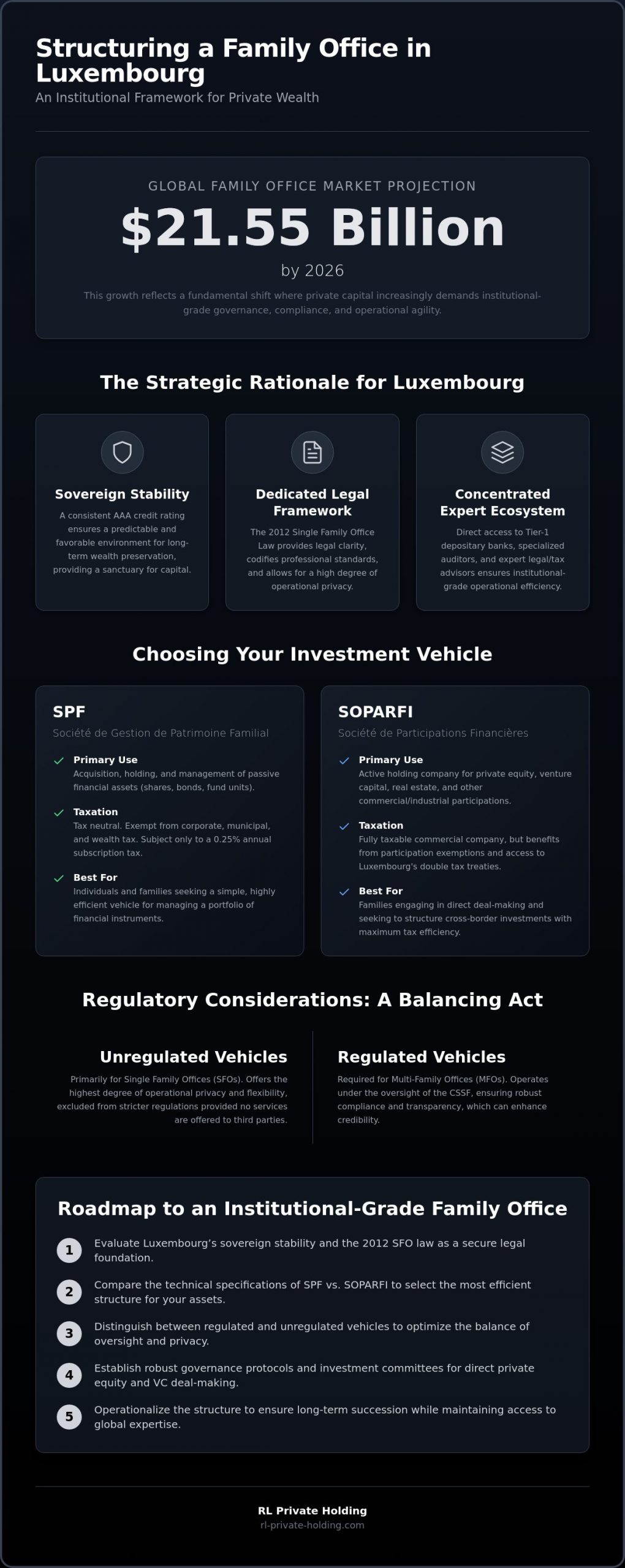
What if your family wealth structure functioned with the same precision and market access as a top-tier institutional fund? By 2026, the global family office market is projected to reach $21.55 billion. This growth reflects a shift where private capital demands institutional-grade governance. You likely recognize that managing a multi-generational legacy requires more than just a holding company. It demands a sophisticated ecosystem that balances regulatory compliance with operational agility. Setting up a family office in Luxembourg offers a unique solution for those seeking to harmonize cross-border tax efficiency with direct access to private equity and real estate markets.
This guide provides a comprehensive framework for selecting and structuring a vehicle that meets the highest standards of the 2026 financial landscape. We examine the technical nuances of the Société de Gestion de Patrimoine Familial (SPF) alongside the latest regulatory requirements for single and multi-family offices. You’ll gain a clear roadmap for operationalizing your structure. This ensures your assets remain protected while you maintain the flexibility to pursue global investment opportunities through a robust and compliant institutional platform.
Key Takeaways
- Evaluate the strategic advantages of Luxembourg’s sovereign stability and the 2012 Single Family Office law in providing a secure, institutional-grade legal framework.
- Compare the technical specifications of the Société de Gestion de Patrimoine Familial (SPF) and the SOPARFI to determine the most efficient structure for setting up a family office in Luxembourg.
- Distinguish between regulated and unregulated vehicles to optimize the balance between CSSF oversight and operational privacy within a cross-border context.
- Establish robust governance protocols and investment committees to manage the growing institutional preference for direct private equity and venture capital deal-making.
- Access a clear roadmap for operationalising a family office that ensures long-term succession while maintaining access to global asset management expertise.
The Strategic Rationale for Luxembourg as a Global Family Office Hub
Luxembourg’s status as a premier financial center is built on a foundation of sovereign stability and a sophisticated legal infrastructure. For principals considering setting up a family office in Luxembourg, the jurisdiction offers a level of institutional security that is increasingly rare in the global market. The Grand Duchy maintains a consistent AAA credit rating from all major agencies. This fiscal health ensures that the state can maintain a predictable and favorable environment for long-term wealth preservation. It provides a sanctuary for capital in an era where many traditional financial centers face heightened economic uncertainty.
The 2012 Single Family Office Law: A Foundation of Clarity
The Law of 21 December 2012 established a dedicated legal framework that defines the scope and professional requirements of family office activities. To understand what is a family office in the Luxembourg context, one must distinguish between the management of private wealth and commercial financial services. This law provides clarity by excluding single family offices from the stricter regulations applied to multi-family offices, provided they don’t offer services to third parties. It codifies the role of the family office professional, ensuring that those managing the structure adhere to high standards of integrity and professional secrecy. This distinction allows for a high degree of operational privacy while maintaining a clear legal identity.
Stability in a Volatile Global Economy
Global economic shifts have prompted a significant migration of capital from traditional offshore jurisdictions toward transparent, onshore hubs. Luxembourg’s political and social stability serves as a prerequisite for multi-generational succession planning. The Commission de Surveillance du Secteur Financier (CSSF) oversees the financial sector with a balanced approach, maintaining a robust regulatory environment that doesn’t compromise operational flexibility. This oversight provides families with the confidence that their assets are held within a jurisdiction that prioritizes transparency and international compliance. The shift toward onshore structures reflects a broader trend of institutionalization among high-net-worth individuals.
The local ecosystem further supports the longevity of these structures through a concentrated pool of specialized service providers. These entities include:
- Tier-1 depositary banks with deep expertise in multi-asset custody and cross-border transactions.
- Specialized auditors familiar with the nuances of family office reporting and Luxembourgish GAAP.
- Legal and tax advisors skilled in the complexities of global wealth structuring and succession law.
This concentration of expertise makes setting up a family office in Luxembourg a strategic choice for families seeking to institutionalize their wealth management. The presence of these professionals ensures that the office can operate with the same efficiency and rigor as a global investment firm.
Evaluating Tax-Efficient Investment Structures for HNWIs
Selecting the appropriate legal vehicle is the most critical technical decision when setting up a family office in Luxembourg. The jurisdiction offers a specialized toolkit designed to accommodate various asset classes, from passive financial instruments to active private equity participations. Each structure serves a distinct purpose within a broader wealth management strategy. The choice depends on the family’s requirement for tax neutrality, treaty access, and operational complexity.
The SPF: Simplicity and Tax Neutrality for Financial Assets
The Société de Gestion de Patrimoine Familial (SPF) remains the premier vehicle for managing the private wealth of individuals and family entities. It’s strictly limited to the acquisition, holding, and management of financial instruments such as shares, bonds, and fund units. The SPF provides a highly efficient environment because it’s exempt from corporate income tax, municipal business tax, and net wealth tax. Instead, it’s subject to an annual subscription tax of 0.25%, which is calculated on the paid-up share capital and share premiums. As of 2025, this tax is capped at a maximum of EUR 125,000 per year. It’s important to recognize that the SPF cannot engage in commercial activities or hold real estate directly. Compliance is vital, as recent modernization of the law has introduced administrative fines of up to EUR 250,000 for specific violations.
The SOPARFI: Strategic Holding of Real Estate and Private Equity
While the SPF focuses on passive financial assets, the SOPARFI (Société de Participations Financières) is a versatile, fully taxable commercial company. Its primary advantage lies in the Luxembourg participation exemption regime. This framework allows for the tax-exempt receipt of dividends and capital gains, provided certain holding periods and ownership thresholds are met. Because it’s a fully taxable entity, the SOPARFI benefits from Luxembourg’s extensive network of double tax treaties. This makes it the preferred vehicle for sophisticated private equity investment management and global real estate holdings. It provides the institutional gravity required for complex, cross-border transactions that involve active management and debt financing.
For families seeking even greater flexibility, the Special Limited Partnership (SCSp) has become a staple for private equity and venture capital allocations. It lacks legal personality, which allows for total contractual freedom in governing the relationship between partners. Similarly, the Reserved Alternative Investment Fund (RAIF) provides an accelerated time-to-market for complex portfolios. It does not require direct CSSF authorization at the fund level, provided it’s managed by an authorized Alternative Investment Fund Manager (AIFM). These structures ensure that when setting up a family office in Luxembourg, principals can mirror the operational sophistication of institutional investors. Families looking to optimize these structures often benefit from the expertise found within a dedicated wealth management service provider to ensure long-term alignment with their strategic goals.
Structural Comparison: Regulated vs. Unregulated Family Office Vehicles
A fundamental decision when setting up a family office in Luxembourg involves determining the appropriate level of regulatory supervision. This choice is rarely binary. It depends on whether the office serves a single family or multiple families, and whether it intends to co-invest with third-party institutional partners. The Law of 21 December 2012 provides the primary boundary. Single-family offices (SFOs) typically operate outside the scope of direct CSSF oversight, provided they don’t offer services to external parties. This unregulated status prioritizes discretion and operational speed. It allows families to manage their private affairs without the extensive reporting burdens associated with traditional financial institutions.
Unregulated Entities: The Path of Operational Efficiency
Unregulated vehicles are often the preferred choice for families who prioritize privacy and cost-effectiveness. The Luxembourg special limited partnership (SCSp) is a prime example of this efficiency. It operates without direct CSSF supervision, offering total contractual freedom to the partners. Governance requirements for unregulated holding companies are generally governed by the standard provisions of the Law on Commercial Companies. This allows for a streamlined organizational hierarchy that can react quickly to market opportunities. Typical use cases include internal family holding arms and dedicated vehicles for specific asset classes where the family retains full control. While these structures lack the “regulatory stamp,” they provide the maximum level of confidentiality for the underlying principals. They are ideal for families whose primary objective is the efficient internal management of a multi-generational legacy.
Regulated Structures: Building Institutional Trust
Regulated structures become necessary when a family office seeks to institutionalize its investment platform or attract co-investment from external partners. The Reserved Alternative Investment Fund (RAIF) serves as a strategic bridge. It offers a higher degree of compliance than an SCSp but avoids the lengthy approval process of a Specialized Investment Fund (SIF). While the RAIF itself isn’t directly authorized by the CSSF, it must be managed by an authorized Alternative Investment Fund Manager (AIFM). This requirement introduces an additional layer of institutional governance. It ensures that the fund adheres to rigorous risk management and transparency standards. These regulated structures are particularly advantageous when setting up a family office in Luxembourg that intends to market its investment strategies to other sophisticated investors. They provide a level of credibility that unregulated vehicles cannot match. This facilitates smoother co-investment processes and enhances the office’s reputation within the global financial community. Balancing these reporting requirements with the family’s need for discretion requires a well-structured governance framework that separates public-facing fund activities from private family matters.
Operationalising the Office: Governance and Asset Allocation
The transition from legal structuring to functional operations marks a critical phase for any principal. It’s where the theoretical benefits of the jurisdiction are tested against real-world market volatility. Setting up a family office in Luxembourg necessitates a robust governance framework that moves beyond simple administrative compliance. A well-structured investment committee provides the discipline required to evaluate complex opportunities. This committee ensures that all decisions align with the family’s long-term objectives and risk tolerance. It serves as the institutional heart of the office, bridging the gap between family vision and professional execution.
Strategic Asset Allocation for 2026
Modern family office portfolios are increasingly defined by a shift toward direct investments. Between 2024 and 2026, Benelux family offices increased their direct deal allocation by 22%. This trend reflects a desire for greater control over underlying assets and a reduction in external management fees. Balancing liquid instruments with long-term illiquid real estate asset management Luxembourg requires a sophisticated approach to liquidity laddering. High-growth sectors are also becoming central to the legacy. Integrating venture capital Luxembourg allows families to capture innovation at the early stages. Managing these concentrated private equity positions demands rigorous risk management protocols to mitigate the lack of immediate liquidity.
Governance and Succession Planning
A family constitution acts as the foundational document for investment decision-making. It defines the parameters for capital deployment and the values that guide the legacy. Preparing the next generation is no longer an informal process. It involves structured participation in the office’s operations and investment committees. By implementing family office investment strategies Luxembourg that are designed to survive market cycles, principals can ensure a seamless transition of control. This institutionalization of wealth management protects the family from the emotional biases that often lead to capital erosion during generational shifts.
Environmental, Social, and Governance (ESG) criteria are now a core component of the family legacy. In 2026, 65% of Benelux family offices have a formal ESG policy, a significant increase from 45% in 2024. Achieving a holistic view of these diverse portfolios requires consolidated reporting systems that can aggregate global multi-asset data into a single, transparent dashboard. This transparency is essential for both regulatory compliance and informed strategic planning. Families seeking to institutionalize their portfolios can leverage professional wealth management services to bridge the gap between private capital and global institutional standards.
Institutionalising Wealth with RL Private Holding
The successful execution of a long-term wealth strategy requires more than a sound legal framework. It demands a partnership with an entity that possesses the institutional gravity to navigate sophisticated global markets. RL Private Holding serves as a strategic partner for principals setting up a family office in Luxembourg. We provide the disciplined oversight required to transform private capital into a professional investment platform. Our firm bridges the gap between private family interests and institutional-grade opportunities. This ensures that the office functions with the same precision as a global asset manager, providing a stable foundation for multi-generational prosperity.
Our approach leverages a global reach while remaining deeply rooted in Luxembourg’s local expertise. We understand that the 2026 economic environment requires a dual focus on asset security and opportunistic growth. By operating as a steady hand in the background, we allow families to maintain their privacy while accessing markets that are often restricted to large-scale institutional players. This balance is essential for maintaining the “quiet authority” that characterizes the most successful family offices in the Benelux region.
Our Integrated Investment Management Approach
Our methodology focuses on the seamless integration of diverse asset classes within a single governance framework. RL Private Holding supports family offices in securing venture capital funding for growth-stage technology companies. These investments allow families to capture value from innovation cycles that are typically inaccessible through traditional retail banking channels. There’s a significant synergy between our extensive real estate portfolio and the diversification needs of private family wealth. We manage these allocations with a focus on long-term capital preservation and inflation protection. Our fee structures are designed for total transparency. They ensure that our incentives are strictly aligned with the family’s interests, fostering a relationship built on trust and institutional permanence.
Partnering for Long-Term Value
The “silent giant” philosophy defines our engagement style. We prioritize a discreet and authoritative management of family interests, ensuring that the principal’s legacy remains protected from public volatility. This approach is particularly valuable for those setting up a family office in Luxembourg who require a partner that values professional distance as much as performance. We consult on the ideal structural mix for global diversification, helping families determine the most effective use of the vehicles discussed in this framework.
Our expertise in private equity and real estate asset management provides the technical depth required to manage complex portfolios. We focus on growth-stage technology and real assets that offer resilience across market cycles. To begin developing your specific roadmap and institutionalize your family’s wealth management, contact RL Private Holding. Our team is prepared to provide the strategic focus and disciplined execution necessary to protect and grow your global legacy.
Securing a Generational Legacy through Institutional Discipline
The transition toward an institutional operating model is a prerequisite for protecting multi-generational wealth in the 2026 economic environment. By leveraging Luxembourg’s robust legal framework and selecting the appropriate vehicle, such as the SPF or SOPARFI, families achieve a balance of tax efficiency and global market access. Success depends on moving beyond simple administration toward a governance model that supports direct investment and rigorous risk management protocols. This structured approach ensures that private capital remains resilient across shifting market cycles.
Setting up a family office in Luxembourg represents a strategic commitment to stability and transparency. This process requires a partner capable of managing a diversified global portfolio of businesses with technical precision. RL Private Holding offers deep expertise across technology, real estate, and asset management to support these complex structures. Headquartered in the heart of the Luxembourg financial centre, we provide the steady oversight required for long-term capital preservation and strategic growth.
We invite you to Explore Strategic Family Office Solutions with RL Private Holding to discuss your specific roadmap. Our disciplined approach ensures your family’s interests are managed with the discretion and authority they deserve. We look forward to supporting your long-term vision with professional excellence.
Frequently Asked Questions
What is the minimum asset threshold for setting up a family office in Luxembourg?
There is no statutory minimum asset threshold for establishing a single-family office under Luxembourgish law. Economic feasibility typically dictates that a family manages assets exceeding EUR 100 million to justify the internal costs of personnel, compliance, and infrastructure. Families with smaller portfolios often utilize multi-family office structures or specialized wealth management services to achieve similar institutional benefits without the full overhead of a dedicated entity.
How does the Luxembourg SPF differ from a standard holding company?
The Société de Gestion de Patrimoine Familial (SPF) is a tax-exempt vehicle strictly restricted to the management of passive financial assets like shares, bonds, and fund units. It cannot engage in commercial activities or hold real estate. In contrast, a standard holding company (SOPARFI) is fully taxable but provides access to Luxembourg’s extensive network of double tax treaties. This makes the SOPARFI more suitable for active private equity and real estate holdings where treaty benefits are essential for tax efficiency.
Can a Luxembourg family office hold real estate assets directly?
A family office cannot hold real estate directly through an SPF structure due to strict legal prohibitions on commercial and physical asset ownership. Principals must utilize a SOPARFI or a Special Limited Partnership (SCSp) for direct property investments. These vehicles are designed to hold physical assets and can manage the operational aspects of real estate portfolios. This distinction is critical when setting up a family office in Luxembourg to ensure the structure aligns with the intended asset allocation.
What are the annual reporting requirements for an unregulated Luxembourg SCSp?
An unregulated Luxembourg SCSp is not subject to direct reporting requirements or supervision from the CSSF. It must maintain accurate accounting records and fulfill standard tax filing obligations with the Luxembourgish tax authorities. Governance remains largely a matter of contractual agreement between the partners as defined in the limited partnership agreement. This lack of external regulatory reporting provides a high degree of privacy and operational flexibility for families managing internal wealth.
How long does it typically take to establish a family office structure in Luxembourg?
Establishing a basic family office structure usually takes between four to eight weeks from the initial planning phase to full incorporation. This timeline includes the drafting of articles of association, the opening of a capital contribution account, and the formal notary appointment. More complex structures, such as those involving a Reserved Alternative Investment Fund (RAIF), may require additional time for operationalizing the management framework and appointing necessary service providers.
Is it possible to migrate an existing offshore family office to Luxembourg?
It’s entirely possible to migrate an existing offshore family office to Luxembourg through a process of redomiciliation or a cross-border merger. This allows the entity to maintain its legal personality and historical track record while moving into a transparent, onshore jurisdiction. The process requires careful coordination between legal advisors in both jurisdictions to ensure a seamless transition and full compliance with Luxembourgish corporate and tax laws.
What is the role of an AIFM in a family office fund structure?
The Alternative Investment Fund Manager (AIFM) is responsible for the portfolio and risk management of regulated family office funds like the RAIF. They ensure the structure complies with the AIFM Directive and handle all necessary reporting to the regulatory authorities. Appointing an authorized AIFM allows the family office to benefit from an institutional-grade management framework while maintaining a clear separation between the family’s private interests and the fund’s operations.
Are there specific tax benefits for family offices investing in venture capital?
Family offices investing in venture capital primarily benefit from the Luxembourg participation exemption regime. This framework allows for the tax-exempt receipt of dividends and capital gains from qualifying participations, provided specific holding periods and ownership thresholds are met. When setting up a family office in Luxembourg, choosing a SOPARFI or SCSp allows the office to reinvest these gains without immediate tax leakage at the entity level. This efficiency is vital for the long-term compounding of capital in high-growth technology sectors.