

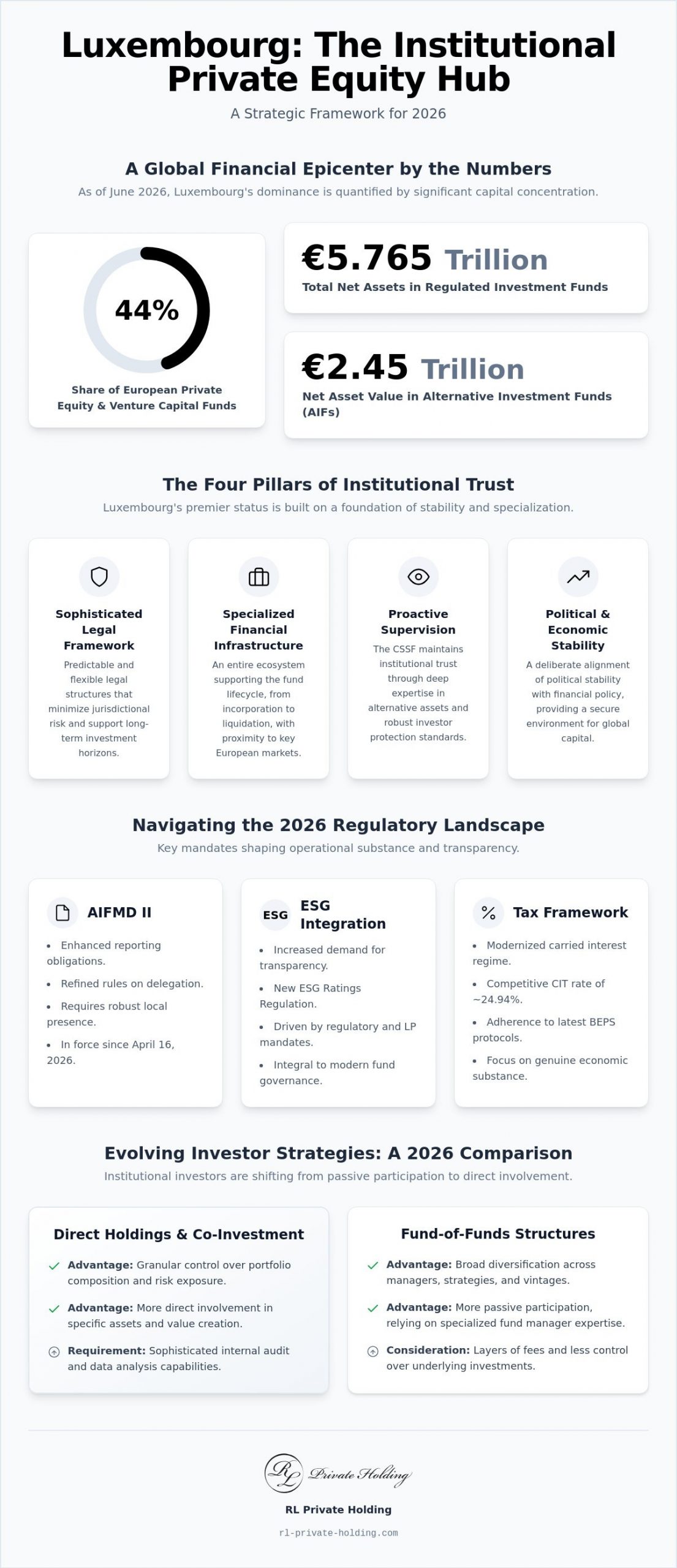
As of June 2026, Luxembourg commands a 44% share of all European private equity and venture capital funds, with alternative investment funds reaching a total Net Asset Value of €2.45 trillion. This concentration of capital confirms that private equity for institutional investors Luxembourg has transitioned from a volume-driven domicile into a specialized strategic hub for high-alpha investment strategies. The jurisdiction’s ability to maintain institutional gravity amidst global volatility is rooted in its sophisticated legal frameworks and its capacity for continuous regulatory adaptation.
Institutional allocators understand that navigating this landscape requires a disciplined approach to structural efficiency and risk management. The implementation of AIFMD II in April 2026 and the new ESG Ratings Regulation have increased the demands for transparency and reporting. You’re likely seeking ways to manage illiquidity while ensuring that your governance frameworks remain robust under these new mandates. This guide provides a comprehensive framework for optimizing your portfolio through the 2026 tax year and beyond. We’ll examine the modernized carried interest tax regime, the strategic utility of the SCSp, and the evolution of ELTIF 2.0 to ensure your structures deliver long-term capital appreciation and operational excellence.
Key Takeaways
- Identify the core factors sustaining Luxembourg’s status as the premier global hub for alternative investment funds and strategic institutional allocations in 2026.
- Analyze the technical efficiencies of the SCSp, RAIF, and SOPARFI vehicles to optimize private equity for institutional investors Luxembourg within the context of AIFMD II.
- Assess the strategic trade-offs between direct private equity holdings and diversified fund-of-funds structures to align with specific institutional risk-return objectives.
- Establish robust risk mitigation and value creation protocols that address the increasing complexities of modern transparency and reporting requirements.
- Explore the application of institutional-grade management frameworks across diverse sectors, including real estate and technology, to ensure long-term portfolio resilience.
The Strategic Role of Luxembourg in Institutional Private Equity Allocations
Luxembourg’s status as the premier global hub for alternative investment funds is firmly established in 2026. The jurisdiction’s total net assets for regulated investment funds surpassed €5.765 trillion by mid-year, representing a significant concentration of global capital. This growth is not merely a result of historical presence; it’s a consequence of the country’s deliberate alignment of political stability with a highly specialized financial infrastructure. For private equity for institutional investors Luxembourg, the environment provides a predictable framework that minimizes jurisdictional risk while maximizing structural flexibility.
The 2026 institutional mandate has evolved beyond simple capital deployment. There’s now a clear shift toward comprehensive transparency and the integration of environmental, social, and governance (ESG) factors. This evolution is driven by both regulatory requirements and the internal policies of institutional investors who require rigorous oversight. Luxembourg’s ability to transpose complex EU directives, such as AIFMD II, into a functional domestic law has reinforced its position as the default choice for cross-border private equity distribution.
Luxembourg as a Global Financial Epicenter
The scale of the Luxembourg ecosystem is evidenced by its 44% market share of all European private equity and venture capital funds as of June 2026. Central to this success is the Commission de Surveillance du Secteur Financier (CSSF), which maintains institutional trust through proactive supervision and a deep understanding of alternative asset classes. The strategic proximity to major European capital markets allows for efficient capital flow and operational ease. This infrastructure supports the entire lifecycle of a fund, from incorporation to final liquidation, ensuring that the legal and tax environments remain conducive to long-term investment horizons.
Institutional Investor Trends for 2026
A notable trend in 2026 is the increasing prevalence of co-investment opportunities for large-scale limited partners. These investors are moving away from passive fund participation in favor of more direct involvement in specific assets. This shift requires fund managers to provide customized reporting and real-time data access to satisfy the sophisticated internal audit requirements of their partners. The evolution of the Luxembourg financial center investments landscape reflects this demand for bespoke solutions. Investors are increasingly utilizing specialized vehicles that allow for granular control over portfolio composition and risk exposure, ensuring that every allocation aligns with their broader institutional objectives.
Navigating the 2026 Luxembourg Regulatory and Structural Framework
The 2026 legal landscape for private equity for institutional investors Luxembourg is defined by a rigorous focus on operational substance and transparency. AIFMD II, which came into force on April 16, 2026, has introduced enhanced reporting obligations and refined rules regarding delegation. These changes necessitate a more robust local presence and clearer lines of accountability for fund managers. For institutional allocators, this regulatory evolution ensures a higher standard of investor protection and reinforces the integrity of the Luxembourg jurisdiction as a stable environment for long-term capital deployment.
Tax transparency remains a cornerstone of the 2026 framework. The adoption of a modernized carried interest tax regime, applicable from the 2026 tax year, distinguishes between contractual and participation interests to provide greater clarity for fund professionals. This update, coupled with a combined corporate income tax rate of approximately 24.94% in Luxembourg City, ensures that the jurisdiction remains competitive while adhering to the latest BEPS protocols. Demonstrating genuine economic substance is no longer a recommendation; it’s a structural requirement for accessing treaty benefits and maintaining tax neutrality.
The SCSp and RAIF: Flexibility for Sophisticated LPs
The Luxembourg special limited partnership (SCSp) remains the vehicle of choice for institutional portfolios due to its contractual flexibility and tax transparency. Its popularity is frequently paired with the Reserved Alternative Investment Fund (RAIF) regime, which has surpassed 2,200 registrations by early 2026. The RAIF offers a significant speed-to-market advantage, as it does not require direct CSSF approval at the fund level, provided an authorized AIFM manages the structure. This allows sophisticated LPs to respond with agility to global market opportunities while maintaining a regulated management layer.
Regulatory Compliance and Governance Standards
Adhering to Luxembourg’s regulatory framework requires a disciplined approach to AML/KYC protocols and governance. The role of the Depositary is critical in this context, acting as a mandatory safeguard that monitors cash flows and verifies asset ownership for institutional protection. Furthermore, the ESG Ratings Regulation, applicable from July 2, 2026, has introduced new disclosure requirements for financial market participants. This regulation ensures that ESG factors in marketing communications are backed by verifiable data, aligning with SFDR Article 8 and 9 standards. Professional private equity investment management ensures that these complex compliance requirements are integrated into the fund’s operational DNA without disrupting the pursuit of alpha.
Comparative Analysis: Direct Holdings vs. Fund-of-Funds for Institutional Portfolios
Selecting the optimal entry point into private equity for institutional investors Luxembourg requires a disciplined evaluation of internal operational capacity and specific risk-return objectives. Direct holdings offer concentrated exposure and granular control over asset governance, while fund-of-funds provide immediate diversification across vintage years, sectors, and geographies. In 2026, this decision is increasingly influenced by the ability to manage heightened transparency requirements and the structural overhead associated with different allocation models.
The choice between these strategies often dictates the long-term resilience of a portfolio. While direct investments allow for the elimination of intermediary fee layers, they demand a sophisticated internal infrastructure to manage the complexities of asset-level due diligence and ongoing monitoring. Conversely, the fund-of-funds approach leverages the expertise of multiple general partners, providing a buffer against the volatility of individual assets. Both models benefit from the stability of the Luxembourg jurisdiction, which continues to provide a predictable environment for large-scale capital commitments.
Direct Investment via SOPARFI Structures
The Société de Participations Financières (SOPARFI) remains the standard vehicle for institutional investors seeking direct ownership of private assets. This structure facilitates maximum control over portfolio company governance and exit strategies, allowing for a more active role in value creation. Implementing a rigorous private equity investment management framework is essential in this context to mitigate the operational risks inherent in concentrated holdings. SOPARFIs are particularly effective for executing global acquisition strategies, as they utilize Luxembourg’s extensive network of double tax treaties to optimize cross-border distributions and capital gains.
The Fund-of-Funds Model for Broad Exposure
For mid-sized institutional allocators, the fund-of-funds model is a strategic tool for mitigating idiosyncratic risk through broad market exposure. This approach provides access to top-tier general partners that may have high minimum commitment thresholds, effectively democratizing access to elite investment talent. By spreading capital across diverse managers, institutions can smooth the “J-curve” effect and achieve a more stable return profile over time. Luxembourg’s Private Equity Framework supports these multi-manager strategies by offering regulated platforms that ensure transparency and investor protection across the entire investment chain.
The cost-benefit analysis in 2026 must also account for liquidity. The secondary market for private equity for institutional investors Luxembourg has reached a level of maturity that allows for more efficient portfolio rebalancing. Whether holding direct assets or fund interests, the ability to access secondary liquidity is vital for managing the 2.40% ECB benchmark rate environment. Institutions must weigh the external management fees of fund-of-funds against the significant internal team overhead required for direct investing to determine which path best serves their fiduciary duties.
Risk Mitigation and Value Creation Protocols for Sophisticated LPs
Risk mitigation in 2026 requires a transition from passive compliance to a performance-driven oversight model. Sophisticated limited partners are implementing protocols that address the persistent volatility of global markets while leveraging the structural advantages of the Luxembourg domicile. The execution of private equity for institutional investors Luxembourg depends on rigorous operational risk management, which involves monitoring the stability of the management company and the integrity of the reporting lines. This disciplined approach ensures that the underlying assets remain resilient against macroeconomic shifts and regulatory updates.
Operational risk management in Luxembourg based structures is now centered on the quality of substance and the transparency of the investment chain. Investors are prioritizing managers who demonstrate a clear alignment of interests and a robust governance framework. This transparency is vital for maintaining the trust of institutional stakeholders and for meeting the sophisticated reporting requirements mandated by recent legislative changes. By focusing on these core principles, LPs can protect their capital while positioning their portfolios for sustainable growth.
Institutional Due Diligence Frameworks
Institutional due diligence in 2026 extends beyond basic financial audits to include comprehensive technical and cultural assessments. In a market where the ECB benchmark interest rate is 2.40%, assessing a general partner’s ability to generate alpha without relying on excessive leverage is a primary objective. For venture capital Luxembourg allocations, technical due diligence now encompasses AI scalability, data sovereignty, and the long term viability of the underlying technology stack. The 2026 standard for operational due diligence is defined as a continuous, data-driven audit of a manager’s infrastructure, governance, and regulatory resilience throughout the investment lifecycle.
Active Value Creation Strategies
Active value creation has become a fundamental requirement for achieving target exit valuations in a competitive environment. Institutional investors are increasingly acting as strategic partners who leverage their global networks to accelerate the growth of portfolio companies. This involvement often includes the implementation of digital transformation initiatives and the integration of artificial intelligence to optimize operational efficiency. Such interventions not only improve the internal performance of the asset but also significantly enhance its attractiveness to potential acquirers during the exit phase.
Exit strategies in 2026 are characterized by a balanced approach between public market listings and the robust secondary market. While IPOs remain a viable path for high growth assets, the efficiency of secondary buyouts often provides a more predictable route to liquidity. Institutional governance plays a critical role in these transitions, as well-structured assets with transparent reporting histories command higher premiums. Professional private equity investment management ensures that every portfolio company is prepared for multiple exit pathways, maximizing the probability of successful capital reclamation and long term appreciation.
RL Private Holding: Institutional Grade Management in the Luxembourg Market
RL Private Holding operates as a disciplined global partner within the European financial landscape. The firm’s presence in the Grand Duchy provides a stable platform for managing complex allocations in private equity for institutional investors Luxembourg. By adhering to a methodical and transparent organizational framework, the firm ensures that every investment is aligned with the rigorous standards of institutional capital. This approach prioritizes structural integrity and long-term capital appreciation over short-term market fluctuations. It reflects an established presence that values stability and professional distance in all financial operations.
The firm’s scope extends across multiple critical sectors, reflecting a worldly and highly organized perspective on asset management. This multi-disciplinary expertise allows for the creation of resilient portfolios that can withstand the volatility discussed in previous sections. The focus remains on providing a steady hand in the background of major investments, maintaining a composed and objective register throughout the investment lifecycle. By focusing on the structural components of the business, the firm projects a sense of institutional permanence and strategic focus.
A Diversified Portfolio Approach
The investment strategy of RL Private Holding is rooted in the integration of diverse asset classes to achieve robust wealth preservation. This includes a sophisticated approach to real estate asset management Luxembourg, where properties are managed with the same institutional gravity as private equity holdings. The firm also provides venture capital funding for high-growth technology sectors, ensuring that portfolios benefit from innovation while maintaining a disciplined risk profile. These offerings are complemented by wealth management services that are tailored to meet the specific requirements of institutional and private investors who value stability and exclusivity.
The Institutional Partner of Choice
RL Private Holding presents itself as a discreet and authoritative expert for those seeking a reliable partner in global financial operations. The firm’s commitment to long-term value is evidenced by its adherence to the highest standards of governance and risk management. Engaging with the firm for strategic allocations in private equity for institutional investors Luxembourg involves a formal and objective process designed to ensure alignment with the entity’s core principles. This methodical rhythm of communication and operation reinforces the firm’s identity as a silent giant in the private equity and asset management sectors. Prospective partners can expect a relationship characterized by institutional permanence and a strategic focus on the preservation and growth of capital.
Strategic Alignment for the 2026 Institutional Mandate
The 2026 landscape demands a transition from passive allocation to a more disciplined, structure-driven approach. Success in this environment is defined by the ability to navigate the complexities of AIFMD II and the ESG Ratings Regulation while maintaining a focus on long-term capital appreciation. By utilizing flexible vehicles like the SCSp and adhering to robust governance protocols, allocators can ensure their portfolios remain resilient against global market volatility.
Achieving excellence in private equity for institutional investors Luxembourg requires a partner who understands the nuances of this specialized financial hub. RL Private Holding provides a steady hand, offering institutional-grade expertise across technology, real estate, and private equity sectors from its Luxembourg headquarters. Our firm maintains a discreet, authoritative presence in the global market, prioritizing structural integrity and wealth preservation for a sophisticated clientele. We invite you to explore RL Private Holding’s institutional investment management services to align your strategic allocations with a partner committed to professional excellence and long-term value.
A well-ordered framework is the foundation of institutional success.
Frequently Asked Questions
Why is Luxembourg the preferred jurisdiction for institutional private equity in 2026?
Luxembourg remains the primary choice due to its unique combination of political stability, a highly specialized financial infrastructure, and a proactive regulatory environment. The jurisdiction’s ability to swiftly transpose EU directives like AIFMD II provides a predictable legal framework. This stability is essential for private equity for institutional investors Luxembourg, as it minimizes jurisdictional risk while offering the structural flexibility required for sophisticated cross-border allocations.
What are the primary differences between an SCSp and a RAIF for institutional investors?
The SCSp is a legal vehicle, a special limited partnership, while the RAIF is a regulatory regime that can utilize the SCSp form. The SCSp offers significant contractual flexibility and tax transparency. In contrast, the RAIF provides a speed-to-market advantage because it does not require direct CSSF approval at the fund level. This allows institutional allocators to deploy capital more efficiently through an authorized manager.
How has AIFMD II changed the reporting landscape for private equity in Luxembourg?
AIFMD II has introduced more rigorous reporting obligations and refined the rules regarding delegation to third parties. These changes, effective as of April 16, 2026, demand greater transparency and a more robust local presence for fund managers. For institutional investors, this evolution ensures a higher standard of asset protection and requires managers to provide more granular data regarding their operational and risk management processes.
Can institutional investors use a SOPARFI for direct private equity investments?
The SOPARFI is the standard vehicle utilized by institutional investors for direct holdings and global acquisitions. It functions as a fully taxable commercial company that benefits from Luxembourg’s extensive double tax treaty network and the participation exemption regime. This structure allows investors to maintain maximum control over portfolio company governance and exit strategies, making it ideal for concentrated, high-conviction investment strategies.
What are the typical management and performance fee structures in Luxembourg PE?
Management and performance fees generally follow established institutional standards, though specific terms are subject to negotiation between the GP and LP. Management fees typically cover the operational and administrative overhead of the fund. Performance fees, or carried interest, are structured to align the interests of the manager with those of the investors, often becoming payable only after a specific preferred return hurdle has been achieved.
How does RL Private Holding manage risk within its private equity portfolio?
RL Private Holding employs a disciplined risk management framework that prioritizes structural integrity and asset-level transparency. The firm conducts continuous, data-driven audits of all portfolio holdings to ensure resilience against macroeconomic volatility. By maintaining a composed and objective approach to private equity for institutional investors Luxembourg, the firm ensures that every allocation is supported by a robust governance framework and clear reporting lines.
What role does ESG play in Luxembourg private equity structures in 2026?
ESG factors are now a mandatory component of the investment process due to the ESG Ratings Regulation applicable from July 2, 2026. This regulation introduces strict disclosure requirements to ensure the integrity of ESG claims in marketing communications. Institutional investors prioritize structures that comply with SFDR Article 8 or 9, as these provide a verified framework for integrating sustainability risks and impacts into the portfolio’s value creation strategy.
Is it possible for institutional investors to co-invest alongside Luxembourg PE firms?
Co-investment is a prominent trend in 2026, allowing large-scale limited partners to gain direct exposure to specific assets alongside general partners. This strategy enables institutions to optimize their fee structures and exercise greater influence over asset governance. Many Luxembourg vehicles are specifically structured to facilitate these co-investment opportunities, providing the bespoke reporting and data access that sophisticated institutional allocators require for their internal oversight.