

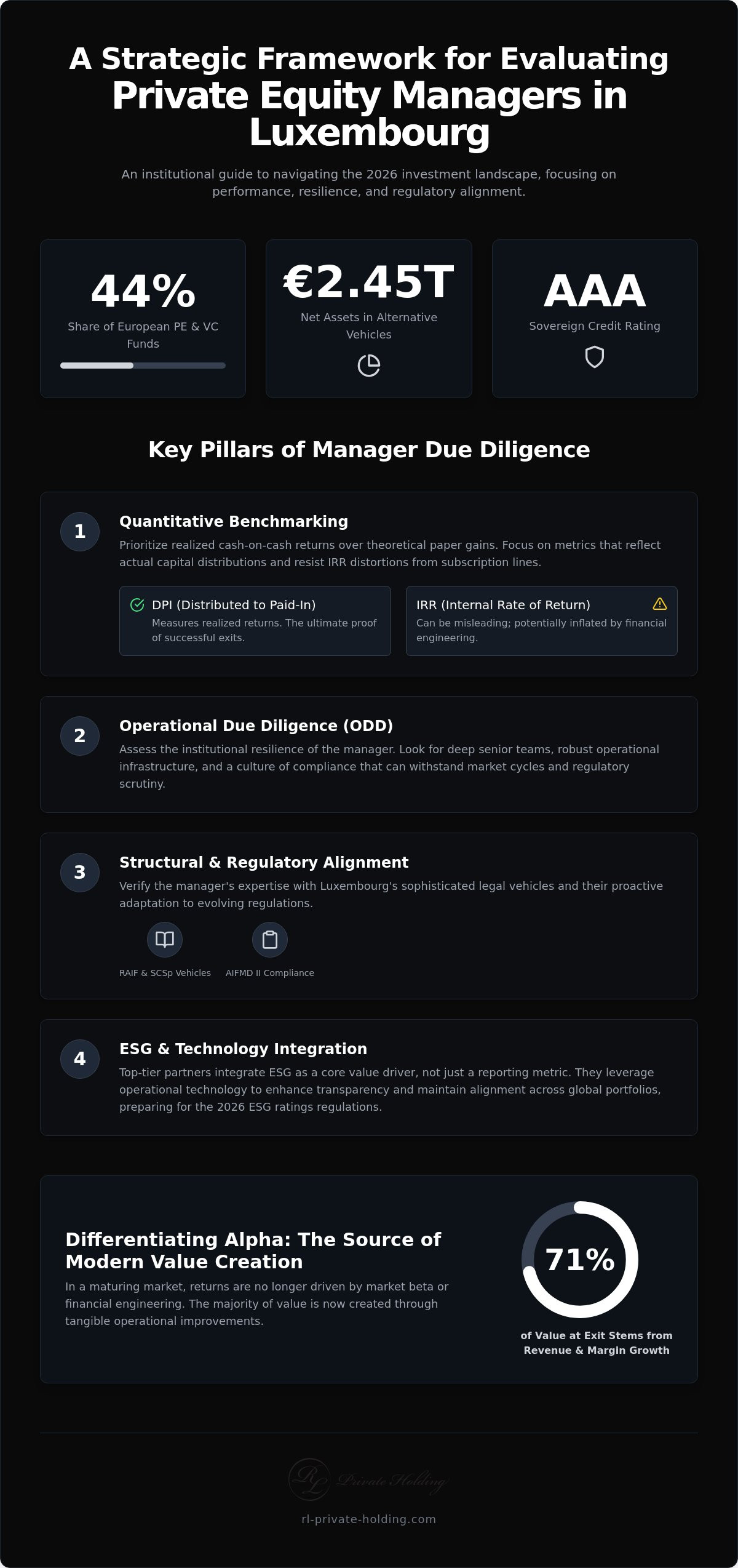
Luxembourg maintains a 44% share of all European private equity and venture capital funds, with total net assets in alternative vehicles reaching 2.45 trillion euros as of January 2026. This concentration of capital necessitates a sophisticated approach to selection, as the distinction between market beta and genuine manager alpha becomes increasingly opaque. When evaluating private equity managers in Luxembourg, institutional investors must move beyond historical returns to assess how a firm manages the complexities of AIFMD II and the modernized carried interest tax regime. You understand that identifying a partner who offers both operational resilience and structural transparency is the primary challenge in a maturing market.
This article provides a comprehensive strategic framework for assessing manager performance and alignment within the current ecosystem. We examine the critical benchmarks for due diligence, including the impact of new leverage caps for loan-originating funds and the 2026 ESG ratings regulations. Readers will gain a repeatable methodology for manager selection that prioritizes regulatory agility and objective value creation. This overview serves as a guide for navigating the legal requirements and incentive structures that define the professional investment landscape in Luxembourg today.
Key Takeaways
- Analyze the impact of Luxembourg’s sovereign stability and AAA credit rating on the long-term viability of fund domiciliation and manager stability.
- Implement a quantitative benchmarking framework that prioritizes realized returns, specifically focusing on DPI and TVPI metrics against relevant vintage year peers.
- Establish a rigorous operational due diligence process for evaluating private equity managers in Luxembourg that assesses senior team depth and institutional resilience.
- Evaluate the strategic alignment between investment mandates and Luxembourg’s regulatory vehicles, including the Reserved Alternative Investment Fund (RAIF) and Special Limited Partnership (SCSp).
- Understand how disciplined institutional partners integrate operational technology and ESG considerations to maintain structural alignment within a diversified global portfolio.
The Evolution of Private Equity Management in Luxembourg for 2026
Luxembourg’s position as a premier global hub for alternative assets is reinforced by its 44% share of the European private equity and venture capital market. By early 2026, the total net asset value of alternative funds domiciled here reached 2.45 trillion euros. This growth isn’t accidental; it’s a direct result of the jurisdiction’s institutional stability and its ability to adapt to global shifts. A central component of this environment is Luxembourg’s economic landscape, which maintains a sovereign AAA credit rating. This rating serves as a critical signal for fund domiciliation, offering a level of security that few other jurisdictions can match. It provides a steady hand for managers who are looking to secure long-term capital commitments.
When evaluating private equity managers in Luxembourg, investors now prioritize those who demonstrate a deep understanding of this maturing ecosystem. The current economic cycle has shifted the focus from broad-market buyout funds toward specialized niche strategies. Sophisticated managers in 2026 are defined by their ability to navigate complex regulatory shifts while maintaining operational excellence. They don’t rely on financial engineering to drive returns. Instead, they focus on organic revenue growth and sector-specific expertise. This evolution reflects a broader trend toward institutional gravity and disciplined management structures.
Regulatory Stability and the 2026 Outlook
The Luxembourg regulatory environment provides a disciplined foundation for long-term capital allocation. The Commission de Surveillance du Secteur Financier (CSSF) has intensified its focus on substance and strategic oversight through the implementation of AIFMD II. These regulations, which became effective in April 2026, harmonize rules for loan-originating funds and enhance delegation requirements. This oversight ensures that the private equity sector operates with a high degree of transparency and investor protection. Cross-border distribution remains a core strength, allowing managers to access global capital with confidence in the legal framework. It’s a system designed to protect the interests of institutional limited partners while fostering innovation.
Differentiating Alpha from Market Beta
Identifying managers who deliver consistent value creation regardless of market fluctuations is essential. Realized returns are increasingly driven by operational improvements rather than passive market exposure. Research indicates that approximately 71% of value created at exit now stems from revenue growth. This shift underscores why private equity investment management requires a disciplined, multi-cycle perspective. Evaluating private equity managers in Luxembourg involves analyzing their sector-specific expertise and their capacity to generate outsized returns in a competitive environment. A manager’s ability to distinguish genuine alpha from market-driven beta is the hallmark of a high-tier institutional partner. It requires a rigorous approach to due diligence that looks beyond historical performance to evaluate the quality of the underlying portfolio companies.
Quantitative Benchmarking: Assessing Investment Performance
Evaluating private equity managers in Luxembourg requires a transition from basic Internal Rate of Return (IRR) metrics toward more transparent cash-flow indicators. While Net IRR remains a standard industry benchmark, it’s often distorted by the use of subscription lines and the specific timing of capital calls. Sophisticated institutional investors now prioritize Distributed to Paid-In (DPI) and Total Value to Paid-In (TVPI). These metrics provide a more accurate representation of actual capital returned and the total value created relative to the initial investment. In a maturing market, cash distributions are the ultimate proof of a manager’s ability to execute a successful exit strategy.
Benchmarking these figures is only effective when they’re contextualized against relevant vintage years and geographic peers. A fund established in 2022 operates under different economic constraints than one launched in 2026. Understanding Luxembourg’s Private Equity Legal Framework is essential for normalizing these results, as structural choices often impact tax efficiency and net performance. When evaluating private equity managers in Luxembourg, it’s also critical to examine “dry powder” management. Managers who deploy capital with discipline during periods of high valuation often outperform those who chase deals at any cost. This long-term perspective is a core component of private equity investment management at the institutional level.
The PME (Public Market Equivalent) Analysis
Public Market Equivalent (PME) analysis serves as a vital tool for justifying the illiquidity premium inherent in private equity. By comparing private returns against global public indices like the MSCI World, investors can determine if a manager is truly generating alpha. In the 2026 context, top-quartile managers must demonstrate a persistence of performance across multiple fund generations. This consistency suggests a repeatable investment process rather than a reliance on a single successful vintage. It’s the difference between a disciplined strategist and a manager who simply benefited from favorable market tailwinds.
Attribution Analysis and Value Creation
Deconstructing returns is the final stage of quantitative due diligence. It’s necessary to distinguish between gains driven by market beta or financial leverage and those derived from genuine operational improvements. Deeper analysis often reveals that high-performing managers possess robust internal Operating Partner capabilities. These teams work closely with portfolio companies to drive organic revenue growth and efficiency. As exit environment volatility persists, the ratio of realized to unrealized gains becomes a primary indicator of a manager’s resilience. Investors should look for managers whose track records are built on fundamental business growth rather than financial engineering.
Operational Due Diligence (ODD): Evaluating Firm Resilience
Operational due diligence has transitioned from a supporting function to a primary pillar of institutional selection. When evaluating private equity managers in Luxembourg, the focus must extend beyond the investment desk to the firm’s underlying organizational structure. This assessment determines whether a manager possesses the institutional gravity required to withstand multi-year market cycles. It’s not merely about the current leadership’s vision. It’s about the depth of the senior investment team and the presence of a clear, documented succession plan. A firm that lacks a robust middle-office or relies too heavily on a single figurehead presents a significant long-term risk to capital preservation.
The Luxembourg ecosystem is defined by its reliance on high-tier third-party service providers. A resilient manager maintains transparent relationships with reputable auditors, depositaries, and legal counsel. These partnerships provide a necessary layer of independent oversight. They verify that the firm adheres to the CSSF’s evolving standards for substance and risk management. Evaluating private equity managers in Luxembourg involves confirming that these external controls are fully integrated into the firm’s daily operations. This structural integrity is what allows the jurisdiction to remain a leading European hub for the PE industry.
Technology and AI Integration in Operations
By 2026, leading managers have moved beyond manual portfolio monitoring. They utilize generative AI and predictive analytics for deal sourcing and real-time risk assessment. This digital transition requires sophisticated cybersecurity protocols to protect sensitive investor data. Institutional transparency is now delivered through real-time reporting dashboards. These tools allow limited partners to access granular data on portfolio performance and fund expenses without the delays of traditional quarterly reporting cycles. It’s an essential requirement for any firm claiming to operate at the cutting edge of the market.
Governance and Conflict Management
Governance frameworks must be examined for their ability to manage complex interests. A disciplined manager maintains an Investment Committee with independent members who can provide objective challenges to proposed transactions. It’s also vital to analyze policies regarding co-investments and related-party transactions to ensure all investors are treated equitably. Alignment is best demonstrated through a significant GP commitment. When the manager’s own capital is at risk alongside the limited partners, it suggests a more cautious and strategic approach to capital allocation and long-term value creation.
Structural Alignment: Luxembourg Vehicles and ESG Integration
Structural integrity serves as the framework through which investment strategies are executed. When evaluating private equity managers in Luxembourg, it’s necessary to determine if the chosen fund vehicle aligns with the risk profile and liquidity requirements of the mandate. The Luxembourg special limited partnership (SCSp) remains a preferred choice due to its contractual flexibility and tax transparency. However, a manager’s proficiency in utilizing the Reserved Alternative Investment Fund (RAIF) regime is equally indicative of their operational sophistication. The RAIF allows for accelerated time-to-market while maintaining high institutional standards, provided the manager possesses the expertise to navigate its specific regulatory nuances.
The implementation of AIFMD II in April 2026 has introduced stricter reporting obligations and harmonized leverage caps for loan-originating funds. Open-ended Alternative Investment Funds (AIFs) are now limited to 175% leverage, while closed-ended structures face a 300% cap. Evaluating private equity managers in Luxembourg requires a thorough review of how these constraints are managed within the portfolio. Managers who proactively adjusted their risk retention and liquidity management tools ahead of the April 2026 deadline demonstrate a level of regulatory agility that’s essential for long-term stability.
Fee Structures and Incentive Alignment
Alignment of interest is codified through the fund’s fee and incentive structures. Benchmarking management fees and hurdle rates against 2026 industry standards ensures that the GP is incentivized to prioritize performance over asset gathering. Investors should scrutinize “catch-up” clauses and carried interest distribution waterfalls to ensure they reflect a fair sharing of alpha. Transparency regarding fund expense allocations and transaction fees is no longer optional; it’s a baseline requirement for institutional-grade management. This disciplined approach to structural alignment is a core principle of private equity investment management at RL Private Holding.
ESG as a Value Driver
Environmental, Social, and Governance (ESG) integration has evolved from a compliance exercise into a fundamental driver of exit multiples. The EU ESG Ratings Regulation, applicable from July 2, 2026, has established a legal framework that increases the comparability of manager claims. Evaluating a manager’s performance now involves monitoring Article 8 and Article 9 fund designations under the SFDR. Impact reporting must be grounded in concrete data rather than aspirational statements. Managers who integrate ESG criteria into their pre-acquisition due diligence are better positioned to mitigate long-term risks and enhance the value of their portfolio companies.
Strategic Partnership with RL Private Holding
RL Private Holding operates as a disciplined institutional partner within the global financial landscape. We focus on sectors with high barriers to entry and long-term growth potential. When evaluating private equity managers in Luxembourg, institutional investors seek stability and a proven ability to manage complex assets. Our firm provides this through a methodical approach to capital allocation. We maintain a composed, neutral stance that prioritizes factual performance over market sentiment. It’s our belief that true authority doesn’t require self-promotion; it’s demonstrated through the consistent execution of a long-term plan.
Our portfolio spans technology, real estate, and private equity investment management. This diversification isn’t merely a risk mitigation tactic. It’s a strategic framework for wealth preservation. We act as a steady hand, ensuring that every investment aligns with our core principles of transparency and internal discipline. By maintaining a global perspective, we identify opportunities that offer structural resilience against localized volatility. We don’t react to market noise. Instead, we analyze the underlying fundamentals to ensure each asset contributes to the firm’s overarching stability.
Institutional-Grade Asset Management
We apply the same level of rigor to our internal operations as we do when evaluating external partners. This includes leveraging our expertise in family office investment strategies in Luxembourg to ensure that capital is managed with a multi-generational focus. Our commitment to professional distance and objective analysis remains unwavering. We don’t chase short-term gains. Instead, we focus on the structural integrity of each investment. This institutional-grade approach ensures that our partners receive a level of service characterized by reliability and strategic focus. Interested parties may contact our Luxembourg headquarters for bespoke investment management inquiries regarding our private equity and wealth management services.
A Diversified Global Outlook
Our firm integrates venture capital Luxembourg strategies with traditional private equity to capture growth across the full business lifecycle. This cross-sector approach provides a strategic advantage. It allows us to build portfolios that are resilient to shifts in specific industries. We believe that the next generation of institutional investors requires a partner who understands the nuances of both digital transformation and physical asset management. Our global outlook ensures that we remain a reliable partner in an increasingly complex financial world. We prioritize the creation of resilient portfolios that can withstand the evolving regulatory and economic challenges of the 2026 landscape.
Advancing Institutional Excellence in 2026
Selection in the current environment requires a departure from traditional IRR analysis toward a framework that emphasizes operational substance and regulatory compliance. Managers must demonstrate proficiency in navigating the AIFMD II landscape while maintaining transparent, institutional-grade governance. Evaluating private equity managers in Luxembourg involves identifying partners who integrate advanced technology with a disciplined approach to value creation. This process ensures that capital is allocated to firms capable of delivering realized alpha through multi-cycle economic shifts. It’s no longer sufficient to rely on historical performance alone; the focus has shifted to the quality of the underlying organizational structure.
RL Private Holding provides a steady hand for institutional investors seeking structural alignment and long-term wealth preservation. Our firm offers a global reach combined with deep-rooted Luxembourg expertise and a diversified portfolio across high-growth sectors. We maintain a commitment to professional transparency and sophisticated governance in all investment management activities. This approach allows us to act as a reliable partner in the background of major global investments. We invite you to Explore Strategic Investment Management with RL Private Holding to discuss how our framework supports your long-term strategic objectives. Building resilient portfolios for the next generation of investors starts with a disciplined selection process.
Frequently Asked Questions
What is the primary benefit of evaluating private equity managers within the Luxembourg jurisdiction?
The primary benefit is the combination of Luxembourg’s sovereign AAA credit rating and its highly specialized regulatory framework. This environment offers institutional investors a predictable legal landscape that facilitates efficient cross-border capital distribution. When evaluating private equity managers in Luxembourg, the jurisdiction’s maturity ensures that managers are supported by a sophisticated network of depositaries and auditors who adhere to rigorous global standards.
How has AIFMD II changed the due diligence process for Luxembourg fund managers in 2026?
AIFMD II has increased the emphasis on delegation oversight and the implementation of harmonized liquidity management tools. Since its implementation in April 2026, the directive requires managers to demonstrate greater strategic oversight of third-party functions. When evaluating private equity managers in Luxembourg, investors must now verify that firms have the internal substance to manage these increased reporting obligations and leverage constraints effectively.
What are the key differences between a RAIF and an SCSp from an investor evaluation perspective?
A Reserved Alternative Investment Fund (RAIF) is an indirectly regulated vehicle that allows for rapid deployment, whereas a Special Limited Partnership (SCSp) is a contractual partnership offering maximum flexibility. From an evaluation perspective, the RAIF requires the manager to have a fully authorized AIFM in place to ensure oversight. The SCSp evaluation focuses more on the specific partnership agreement and the manager’s ability to structure bespoke terms for limited partners.
How should institutional investors benchmark private equity fees in 2026?
Investors should benchmark fees by analyzing the total cost of ownership, including management fees, transaction costs, and fund expenses. It’s essential to compare these costs against peer funds of the same vintage and asset class. A disciplined manager will provide a transparent breakdown of how fees align with the long-term performance hurdle and the carried interest waterfall rather than relying on generic industry averages.
What role does operational due diligence play in mitigating investment risk?
Operational due diligence serves as a critical mechanism for identifying non-investment risks related to a firm’s internal controls and infrastructure. It examines the stability of the middle-office and the robustness of cybersecurity protocols. By identifying weaknesses in a manager’s operational resilience, this process helps prevent losses stemming from administrative failures or inadequate reporting systems that could compromise fund performance.
How can I verify a manager’s ESG claims under the current SFDR framework?
You can verify ESG claims by analyzing the manager’s mandatory SFDR periodic disclosures and their compliance with the 2026 EU ESG Ratings Regulation. These regulations require providers to be authorized and supervised by ESMA, ensuring that ESG ratings are transparent and comparable. Investors should look for concrete data on Article 8 or Article 9 fund performance rather than relying on qualitative marketing statements.
What is a typical GP commitment in the Luxembourg private equity market?
A typical GP commitment in the Luxembourg market ranges between 1% and 2% of the total fund size, though this varies by firm size and strategy. A significant commitment serves as a primary indicator of alignment between the manager and the limited partners. It demonstrates that the General Partner has a meaningful financial stake in the successful execution of the investment mandate and the achievement of long-term goals.
Why is DPI considered a more honest metric than IRR for mature funds?
Distributed to Paid-In (DPI) is considered a more reliable metric because it represents actual cash distributions rather than paper gains or estimated valuations. While IRR is susceptible to distortion by bridge financing and the use of subscription lines, DPI provides an objective measure of capital actually returned to investors. For mature funds, it’s the ultimate proof of a manager’s ability to realize value through successful exits.