

The economic contraction projected for 2026 presents a definitive divergence between portfolios reliant on public market liquidity and those structured for private market resilience. While public indices frequently succumb to immediate sentiment-driven volatility, historical data confirms that private equity performance during recession periods remains remarkably stable because of long-term capital structures and direct operational control. Investors now operate in a landscape defined by a 3.63% federal funds rate and a necessary shift toward execution-based value creation. It’s no longer possible to rely on the multiple expansion that characterized the previous decade of cheap credit.
You probably feel the pressure of managing the denominator effect while navigating the uncertainty of capital call timing during liquidity crunches. This analysis provides an institutional-grade framework for understanding why private equity consistently generates alpha during downturns and how to position your portfolio for the 2026 cycle. We examine the critical importance of vintage years, the strategic role of the secondary market, and specific criteria for manager selection in an environment where the median EBITDA multiple has compressed to 13.4x. This disciplined approach ensures that capital remains productive even when traditional markets falter.
Key Takeaways
- Understand the structural factors that allow private equity performance during recession periods to consistently surpass public market benchmarks through lower volatility and faster recovery speeds.
- Identify how the strategic deployment of dry powder into devalued assets and active operational restructuring serve as offensive engines during economic contractions.
- Evaluate the historical significance of vintage years to determine how entry multiples in a contractionary environment influence long-term internal rates of return.
- Adopt a 2026 strategic framework that emphasizes sector-specific resilience in technology and real estate while transitioning from financial engineering to operational alpha.
- Gain insight into the advantages of utilizing Luxembourg-based investment structures for institutional risk management and global portfolio diversification.
The Historical Resilience of Private Equity in Economic Downturns
Historically, private equity has demonstrated a capacity to withstand macroeconomic stress more effectively than public markets. This resilience isn’t accidental; it’s the result of a structural alignment between long-term capital and the ability to intervene directly in portfolio company operations. Throughout the history of private equity, periods of market distress have often served as catalysts for significant alpha generation. Private equity performance during recession periods is frequently characterized by a smoothing effect, where the asset class avoids the sharp, sentiment-driven troughs seen in public indices.
During market corrections, public equity valuations often drop rapidly. This causes the private equity portion of an institutional portfolio to appear overweight on a percentage basis, even if the absolute value hasn’t changed. This phenomenon, known as the denominator effect, often forces institutions to pause new commitments just as the most attractive vintage years are beginning. Historical data suggests that private equity performance during recession environments is supported by the ability of managers to hold assets until market conditions improve, avoiding forced liquidations at the bottom of a cycle.
Recession resilience in private markets is defined as the ability to preserve capital through valuation lag while simultaneously utilizing operational control to protect margins. It isn’t merely about waiting for a recovery; it’s about actively managing through the trough. Analysis of the 2001 and 2008 cycles reveals that private portfolios often recover their pre-recession valuations faster than the S&P 500, primarily because GPs can implement cost-restructuring and strategic pivots without the scrutiny of public quarterly earnings calls.
Performance Correlation: Private vs. Public Equities
Private equity typically exhibits a lower beta relative to the S&P 500 during contraction phases. The absence of daily mark-to-market pricing prevents the emotional capital flight often seen in public exchanges. The illiquidity premium represents the excess return required by investors to compensate for the inability to access capital for extended durations, effectively acting as a mechanism to lock in long-term value. By removing the option for impulsive exits, this structure protects the long-term ROI of the institutional allocation.
Volatility Dampening and Reporting Lags
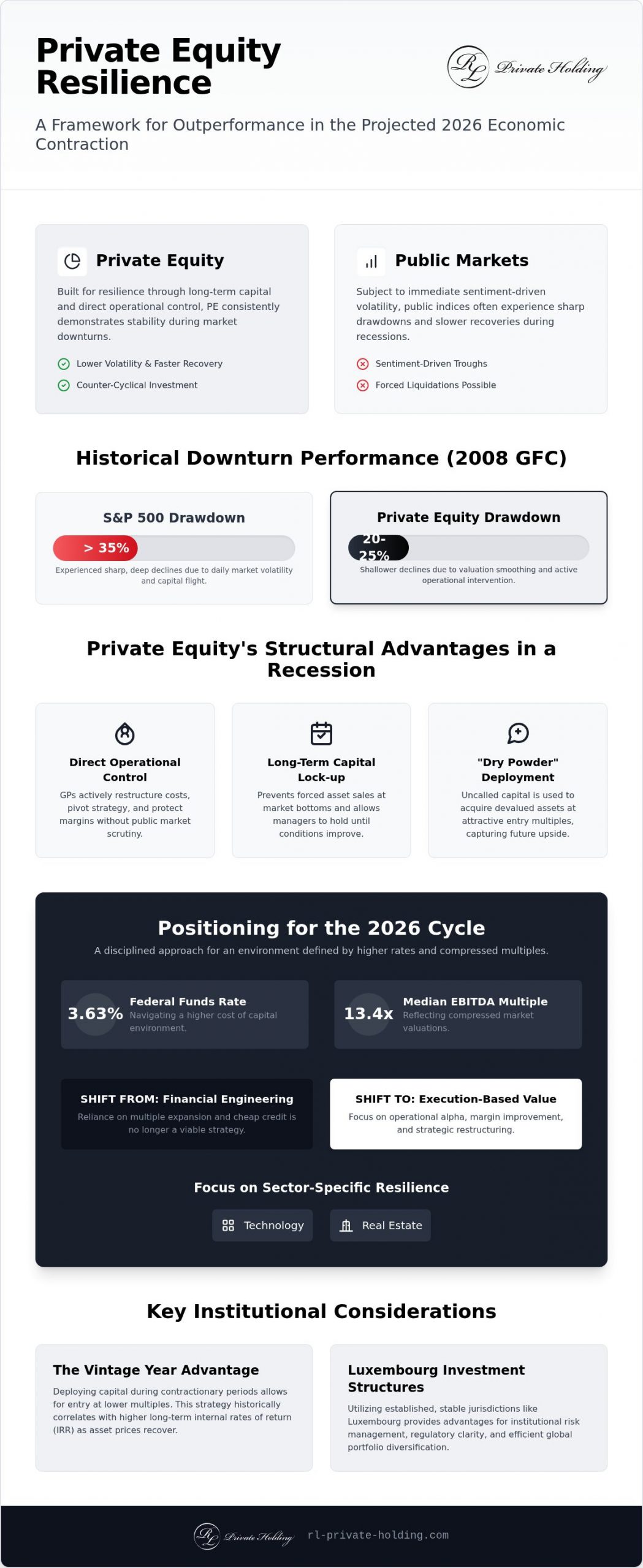
There’s a distinction between the artificial stability provided by lagged quarterly reporting and the real stability gained through operational intervention. In 2008, while the S&P 500 experienced drawdowns exceeding 35%, many private equity portfolios reported significantly shallower declines, often in the 20% to 25% range. This is partly due to the valuation process, but it’s also because GP-led restructurings happen in real-time. Quarterly valuation cycles provide a structured framework for institutional risk management, allowing for deliberate adjustments rather than reflexive reactions to daily news cycles.
Structural Advantages: Why Private Equity Outperforms During Recessions
The consistent outperformance of this asset class isn’t merely a function of valuation lags. It’s driven by the structural capacity to deploy capital when public sentiment is at its lowest. Dry powder refers to the uncalled capital commitments that allow managers to acquire distressed or devalued assets at attractive entry multiples. This counter-cyclical deployment is a primary driver of private equity performance during recession periods, as it captures the eventual recovery of asset prices from a lower cost basis. Unlike public funds that may face redemption pressure, private equity funds have the mandate to invest throughout the cycle.
The alignment of interests between General Partners (GPs) and Limited Partners (LPs) is specifically designed for multi-year downturns. Carried interest depends on long-term capital gains; this removes the incentive for short-termism that plagues public markets. Additionally, the rise of private credit provides a buffer when public credit markets freeze. This access to bespoke financing ensures that portfolio companies can maintain operations or pursue acquisitions without relying on volatile traditional banking sectors. It’s a level of financial flexibility that public companies rarely enjoy during a liquidity crunch.
Active Ownership and Operational Intervention
Public equity investors are generally passive observers of corporate governance. In contrast, private equity involves direct control. This active ownership allows for immediate cost-restructuring and strategic pivots that public companies might delay due to market pressure. Specialized operating partners are often embedded within portfolio companies to drive efficiency. During previous market corrections, technology firms under private ownership successfully pivoted from growth-at-all-costs to cash-flow-positive models much faster than their public peers. This operational alpha is a hallmark of disciplined private equity investment management.
Long-Term Capital Horizons and Patient Capital
The standard 10-year fund lifecycle serves as a shield against short-term macroeconomic noise. Managers aren’t forced to sell assets at the bottom of a cycle to meet redemption requests. Instead, they practice patient capital by waiting for optimal exit windows. Strategic use of follow-on investments supports the strongest companies through the trough, ensuring they emerge with higher market share. This structural stability is why private equity performance during recession cycles often exceeds initial expectations, as the forced selling seen in public markets is entirely avoided.
Analyzing Vintage Year Performance: Lessons from the GFC
Historical data highlights a stark contrast in performance based on fund inception dates. Pre-recession vintages from 2006 and 2007 faced the dual challenge of high entry multiples and the immediate onset of the global financial crisis. Conversely, funds established in 2009 and 2010 benefited from a depressed valuation environment. This divergence proves that private equity performance during recession periods is heavily influenced by the entry multiple, which creates a significant margin of safety for future exit internal rates of return (IRR). When assets are acquired at the trough of a cycle, the potential for multiple expansion during the recovery phase is substantially higher.
Industry data from sources such as Pitchbook and Preqin indicates that US buyout funds from the 2009 vintage achieved median net IRRs often exceeding 24%. In comparison, the 2007 vintage, which deployed capital at the market peak, saw median returns closer to 11%. This discrepancy underscores why institutional investors prioritize time-diversification. Attempting to time the market is frequently less effective than maintaining a consistent allocation strategy that captures varied economic conditions. Consistent capital deployment ensures that a portfolio isn’t overly concentrated in high-valuation years.
The 2009 Phenomenon: Capitalizing on the Trough
The highest-performing funds are frequently raised when market sentiment is at its most pessimistic. During the 2009 trough, limited competition for deals allowed disciplined managers to secure high-quality assets at valuations that significantly enhanced the multiple-on-invested-capital (MOIC). These value-driven strategies focused on resilient companies with temporarily depressed valuations, rather than purely “vulture” strategies that targeted insolvent entities. This distinction is vital for institutional-grade wealth preservation, as it prioritizes underlying business quality over speculative distress.
Avoidance of Pro-Cyclical Investment Errors
A common pitfall in institutional asset management is pro-cyclical allocation, which is the tendency to increase commitments during market peaks when liquidity is abundant. The excessive valuations of late 2021 and early 2022 serve as a modern reminder of this risk. Disciplined managers avoid these errors by adhering to a steady investment pace. This approach is central to effective Private Equity Investment Management: A Strategic Framework for Institutional Portfolios. By ignoring macroeconomic headlines and focusing on fundamental unit economics, firms ensure that private equity performance during recession cycles remains a source of stability rather than a driver of volatility.
Strategic Allocation Frameworks for the 2026 Environment
The 2026 economic environment requires a fundamental transition from the multiple-expansion models of the previous decade. With the federal funds rate at 3.63% as of August 2026, the era of relying on cheap leverage to drive returns has concluded. Investors must now prioritize managers who demonstrate a capacity for genuine operational value creation rather than simple financial engineering. This shift is essential for maintaining private equity performance during recession cycles where credit remains expensive and exit multiples are under pressure. Success in this landscape is defined by the ability to improve margins and grow top-line revenue without the tailwinds of declining interest rates.
Geographic diversification remains a critical pillar of institutional risk management. Luxembourg continues to serve as a primary hub for global capital deployment, offering sophisticated investment structures such as the SOPARFI and SCSp. These vehicles provide the structural transparency and regulatory oversight necessary for managing cross-border assets during periods of regional volatility. A disciplined approach to geographic allocation helps mitigate the risks associated with localized economic contractions and ensures a more stable return profile for the overall portfolio.
Sector-Specific Resilience: Tech and Real Estate
B2B technology companies with high recurring revenue and mission-critical utility often outperform discretionary consumer sectors during downturns. These firms maintain significant pricing power despite inflationary pressures. Similarly, Real Estate Asset Management in the Luxembourg Market emphasizes institutional-grade assets that provide inflation-linked yields and high occupancy rates. These defensive qualities are vital when public market REITs experience high volatility, as they anchor the portfolio with tangible, cash-flowing assets that possess intrinsic value regardless of market sentiment.
Manager Selection and Due Diligence in a Downturn
Evaluating loss ratios across previous cycles, specifically 2008 and 2020, is the most reliable indicator of a manager’s resilience. Historical success during periods of abundant liquidity doesn’t necessarily translate to success in the current environment. Operational depth, characterized by in-house teams of industry experts who can step into portfolio companies, is now more valuable than pure deal-making experience. A rigorous process of private equity due diligence is the only reliable method for identifying managers who possess a proven track record of downside protection. For those seeking to optimize their allocations, partnering with a disciplined firm is essential. Explore our private equity investment management services to learn more about our 2026 strategic frameworks.
Institutional Discipline with RL Private Holding
RL Private Holding operates with a focus on institutional-grade wealth preservation. Our holding company structure provides a level of permanence that standard fund cycles may lack. This structural stability is a fundamental component of maintaining private equity performance during recession periods. By acting as a steady hand in the global financial landscape, we ensure that capital remains deployed in sectors with high intrinsic value and structural tailwinds. This disciplined approach minimizes exposure to the sentiment-driven volatility of public exchanges and provides a transparent framework for long-term growth.
Our organizational framework prioritizes transparency and governance. We believe that professional asset management fees should drive superior risk-adjusted returns through active intervention and rigorous risk management. This commitment to institutional discipline allows our partners to navigate the complexities of the 2026 economic cycle with confidence. By focusing on the structural components of our business, we maintain a clear path toward value creation regardless of broader market dislocations. Our firm does not attempt to persuade through excitement; we project stability through factual, objective management.
Luxembourg: A Global Financial Anchor
Luxembourg remains the premier jurisdiction for sophisticated institutional investors. The firm utilizes Luxembourg investment structures, such as the Special Limited Partnership (SCSp), to manage multi-jurisdictional portfolios with high efficiency. Political and economic stability are prerequisites for success in private equity; Luxembourg provides this foundation through its Triple-A credit rating and established legal framework. Our presence in this financial hub ensures that we remain at the forefront of regulatory compliance and structural innovation. This geographic anchor provides our partners with a secure environment for capital deployment during periods of global uncertainty.
A Partner for Long-Term Value Creation
The philosophy of RL Private Holding is rooted in “quiet authority.” We project stability through a sober presentation of our global operational scale and sector expertise. Our focus remains on sectors with structural tailwinds, specifically technology and real estate, where operational alpha can be most effectively realized. We ensure institutional ROI by adhering to rigorous private wealth management principles that prioritize risk-adjusted growth over speculative gains. This disciplined asset management process ensures that private equity performance during recession cycles remains robust, providing a reliable engine for wealth preservation in an uncertain global economy.
Navigating the 2026 Cycle with Institutional Precision
The current economic landscape necessitates a shift toward disciplined, operational management. Private equity performance during recession cycles has historically proven that active governance and patient capital horizons provide a significant advantage over public market indices. It’s a strategic necessity to prioritize entry multiples and sector-specific resilience in technology and real estate to mitigate the risks of volatility. This framework is essential for maintaining growth when traditional liquidity markets contract.
RL Private Holding provides the institutional gravity required for this complex environment. Headquartered in Luxembourg, the world’s leading hub for private equity, we manage a diversified global portfolio with a commitment to long-term institutional ROI. Our firm acts as a steady hand, focusing on structural tailwinds and rigorous risk management rather than short-term market sentiment. Contact RL Private Holding for a Strategic Consultation on Institutional Allocation to discuss how our frameworks can support your wealth preservation goals. A methodical strategy remains the most effective tool for navigating the 2026 cycle with confidence.
Frequently Asked Questions
Is private equity actually safer than public stocks during a recession?
Private equity provides a more stable return profile than public stocks because of its structural isolation from daily market sentiment. While public indices are subject to immediate liquidation pressure, private equity performance during recession periods is anchored by long-term capital commitments. This structure prevents forced selling at market troughs. The ability of managers to intervene directly in company operations offers a defensive layer that passive public stock holding cannot match.
What is the “denominator effect” and how does it affect private equity performance?
The denominator effect is a portfolio rebalancing challenge that arises when the value of public equities declines significantly. Because private equity valuations are updated less frequently, they appear to occupy a larger percentage of the total portfolio than originally intended. This often leads institutional investors to pause new commitments to stay within allocation limits. It is a technical constraint rather than a reflection of the underlying health of the private assets.
Why do private equity firms often raise more capital during economic downturns?
Firms often accelerate fundraising during downturns to capitalize on depressed asset valuations and reduced competition. These recessionary vintages historically deliver superior returns because managers can deploy dry powder into high-quality companies at lower entry multiples. Strategic acquisitions made during these periods provide a substantial margin of safety. This counter-cyclical investment approach is a primary driver of long-term alpha for institutional portfolios that maintain a consistent deployment pace.
How do private equity valuations stay stable when public markets are crashing?
Valuations remain stable because they are based on quarterly fundamental assessments rather than daily trading volume. Private equity performance during recession cycles avoids the sharp troughs of public markets by utilizing appraisal-based methodologies. These valuations focus on long-term cash flow projections and operational improvements. This smoothing effect allows institutional managers to maintain a disciplined risk management framework without reacting to the emotional volatility that characterizes public exchange activity.
What are the best-performing private equity sectors in a recessionary environment?
B2B technology and essential real estate sectors typically exhibit the highest resilience during economic contractions. Technology firms with high recurring revenue and mission-critical services maintain strong pricing power even as discretionary spending falls. Institutional real estate asset management also provides stability through inflation-linked yields and tangible asset value. These sectors prioritize cash flow over speculative growth, making them ideal anchors for a diversified portfolio during periods of macro instability.
How does the 2026 interest rate environment impact private equity returns?
The 2026 environment, defined by a 3.63% federal funds rate, necessitates a shift from financial engineering to operational value creation. Higher borrowing costs reduce the efficacy of traditional leveraged buyout models. Managers must now drive returns through margin expansion, cost-restructuring, and organic revenue growth. This transition ensures that returns are sustainable and less dependent on the availability of cheap credit, which was a hallmark of the previous decade’s investment landscape.
Does the “lag” in private equity reporting hide real investment losses?
Reporting lags don’t hide losses; they filter out the noise of temporary market sentiment to focus on fundamental business health. While public markets react instantly to macroeconomic headlines, private equity valuations reflect the progress of multi-year operational plans. This delay provides a more accurate view of the long-term value being built within a company. It allows managers to execute restructurings without the pressure of meeting public quarterly earnings expectations during a crisis.
What should institutional investors look for in a private equity manager during a downturn?
Investors should prioritize managers with significant operational depth and a proven history of low loss ratios across multiple cycles. A manager’s performance during the 2008 and 2020 downturns offers critical insight into their downside protection capabilities. It is essential to select partners who possess in-house operating teams rather than those who rely solely on deal-making experience. This expertise is vital for navigating the complex restructurings often required during a prolonged economic contraction.