

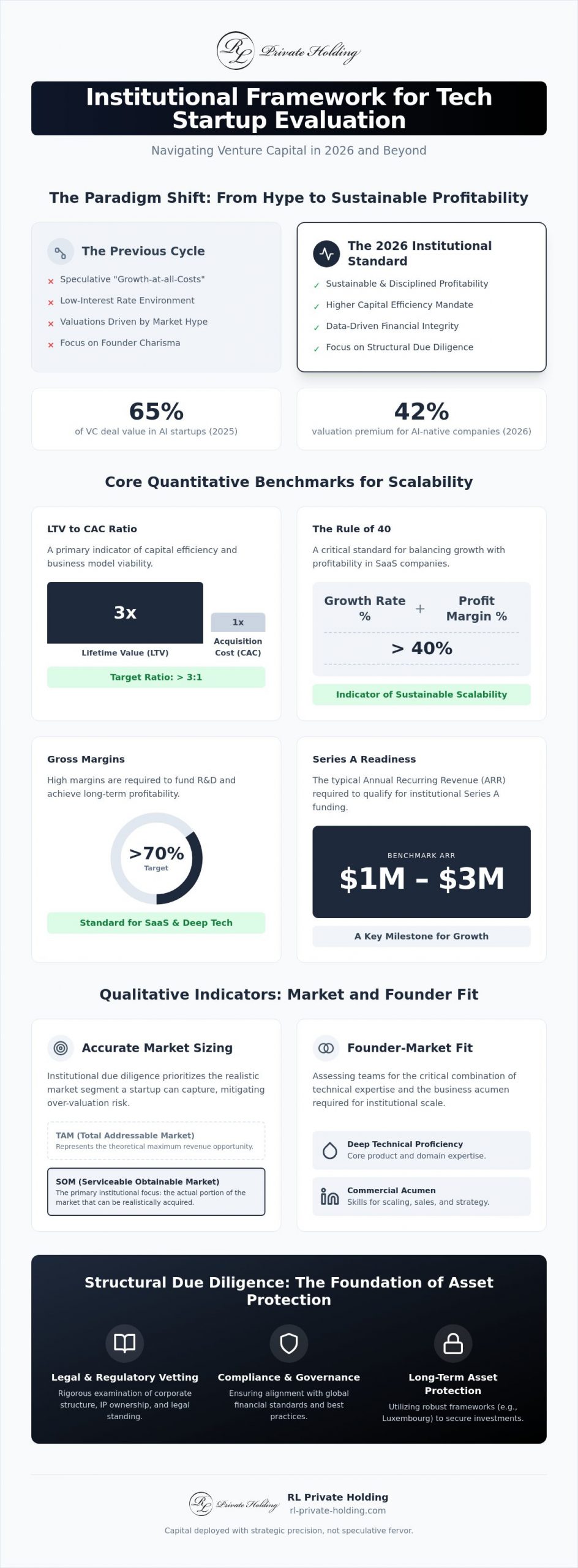
In 2025, AI startups accounted for 65% of all venture capital deal value, yet the distinction between true technical depth and temporary market hype has never been more difficult to discern. While AI-native companies command a 42% valuation premium in 2026, the process of evaluating tech startups for venture capital investment requires more than just following sector momentum. You likely recognize that early-stage tech investments carry inherent risks, often obscured by opaque founder dynamics or unsustainable unit economics that fail to survive shifting interest rates. It’s a challenge to maintain discipline when the market moves at such a rapid pace.
This guide provides an institutional-grade framework designed to mitigate these risks by applying the rigorous quantitative and qualitative vetting standards utilized by global investment firms. We’ll provide you with a repeatable methodology for startup assessment that prioritizes structural due diligence and financial integrity. By the end of this analysis, you’ll understand how to align high-growth technology allocations with the requirements of long-term wealth preservation, ensuring that your capital is deployed with strategic precision rather than speculative fervor.
Key Takeaways
- Identify the transition from aggressive expansion to sustainable profitability and recurring revenue quality as the primary standard for 2026.
- Implement a multi-layered framework for evaluating tech startups for venture capital investment that balances financial KPIs with structural risk assessment.
- Assess founder-market fit by prioritizing teams that pair deep technical proficiency with the commercial acumen required for institutional scaling.
- Leverage the benefits of structural due diligence within the Luxembourg regulatory framework to ensure compliance and long-term asset protection.
- Adopt an active private equity management perspective to transform capital allocation into a strategic partnership that drives measurable portfolio growth.
The Evolution of Tech Startup Evaluation for Venture Capital
The process of evaluating tech startups for venture capital investment has undergone a significant transformation. It’s no longer a pursuit of speculative growth driven by low-interest-rate environments. Instead, it has evolved into a multi-layered risk mitigation and value identification process. Institutional firms now prioritize structural integrity and long-term stability over the rapid, often unsustainable expansion that characterized previous cycles. This shift ensures that venture capital remains a productive, high-growth component within a diversified global investment portfolio. This Venture capital overview provides foundational context on how these investment structures have matured to meet modern institutional standards.
While traditional angel investors may rely on qualitative sentiment or founder charisma, institutional managers require a more robust framework. Professional evaluation necessitates a sober, factual presentation of a startup’s potential. It focuses on the entity’s organizational hierarchy and its ability to withstand market volatility. By 2026, the industry has moved decisively away from “growth-at-all-costs” models. The new standard is sustainable profitability, where capital is deployed with the expectation of disciplined cost structures and predictable recurring revenue from the earliest stages of growth.
Shifting from Hype to Unit Economics
The 2026 investment environment is defined by a return to fundamental financial discipline. Valuation benchmarks are now heavily influenced by the Federal Reserve’s benchmark interest rate, which remains at 3.50%–3.75% as of the June 2026 FOMC meeting. These elevated rates demand higher capital efficiency. When evaluating tech startups for venture capital investment, institutional partners prioritize companies that maintain a 3:1 Ratio of Lifetime Value (LTV) to Customer Acquisition Cost (CAC). Additionally, compliance with the “Rule of 40” is a critical standard for growth-stage technology firms. This metric requires that a company’s combined growth rate and profit margin exceed 40%, serving as a reliable indicator of sustainable scalability in a competitive market.
The Importance of Total Addressable Market (TAM) Accuracy
Theoretical market size often obscures the actual revenue potential of a startup. Institutional due diligence focuses on the Serviceable Obtainable Market (SOM) rather than the Total Addressable Market (TAM). This distinction helps identify market saturation risks in mature sectors, such as traditional SaaS, where competition has compressed margins. Within the context of institutional risk assessment, the Total Addressable Market represents the maximum possible revenue opportunity available to a product if 100% market share is achieved under current regulatory and economic conditions. Accurate TAM modeling must account for these constraints to prevent over-valuation and ensure alignment with long-term wealth preservation goals.
Quantitative Benchmarks: Assessing Scalability and Financial Viability
Quantitative analysis serves as the foundation for modern risk management in the technology sector. Institutional firms move beyond narrative-driven pitches to scrutinize the structural integrity of a startup’s balance sheet with clinical precision. When evaluating tech startups for venture capital investment, the focus shifts toward verifiable metrics that prove a business model can scale without proportional increases in operational overhead. Professional investors prioritize companies with clear visibility into their unit economics, particularly as software companies in 2026 typically require between $1 million and $3 million in annual recurring revenue (ARR) to qualify for Series A discussions.
Gross margins remain a primary indicator of long-term scalability. For software-as-a-service (SaaS) and deep-tech models, institutional standards expect gross margins to exceed 70%. These high margins provide the necessary capital to reinvest in research and development while maintaining a clear path to profitability. This structured approach to How VCs Evaluate Startups ensures that capital is not merely funding daily operations but is instead fueling an efficient engine of growth. For those seeking to align their portfolios with these rigorous standards, exploring professional private equity investment management can provide the necessary oversight for complex technology allocations.
Revenue Quality and Retention Metrics
Not all revenue carries equal weight in a professional evaluation. Recurring income streams are valued significantly higher than transactional ones due to their inherent predictability. Net Revenue Retention (NRR) serves as a proxy for product-market fit; a figure above 110% suggests that existing customers are expanding their usage, effectively offsetting churn. High churn rates negatively impact valuation multiples, which for strong performers have settled between 8x and 12x ARR. Investors also analyze customer concentration to ensure that no single account represents a disproportionate percentage of total revenue, which would create a structural vulnerability.
Capital Efficiency and Burn Rate Analysis
Capital efficiency is measured through the Burn Multiple, which tracks how much capital is consumed for every dollar of new ARR generated. A healthy Burn Multiple for a growth-stage firm is typically below 1.5x. Investors also assess the “Hype Ratio” by comparing total capital raised to current ARR to identify potential over-capitalization. In a volatile funding environment, determining if a firm is “Default Alive” is essential. This status indicates that the startup can reach profitability with its current cash reserves. Evaluating a startup’s runway requires a sober assessment of its monthly burn against the current Federal Funds Rate of 3.50% to 3.75%, as higher interest rates increase the opportunity cost of capital.
Qualitative Indicators: Founders, Intellectual Property, and Moats
Quantitative benchmarks provide the necessary floor for any investment, yet qualitative indicators often determine the ultimate ceiling of a startup’s potential. Professional evaluation requires a disciplined assessment of the intangible assets that protect a company’s market position. When evaluating tech startups for venture capital investment, the focus extends beyond the current balance sheet to the structural defensibility of the business model. This involves a rigorous analysis of the management team, the uniqueness of the technology, and the strength of the existing investor syndicate. It’s not enough to identify a growing market; an investor must also identify the specific team capable of capturing and defending that market share.
A startup’s competitive advantage in 2026 is increasingly tied to its ability to maintain an economic moat within a rapidly evolving, AI-driven landscape. While quantitative analysis relies on established Venture Capital Valuation Methods, qualitative barriers such as intellectual property provide the structural defensibility that justifies those valuations over the long term. Institutional investors prioritize firms that demonstrate a clear “Founder-Market Fit,” where technical proficiency is inextricably linked with commercial acumen. The quality of the surrounding syndicate also serves as a critical signal. The presence of reputable advisors and experienced co-investors reduces operational risk and provides a network of support that smaller, isolated teams often lack.
Evaluating the Management Team’s Execution Capability
Institutional firms prioritize teams with a documented history of operational success and a clear understanding of exit dynamics. Past exit experience is a valuable metric, as it suggests the founders understand the requirements of a liquidity event and the rigorous standards of institutional reporting. Beyond history, the concept of “Talent Magnetism” is essential. The ability of a founding team to attract top-tier engineering talent in a competitive market is a primary indicator of future execution capability. It’s often the best proxy for the internal culture and the perceived potential of the technology. The optimal management structure harmonizes the visionary agility of the founding team with the disciplined oversight of institutional governance to ensure long-term stability.
Assessing Intellectual Property (IP) and Competitive Barriers
Defensibility is no longer solely about patent portfolios, which can be slow to materialize and difficult to defend in some jurisdictions. In the current technology cycle, proprietary algorithms and unique data moats often provide more immediate protection than traditional IP filings. Investors must evaluate if a startup benefits from network effects, where the value of the service increases as the user base expands. This creates a barrier to entry that’s difficult for competitors to breach without significant capital expenditure. Additionally, the speed of innovation serves as a qualitative advantage. A firm that consistently outpaces its peers in product development demonstrates a level of agility that serves as its own form of market protection, making it harder for incumbents to catch up.
Structural Due Diligence: Legal and Regulatory Alignment
Structural due diligence serves as the final, critical layer of institutional risk management. While financial and qualitative metrics identify potential, the legal and regulatory framework ensures that this potential can be realized without unforeseen complications. Professional investors recognize that a startup’s internal governance and corporate structure are as vital as its technology. When evaluating tech startups for venture capital investment, it’s essential to verify that the entity’s organizational hierarchy and shareholder agreements align with global standards. This includes a meticulous review of the cap table to identify liquidation preferences, voting rights, or historical debt obligations that might compromise future funding rounds or exit valuations.
The choice of jurisdiction is a primary factor in maintaining institutional-grade security. Luxembourg has established itself as a premier hub for venture capital Luxembourg, offering a stable and transparent environment for global allocations. This regulatory stability protects institutional capital by providing a predictable legal framework that is respected by global financial institutions. As of January 1, 2026, new Anti-Money Laundering (AML) requirements have increased the scrutiny on venture capital firms, making the choice of a compliant, well-regulated jurisdiction even more critical for long-term wealth preservation.
Navigating Luxembourg Investment Structures
The Luxembourg Special Limited Partnership (SCSp) has become a preferred vehicle for technology investments due to its contractual flexibility and tax transparency. It allows institutional partners to tailor governance structures to specific portfolio needs while maintaining the confidentiality and efficiency required for private equity. Additionally, many firms utilize SOPARFI (Société de Participations Financières) structures to manage global technology holdings. These entities provide a robust framework for cross-border investment, ensuring that capital is deployed through a secure, recognized holding structure that facilitates efficient global operations.
ESG Compliance and Governance Standards
In 2026, alignment with Environmental, Social, and Governance (ESG) standards is no longer optional for institutional-grade portfolios. Evaluation protocols must incorporate the EU taxonomy and Sustainable Finance Disclosure Regulation (SFDR) to ensure compliance with evolving European standards. This involves assessing board composition, transparency protocols, and the ethical implications of the startup’s technology. For firms specializing in AI and data-heavy sectors, structural due diligence includes identifying risks related to data privacy and algorithmic bias. Ensuring these governance standards are met is a prerequisite for any firm seeking strategic venture capital funding from institutional partners who value stability and professional distance.
Strategic Partnership: The RL Private Holding Approach
The process of evaluating tech startups for venture capital investment matures into a strategic partnership once the capital is deployed. Institutional investors recognize that capital alone isn’t a sufficient differentiator in a competitive technology market. Instead, the focus shifts toward providing a stable operational foundation that allows growth-stage firms to scale with discipline. By applying a private equity investment management perspective to venture capital, RL Private Holding ensures that every allocation is supported by rigorous oversight and long-term value creation. This approach moves beyond the limitations of passive capital, transforming the investment into an active component of a diversified global portfolio.
Operational stability is a primary requirement for technology firms navigating the complexities of 2026. Traditional venture models often prioritize rapid exits to satisfy fund lifecycles, which can lead to premature liquidity events or compromised growth. A holding company structure provides an alternative by offering permanent capital commitment. This alignment of timelines ensures that technical development and market expansion occur at a pace that preserves the enterprise’s structural integrity. It’s a methodical transition from a startup’s initial agility to the institutional permanence required for global leadership.
The Value of a Diversified Holding Company Perspective
Scaling a technology firm requires more than engineering proficiency; it necessitates expertise in real estate, asset management, and global logistics. RL Private Holding leverages its cross-sector experience to provide growth-stage companies with the resources they need to expand into new markets. Our global operational scale benefits local innovators by providing access to a network of established institutional partners. This diversified perspective reduces the risks associated with sector-specific volatility and ensures that the technology remains a productive asset even as market conditions shift. It’s a disciplined strategy that prioritizes the health of the entire portfolio over short-term speculative gains.
Integrating VC into a Comprehensive Wealth Strategy
Venture capital shouldn’t exist in a vacuum. It functions most effectively when integrated into family office investment strategies in Luxembourg, serving as a high-growth driver for institutional ROI. Aligning technology exposure with broader wealth preservation goals requires a sophisticated management framework that accounts for both market potential and structural risk. For those seeking to deploy capital with this level of precision, RL Private Holding offers sophisticated investment management solutions tailored to the needs of institutional partners. We invite you to contact us to discuss how our strategic framework can support your long-term wealth objectives through disciplined technology allocation.
Securing Institutional Growth through Disciplined Technology Allocation
The investment landscape of 2026 necessitates a departure from speculative growth in favor of structural integrity and sustainable unit economics. Success in this environment depends on a rigorous balance between quantitative benchmarks, such as the Rule of 40, and the qualitative assessment of founder-market fit. Professional standards for evaluating tech startups for venture capital investment must prioritize long-term wealth preservation over short-term market momentum. By aligning technical potential with robust regulatory frameworks like the Luxembourg SCSp, institutional partners can mitigate risk while capturing the value of the next generation of technology leaders.
RL Private Holding provides the institutional gravity and cross-sector expertise required to navigate these complexities. As a Luxembourg-based global investment firm, we specialize in private equity and venture capital structures that deliver stable, long-term results. We invite you to Discover Strategic Investment Management with RL Private Holding and explore how our sophisticated wealth management services can support your portfolio objectives. It’s a disciplined path toward securing a resilient financial future in an evolving global market.
Frequently Asked Questions
What are the most important financial metrics when evaluating a tech startup?
Core financial metrics include the Rule of 40, the LTV:CAC ratio, and Net Revenue Retention. The Rule of 40 provides a benchmark for balancing growth and profitability, while a 3:1 LTV:CAC ratio is the standard for sustainable customer acquisition. Net Revenue Retention identifies the quality of product-market fit by measuring expansion revenue from existing clients. These metrics provide a factual basis for assessing long-term scalability.
How do venture capitalists assess the quality of a startup management team?
Institutional investors assess management by evaluating past operational history and the ability to attract top-tier engineering talent. This talent magnetism serves as a proxy for leadership capability and technical vision in a competitive market. A balanced team must pair deep domain expertise with the commercial acumen required for institutional scaling. Evaluation also focuses on the team’s understanding of institutional governance and reporting standards.
Why is Luxembourg a preferred jurisdiction for venture capital investment structures?
Luxembourg is preferred due to its regulatory stability and the flexibility of the Special Limited Partnership (SCSp) structure. These frameworks provide tax transparency and contractual freedom for institutional partners. The jurisdiction’s adherence to global transparency standards ensures that technology holdings are protected within a recognized and predictable legal environment. This makes Luxembourg a primary hub for cross-border venture capital allocations.
What is the difference between TAM, SAM, and SOM in startup evaluation?
TAM represents the total theoretical market, while SAM is the serviceable addressable market, and SOM is the serviceable obtainable market. Professional evaluation focuses on SOM to determine realistic revenue potential within current operational constraints. Distinguishing between these layers prevents over-valuation by identifying the actual portion of the market a startup can realistically capture given its current resources and the competitive landscape.
How does structural due diligence differ from financial due diligence?
Financial due diligence focuses on revenue quality and capital efficiency, while structural due diligence evaluates legal frameworks and governance protocols. Structural analysis includes a review of the cap table and shareholder agreements to identify potential legal complications. It ensures the entity is organized in a way that supports institutional funding and complies with jurisdictional requirements. Both are essential when evaluating tech startups for venture capital investment.
What role does ESG play in technology startup evaluation in 2026?
ESG standards act as a framework for identifying ethical risks and ensuring compliance with the EU’s SFDR and taxonomy regulations. Investors evaluate board composition and transparency protocols to ensure robust governance. In 2026, the focus has expanded to include the ethical implications of data usage and algorithmic bias in AI-native startups. Alignment with these standards is now a prerequisite for securing institutional-grade capital.
How can a holding company structure benefit a technology investment portfolio?
A holding company structure provides permanent capital commitment and operational stability that traditional 10-year funds cannot match. It allows startups to leverage cross-sector expertise in areas like real estate and asset management to facilitate scaling. This model aligns investment timelines with technical development, ensuring that growth is managed with a long-term perspective on wealth preservation rather than short-term exit pressure.
What are the primary risks associated with growth-stage technology investments?
Primary risks include unsustainable unit economics, opaque founder-related risks, and rapid regulatory shifts in the technology sector. High failure rates often stem from a startup’s inability to transition from venture-backed expansion to sustainable profitability. Evaluating tech startups for venture capital investment requires identifying these vulnerabilities early. Risks are also associated with market saturation and the increasing cost of capital in a volatile interest rate environment.