

In the high-stakes environment of early-stage investing, the difference between a portfolio-defining exit and a total loss often rests on the variables that remain unsaid during a founder’s pitch. Institutional investors recognize that information asymmetry is a structural reality in venture capital. Verifying technical moats and founder claims requires more than a cursory review of a data room; it demands a systematic approach to risk. A robust venture capital due diligence checklist serves as the necessary bridge between speculative interest and disciplined capital allocation.
You likely recognize that a lack of standardized assessment frameworks often leads to inconsistent results across different deal teams. This guide provides a comprehensive, institutional-grade framework designed to mitigate operational risk and isolate the signals that lead to ‘Power Law’ returns. We will examine the essential pillars of deal evaluation, including rigorous technical verification and the 2026 AML compliance standards, to ensure your investment committee operates with absolute clarity and confidence. By following this methodical structure, firms can transform due diligence from a simple audit into a strategic tool for identifying global growth opportunities.
Key Takeaways
- Establish a multi-layered investigative process to validate startup viability and mitigate the structural risks associated with early-stage failure rates.
- Evaluate the foundational pillars of management and market positioning, focusing on founder resilience and the granular analysis of serviceable market segments.
- Implement a rigorous venture capital due diligence checklist to assess financial integrity, including burn rate audits and the identification of cap table complexities.
- Analyze operational scalability by auditing technology stacks for technical debt and verifying the repeatability of go-to-market strategies.
- Adopt an institutional perspective that balances standardized frameworks with the expert intuition required for sophisticated, growth-stage global investments.
The Strategic Role of Due Diligence in Venture Capital
Professional institutional investors recognize that due diligence in venture capital is a multi-layered investigative process. It’s designed to validate a startup’s viability by uncovering hidden operational risks and verifying the structural integrity of a business model before capital is committed. The primary objective is to move beyond simple deal sourcing and transition toward a model of disciplined, risk-adjusted capital allocation. This process isn’t a mere formality; it’s the foundation of long-term portfolio stability.
In the venture asset class, the ‘Power Law’ dictates that a small fraction of investments generate the majority of fund returns. Because startup failure rates are naturally high, rigorous screening is a firm’s only defense against capital erosion. Utilizing a standardized venture capital due diligence checklist ensures every deal undergoes the same level of institutional scrutiny, regardless of the initial excitement surrounding a founder’s pitch. This structured approach allows partners to remain objective when evaluating high-potential but high-risk opportunities.
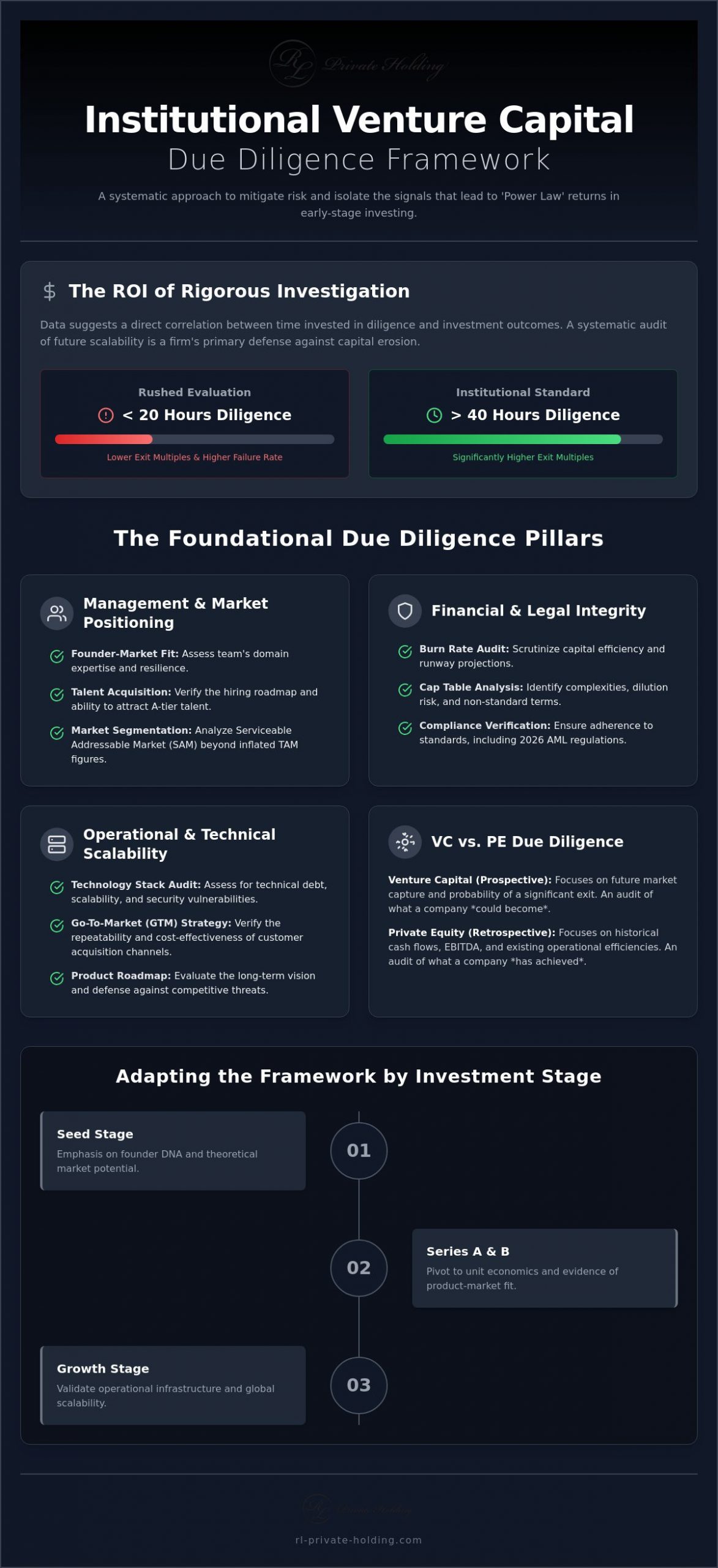
The investigative approach in venture capital is primarily prospective. It differs significantly from private equity investment management, which typically focuses on retrospective audits of historical cash flows and EBITDA. While private equity looks at what a company has achieved, venture diligence focuses on future market capture and the probability of reaching a significant exit. It’s an assessment of what a company could become under the right conditions.
The ROI of Rigorous Investigation
Data suggests that investment teams spending at least 40 hours on the diligence process correlate with significantly higher exit multiples compared to those who rush the evaluation. This time investment helps mitigate the ‘Signal vs. Noise’ problem that’s common in high-growth technology sectors. Venture due diligence is a strategic audit of future scalability. By dedicating sufficient resources to this phase, firms can identify the subtle red flags that often precede a total loss of capital.
Adapting the Framework by Investment Stage
The focus of the framework must shift as a company matures. At the Seed stage, the emphasis rests heavily on founder DNA and the theoretical market potential. By Series A and B, the focus pivots toward unit economics and evidence of product-market fit. For growth-stage deals, the priority is validating the operational infrastructure and the company’s ability to achieve global scalability. Each stage requires a different depth of investigation to ensure the investment aligns with the firm’s overall risk profile.
Venture Capital Due Diligence Checklist: The Foundational Pillars
An institutional venture capital due diligence checklist prioritizes the human element as the primary indicator of future performance. While technical infrastructure and financial projections provide a framework, the quality of leadership determines the execution of the strategic vision. Sophisticated investors treat these foundational pillars not as boxes to be checked, but as a series of stress tests designed to reveal the resilience of the business model. This qualitative analysis is the first line of defense against the high failure rates inherent in early-stage growth.
Management Team Assessment
Evaluating ‘Founder-Market Fit’ is non-negotiable. We analyze whether the team possesses the specific technical expertise and professional resilience required to navigate their chosen sector. A robust assessment includes deep background checks and professional history verification. It also examines the hiring roadmap. A founder’s ability to attract top-tier talent for the next growth phase is a leading indicator of scalability. If a leadership team cannot articulate a clear plan for talent acquisition, the venture’s ability to scale remains theoretical. For firms seeking to refine their internal processes, reviewing the disciplined investment standards of global partners can provide a benchmark for institutional quality.
Market and Competitive Landscape
Market analysis must move beyond inflated Total Addressable Market (TAM) figures. Disciplined investors focus on Serviceable Addressable Market (SAM) and Serviceable Obtainable Market (SOM) to determine realistic revenue ceilings. Timing remains a critical risk factor. Entering a market too early is functionally identical to being wrong. Additionally, identifying regulatory headwinds is vital. The SEC’s 2026 rulemaking agenda introduces new complexities for crypto assets and accredited investor definitions that could impact market entry and exit strategies. We look for companies operating in ‘Blue Ocean’ environments where they can establish dominance before the market becomes a commoditized ‘Red Ocean’.
Product Differentiation and Customer Verification
Assessing the ‘moat’ involves a technical audit of intellectual property and proprietary technology. Defensibility isn’t just about patents; it’s about the speed of innovation and the difficulty of replication. A technical stack audit reveals whether the company is building on a foundation of technical debt or if they’ve created a proprietary engine that provides a sustainable advantage. We validate these claims through direct customer reference calls. These conversations reveal the actual ‘stickiness’ of the product and offer an unfiltered view of the value proposition that pitch decks can’t replicate. If customers can’t articulate why they chose this specific solution over a competitor, the moat is likely shallower than the founders claim. These primary data points are essential for any comprehensive venture capital due diligence checklist.
Financial and Legal Integrity: Structural Due Diligence
While the qualitative pillars establish the potential for growth, the structural integrity of a deal is verified through a rigorous audit of financial and legal frameworks. A professional venture capital due diligence checklist must prioritize the verification of cash runway and revenue quality to ensure the business can survive market volatility. This phase of the investigation moves beyond the pitch deck to examine the underlying mechanics of the corporate entity. It’s here that institutional investors identify the structural risks that could compromise future exit valuations.
Cap table integrity is a primary concern for sophisticated partners. We look for ‘dead equity’ held by inactive founders or early advisors, as this can disincentivize current leadership and complicate future funding rounds. The analysis also covers liquidation preferences and anti-dilution clauses that might impact the returns of later-stage investors. Simultaneously, we verify that all core intellectual property is legally owned by the company rather than the individual founders. Without clear IP assignment, a startup’s technical moat is effectively non-existent from an institutional perspective.
Legal and corporate governance reviews ensure the business operates with a professional board structure and clear articles of incorporation. This transparency is vital for maintaining fiduciary responsibility to limited partners. We evaluate whether the firm’s governance allows for the steady, methodical oversight required to manage global technology portfolios. This structural scrutiny protects the investment from the internal disputes and legal ambiguities that often plague early-stage ventures.
The Quality of Revenue and Unit Economics
Institutional investors focus on the sustainability of customer acquisition through LTV/CAC ratios. We perform a granular gross margin analysis to determine if the business can scale without a linear increase in operational costs. Revenue quality is assessed by distinguishing between recurring contracts and one-time service fees. The Burn Multiple serves as a critical efficiency metric for 2026, as it measures how much venture capital a company consumes for every dollar of net new ARR generated. These figures provide an objective view of the firm’s operational discipline.
Legal Structure and Luxembourg Standards
The choice of investment vehicle significantly impacts the transparency and efficiency of the deal. Utilizing venture capital Luxembourg structures provides a globally recognized framework that meets the highest institutional standards. This is particularly relevant given that, as of January 1, 2026, SEC-registered advisers and Exempt Reporting Advisers are required to establish formal AML compliance programs. We ensure all term sheets and corporate structures align with these updated international KYC protocols. This methodical approach to compliance reinforces the firm’s position as a stable and disciplined global partner.
Operational Scalability and Risk Assessment
Operational diligence represents the transition from evaluating a business’s current state to predicting its future performance under stress. While financial audits confirm the past, an institutional venture capital due diligence checklist must scrutinize the internal machinery that will drive growth. This phase focuses on the repeatability of the business model and the robustness of the underlying infrastructure. It’s a critical step in ensuring that the capital deployed is used to scale a functional engine rather than to repair a broken one.
Technical and Operational Infrastructure
A comprehensive technology stack audit identifies technical debt that could hinder future expansion. We evaluate whether the current architecture can withstand a 10x increase in user load without requiring a complete rebuild. This assessment includes a review of cybersecurity protocols and strict adherence to data privacy regulations such as GDPR and CCPA. Investors must also identify dependency risks, including reliance on single-source suppliers or third-party platforms that could unilaterally change their terms of service. A failure to account for these vulnerabilities can lead to significant operational disruptions after the investment has been finalized.
Sales and marketing efficiency is another pillar of operational risk. We test the repeatability of the go-to-market strategy by analyzing customer acquisition channels and conversion rates. If growth is driven by founder-led sales or non-repeatable marketing stunts, the business lacks the scalability required for institutional capital. Simultaneously, we assess human resources and organizational culture. High turnover rates in key technical or leadership roles represent a significant retention risk. We look for a culture of discipline and a management team capable of maintaining organizational health as the headcount grows.
Exit Path and Portfolio Synergy
The feasibility of an exit strategy is often overlooked during the initial stages of diligence. However, identifying potential strategic acquirers or viable IPO pathways is essential for long-term capital preservation. We analyze historical exit multiples within the target sector to establish realistic return expectations. This analysis ensures the deal aligns with broader family office investment strategies Luxembourg, where venture assets must complement a diversified institutional portfolio. A startup may have impressive growth, but without a clear path to liquidity, it remains a stranded asset.
Evaluating these operational factors allows firms to maintain a methodical approach to risk management. This discipline ensures that every investment has the structural support necessary to achieve global prominence. For those seeking to enhance their deal evaluation process, partnering with an expert in institutional investment management can provide the necessary professional distance and objectivity required for high-stakes capital allocation.
Executing the Checklist: The RL Private Holding Approach
The application of a venture capital due diligence checklist is not merely a procedural requirement; it is a manifestation of institutional discipline. At RL Private Holding, we view the diligence process as an exercise in ‘quiet authority.’ This approach combines the structural integrity of institutional frameworks with the expert intuition developed through the management of global portfolios. We maintain a professional distance that ensures objectivity, allowing us to separate the enthusiasm of a founder’s vision from the sober reality of risk-adjusted returns. By prioritizing capital preservation, we ensure that every growth-stage investment aligns with a broader strategy of long-term stability.
Our methodology leverages Luxembourg’s position as a premier global financial hub to facilitate cross-border diligence. This geographical advantage provides access to diverse regulatory insights and sophisticated investment structures that are essential for evaluating international tech and growth-stage companies. We move beyond the initial audit to integrate venture assets into a comprehensive wealth preservation framework. This ensures that high-potential investments are not isolated bets but are instead functional components of a diversified institutional portfolio.
Standardizing the Investment Committee Memo
The transition from raw data to a strategic investment thesis occurs within the standardized investment committee memo. This document translates complex findings into a clear narrative that identifies specific risks and growth catalysts. We employ a ‘Devil’s Advocate’ protocol during the decision-making process to challenge every assumption within the memo. This internal friction ensures that the investment thesis can withstand rigorous scrutiny before capital is committed. We recognize that diligence does not end at the closing of a round. It evolves into a continuous monitoring process that tracks operational performance against the original benchmarks established during the audit phase.
Institutional Partnership and Growth
Professional holding companies add significant value post-investment by providing the structural oversight and disciplined networks required for growth-stage success. RL Private Holding acts as a steady hand in the background, offering the institutional gravity necessary to guide a venture toward a successful exit. Our firm provides access to exclusive opportunities through a network built on transparency and long-term thinking. For those seeking to enhance their capital allocation strategies, contacting RL Private Holding for institutional-grade portfolio management ensures that your venture capital interests are managed with the highest level of professional rigor and global perspective.
Advancing Institutional Capital through Disciplined Diligence
Mastering the venture asset class requires a transition from speculative interest to methodical capital allocation. A comprehensive venture capital due diligence checklist serves as the primary mechanism for this evolution. It allows investors to move beyond the superficial appeal of a pitch deck to verify the underlying moats and operational scalability of a business. By prioritizing structural integrity and founder resilience, firms can effectively navigate the risks inherent in high-growth technology sectors. It’s through this rigorous screening that the most promising growth-stage opportunities are isolated from the noise of the market.
RL Private Holding maintains a global investment portfolio characterized by professional institutional gravity and a commitment to capital preservation. Our specialized expertise in Luxembourg financial structures provides the transparency and security necessary for sophisticated cross-border investments. We invite you to Partner with RL Private Holding for Disciplined Venture Capital Investment to leverage our methodical approach to risk management. Implementing these rigorous standards ensures that your portfolio is positioned to capture the long-term rewards of global innovation through a lens of stability and institutional discipline.
Frequently Asked Questions
What is the most critical element of a venture capital due diligence checklist?
The assessment of the management team is the most critical element of any evaluation. While financial projections and market data provide a necessary framework, the founder’s ability to execute the strategic vision under stress is the primary determinant of long-term success. Investors prioritize evaluating resilience, technical competency, and the leadership’s capacity to attract top-tier talent during the growth phase.
How long does the venture capital due diligence process typically take?
The process typically spans four to twelve weeks from the initial term sheet to the final investment committee decision. This timeline fluctuates based on the investment stage and the maturity of the startup’s data room. Utilizing a comprehensive venture capital due diligence checklist ensures that sufficient time is allocated for technical audits, legal reviews, and extensive customer reference calls to ensure capital preservation.
What are the common ‘red flags’ found during the VC due diligence process?
Common red flags include ‘dead equity’ on the cap table and a lack of clear intellectual property assignment. Discrepancies between the founder’s pitch and the audited financial statements also serve as significant warning signs. High customer concentration and unsustainable burn rates are structural risks that often lead to a rejection by the investment committee regardless of the product’s perceived potential.
How does VC due diligence differ between Seed and Series B rounds?
Seed-stage diligence focuses heavily on founder-market fit and the theoretical potential of the sector. By Series B, the emphasis shifts to unit economics and the repeatability of the go-to-market strategy. Investors at later stages require concrete data regarding customer acquisition costs and long-term retention rates to validate the business’s scalability before committing larger tranches of capital.
Why is cap table analysis so important for institutional investors?
Cap table analysis is vital because it defines the economic rights, liquidation preferences, and control of all shareholders. Institutional investors must identify anti-dilution clauses and potential conflicts that could impact their eventual returns. A messy cap table with inactive shareholders can disincentivize current leadership and complicate the governance required for future funding rounds or an eventual exit.
What role does intellectual property play in technology venture capital diligence?
Intellectual property provides the defensive moat necessary to maintain a competitive advantage in high-growth technology sectors. Diligence must confirm that the corporate entity, rather than individual founders or contractors, legally owns all core assets. Without verified IP ownership and clear assignment agreements, the technical infrastructure lacks the defensibility required for institutional-grade capital allocation.
Can a startup fail due diligence even with strong revenue growth?
Startups with strong revenue growth can fail diligence if that revenue is of poor quality or is acquired through unsustainable burn rates. Low gross margins or high churn rates indicate that the business model isn’t scalable in its current form. Structural deficiencies in corporate governance or non-compliance with updated 2026 AML regulations can also disqualify a high-growth company from institutional investment.
How should investors evaluate a founder’s background during diligence?
Investors evaluate a founder’s background through extensive professional history verification and third-party reference checks. We analyze past performance in similar sectors to determine if the leadership possesses the specific expertise required for the current challenge. This evaluation includes assessing coachability and the ability to maintain organizational health as the headcount and operational complexity increase.