

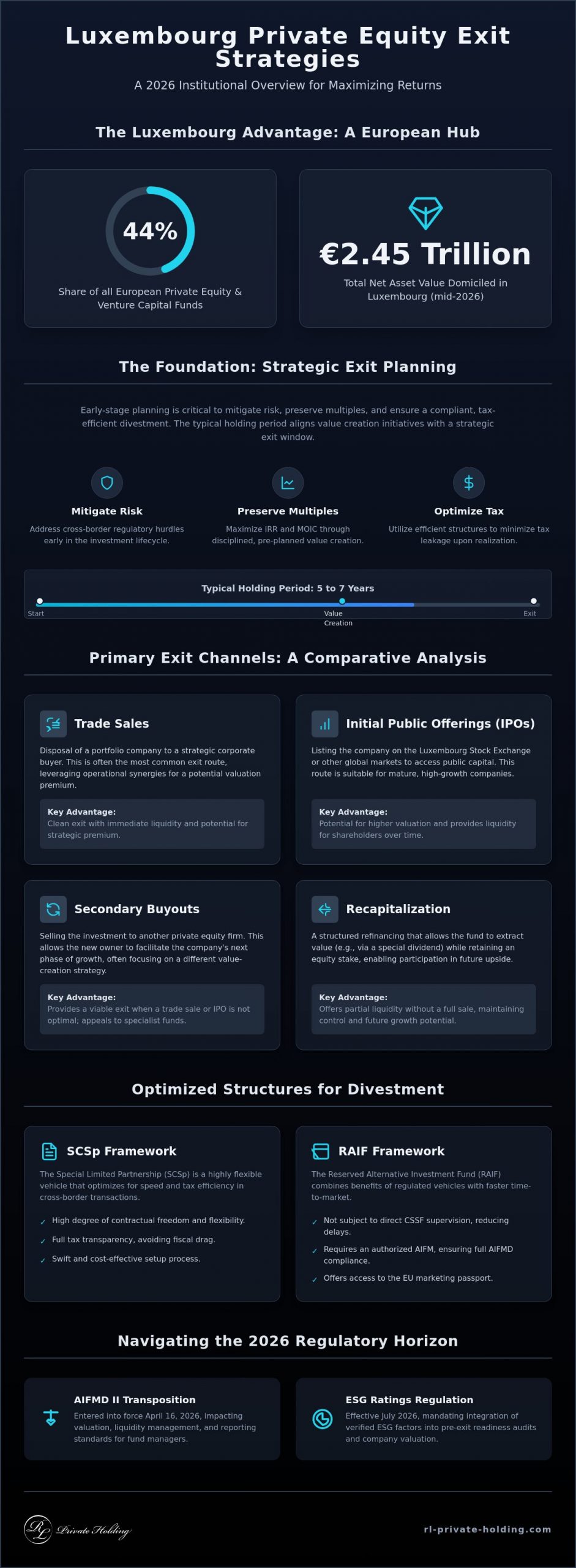
As of mid-2026, Luxembourg maintains a commanding 44% share of all European private equity and venture capital funds, representing a total net asset value of €2.45 trillion. This dominance underscores the jurisdiction’s stability, yet the path to a successful divestment remains intricate for institutional investors. You likely recognize that achieving a clean exit while navigating the dual pressures of regulatory compliance and tax efficiency is a significant challenge. The complexity of cross-border transactions often creates friction that can erode your final multiples if not managed with technical precision.
This article provides an authoritative analysis of the primary divestment channels and structural optimizations for private equity exit strategies Luxembourg firms utilize to maximize IRR and MOIC. We examine how the recent transposition of AIFMD II and the July 2026 ESG Ratings Regulation impact valuation and liquidity management. You’ll gain a clear framework for identifying the most effective exit channels for your specific asset classes. This overview ensures your divestment process remains fully compliant with the latest EU mandates while securing the best possible returns for your stakeholders. We prioritize the structural integrity of the exit to reflect the disciplined nature of global asset management.
Key Takeaways
- Evaluate the critical role of early-stage exit planning in mitigating cross-border regulatory risks and preserving investment multiples within the Luxembourg jurisdiction.
- Navigate the primary private equity exit strategies Luxembourg utilizes, comparing the strategic advantages of trade sales against the complexities of Initial Public Offerings.
- Examine the structural benefits of the Special Limited Partnership (SCSp) and Reserved Alternative Investment Fund (RAIF) frameworks in optimizing tax efficiency and divestment speed.
- Implement disciplined value-creation strategies to maximize IRR through targeted operational margin expansion and comprehensive pre-exit readiness audits.
- Align divestment objectives with institutional wealth management principles to ensure a seamless transition from asset realization to long-term capital preservation.
The Strategic Importance of Exit Planning in the Luxembourg Ecosystem
A private equity exit represents the definitive realization of value after a deliberate holding period. Within the Luxembourg financial ecosystem, this event is the culmination of a strategic lifecycle that begins long before the actual divestment. The choice of private equity exit strategies Luxembourg fund managers employ often dictates the initial fund structure and the selection of specific investment vehicles. In 2026, market participants must reconcile their exit timing with new regulatory frameworks, such as the AIFMD II transposition that entered into force on April 16, 2026. This jurisdictional stability allows for precise multi-jurisdictional planning that minimizes friction during the transition of ownership.
Effective exit planning serves as the foundation for institutional trust. It ensures that the transition from asset management to capital realization occurs with minimal tax leakage and regulatory delay. The current market conditions in 2026, characterized by a 44% share of European alternative funds being domiciled in the Grand Duchy, emphasize the importance of using standardized, transparent frameworks. A well-constructed strategy anticipates the requirements of potential buyers, whether they are strategic corporates or other institutional investors, ensuring the asset is presented in its most optimized state.
Defining the Exit Horizon for Institutional Portfolios
The exit horizon is typically structured around a five to seven year holding period, though this timeline is increasingly flexible to accommodate specific limited partner liquidity requirements. Asset managers must balance the desire for maximum multiples with the contractual obligations of the fund’s lifecycle. Successful private equity investment management requires a clear definition of the exit horizon to align operational improvements with the eventual divestment window. This alignment ensures that value creation initiatives, such as margin expansion or digital transformation, reach maturity exactly when the market is most receptive to the asset class.
Luxembourg as a Global Hub for Divestment
Luxembourg provides a sophisticated infrastructure for executing common exit routes, ranging from secondary buyouts to complex trade sales. The Commission de Surveillance du Secteur Financier (CSSF) maintains a transparent environment that appeals to global buyers who prioritize regulatory certainty. Compared to other European jurisdictions, Luxembourg offers superior flexibility in cross-border transactions, particularly for assets held through SOPARFI or SCSp structures. This maturity in the local financial center allows for the efficient repatriation of capital and the implementation of private equity exit strategies Luxembourg professionals use to maintain a competitive edge in the global landscape. The availability of specialized legal and tax expertise ensures that even the most complex divestments are handled with institutional-grade precision.
Primary Exit Channels for Private Equity Funds in Luxembourg
The diversification of private equity exit strategies Luxembourg practitioners utilize reflects the maturity of the Luxembourg private equity landscape. While the objective remains the realization of capital, the selection of a specific channel depends on the asset’s growth stage and the prevailing market liquidity. Institutional managers evaluate several distinct pathways to ensure optimal returns:
- Trade Sales: The disposal of a portfolio company to a strategic corporate buyer seeking operational synergies.
- Initial Public Offerings (IPOs): Listing the entity on the Luxembourg Stock Exchange or global markets to access public capital.
- Secondary Buyouts: Selling the investment to another private equity firm to facilitate the next phase of growth.
- Recapitalization: Structured refinancing that allows the fund to extract cash while retaining an equity stake.
- Liquidation: The orderly distribution of assets as a fund approaches its final sunset phase.
Trade Sales and Strategic Acquisitions
Trade sales remain a dominant exit route because strategic buyers often pay a premium for synergies that financial buyers cannot replicate. In 2026, preparing for a trade sale requires an intense focus on corporate due diligence, particularly regarding digital infrastructure and ESG compliance. Buyers in the technology and healthcare sectors are increasingly scrutinizing data sovereignty and carbon footprints. A successful trade sale hinges on the seller’s ability to present a clean, integrated operation that can be absorbed into a larger corporate structure without significant friction. This process often begins eighteen months before the intended exit to ensure all operational red flags are addressed.
GP-Led Secondaries and Continuation Funds
GP-led secondary transactions have transitioned from a niche liquidity solution to a mainstream portfolio management tool within the Luxembourg market. These structures allow managers to transfer high-performing assets into a continuation fund, providing liquidity to existing limited partners while extending the value-creation period. This is particularly relevant for private equity exit strategies Luxembourg firms employ when an asset requires more time to reach its full potential than a traditional fund lifecycle allows. Managing these exits requires rigorous conflict of interest protocols to ensure the valuation is fair to both exiting and entering investors. The use of independent fairness opinions has become standard practice to maintain institutional transparency. Organizations focused on private equity investment management often utilize these tools to balance immediate liquidity needs with long-term capital appreciation. This sophisticated approach ensures that top-tier assets are not sold prematurely due to arbitrary fund expiration dates.
Structural and Regulatory Considerations for Divestment
The selection of private equity exit strategies Luxembourg funds prioritize is intrinsically linked to the underlying legal vehicle chosen at the inception of the investment. A sophisticated divestment process requires more than just a willing buyer; it demands a structure that preserves value through tax neutrality and regulatory precision. The Luxembourg special limited partnership (SCSp) has become a preferred vehicle for this reason, offering contractual flexibility that simplifies the transfer of interests. This structural foresight ensures that private equity exit strategies Luxembourg professionals implement are both tax-efficient and legally resilient.
Speed of execution often dictates the success of a divestment in volatile markets. Utilizing the Reserved Alternative Investment Fund (RAIF) framework allows managers to bypass direct product-level authorization from the CSSF, facilitating a rapid exit while maintaining institutional-grade oversight through an authorized AIFM. However, this agility must be balanced with the reporting requirements of AIFMD II, which entered into force on April 16, 2026. Managers must also navigate the ESG Ratings Regulation that became applicable on July 2, 2026, as institutional buyers now require comprehensive sustainability disclosures under SFDR before committing to a purchase.
Tax Neutrality and the SOPARFI Structure
The SOPARFI remains the cornerstone of Luxembourg holding structures due to its extensive double tax treaty network and the participation exemption regime. This regime can exempt capital gains from corporate income tax, provided the holding meets specific duration and ownership thresholds. Maintaining substantial economic substance in Luxembourg is vital to defending these benefits against international tax challenges. The legal framework governing the Primary Exit Channels in Luxembourg requires a thorough understanding of how these tax protections interact with the buyer’s jurisdiction to prevent unnecessary leakage during the repatriation of proceeds.
Regulatory Governance and Anti-Money Laundering (AML)
Institutional discipline is most visible during the final stages of a transaction, where ‘know your buyer’ (KYB) protocols must be strictly enforced. The fund’s depositary plays a critical role here, verifying the source of funds and ensuring the orderly distribution of exit proceeds to limited partners. Rigorous adherence to Anti-Money Laundering (AML) and Counter-Terrorist Financing (CTF) frameworks remains a non-negotiable prerequisite for the successful closure of any private equity transaction in Luxembourg. This oversight protects the fund’s reputation and ensures that the realization of value doesn’t encounter eleventh-hour legal hurdles. Proper documentation of the entire divestment lifecycle is essential for future regulatory audits and maintaining the trust of global investors.
Maximizing Exit Multiples: Value Creation and Timing
Maximizing the Multiple of Invested Capital (MOIC) requires a shift in focus from administrative compliance to operational maturity. While the legal architecture provides the vessel, the exit multiple is determined by the quality of the underlying asset and the precision of the timing. Sophisticated private equity exit strategies Luxembourg managers deploy often involve an eighteen-month preparation phase. This window ensures the portfolio company demonstrates sustainable margin expansion and high-quality recurring revenue before entering the market. Institutional buyers are increasingly looking for evidence of resilient cash flows that can withstand broader economic shifts.
The ‘Exit Readiness’ audit serves as a critical tool in this preparatory phase. By identifying and resolving potential red flags in financial reporting, legal standing, or ESG compliance before external due diligence begins, managers prevent price chipping. A clean audit trail and transparent operational data significantly reduce the friction of the sale. This internal discipline creates a sense of reliability that appeals to the most sophisticated global acquirers, ensuring that the final purchase price reflects the asset’s full intrinsic value.
Operational Value Creation Strategies
Institutional buyers prioritize assets with a management team capable of executing the next growth phase without significant intervention. Digital transformation serves as a critical valuation multiplier; it modernizes legacy systems to improve data transparency and operational efficiency. In the technology sector, aligning with current venture capital Luxembourg trends is essential for positioning assets toward strategic acquirers. These buyers value verifiable digital maturity and scalable infrastructure above speculative growth. Strengthening the management layer and optimizing the technology stack are non-negotiable steps for achieving a premium valuation in the 2026 landscape.
Navigating Market Volatility in 2026
Market timing in 2026 remains influenced by European Central Bank (ECB) monetary policies and the resulting cost of debt for potential buyers. High levels of global “dry powder” continue to drive demand for quality assets, yet buyers are more discerning regarding risk than in previous cycles. When interest rates create valuation gaps, the strategic use of earn-outs and deferred consideration can bridge the difference between seller expectations and buyer caution. This approach allows for the realization of value over an extended period, mitigating the impact of temporary market fluctuations. Building a competitive auction process further drives the purchase price by creating urgency among a curated group of strategic and financial bidders. For those seeking to optimize their divestment results, professional private equity investment management provides the necessary oversight to align portfolio maturity with market receptivity.
RL Private Holding: Institutional Excellence in Exit Management
RL Private Holding provides a steady hand in the realization of capital within the Grand Duchy’s sophisticated financial landscape. Our approach to private equity exit strategies Luxembourg focuses on the seamless transition of assets from an active holding phase to a successful divestment. We manage a diversified portfolio across technology, real estate, and private equity from our national headquarters, ensuring that every transaction reflects our commitment to institutional gravity. This local presence is balanced with a global scale, allowing us to navigate complex, multi-sector divestments with the precision required by institutional partners.
Our firm operates on a foundation of “quiet authority,” prioritizing stability and long-term strategic focus over aggressive self-promotion. We understand that a successful exit is the result of a disciplined lifecycle, beginning with the initial fund structure and concluding with a transparent distribution of proceeds. By maintaining a professional distance and a worldly perspective, we serve as a reliable partner for those who value discretion in high-stakes financial environments. Our internal discipline ensures that every portfolio realization is conducted according to a clear, methodical plan.
Integrated Wealth and Asset Management
Effective divestment is not an end point but a critical transition in the capital lifecycle. Successful exits often lead to the implementation of family office investment strategies that prioritize capital preservation and tax-efficient reinvestment. We facilitate the shift from illiquid private equity holdings to diversified wealth structures, ensuring that the liquidity generated is managed with the same rigor as the original investment. Our discreet advisory services for institutional partners and ultra-high-net-worth individuals provide a framework for transitioning gains into long-term wealth preservation vehicles. This integrated approach minimizes tax leakage and ensures that the proceeds from private equity exit strategies Luxembourg firms execute are positioned for future growth.
Partnering for the Full Investment Lifecycle
We align our interests with our partners through a performance-based carried interest model that reflects the 2026 tax regime updates. This includes navigating the technical distinctions between contractual carry and participation carry to ensure the most efficient distribution of remuneration. Our expertise extends across the full investment spectrum, from providing venture capital funding to managing the final strategic private equity exit. This comprehensive oversight allows us to maintain a steady hand in the background of major investments, providing the structural integrity required for complex cross-border transactions. Organizations seeking to optimize their portfolios can engage with RL Private Holding to leverage our deep Luxembourgish roots and our sophisticated understanding of global investment structures. We remain a steady partner, focused on the methodical realization of value and the disciplined management of institutional assets.
Navigating the Future of Divestment in the Grand Duchy
The successful execution of private equity exit strategies Luxembourg requires a synthesis of structural precision and operational discipline. As the 2026 regulatory landscape matures, the integration of AIFMD II compliance and transparent ESG reporting has transitioned from a secondary concern to a primary driver of valuation. Investors must prioritize early-stage planning, utilizing flexible vehicles like the SCSp and RAIF to ensure tax neutrality and rapid execution. This methodical approach preserves the integrity of the investment lifecycle, allowing for the efficient repatriation of capital and the transition to long-term wealth preservation.
RL Private Holding maintains a disciplined focus on these complexities, providing the steady hand required for high-stakes portfolio realization. Our firm combines specialized knowledge of Luxembourg investment structures with global portfolio management expertise to deliver institutional-grade transparency at every stage of divestment. We invite you to Explore Strategic Investment Management with RL Private Holding to align your assets with a partner committed to professional excellence. Achieving optimal IRR and MOIC is a function of strategic foresight and a worldly perspective. We look forward to supporting your long-term investment objectives.
Frequently Asked Questions
What is the most common private equity exit strategy in Luxembourg?
Trade sales to strategic buyers and secondary buyouts currently represent the most frequent private equity exit strategies Luxembourg funds employ. Trade sales are prioritized when a corporate acquirer can realize operational synergies, while secondary buyouts facilitate the transfer of assets between private equity firms for continued growth. Both channels leverage Luxembourg’s established legal framework to ensure a predictable transfer of ownership during the final realization of value.
How has AIFMD II changed the exit process for Luxembourg funds?
AIFMD II, which entered into force on April 16, 2026, has introduced harmonized requirements for liquidity management and regulatory reporting. While the most intensive reporting obligations apply from April 16, 2027, funds must now implement specific liquidity management tools from a harmonized EU list. These updates ensure that divestment processes remain transparent and that alternative investment funds maintain sufficient liquidity during the strategic realization of institutional assets.
Is a trade sale better than an IPO for a Luxembourg portfolio company?
A trade sale is often preferred over an IPO because it typically provides immediate liquidity and a synergy premium from a strategic buyer. Conversely, an Initial Public Offering on the Luxembourg Stock Exchange or global markets offers access to public capital but involves significant regulatory disclosure and market timing risks. Most institutional managers choose the path that maximizes the multiple while minimizing post-exit lock-up constraints, ensuring a clean and efficient repatriation of capital.
What are the tax implications of a private equity exit in Luxembourg?
The tax implications of an exit are primarily governed by the participation exemption regime and the new carried interest rules applicable from January 1, 2026. Capital gains realized through a SOPARFI may be exempt from corporate income tax under specific holding conditions. Additionally, the 2026 regime taxes contractual carry at approximately 11.5%, while participation carry linked to direct investment can be fully exempt from Luxembourg tax, provided the investment is held for at least six months.
How does the SCSp structure facilitate a smoother exit process?
The Special Limited Partnership (SCSp) facilitates a smoother exit by offering high levels of contractual flexibility and tax transparency. This structure allows for the seamless transfer of partnership interests without the administrative burden associated with share transfers in corporate entities. It remains a preferred vehicle for private equity exit strategies Luxembourg firms use to tailor governance and distribution waterfalls to specific investor requirements, ensuring a clean break for exiting partners.
What is a GP-led secondary transaction and why is it popular in 2026?
A GP-led secondary transaction involves a fund manager transferring assets from an existing fund into a continuation vehicle to extend the value creation period. This strategy has gained popularity in 2026 as a sophisticated tool for providing liquidity to limited partners while retaining high-performing assets. These transactions require rigorous conflict-of-interest protocols and independent fairness opinions to ensure institutional-grade transparency for all parties involved, reflecting the maturing nature of the local market.
How long does the average private equity exit take in the Luxembourg market?
The average duration for a private equity exit in Luxembourg ranges from six to twelve months for the formal transaction phase. However, a disciplined preparation period typically begins eighteen months prior to the intended sale to address operational improvements and “exit readiness” audits. The specific timeline is influenced by the choice of exit channel, the complexity of the asset, and the depth of the buyer’s due diligence process in the current market.
Can a Luxembourg RAIF be used for both venture capital and private equity exits?
The Reserved Alternative Investment Fund (RAIF) is a versatile vehicle suitable for both venture capital and private equity exits due to its structural flexibility. Because the RAIF doesn’t require direct product-level authorization from the CSSF, it allows for a rapid setup and efficient divestment execution. This agility makes it an ideal structure for institutional managers who need to respond quickly to sector-specific market cycles and liquidity opportunities in the Grand Duchy.