

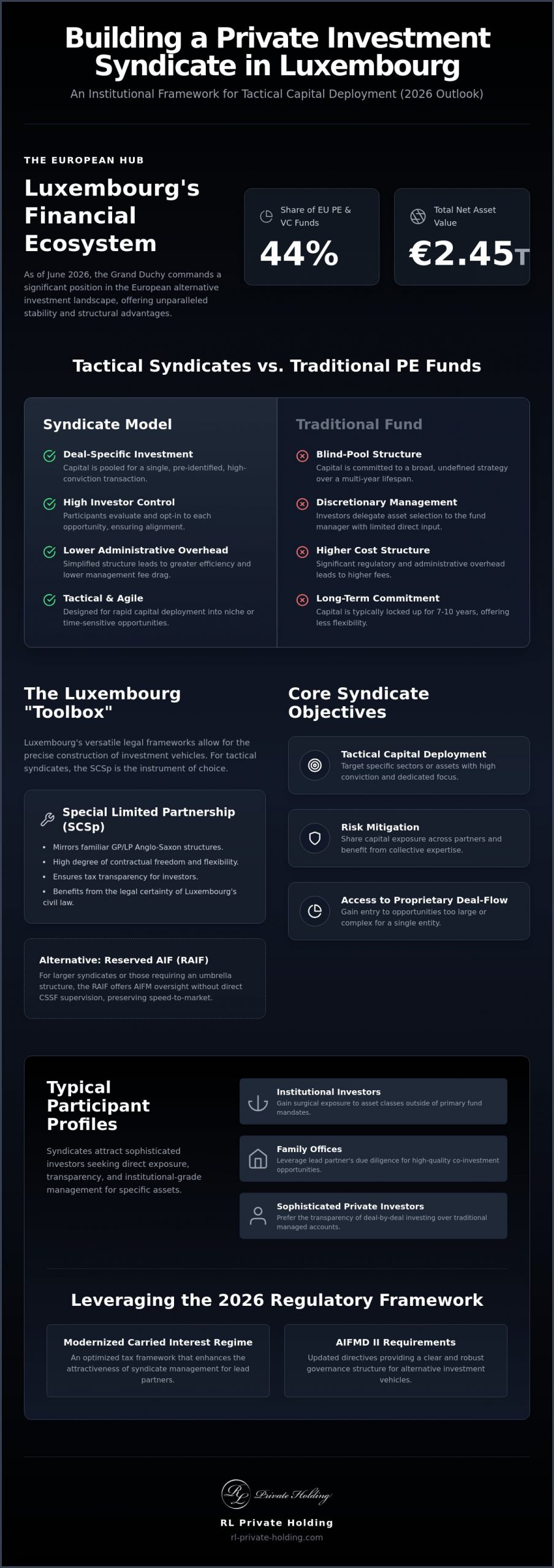
As of June 2026, Luxembourg holds a 44% share of all European private equity and venture capital funds, representing a total net asset value of over €2.45 trillion. You likely recognize the Grand Duchy’s dominance in the global financial landscape, yet you also understand the friction involved in managing high-stakes tactical deals. The administrative overhead of traditional, regulated fund structures can often feel disproportionate to the agility required for niche opportunities. Building a private investment syndicate in Luxembourg requires a precise balance between regulatory compliance and operational flexibility.
This guide provides an institutional-grade framework for establishing a syndicate that prioritizes efficiency and structural integrity. It focuses on the Special Limited Partnership (SCSp) and the strategic advantages offered by the modernized 2026 regulatory environment. You’ll gain a clear understanding of the new carried interest tax regime, the implications of AIFMD II, and a robust framework for syndicate governance. We’ll also explore the criteria for identifying a strategic lead partner capable of managing complex GP and LP interests with the necessary professional distance.
Key Takeaways
- Define the tactical advantages of the syndicate model for pooling capital toward specific, high-conviction transactions rather than traditional blind-pool funds.
- Navigate the Luxembourg “toolbox” by selecting the appropriate legal structure, specifically the Special Limited Partnership (SCSp), for building a private investment syndicate in Luxembourg.
- Implement institutional-grade governance and transparency protocols to ensure alignment between lead managers and participating investors.
- Leverage the 2026 regulatory framework, including the modernized carried interest regime and AIFMD II requirements, to optimize operational efficiency.
- Assess the strategic benefits of partnering with an established lead manager to oversee deal sourcing and complex asset management.
Understanding the Private Investment Syndicate Model
A private investment syndicate represents a targeted investment structure where a group of sophisticated participants pools capital to acquire a specific, pre-identified asset. Unlike the traditional private equity model, which typically operates through a blind-pool fund with a multi-year lifespan, a syndicate is deal-specific. This tactical approach allows investors to evaluate the merits of a single transaction rather than committing capital to a broader, undefined strategy. Building a private investment syndicate in Luxembourg has emerged as a primary solution for those seeking to deploy capital with greater precision and lower administrative complexity than a full-scale regulated fund.
The lead manager serves as the cornerstone of the syndicate. Their responsibilities encompass the entire lifecycle of the investment, beginning with proprietary deal sourcing and extending through rigorous due diligence. Once the capital is deployed, the lead manager provides ongoing asset management and governance, ensuring the investment remains aligned with the initial thesis. This role is distinct from retail fund management, where the focus often lies on broad distribution and standardized reporting. In a syndicate, the relationship is characterized by institutional-grade transparency and a shared interest in the outcome of a specific transaction.
In 2026, the preference for syndication among family offices and institutional co-investors has intensified. This shift is driven by a desire for increased control over asset selection and a move away from the high management fees associated with traditional fund structures. Luxembourg’s evolution into a strategic hub for substance-heavy operations has further supported this trend, providing a stable environment for these specialized vehicles. The structure allows for a more direct connection between the investor and the underlying asset, which is increasingly valued in a volatile global market.
Core Objectives of Syndicate Formation
- Tactical capital deployment: Investors can target specific sectors like technology or real estate with high conviction and dedicated focus.
- Risk mitigation: Sharing capital exposure across multiple partners reduces the impact of a single asset on a broader portfolio while benefiting from collective expertise.
- Access to proprietary deal-flow: Syndicates allow participants to access opportunities that might be too large or complex for an individual entity to manage independently.
Participant Profiles in Luxembourg Syndicates
Institutional investors often use syndicates to gain surgical exposure to specific geographic regions or asset classes that fall outside their primary fund mandates. Family offices, seeking co-investment opportunities, benefit from the professional due diligence and management provided by an established lead partner. Additionally, sophisticated private investors who require institutional-grade structures often prefer the transparency of deal-by-deal investing over traditional managed accounts. These profiles share a common requirement for a jurisdiction that offers both legal certainty and operational flexibility.
The Luxembourg “Toolbox”: Legal Frameworks for Syndicates
Luxembourg provides a sophisticated array of vehicles designed for efficient asset pooling. Selecting the correct legal structure is a prerequisite for long-term operational success. For those building a private investment syndicate in Luxembourg, the chosen framework must accommodate rapid deployment while maintaining absolute tax transparency. The Grand Duchy’s reputation as a premier financial center rests on the versatility of Luxembourg’s legal frameworks, which allow sponsors to select between regulated and unregulated options based on the specific needs of their investor base.
The Special Limited Partnership (SCSp) serves as the primary instrument for tactical syndication. It mirrors the familiar GP/LP structures found in Anglo-Saxon jurisdictions but benefits from the legal certainty of Luxembourg’s civil law protections. For larger syndicates that require an umbrella structure or specific regulatory oversight, the Reserved Alternative Investment Fund (RAIF) offers an efficient alternative. While the RAIF is subject to the AIFM directive, it does not require direct supervision by the CSSF, which preserves the speed to market essential for competitive deal-making.
Underpinning these vehicles is the SOPARFI (Société de Participations Financières). This common commercial company acts as a robust holding entity for the syndicate’s underlying assets, providing access to Luxembourg’s extensive double tax treaty network. This multi-layered approach ensures the syndicate remains tax-neutral for participants while securing the legal standing of the acquisition vehicle. It’s a structure that prioritizes the integrity of the investment while minimizing administrative friction.
The Strategic Advantage of the SCSp
The Luxembourg special limited partnership offers unparalleled contractual freedom. Partners can precisely define governance protocols and distribution waterfalls within the Limited Partnership Agreement (LPA). Since there is no minimum share capital requirement and the vehicle can be established via private deed, it remains the most efficient path for deal-specific pooling. This flexibility allows the lead manager to align incentives with the specific risk profile of the transaction.
Regulatory Compliance and FATF Standards in 2026
Compliance remains a pillar of institutional stability in the Grand Duchy. In April 2026, the implementation of AIFMD II introduced stricter rules regarding loan origination and liquidity management tools. Syndicate managers must ensure robust local substance and genuine decision-making to meet these evolving standards. Adherence to FATF-aligned AML and KYC protocols is mandatory for all global participants to protect the integrity of the structure. Engaging with an established investment management partner ensures that these complex regulatory requirements are handled with the necessary precision and professional distance.
Tactical Syndicates vs. Traditional Private Equity Funds
Traditional private equity vehicles typically require investors to commit capital to a blind pool, often spanning a ten-year lifecycle. While this model provides fund managers with long-term stability, it restricts investor autonomy and locks capital into a broad mandate. Building a private investment syndicate in Luxembourg offers a more surgical alternative. Instead of a multi-year commitment to an undefined portfolio, syndicate participants gain direct exposure to a specific, pre-vetted asset. This transparency allows for a more granular assessment of risk and return, which is particularly critical in the high-stakes environment of 2026.
Fee structures also diverge significantly between these two models. Traditional funds generally follow a fixed management fee and carried interest pattern regardless of individual asset performance. Syndicates, however, often utilize transaction-based incentives that align the lead manager’s compensation more closely with the success of the specific deal. Exit strategies are equally distinct. In a traditional fund, liquidity depends on the overall fund’s divestment schedule. A syndicate’s lifespan is inextricably linked to the underlying asset’s lifecycle, providing a clearly defined path to liquidity once the specific investment thesis is realized.
Agility and Speed to Market
Syndicates prioritize deployment speed, allowing for immediate capital calls once a target is identified. This agility is essential for time-sensitive acquisitions where the delay of traditional fundraising cycles could result in lost opportunities. By utilizing the SCSp structure, sponsors can establish the vehicle in a matter of weeks, significantly reducing the administrative lag associated with traditional private equity investment management. This streamlined decision-making process ensures that tactical capital is deployed exactly when and where it’s most effective.
Cost-Efficiency and Administrative Burden
Operational costs are optimized by focusing the administrative framework on a single asset rather than a broad, multi-asset portfolio. Building a private investment syndicate in Luxembourg allows sponsors to leverage the local service provider ecosystem for lean, deal-specific management. While regulated vehicles must adhere to the formal CSSF authorisation process, many tactical syndicates operate as unregulated partnerships to maintain structural simplicity. This balance ensures that the vehicle remains compliant with AML and KYC standards without the excessive overhead of a fully regulated retail fund structure. It’s a pragmatic approach that favors performance and transparency over institutional complexity.
Operational Excellence: Governance and Best Practices
Operational success depends on the transition from legal formation to disciplined governance. When building a private investment syndicate in Luxembourg, the Limited Partnership Agreement (LPA) serves as the definitive constitutional document. It must provide a clear architecture for decision-making and reporting to maintain institutional gravity. This is especially relevant in 2026 as investors demand higher levels of transparency and local substance to comply with evolving EU standards. Establishing these protocols early prevents the administrative friction that can undermine tactical deal-making. Building a private investment syndicate in Luxembourg requires this foundational trust to attract and retain sophisticated co-investors.
Managing conflicts of interest is a primary concern in co-investment scenarios. Lead managers must establish robust risk management frameworks, particularly for cross-border venture capital Luxembourg investments. These frameworks should address how deal-flow is allocated and how the lead manager’s existing portfolio interests are walled off from the syndicate’s specific assets. Clear disclosure of all transaction-based fees and incentive structures ensures that every participant operates with a full understanding of the economic landscape. This level of professional distance is essential for maintaining the “silent giant” persona that characterizes successful institutional partners.
Decision-Making Protocols
The General Partner (GP) typically maintains full discretion over day-to-day management and asset execution. However, Limited Partners (LPs) often negotiate veto powers over specific “reserved matters,” such as follow-on funding rounds or significant changes to the investment’s risk profile. In tactical technology or real estate deals, these rights must be balanced to ensure the lead manager can act with the necessary speed. Standardized frameworks for capital calls should be established to ensure liquidity is available within the narrow windows often required for private acquisitions.
Performance-Driven Incentive Structures
The modernized Luxembourg tax regime, effective January 1, 2026, has introduced significant clarity for carried interest. For individuals actively involved in managing the syndicate, contractual carry is now taxed at an effective rate of approximately 11.5% to 13%. If the carry is linked to a genuine investment representing no more than 10% of capital and held for at least six months, the gains are completely exempt from Luxembourg tax. This framework allows for the design of incentive structures that precisely align the interests of the lead manager with the syndicate’s performance. Transparent distribution waterfalls, benchmarked against institutional private equity standards, ensure that all participants understand the priority of payments upon a successful asset exit.
Organizations seeking to implement these governance standards can partner with RL Private Holding to ensure their syndicate operates with institutional precision and strategic focus.
Strategic Management with RL Private Holding
RL Private Holding provides the institutional stability and professional distance required to oversee complex investment vehicles. As a Luxembourg-based investment holding company, we specialize in the management of venture capital, private equity, and real estate assets. Our firm serves as a disciplined global partner, offering the “quiet authority” necessary to navigate the high-stakes environment of international finance. Building a private investment syndicate in Luxembourg through an established lead manager ensures that tactical deal-flow is supported by robust governance and a clear organizational hierarchy. We prioritize structural integrity and long-term value creation over disruptive innovation, appealing to partners who value professional distance and institutional permanence.
Our approach to syndicate management focuses on providing sophisticated participants with access to a diversified global portfolio. By maintaining a steady hand in the background of major investments, we allow our partners to benefit from high-level financial and corporate expertise. Our operational framework is designed to handle the nuances of the Special Limited Partnership (SCSp) and other tactical vehicles with methodical precision. This commitment to internal discipline ensures that every syndicate we manage adheres to the highest standards of transparency and regulatory compliance expected in the 2026 financial landscape.
Institutional Deal Sourcing
RL Private Holding identifies high-alpha opportunities through a methodical and deliberate sourcing process. We focus on growth-stage technology and specialized real estate sectors where our global operations provide a distinct advantage. Our team applies rigorous due diligence protocols to every potential transaction, ensuring that only assets with a clear path to value realization are presented for syndicate participation. By leveraging our established networks, we often secure off-market transactions that aren’t available through traditional brokerage channels. This proprietary deal-flow is a cornerstone of our strategy, providing our partners with exclusive entry points into high-conviction assets.
Wealth Preservation and Strategic Growth
Integrating syndication into a broader family office investment strategies Luxembourg plan allows for greater precision in capital allocation. We position these tactical vehicles as core components of institutional wealth management, focusing on steady growth and risk mitigation. Our expertise in real estate asset management Luxembourg and venture capital funding provides a balanced exposure across different asset classes. Building a private investment syndicate in Luxembourg with RL Private Holding ensures that wealth preservation is prioritized through disciplined management and a clear exit strategy. This methodical approach to asset growth reflects our firm’s commitment to providing a reliable framework for sophisticated global investors.
Advancing Institutional Syndicate Strategies in 2026
The Luxembourg financial landscape has solidified its position as a strategic hub for specialized investment vehicles. Success in this jurisdiction requires a meticulous approach to structural selection, particularly the utilization of the Special Limited Partnership for its contractual flexibility. Implementing robust governance protocols and adhering to the 2026 regulatory standards ensures that tactical vehicles remain compliant while maintaining speed to market. Building a private investment syndicate in Luxembourg provides a sophisticated pathway for pooling capital toward high-conviction assets without the administrative friction of traditional funds.
A disciplined approach to asset management and deal sourcing remains the differentiator for high-alpha portfolios. By focusing on institutional-grade transparency and professional distance, sponsors can navigate complex global markets with confidence. Establishing a reliable framework for co-investment allows for the efficient deployment of capital into growth-stage technology and real estate sectors. It’s a structure built for permanence and steady growth. We invite you to Partner with RL Private Holding for Institutional Syndicate Management to leverage our Luxembourg-based expertise and diversified global investment portfolio. We look forward to supporting your strategic objectives within this modernized framework.
Frequently Asked Questions
What is the most common legal structure for a private investment syndicate in Luxembourg?
The Special Limited Partnership (SCSp) is the most prevalent vehicle for this purpose. It offers the contractual flexibility required for tactical deal-making while remaining tax-transparent. This structure is particularly favored by those building a private investment syndicate in Luxembourg due to its lack of legal personality and the ability to define governance through a private partnership agreement rather than rigid statutory requirements.
How does a syndicate differ from a traditional private equity fund?
A syndicate is a deal-specific vehicle where capital is pooled for a pre-identified asset, whereas a traditional fund is a blind pool. Participants in a syndicate have direct visibility into the underlying investment from the outset. This model eliminates the long-term capital commitments associated with multi-asset funds and provides a more defined path to liquidity based on the asset’s specific lifecycle.
What are the regulatory requirements for a lead manager of a Luxembourg syndicate?
Lead managers must demonstrate adequate local substance and maintain robust decision-making processes within the Grand Duchy. Compliance with AML and KYC regulations is mandatory for all participants. Depending on the aggregate assets under management, the lead manager may also need to register as an Alternative Investment Fund Manager (AIFM) or appoint a third-party provider to meet AIFMD II standards.
Can a private investment syndicate be used for real estate acquisitions in Luxembourg?
Yes, the Luxembourg toolbox is highly effective for cross-border real estate acquisitions. Syndicates often utilize an SCSp in conjunction with a SOPARFI holding company to optimize the tax treatment of rental income and capital gains. This approach allows sophisticated partners to participate in specific property transactions with the same institutional rigor applied to private equity or venture capital investments.
How are management fees and carried interest typically structured in a syndicate?
Management fees are typically calculated as a percentage of committed or invested capital, while carried interest aligns the manager’s incentives with asset performance. In a syndicate, transaction-based fees are common at the point of acquisition and exit. These structures are benchmarked against institutional standards to ensure that the lead manager’s compensation reflects the successful execution of the specific investment thesis.
Is an SCSp required to have a regulated manager (AIFM)?
An SCSp does not automatically require a regulated manager unless it falls under the scope of the AIFM Directive. If the vehicle is considered an Alternative Investment Fund and its assets exceed the €100 million threshold, or €500 million for unleveraged, long-term funds, a regulated AIFM must be appointed. Many tactical syndicates operate below these thresholds or utilize specific exemptions to maintain structural simplicity.
What is the typical timeline for setting up a tactical syndicate in Luxembourg?
Establishing an unregulated SCSp can often be completed within two to four weeks. This timeline is significantly shorter than the months required for regulated vehicles like a SIF or SICAR. For those building a private investment syndicate in Luxembourg, this speed to market is essential for securing time-sensitive deals. The process involves drafting the partnership agreement and completing the necessary AML and KYC registrations.
How do Luxembourg syndicates handle AML and KYC for international participants?
Luxembourg syndicates utilize centralized registries and professional administrators to manage AML and KYC compliance for global investors. Every participant must provide documentation verifying their identity and the source of their funds in accordance with EU directives. This rigorous process protects the integrity of the syndicate and ensures that all participants meet the standards expected of sophisticated institutional partners.