

The distinction between private philanthropy and fiduciary duty has dissolved into a unified institutional mandate for the modern principal. In 2026, the implementation of sophisticated impact investing frameworks for family offices is no longer a discretionary exercise but a strategic necessity for maintaining capital relevance within a tightening global regulatory environment. You understand that moving beyond basic ESG risk mitigation requires more than intent; it demands a technical infrastructure capable of quantifying non-financial returns across complex, multi-asset portfolios.
This analysis offers a disciplined roadmap for selecting and integrating institutional-grade frameworks that align multi-generational legacy with contemporary sustainability standards. We’ll examine the practical application of the IRIS+ 5.3c system and the recently released Sector Impact Matrix to bridge the gap between high-level objectives and granular performance data. By the end of this guide, you’ll possess the structural clarity needed to establish robust reporting protocols that satisfy both the European Sustainability Reporting Standards and the rigorous transparency demands of next-generation stakeholders.
Key Takeaways
- Identify the transition from discretionary philanthropy to institutional mandates, ensuring that capital allocation remains relevant during the multi-generational wealth transfer.
- Evaluate the technical implementation of impact investing frameworks for family offices, focusing on the IRIS+ system and the Impact Management Project’s five dimensions of impact.
- Integrate rigorous impact performance indicators into private equity and venture capital asset classes through enhanced due diligence and specific impact clauses.
- Establish institutional governance by defining impact mandates within the family office charter and developing internal committees to oversee non-financial reporting.
- Utilize the structural stability of Luxembourg-based investment vehicles to facilitate disciplined, cross-sector global impact strategies within a diversified holding company framework.
The Paradigm Shift: From Philanthropic Grants to Strategic Impact Allocation
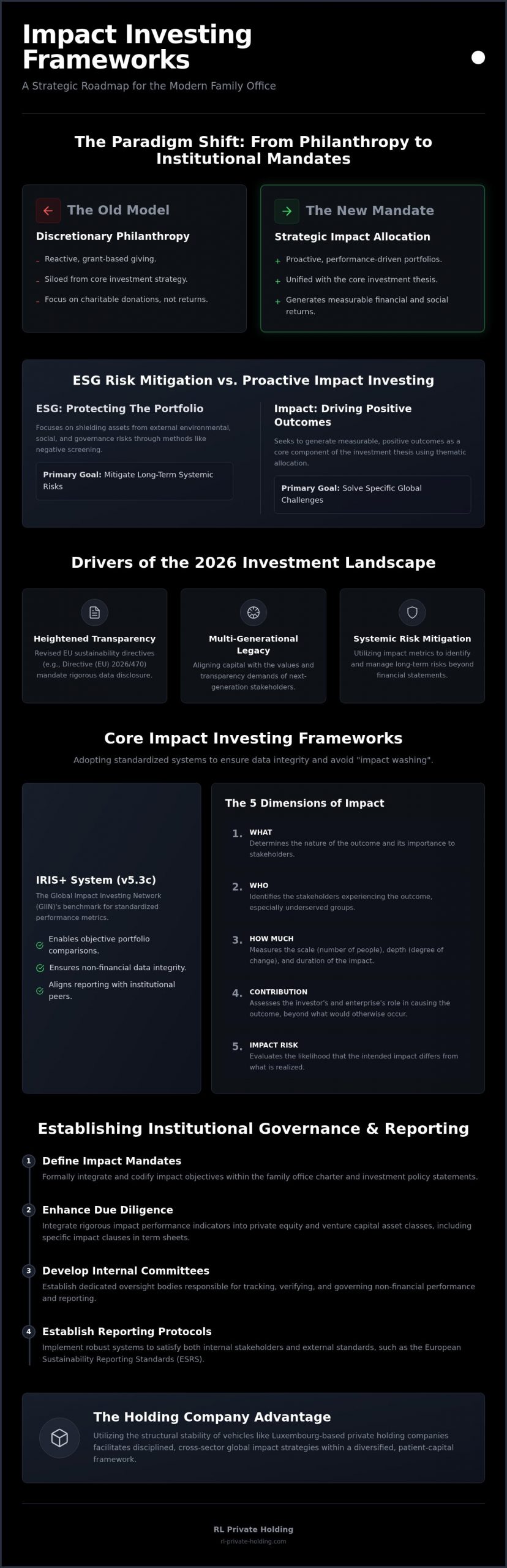
The structural realignment of global wealth is no longer a theoretical projection. The “Great Wealth Transfer” serves as the foundational catalyst for a move toward institutional impact mandates. As trillions in assets transition to a generation that views fiduciary duty through the lens of systemic resilience, the traditional silos between philanthropy and investment are collapsing. Implementing effective impact investing frameworks for family offices ensures that these entities remain at the forefront of global capital allocation. Family offices are uniquely positioned to lead this evolution. Their status as patient capital allows for the absorption of longer duration risks that traditional institutional funds often avoid. This transition marks a shift from reactive, grant-based giving to the construction of proactive, performance-driven impact portfolios.
To understand this shift, one must distinguish between ESG risk mitigation and proactive thematic allocation. While ESG focuses on protecting the portfolio from external environmental and social risks, impact investing seeks to generate measurable, positive outcomes as a core component of the investment thesis. Those seeking a foundational overview of what is impact investing recognize that it requires a deliberate intention to solve specific global challenges. For principals, this means adopting sophisticated impact investing frameworks for family offices that can track non-financial returns with the same rigor applied to internal rates of return (IRR).
Drivers of Impact in the 2026 Investment Landscape
The regulatory environment in 2026 has introduced new layers of complexity for private holdings. With the Omnibus I simplification package (Directive (EU) 2026/470) now in force, the transparency requirements for sustainability data have intensified. These drivers include:
- Heightened transparency requirements under the revised EU sustainability directives.
- The requirement to align multi-generational legacy with modern institutional standards.
- The use of impact metrics to identify and mitigate long-term systemic risks.
The Institutional Case for Impact Maturity
Institutional maturity involves moving beyond simple negative screening. It’s about active value creation. In the venture capital sector, “impact alpha” is emerging as a primary differentiator for sourcing high-quality deals. Founders increasingly prefer partners who bring more than just capital. They want investors whose governance structures support long-term sustainability objectives. Impact maturity for a diversified holding company is the seamless integration of measurable social and environmental outcomes into the core financial performance and governance structure of every portfolio entity.
Evaluating Core Impact Investing Frameworks: IRIS+, IMP, and Beyond
The selection of impact investing frameworks for family offices requires a meticulous evaluation of how data is captured, verified, and reported across diverse asset classes. Without a standardized language, the risk of “impact washing” increases, undermining the institutional credibility of the family office. The Global Impact Investing Network (GIIN) provides the most widely adopted system through IRIS+. This framework offers a catalog of performance metrics that allow for objective comparisons across portfolios. By adopting these standards, principals can ensure that their non-financial data possesses the same integrity as their audited financial statements.
IRIS+: The Standard for Impact Performance
Version 5.3c of the IRIS+ framework, released in December 2025, remains the benchmark for standardized metrics. It provides updated metric codes and expanded coverage areas that are essential for private equity allocations. By utilizing core metric sets, family offices can ensure that their data remains comparable with global institutional peers. Integrating these metrics into existing financial reporting software allows for a unified view of both financial and non-financial performance. This technical rigor is particularly valuable when assessing growth-stage technology investments where traditional KPIs may not capture the full scope of value creation.
The Five Dimensions of Impact (IMP) Framework
The Impact Management Project (IMP) provides a holistic lens through five specific dimensions: What, Who, How Much, Contribution, and Risk. This structure allows principals to move beyond simple output tracking. It facilitates a deeper understanding of the investor’s specific contribution to an outcome. For instance, applying the IMP lens to venture capital allows for a clearer assessment of the “Additionality” provided by the family office beyond mere capital provision. This clarity is vital when communicating with institutional partners or co-investors in complex syndicates. The July 2026 release of the Sector Impact Matrix further enhances this by mapping likely impacts across over 1,000 economic sectors, providing a data-driven foundation for thematic allocation.
Aligning these impact investing frameworks for family offices with the UN Sustainable Development Goals (SDGs) provides a globally recognized language for legacy and impact. However, the choice of framework must ultimately reflect the size of the family office and the complexity of its asset classes. Larger entities with significant private equity and real estate holdings may require a hybrid approach, combining the granular metrics of IRIS+ with the strategic oversight of the IMP dimensions. Establishing a disciplined approach to wealth management services ensures that these frameworks are not merely academic exercises but functional components of a long-term capital strategy.
Integrating Impact within Private Equity and Venture Capital Asset Classes
Capital follows conviction. The institutional integration of impact investing frameworks for family offices requires a fundamental shift in how private equity and venture capital deals are structured. It’s no longer sufficient to treat impact as a post-investment reporting exercise. Instead, impact criteria must be embedded directly into the due diligence process. This ensures that every allocation aligns with the family’s long-term legacy and risk appetite before capital is committed. We’re seeing a significant rise in the use of ‘Impact Clauses’ within limited partnership agreements (LPAs). These legal provisions codify the requirement for regular, transparent impact reporting. They ensure that general partners (GPs) remain accountable to the specific sustainability objectives of the family office.
Measuring the success of these allocations involves a dual-track approach. While Internal Rate of Return (IRR) and Multiple on Invested Capital (MOIC) remain the primary indicators of financial health, they’re now accompanied by social and environmental ROI metrics. This balanced scorecard provides a comprehensive view of value creation. It allows principals to assess how their capital contributes to systemic solutions while maintaining the financial discipline required for multi-generational wealth preservation. Data drives decisions. By utilizing standardized metrics, family offices can compare the performance of diverse holdings with institutional precision.
Impact in Venture Capital: Sourcing and Value Creation
Identifying ‘Impact-First’ technology startups requires a specialized lens. The goal is to find founders who view social or environmental problems as massive market opportunities. Family offices play a critical role here. They often provide the follow-on capital necessary for high-impact firms to scale beyond the initial growth phase. To navigate these complexities, one must understand the strategic frameworks for venture capital that govern institutional growth. This alignment ensures that thematic allocations don’t compromise the target growth potential of the portfolio.
Private Equity and the Transition to Sustainable Real Estate
Within private equity, decarbonisation has evolved from a regulatory burden into a primary value-creation lever. In the context of real estate asset management, retrofitting existing assets to meet institutional green building standards can significantly enhance long-term valuation. This nexus of private equity discipline and environmental stewardship is essential for modern portfolios. By applying rigorous impact investing frameworks for family offices to sustainable infrastructure and real estate, principals can secure stable, yield-generating assets that also fulfill their global sustainability mandates.
Establishing Institutional Governance and Impact Reporting Protocols
Institutionalizing the impact mandate requires more than intent; it demands a structural integration into the family office charter. This foundational document serves as the primary governance tool, ensuring that impact objectives are treated with the same fiduciary weight as financial returns. Establishing a dedicated Impact Committee or appointing a Head of Impact provides the necessary oversight to manage these objectives. These roles are responsible for translating the principal’s vision into actionable investment policies. They ensure that the selection of impact investing frameworks for family offices remains consistent across the entire portfolio and through various market cycles.
Transparency is maintained through the production of a formal annual impact report. This document provides stakeholders with a clear view of how capital has been deployed and the measurable outcomes achieved relative to the initial thesis. To maintain institutional integrity, family offices increasingly leverage third-party auditors. These independent entities verify impact claims, providing an essential safeguard against the risks of greenwashing. This level of rigor is vital for maintaining the firm’s reputation within the global financial community and ensuring that all claims are backed by verifiable data.
Step-by-Step Implementation of an Impact Protocol
The implementation of impact investing frameworks for family offices begins with drafting a comprehensive impact investment policy statement (IPS). This document outlines the specific social and environmental targets, risk tolerances, and return expectations. Once the IPS is established, the office must select its primary and secondary reporting frameworks. Following the technical standards discussed in previous sections, the office establishes data collection cadences with portfolio companies. This ensures that granular data is available for integration into the quarterly board review. This methodical approach allows the family office to monitor performance in real-time and make data-driven adjustments to the allocation strategy.
Governance for Multi-Generational Wealth Preservation
Long-term success depends on ensuring that impact alignment survives the transition between generations. Governance structures must be robust enough to withstand shifting priorities while remaining flexible to new global challenges. Utilizing sophisticated family office investment strategies helps anchor these long-term mandates within a disciplined financial framework. The Luxembourg financial ecosystem provides a unique advantage here, offering a stable legal environment and a wealth of expertise in structuring complex, multi-generational holdings. This structural stability is a prerequisite for any family office seeking to lead in the impact space.
Principals who require a disciplined approach to governance and capital allocation should evaluate our wealth management services to ensure their impact mandates are institutionalized for the long term.
The Role of a Private Holding Structure in Facilitating Global Impact
A diversified holding company serves as the foundational vehicle for executing a cross-sector impact strategy with institutional precision. This structure provides the centralization necessary to apply impact investing frameworks for family offices across a wide array of asset classes, from growth-stage technology to sustainable real estate. Unlike fragmented investment portfolios, a holding company allows for the aggregation of impact data at a single point of oversight. This ensures that the principal’s sustainability objectives remain consistent across the entire enterprise. It also facilitates a more efficient allocation of capital, as the holding company can rebalance its exposures based on both financial performance and measurable social or environmental outcomes.
Managing the inherent tension between liquidity requirements and the long-term horizons of impact assets is a primary function of the holding structure. Many high-impact investments in private equity and infrastructure require patient capital with horizons extending beyond a decade. A diversified holding company mitigates the risks associated with these illiquid positions by balancing them against more liquid assets within the broader portfolio. This strategic equilibrium allows the family office to fund systemic solutions without compromising the firm’s immediate operational flexibility. It positions the office as a sophisticated partner capable of committing to the long-term cycles required for genuine value creation.
Structural Excellence in Impact Allocation
Utilizing private equity investment management within a centralized holding model provides a disciplined mechanism for driving impact. This arrangement simplifies the reporting process, as portfolio companies are held to a unified standard of transparency and accountability. Institutional gravity at the holding level attracts premier impact opportunities by signaling a commitment to long-term capital stability and professional governance. By establishing these clear reporting lines, the family office ensures that its impact investing frameworks for family offices are not just theoretical but are actively driving performance at the subsidiary level.
Luxembourg: A Hub for Sustainable Institutional Finance
Luxembourg remains the preeminent jurisdiction for family offices seeking to deploy impact capital on a global scale. The ecosystem, supported by the Luxembourg Green Exchange and a high concentration of sustainability experts, offers the technical infrastructure needed for complex allocations. Many principals utilize the Luxembourg special limited partnership to structure their impact funds, benefiting from a legal framework that prioritizes both flexibility and certainty. RL Private Holding’s commitment to disciplined, global investment management ensures that these structures are utilized to achieve measurable impact while preserving the firm’s multi-generational legacy within a stable, institutional environment.
Securing Multi-Generational Legacy through Institutional Impact
The transition toward institutional-grade impact requires a definitive shift from qualitative intent to quantitative rigor. By adopting standardized impact investing frameworks for family offices, principals ensure their portfolios deliver measurable value across diverse asset classes like private equity and venture capital. Success in this evolving landscape depends on robust governance and the utilization of stable investment structures that can absorb long-term risks while providing transparent reporting to next-generation stakeholders.
RL Private Holding provides the structural stability and technical expertise required to manage these complex allocations. Our global operational scale and deep specialization in Luxembourg private equity structures offer the institutional-grade investment governance necessary to align capital with the highest global standards. We invite you to Explore Strategic Investment Management with RL Private Holding to institutionalize your impact mandate for the long term. Establishing a disciplined framework today ensures your capital remains relevant and resilient for decades to come.
Frequently Asked Questions
What is the most widely used impact investing framework for family offices in 2026?
IRIS+, specifically version 5.3c released in December 2025, remains the global benchmark for measuring impact performance. It provides a technical catalog of standardized metrics that allow family offices to compare non-financial data across diverse portfolios with institutional precision. This framework is frequently utilized alongside the Impact Management Project (IMP) to provide a holistic view of both the outcomes achieved and the methodology used to manage those impacts.
Can a family office maintain fiduciary duty while pursuing an impact mandate?
A family office can maintain its fiduciary duty by framing sustainability as a core component of risk management and long-term value creation. In 2026, failing to account for environmental or social factors is increasingly viewed as a potential breach of duty, as these systemic risks can materially affect financial performance. Integrating impact investing frameworks for family offices ensures that these mandates are executed within a disciplined, performance-driven structure that protects the principal’s capital.
How do IRIS+ and the UN SDGs work together in an investment portfolio?
The UN Sustainable Development Goals (SDGs) serve as the high-level thematic objectives, while IRIS+ provides the granular, standardized metrics required to measure progress toward those goals. In a sophisticated portfolio, the SDGs act as the language for communicating impact intent to stakeholders; IRIS+ functions as the technical accounting system. This combination allows family offices to align their legacy with global priorities while maintaining institutional-grade data integrity and comparability.
What are the primary risks associated with impact reporting for private holdings?
The primary risks include data fragmentation and the potential for greenwashing, where impact claims are not supported by verifiable evidence. Without standardized impact investing frameworks for family offices, reporting can become subjective or inconsistent across different asset classes. To mitigate these risks, many offices employ third-party auditors and utilize technical platforms that provide a single source of truth for all non-financial performance indicators throughout the holding structure.
How often should a family office produce an impact report for its stakeholders?
Family offices should produce a comprehensive annual impact report for their stakeholders, supplemented by granular data reviews at the quarterly board level. This cadence ensures that impact performance is monitored with the same frequency as financial returns, allowing for timely adjustments to the allocation strategy. Regular reporting reinforces accountability and ensures that the impact mandate remains a central, transparent component of the family office’s governance and multi-generational legacy.
Is impact investing only applicable to venture capital and private equity?
Impact investing is applicable across all asset classes, including real estate, sustainable infrastructure, and fixed income. While venture capital and private equity are often the focus of thematic allocations, real estate asset management offers significant opportunities for impact through decarbonization and urban renewal projects. A diversified holding company can apply impact principles across its entire portfolio to drive systemic change while maintaining a balanced risk-return profile and stable yield.
How does the Impact Management Project (IMP) define ‘investor contribution’?
The Impact Management Project (IMP) defines investor contribution as the specific effect an investor has on the impact of an underlying enterprise. This goes beyond the provision of capital to include activities such as active board engagement, providing technical expertise, or improving the enterprise’s access to global markets. By quantifying this contribution, family offices can demonstrate their unique role in driving positive outcomes that wouldn’t have occurred without their specific involvement and strategic support.
What role does the Luxembourg financial centre play in impact framework adoption?
The Luxembourg financial centre serves as a critical hub for the adoption of impact frameworks due to its stable legal environment and specialized expertise in sustainable finance. It provides family offices with access to sophisticated investment vehicles, such as the special limited partnership, and institutional platforms like the Luxembourg Green Exchange. This ecosystem supports the implementation of rigorous reporting standards, ensuring that global impact allocations are structured with the highest level of professional discipline.