

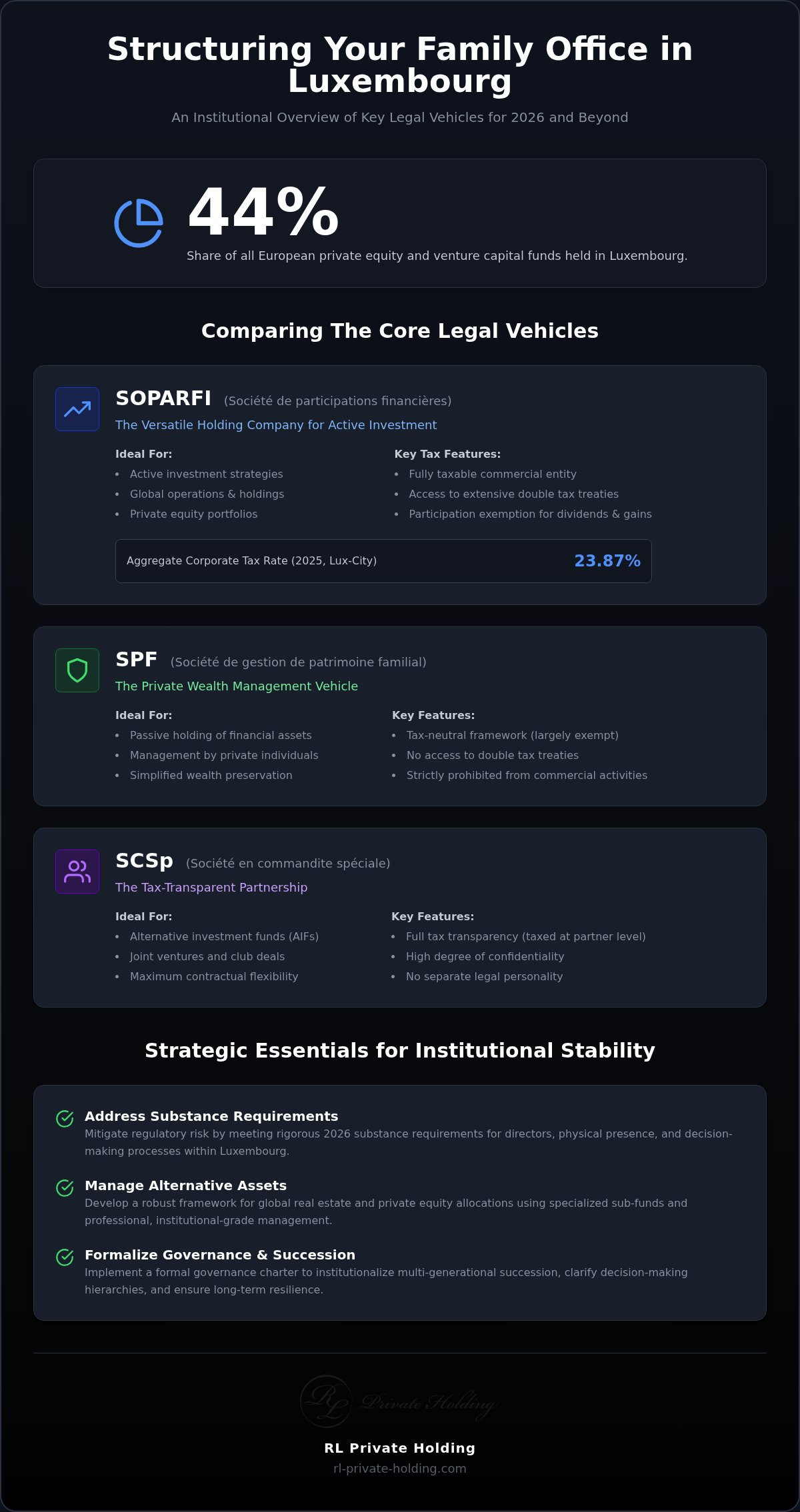
As of June 2026, Luxembourg maintains a 44% share of all European private equity and venture capital funds, solidifying its position as the preeminent jurisdiction for sophisticated capital. For many principals, the complexity of managing global diversified portfolios necessitates a transition from informal management to a formal institutional framework. Achieving successful family office structuring Luxembourg requires a precise alignment of legal substance with long-term investment objectives, especially as regulatory scrutiny regarding substance and transparency intensifies.
You likely recognize that maintaining a robust, compliant legal vehicle is no longer a matter of simple administration; it’s a strategic necessity. This guide provides a comprehensive institutional overview of the legal, regulatory, and strategic requirements essential for the current year. We examine the evolution of SOPARFI and SPF structures, the implementation of AIFMD II, and the integration of illiquid assets into a clear governance and succession framework. This methodical approach ensures your structure remains resilient across generations while maintaining the flexibility required for modern asset management.
Key Takeaways
- Identify the optimal legal vehicle for your objectives by comparing the tax transparency of the SCSp with the corporate benefits of the SOPARFI and SPF.
- Address the rigorous 2026 substance requirements for family office structuring Luxembourg to mitigate regulatory risks and ensure institutional stability.
- Develop a robust framework for managing global real estate and private equity allocations through specialized sub-funds and professional asset management.
- Implement a formal governance charter to institutionalize multi-generational succession and clarify the decision-making hierarchy within the family office.
- Leverage institutional-grade wealth management expertise to maintain the operational integrity and long-term performance of your investment holding company.
The Strategic Evolution of Family Office Structuring in Luxembourg
The landscape of international wealth preservation has undergone a fundamental transformation. While traditional hubs once focused on simple asset protection, 2026 marks a period where family office structuring Luxembourg has evolved into a sophisticated exercise in institutional-grade asset management. The Grand Duchy’s enduring AAA credit rating provides a rare foundation of stability, yet the true value lies in its transition from a passive wealth management center to a global hub for active investment holding companies. Families now require structures that don’t just hold assets but actively manage them with the same rigor as institutional funds.
Geopolitical shifts and the implementation of stricter global tax transparency standards have accelerated this trend. Principals are increasingly moving away from opaque, decentralized arrangements in favor of centralized, regulated frameworks. Luxembourg’s legal certainty and political neutrality act as a hedge against volatility, making it the preferred destination for multi-generational wealth that demands both security and performance.
The Grand Duchy as a Global Financial Anchor
Luxembourg’s regulatory framework, overseen by the Commission de Surveillance du Secteur Financier (CSSF), offers a level of oversight that appeals to families seeking institutional credibility. In 2026, the ability to access the European Union’s single market for investment distribution remains a primary driver for families with global interests. This access allows for the efficient movement of capital and the streamlined management of cross-border portfolios. The legal landscape has matured to support complex investment strategies, ensuring that family structures can withstand the scrutiny of modern anti-tax avoidance directives while maintaining operational efficiency.
Defining the Modern Luxembourg Family Office
The contemporary global family office concept has shifted significantly toward corporate-based models. While traditional trust-based structures remain relevant in common law jurisdictions, the Luxembourg “holding company” model, such as the SOPARFI, has become the standard for those seeking transparency and integration with the broader financial ecosystem. This shift is supported by the Luxembourg Single Family Office Law, which provides a clear legal definition and framework for these entities.
Distinctions between Single Family Offices (SFO) and Multi-Family Offices (MFO) are now more pronounced, primarily regarding regulatory reporting and the scope of services provided. Most principals favor the SFO model for its total alignment with the family’s specific risk profile and governance needs. By adopting an institutionalized approach to family office structuring Luxembourg, families can effectively manage diverse asset classes, including private equity and real estate, within a single, cohesive legal framework. This professionalization ensures that the family office functions as a disciplined global partner rather than a mere administrative office.
Selecting the Optimal Legal Vehicle: SPF, SOPARFI, and SCSp
Selecting the appropriate legal entity is a critical decision in the process of family office structuring Luxembourg. The Grand Duchy offers a diverse toolkit of vehicles, each designed to address specific requirements regarding tax efficiency, regulatory oversight, and investment activity. The choice between a corporate or partnership model depends largely on whether the family office intends to act as a passive holding vehicle or an active investment engine. For 2026, the alignment of these structures with international substance requirements is non-negotiable for ensuring long-term viability.
The SOPARFI: The Versatile Holding Company
The SOPARFI (Société de participations financières) remains the primary choice for families engaged in active investment strategies. As a fully taxable commercial company, it benefits from Luxembourg’s extensive network of double tax treaties, making it ideal for global operations. For the 2025 tax year, the aggregate corporate tax rate for a SOPARFI in Luxembourg-City is 23.87%. This vehicle is particularly effective for private equity holdings due to the participation exemption regime, which allows for tax-exempt dividends and capital gains when specific holding periods and ownership thresholds are met. Recent legislative updates, such as the law of May 18, 2026, now permit the payment of cash contributions for a SARL to be deferred for up to twelve months from incorporation, providing additional operational flexibility.
The SPF: Private Wealth Management for Passive Assets
The SPF (Société de gestion de patrimoine familial) is a specialized vehicle restricted to the acquisition, holding, and management of financial assets. It’s strictly prohibited from engaging in commercial activities or directly holding real estate, a restriction reinforced by regulations effective since July 2021. The SPF’s primary advantage is its tax-exempt status at the corporate level, subject only to an annual subscription tax of 0.25%. This tax is capped at a maximum of €125,000, with a minimum of €1,000 as of 2025. It’s an excellent tool for families seeking a simple, low-cost structure for passive financial instruments, provided they don’t require access to double tax treaties.
The SCSp: Transparency and Flexibility for Fund-Like Structures
The Luxembourg special limited partnership (SCSp) has seen a significant rise in adoption for alternative asset management within family offices. Unlike corporate vehicles, the SCSp lacks legal personality and is typically tax-transparent, allowing income to flow directly to partners. Its contractual flexibility is unparalleled, making it the preferred choice for co-investments and complex carried interest arrangements. This structure allows principals to mirror the governance of institutional funds, providing a sophisticated framework for managing diversified portfolios. Utilizing the expertise of private wealth management firms Luxembourg can help ensure these partnership agreements are drafted to meet both family governance and regulatory standards.
Integrating Alternative Assets: Private Equity and Real Estate Focus
Sophisticated wealth preservation requires more than traditional equity and bond portfolios. As of 2026, single-family offices typically allocate between 10% and 25% of their portfolios to private equity and venture capital. Effective family office structuring Luxembourg must account for the specific liquidity profiles and reporting requirements of these private markets. Unlike public securities, alternative assets demand a structured approach to valuation and long-term capital commitment, necessitating a robust institutional framework that can manage irregular cash flows and complex exit strategies.
Private Equity and Venture Capital Integration
Principals must decide between direct investments and fund-of-funds allocations. Direct participation offers greater control and lower fee layers but requires significant internal expertise to manage due diligence and monitoring. Utilizing Luxembourg structures to manage venture capital Luxembourg portfolios allows families to gain exposure to high-growth technology sectors while maintaining a clear legal perimeter. This approach is essential for families looking to drive multi-generational growth through technology exposure.
Within this framework, private equity investment management involves sophisticated mechanics like performance-based carried interest and management fees. These incentives align the interests of the family office’s investment team with the long-term growth of the assets. Structuring these incentives correctly within an SCSp or SOPARFI ensures that the family office operates with the discipline of an institutional fund manager, providing transparency to all family stakeholders.
Real Estate Portfolio Optimization
Real estate remains a cornerstone of multi-generational wealth, yet it presents unique challenges regarding cross-border taxation and operational management. For families with significant property holdings, family office structuring Luxembourg provides the necessary tools for portfolio optimization. Managing global real estate asset management Luxembourg portfolios often involves using dedicated sub-funds to isolate risks across different geographical regions or asset types. The SOPARFI structure is particularly effective for these holdings, providing tax efficiency for rental income and capital gains through Luxembourg’s treaty network.
In 2026, the integration of ESG criteria isn’t optional; it’s a core requirement for institutional-grade portfolios. Families are increasingly adopting science-based targets and measurable outcomes for their real estate holdings. This commitment to sustainable finance not only mitigates regulatory risk but also preserves the long-term value of the assets. Balancing these ESG requirements with disciplined liquidity management ensures the structure remains resilient during market shifts while fulfilling the family’s legacy objectives.
Governance Protocols and Operational Substance Requirements
The transition from nominal presence to economic reality is the defining regulatory theme for 2026. For those engaged in family office structuring Luxembourg, substance has moved beyond a compliance checkbox to become a core structural pillar. The Grand Duchy’s authorities, following the updated CSSF guidance released in the first quarter of 2026, place significant emphasis on the qualitative nature of management and control. Entities that fail to demonstrate genuine economic activity face increased scrutiny under the transposition of the EU’s Anti-Tax Avoidance Directive 3, or ATAD III.
Effective governance requires a formalization of the family’s values and objectives through a structured charter. Integrating family office investment strategies Luxembourg into a governance framework ensures that decision-making remains objective and disciplined. This institutionalization is particularly vital for multi-generational wealth. Clarity regarding the Board’s role and the investment committee’s mandate prevents the fragmentation of the family’s strategic vision and ensures long-term alignment.
Establishing Institutional Governance
A professional Board of Directors serves as the primary safeguard for the family’s assets. It’s essential to define clear conflict of interest policies, especially when family members are employed within the office. Transparent communication and rigorous reporting standards allow stakeholders to monitor performance while maintaining a healthy distance from daily operations. This separation of ownership and management is a hallmark of institutional-grade structures. It ensures that the family office functions as a disciplined global partner, focusing on strategic focus and institutional permanence.
Substance Checklist for 2026 Compliance
Compliance in the current year necessitates a verifiable physical and intellectual presence for any family office structuring Luxembourg project. The Unshell Directive specifically targets entities where more than 65% of income is passive and over 55% is cross-border. To mitigate the presumption of being a shell company, family offices should adhere to the following framework:
- Maintain a majority of Luxembourg-resident directors with appropriate financial and corporate qualifications.
- Secure physical office space dedicated to the entity’s daily operations, moving beyond simple registered addresses.
- Ensure all key strategic decisions, particularly those regarding asset allocation and risk management, are documented as having taken place in Luxembourg.
- Employ qualified personnel whose expertise is commensurate with the complexity of the global portfolio.
Documenting the economic rationale for the chosen structure is now as important as the structure itself. For families seeking to professionalize their operations while ensuring full compliance, partnering with an established firm provides the necessary operational depth. You may consider how wealth management services can reinforce your structure’s substance and institutional longevity.
Strategic Partnership with RL Private Holding for Structural Longevity
Achieving structural longevity in an increasingly complex regulatory environment requires more than technical compliance; it demands a partner with institutional gravity and a clear strategic focus. RL Private Holding operates as a disciplined global partner, offering the structural integrity necessary for sophisticated family office structuring Luxembourg. By aligning wealth preservation goals with an established investment framework, principals gain access to a platform designed for stability and professional distance. This institutional approach ensures that the family office remains resilient against market volatility while maintaining full compliance with the evolving standards of the Grand Duchy.
The 2026 regulatory landscape has raised the threshold for what constitutes a robust investment vehicle. Partnering with recognized private wealth management firms Luxembourg provides the necessary operational depth to meet these standards. RL Private Holding supports family offices by providing a stable environment for capital growth, rooted in the structural discipline of the Luxembourg financial ecosystem. Our firm acts as a steady hand in the background, allowing families to benefit from a worldly and highly organized investment holding company model.
A Disciplined Approach to Investment Management
Our investment philosophy is characterized by a high degree of professionalism and a focus on sectors that drive long-term value. We specialize in technology, real estate, and private equity, providing family offices with access to institutional-grade co-investment opportunities. This sector-specific expertise is paired with total transparency regarding fee structures and performance-based incentives. We prioritize the structural components of the business, ensuring that management fees and carried interest arrangements are clearly defined and aligned with the principal’s long-term objectives. This methodical approach allows for a controlled pace of capital deployment and a focus on underlying principles rather than market hyperbole.
Next Steps for Structural Review
Reviewing a current structure against 2026 regulatory standards is a critical step for maintaining operational integrity. As substance requirements and tax directives like ATAD III become more stringent, a formal evaluation of the legal vehicle’s economic rationale is essential. RL Private Holding provides the strategic asset allocation expertise required to optimize these structures for the current year and beyond. Families looking to institutionalize their investment holding company can benefit from our deep local roots and global reach.
To ensure your family office is positioned for multi-generational success, a formal consultation is recommended. This process involves a detailed analysis of your existing framework and the identification of strategic opportunities for structural refinement. Engaging with our Luxembourg headquarters allows for a sober, factual presentation of how our wealth management services can support your long-term vision. We invite you to contact us to discuss the structural requirements for your global portfolio and to explore the benefits of a disciplined global partner.
Securing the Future of Multi-Generational Capital
The transition toward institutional-grade frameworks is no longer an optional evolution; it’s a fundamental requirement for capital preservation. Successful family office structuring Luxembourg in 2026 relies on the precise integration of legal substance with a disciplined approach to alternative assets. By prioritizing operational transparency and formal governance, principals ensure their structures withstand regulatory scrutiny while maintaining the flexibility needed for global asset management. This methodical alignment between the legal vehicle and the investment strategy is what defines a resilient family office.
RL Private Holding provides the steady hand required to manage these complexities from our headquarters in the heart of Luxembourg’s financial centre. Our institutional expertise in private equity and venture capital, combined with a diversified global portfolio across technology and real estate sectors, positions us as a reliable partner for families seeking structural longevity. We invite you to consult with RL Private Holding on your family office investment strategy to evaluate your current framework against the latest standards. Establishing a robust foundation today ensures the continued growth and security of your family’s legacy.
Frequently Asked Questions
What is the minimum asset threshold for establishing a Luxembourg family office?
There is no specific legal minimum for total assets under management to begin the process of family office structuring Luxembourg. However, the operational costs associated with maintaining a dedicated single-family office typically suggest a threshold of €50 million to €100 million for economic efficiency. From a legal standpoint, a SARL requires a minimum share capital of €12,000, while a Société Anonyme (SA) requires €30,000, which must be fully subscribed at incorporation.
How does the Luxembourg SOPARFI differ from a traditional holding company?
A SOPARFI is a fully taxable entity that provides access to Luxembourg’s extensive network of over 80 double tax treaties. Unlike traditional holding companies in less regulated jurisdictions, it allows for tax-exempt dividends and capital gains through the participation exemption regime. This makes it an institutional choice for active investment management rather than a simple passive asset holder, offering the stability and legal certainty required by international families.
What are the specific substance requirements for a family office in 2026?
Substance in 2026 requires a demonstrable link between the entity and its Luxembourg operations. This includes having a majority of directors who are local residents, maintaining a dedicated physical office space, and ensuring that all strategic investment decisions are taken within the Grand Duchy. These measures are essential to satisfy the requirements of the ATAD III directive and ensure the structure isn’t classified as a shell company by international tax authorities.
Can a Luxembourg family office hold assets located outside the European Union?
Luxembourg structures are designed for global reach and can hold assets located anywhere in the world. The Grand Duchy serves as a neutral hub for international portfolios, allowing families to consolidate holdings from the United States, Asia, and emerging markets under a single governance framework. This cross-border capability is a primary reason for the jurisdiction’s dominance in the management of private equity and real estate asset classes.
How is carried interest taxed within a Luxembourg SCSp structure?
Taxation of carried interest within an SCSp depends on the tax residency of the partners because the structure is typically tax-transparent. For individuals resident in Luxembourg who are involved in managing alternative funds, a specific tax regime may apply to carried interest, often resulting in a significantly reduced effective tax rate. This transparency allows for the efficient distribution of performance-based incentives to family members or professional managers within the family office structuring Luxembourg framework.
What is the role of the CSSF in supervising family offices?
The CSSF (Commission de Surveillance du Secteur Financier) primarily supervises regulated financial professionals and investment funds. While most single-family offices operate as unregulated entities, they must still adhere to anti-money laundering (AML) and know-your-customer (KYC) regulations. If a family office provides services to third parties or manages certain types of alternative funds, it may fall under direct CSSF oversight or require specific professional licensing.
How can family offices integrate ESG criteria into their Luxembourg structures?
ESG integration is achieved by embedding specific sustainability targets into the family office’s investment charter and governance protocols. Many families utilize Luxembourg’s sophisticated reporting frameworks to align their portfolios with the Sustainable Finance Disclosure Regulation (SFDR). In sectors such as real estate, this often involves adopting science-based targets to ensure long-term value preservation and compliance with the evolving environmental standards of the European Union.