

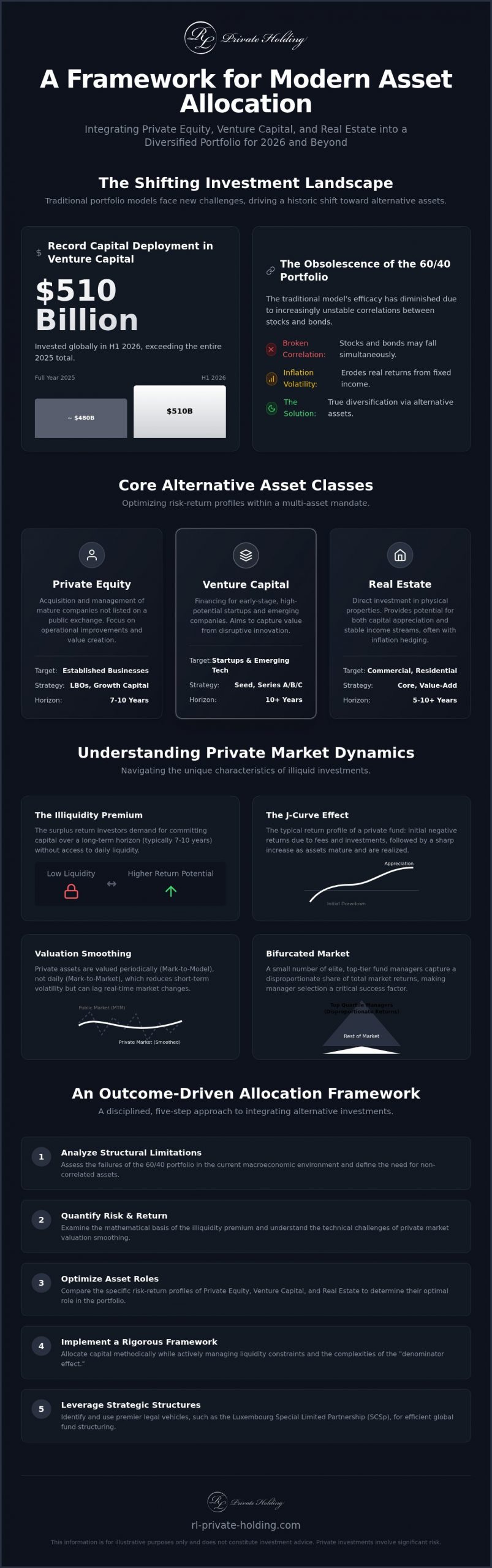
Global venture capital investment reached a record $510 billion in the first half of 2026, a figure that already exceeds the total capital deployed throughout the entirety of 2025. This surge in volume occurs even as institutional investors confront the increasing instability of traditional stock and bond correlations. Most sophisticated partners recognize that a static approach to portfolio construction is no longer sufficient for the current macroeconomic environment.
This analysis provides a structured framework for allocating capital to alternative investments within a modern multi-asset portfolio. You’ll gain an institutional-grade understanding of how to integrate private equity, venture capital, and real estate while navigating the complexities of illiquid asset valuation. We will examine the reality of the illiquidity premium, the impact of Luxembourg’s Bill No. 8814 on fund structuring, and the specific selection criteria necessary to identify top-tier managers in a bifurcated market.
Key Takeaways
- Analyze the structural limitations of the traditional 60/40 portfolio and the necessity of alternative assets in the 2026 macroeconomic environment.
- Examine the mathematical foundations of the illiquidity premium and the technical challenges associated with valuation smoothing in private markets.
- Assess the comparative risk-return profiles of private equity, venture capital, and real estate to optimize their roles within a multi-asset mandate.
- Implement a rigorous, outcome-driven framework for allocating capital to alternative investments while managing the complexities of the denominator effect.
- Identify the strategic benefits of the Luxembourg Special Limited Partnership (SCSp) as a primary vehicle for global alternative fund structures.
The Evolution of Strategic Asset Allocation in 2026
An alternative investment is broadly defined as any asset class that exists outside the traditional categories of long-only equities, fixed income, or cash. While these instruments were once relegated to the periphery of institutional portfolios, the economic environment of 2026 has necessitated a fundamental reclassification. Alternatives have transitioned from supplemental “satellite” holdings to core structural components. This shift reflects a broader adoption of the endowment-style model within private wealth management, prioritizing long-term capital appreciation over short-term liquidity.
The traditional 60/40 portfolio model has largely lost its efficacy. In previous decades, the inverse correlation between stocks and bonds provided a reliable cushion during market downturns. By 2026, this relationship has become increasingly unstable, often resulting in simultaneous declines across both asset classes. Consequently, allocating capital to alternative investments has become the primary mechanism for achieving genuine diversification and mitigating systemic risk.
Drivers of Alternative Capital Allocation
Persistent inflation volatility has fundamentally altered the search for yield. In a fragmented global economic landscape, traditional fixed-income instruments often fail to provide returns that exceed the rate of inflation. Investors now look toward private markets to capture the illiquidity premium. The scale of this movement is evident in recent data. Global venture capital investment reached a record $510 billion in the first half of 2026 alone. This massive deployment of capital suggests that investors are increasingly comfortable with longer lock-up periods in exchange for non-correlated return streams that aren’t tied to the whims of public exchange volatility.
The Institutional Shift Toward Private Markets
Major sovereign wealth funds and global pension schemes have led the transition toward a “replacement effect” in modern portfolio theory. This concept involves substituting a portion of public equity and bond allocations with private equity, real estate, and venture capital. The goal isn’t just higher returns. It’s the pursuit of institutional-grade governance and direct influence over asset performance. As private markets mature, the necessity for sophisticated selection criteria becomes paramount. Successful capital deployment now requires a disciplined framework to identify managers capable of navigating a bifurcated market where a small number of elite firms capture a disproportionate share of total returns. This evolution demands a level of transparency and organizational focus that was previously reserved for the world’s largest financial entities.
Quantifying the Illiquidity Premium and Risk Dynamics
The illiquidity premium represents the primary mathematical justification for allocating capital to alternative investments. It is the surplus return that investors demand in exchange for the inability to liquidate an asset on demand. Unlike public securities, private market assets require a commitment period often spanning seven to ten years. This duration risk is compensated through higher target internal rates of return (IRR) and multiple of money (MoM) benchmarks. The trade-off is clear: investors sacrifice immediate liquidity to capture long-term capital appreciation that is generally unavailable in the public markets.
The “J-Curve” effect is a critical component of this dynamic. In the early stages of a fund’s lifecycle, management fees and initial investment costs typically result in negative returns. As the underlying assets mature and realizations occur, the portfolio enters a period of capital appreciation. Managing this cycle requires a long-term orientation and the ability to withstand temporary valuation drawdowns while assets are in their gestation phase.
Understanding Valuation Idiosyncrasies
Valuation methodologies in private markets differ significantly from the Mark-to-Market (MTM) approach used in public exchanges. Instead, managers often employ Mark-to-Model techniques, which rely on discounted cash flow analyses or comparable company multiples. This process inherently leads to valuation smoothing. While it reduces perceived portfolio volatility by filtering out daily market noise, it also creates lagged reporting. Investors must ensure that Net Asset Value (NAV) figures are accurate and reflect current fundamental performance rather than historical cost. Given Luxembourg’s role as a hub for alternative investments, the regulatory standards for fund reporting remain among the most rigorous globally, providing a layer of transparency for institutional partners.
Risk Management in Private Portfolios
Risk in alternative allocations is not merely a function of price volatility. It encompasses capital call risk, where investors must provide liquidity on short notice, and vintage year concentration. If a portfolio is heavily weighted toward a single year, it becomes vulnerable to the specific macroeconomic conditions of that period. Effective private equity risk management involves diversifying across multiple vintage years and sectors to ensure a steady stream of distributions over time.
Secondary markets have become an essential tool for tactical liquidity. By selling interests in existing funds, investors can rebalance their portfolios or exit positions before the end of a fund’s natural term. This mechanism helps mitigate the exit bottleneck currently observed in 2026, where global exit volume is on pace for a decade low. Those seeking to optimize their multi-asset strategy should consider how professional investment management can align these risks with long-term objectives.
Comparative Analysis: Private Equity, Venture Capital, and Real Estate
Effective capital deployment requires a granular understanding of how different alternative asset classes interact with macroeconomic variables. While these assets share the common trait of illiquidity, their risk-return profiles and sensitivities to market shifts vary significantly. In 2026, the primary objective of allocating capital to alternative investments is to construct a portfolio that remains resilient across varying interest rate cycles. Private equity typically offers a combination of capital appreciation and downside protection through majority control. Venture capital provides high-convexity returns driven by technological disruption. Real estate serves a distinct role, primarily functioning as a yield-generating instrument and a durable hedge against persistent inflation.
Sector-specific expertise has become the most critical driver of alpha in this environment. In a bifurcated market, broad beta exposure is no longer sufficient to justify the fees and lock-up periods associated with private funds. Alpha generation now depends on a manager’s ability to implement operational improvements or navigate complex regulatory landscapes, rather than relying on the general upward trend of the broader markets.
Private Equity and Venture Capital Dynamics
The distinction between buyout strategies and growth-stage funding has widened. Private equity buyouts in 2026 focus heavily on operational value creation, moving away from the financial engineering and high leverage that characterized previous cycles. Conversely, venture capital Luxembourg structures are increasingly utilized to capture the rapid expansion of technology firms. Data from the first half of 2026 indicates that AI-related companies captured approximately 86% of all U.S. venture capital investment by dollar volume. This concentration highlights the necessity of identifying managers with deep technical proficiency who can distinguish between sustainable foundational models and transient hype.
Real Estate Asset Management as an Inflation Hedge
Real estate remains a cornerstone for institutional allocators seeking stable cash flows. The strategy employed, whether core, value-add, or opportunistic, depends on the investor’s specific risk tolerance and income requirements. Within real estate asset management Luxembourg, there’s a growing emphasis on high-quality, modern assets that meet stringent ESG requirements. By 2026, environmental sustainability has become a primary valuation metric; assets that fail to meet these standards face significant “brown discounts.” Despite capital value corrections in some regions, global transaction volume reached $890 billion in the past year, representing a 17% increase. This suggests that while interest rate sensitivity remains high, the underlying demand for logistics, data centers, and residential supply continues to support rental growth and long-term valuations.
Frameworks for Optimal Capital Allocation and Sizing
Determining the appropriate scale for allocating capital to alternative investments requires an outcome-driven approach that transcends simple percentage-based targets. Investors must evaluate the “true” risk contribution of these assets, accounting for the lack of daily price discovery. A 10% allocation to venture capital carries significantly more volatility than a 10% allocation to core real estate, despite both being classified as alternatives. By 2026, sophisticated allocators have moved toward a risk-factor framework, where assets are grouped by their underlying drivers such as economic growth, inflation sensitivity, or credit spreads.
The “denominator effect” remains a primary challenge for institutional governance. When public equity valuations decline, the relative weight of illiquid assets increases automatically. This can force allocators to halt new commitments or sell interests on the secondary market to maintain mandate compliance. Managing this risk involves a disciplined approach to vintage year diversification. Consistency is key. Committing capital every year, regardless of the macro environment, ensures that a portfolio isn’t overly exposed to the specific entry valuations of a single cycle. This is particularly relevant in 2026, as North American private equity fundraising reached $308 billion in the first half of the year, even as the number of fund closures hit a multi-year low.
Allocation Sizing by Investor Profile
Allocation ranges vary based on liquidity requirements and return hurdles. Family offices typically allocate between 20% and 40% to private markets, leveraging their longer time horizons to capture the illiquidity premium. In contrast, large institutional funds may maintain lower targets due to regulatory constraints or immediate payout obligations. A “liquidity bucket” approach is essential for these profiles. It involves maintaining a reserve of highly liquid instruments to meet capital calls during periods of market stress. Calculating the true risk contribution requires looking past smoothed returns to understand the underlying leverage and operational risks inherent in each fund.
Strategic Rebalancing and Cash Flow Management
Managing cash flows in a private portfolio requires an over-commitment strategy. Since capital is called over several years and eventually returned through distributions, investors must commit more than their target allocation to maintain a steady level of exposure. This requires sophisticated modeling of expected distributions. In 2026, global exit volumes are on pace for a decade low, making the timing of capital returns less predictable. Private credit often serves as a tactical liquidity bridge in this environment, providing the necessary cash flow to satisfy obligations without forced liquidation of core holdings. For those navigating these structural complexities, utilizing sophisticated wealth management services provides the institutional oversight necessary to maintain target exposure through varying market conditions.
Luxembourg: The Global Hub for Alternative Investment Structures
Luxembourg has solidified its position as the premier jurisdiction for allocating capital to alternative investments within a global context. Its dominance is rooted in a robust legal framework that provides institutional investors with the predictability required for multi-decade commitments. As of August 2026, the submission of Bill No. 8814 has further enhanced this environment by allowing unregulated alternative investment funds (AIFs) structured as common limited partnerships to create legally segregated multi-compartment structures. This development offers statutory ring-fencing of assets without the administrative complexity of traditional fund regimes, making it an ideal vehicle for parallel investment strategies.
The Luxembourg special limited partnership (SCSp) remains the most utilized structure for private equity and venture capital vehicles. Its contractual flexibility allows sponsors to tailor governance and economic terms to the specific needs of sophisticated partners. By utilizing an investment holding company within this ecosystem, global investors can efficiently manage diverse portfolios across multiple jurisdictions while maintaining a centralized point of oversight and reporting.
Institutional Governance and Regulatory Frameworks
The Alternative Investment Fund Managers Directive (AIFMD) provides the regulatory backbone for cross-border capital allocation. It ensures a high standard of investor protection and transparency, which is essential for managing the valuation smoothing and lagged reporting discussed in previous sections. A critical component of the Luxembourg model is the requirement for “substance.” This ensures that the management and decision-making processes occur within the jurisdiction, providing a layer of operational integrity that global tax authorities and institutional partners expect. The legal environment offers a level of stability that is often unavailable in more fragmented markets, allowing for long-term strategic planning without the risk of sudden regulatory shifts.
RL Private Holding: Strategic Capital Allocation
RL Private Holding operates with a disciplined focus on technology, real estate, and private equity from its Luxembourg headquarters. The firm’s approach is characterized by a “quiet authority,” serving as a steady hand in the background of major global investments. By maintaining a diversified portfolio that prioritizes fundamental value over market hype, the firm facilitates long-term wealth preservation for its institutional partners. This methodical strategy ensures that capital is deployed into sectors with durable growth potential, such as AI infrastructure and modern logistics, while mitigating the risks associated with vintage year concentration and the denominator effect. Through rigorous selection criteria and a commitment to institutional-grade governance, RL Private Holding provides the structural framework necessary for successful capital deployment in the 2026 macroeconomic landscape.
Optimizing the Institutional Mandate for a New Economic Era
The transition toward private markets is no longer a tactical adjustment but a fundamental requirement for institutional resilience. Successfully allocating capital to alternative investments in 2026 demands a departure from static models in favor of a risk-factor approach that accounts for valuation smoothing and the denominator effect. By leveraging the structural advancements within the Luxembourg legal framework and adhering to a disciplined vintage year strategy, investors can navigate current liquidity constraints while positioning for long-term appreciation.
Institutional-grade governance and specialized expertise in private equity, venture capital, and real estate are the essential cornerstones of this strategic evolution. A methodical focus on fundamental value and regulatory substance ensures that portfolios remain robust against macroeconomic volatility. Those who prioritize transparency and internal discipline will be best equipped to capture the illiquidity premium in an increasingly bifurcated global landscape.
Explore Strategic Investment Management with RL Private Holding to leverage our Luxembourg-based global portfolio management and wealth preservation expertise. A disciplined approach to alternative assets provides the stability required for enduring success.
Frequently Asked Questions
What is the typical minimum allocation to alternatives for institutional portfolios?
Institutional portfolios generally maintain a minimum allocation of 5% to justify the operational complexity and due diligence requirements of the asset class. In the 2026 macroeconomic environment, many sophisticated allocators have increased this target to a range of 15% to 25%. This higher threshold is often necessary to achieve meaningful diversification and to counteract the increasing instability of traditional stock and bond correlations.
How do I manage the liquidity risks associated with private equity capital calls?
Managing capital call risk requires a disciplined liquidity bucket approach, where a portion of the portfolio is held in highly liquid, short-duration instruments. Sophisticated investors utilize cash flow modeling to predict the timing of drawdowns based on fund vintage and strategy. Some partners also employ private credit facilities as a tactical bridge to meet these obligations without being forced to liquidate public equity positions during periods of market volatility.
What are the primary benefits of using a Luxembourg structure for alternative investments?
Luxembourg provides a premier legal and regulatory framework that offers institutional-grade certainty for global investors. The jurisdiction’s Special Limited Partnership (SCSp) is highly valued for its contractual flexibility and its alignment with AIFMD standards for cross-border distribution. Recent legislative updates, specifically Bill No. 8814, have further enhanced the environment by allowing for legally segregated multi-compartment structures within unregulated vehicles, significantly improving operational efficiency for multi-strategy funds.
How does the ‘J-Curve’ effect impact short-term performance reporting in alternatives?
The J-Curve effect typically results in unrealized losses or flat returns during the initial years of a fund’s lifecycle as management fees and investment costs are incurred before capital appreciation occurs. This dynamic can create a misleading impression of underperformance in short-term reports. Investors must maintain a long-term perspective, recognizing that the most significant value creation typically happens in the middle and later stages of the investment term as assets mature and realizations begin.
What is the difference between direct investment and fund-of-funds allocation?
Direct investment involves committing capital to a specific private equity or venture capital fund, providing greater transparency and a lower fee structure. A fund-of-funds model offers immediate diversification across multiple managers and sectors, which can be advantageous for those with smaller capital bases. However, the fund-of-funds approach introduces an additional layer of management fees and carried interest, which can significantly compress the net returns for the end investor.
How does RL Private Holding approach sector diversification in its portfolio?
RL Private Holding maintains a disciplined focus on technology, real estate, and private equity to ensure a balanced risk profile across its global holdings. The firm prioritizes assets with durable foundational value and needs-based demand, such as AI infrastructure and modern logistics. This methodical approach to allocating capital to alternative investments prevents over-concentration in any single industry and ensures the portfolio remains resilient through various economic cycles.
Why is vintage year diversification critical in private market investing?
Vintage year diversification is essential to mitigate timing risk, as it spreads an investor’s exposure across different entry valuations and economic conditions. Committing capital consistently every year ensures that the portfolio is not disproportionately affected by the specific headwinds of a single market cycle. This steady deployment pace creates a laddered effect of capital calls and distributions, providing a more predictable and stable cash flow profile over the long term.
What impact do interest rates have on alternative investment valuations in 2026?
Interest rates remain a primary valuation driver in 2026, particularly for leveraged strategies such as buyouts and core real estate. Higher financing costs have necessitated a shift away from return models based on yield compression and toward those driven by operational improvement and organic income growth. Consequently, assets with strong pricing power and the ability to grow cash flow fundamentally are commanding higher premiums than those reliant on cheap debt for performance.