

The traditional reliance on public market liquidity often serves as a veil for systemic volatility and diminishing returns in an increasingly efficient global exchange environment. Sophisticated investors recognize that the constant pressure of mark-to-market valuations and the lack of direct influence over corporate governance can limit the potential for true alpha. It’s clear that the decision to migrate from public equities to private equity manager structures is no longer a niche preference but a strategic necessity for those seeking to capture growth before a company reaches the public stage. This shift requires a disciplined approach to capital allocation that prioritizes long-term stability over daily price fluctuations.
This article provides a professional guide on reallocating capital to private markets for enhanced value and portfolio diversification. We will examine the structural advantages of private ownership, the importance of manager selection within the Luxembourg financial ecosystem, and the specific logistical steps required to execute this transition for the 2026 fiscal year. By focusing on active value creation rather than passive price-taking, investors can better align their portfolios with the realities of the modern global economy and secure a position within the next generation of industry leaders.
Key Takeaways
- Analyze the diminishing efficacy of traditional 60/40 portfolios and the necessity of private market allocation for superior risk-adjusted returns in 2026.
- Identify the strategic framework required to migrate from public equities to private equity manager structures while maintaining institutional-grade risk management.
- Understand the mechanics of the illiquidity premium and how performance-based fee structures ensure a closer alignment between investor objectives and manager actions.
- Implement a disciplined five-step transition process that prioritizes rigorous due diligence and the evaluation of sector-specific operational track records.
- Utilize the structural advantages of the Luxembourg financial ecosystem to facilitate global diversification and long-term wealth preservation.
The Strategic Rationale for Migrating from Public Equities to Private Equity
For many institutional portfolios, the traditional 60/40 allocation model has reached a point of exhaustion. In the 2026 economic environment, public markets are increasingly dominated by passive index tracking and algorithmic execution. This environment leaves little room for idiosyncratic alpha. As a result, sophisticated investors are choosing to migrate from public equities to private equity manager structures to capture value that is no longer accessible on secondary exchanges. This “Alpha Gap” represents the fundamental difference between efficient, low-margin public trading and the untapped potential found in the private enterprise sector.
Addressing Public Market Volatility and Efficiency
Public exchanges have become hyper-efficient, yet they remain susceptible to extreme sentiment-driven volatility. High-frequency trading and algorithmic models now account for a significant portion of daily volume. This often compresses margins and reduces the window for fundamental analysis to yield results. By shifting capital into private markets, investors effectively detach their holdings from the daily “mark-to-market” anxiety that characterizes public ownership. This transition allows for a focus on long-term fundamentals rather than short-term price discovery. It’s also clear that the most significant growth stages of modern enterprises now frequently occur before an initial public offering, making early entry through private channels essential for wealth preservation.
The Shift toward Active Value Creation
The primary differentiator in private equity is the ability to exert direct influence over a company’s operational trajectory. Unlike public market participants who remain passive price-takers, a private equity manager implements specific strategic changes to drive EBITDA growth. This active management model includes several key levers:
- Operational turnarounds and cost-structure optimization to improve margins.
- Strategic bolt-on acquisitions to expand market share and achieve economies of scale.
- Governance reforms and executive leadership alignment to ensure long-term stability.
Data consistently indicates a strong correlation between manager involvement and superior internal rates of return (IRR). When an investor decides to migrate from public equities to private equity manager oversight, they aren’t just changing an asset class; they’re opting for a governance model where capital is actively managed to create value. This structural control provides a layer of protection against the systemic risks inherent in public indices. It ensures that the investment’s success is tied to tangible business improvements rather than the unpredictable whims of the broader market.
Structural Advantages of Private Equity Management
The decision to migrate from public equities to private equity manager partnerships represents a fundamental shift in how capital is governed and deployed. While public markets are designed for liquidity and broad participation, private equity structures are built for concentration and control. This structural distinction creates several inherent advantages that are absent in the highly regulated and bureaucratic environment of public exchanges. By moving away from the constraints of public reporting, investors can access a more streamlined and effective form of corporate oversight.
Private equity boards are typically smaller and more specialized than public company boards. They consist of professional investors and industry veterans who are deeply involved in the strategic direction of the business. This lean governance model eliminates the friction of public company bureaucracy, allowing for rapid decision-making and high-conviction pivots. In this environment, the objective isn’t to manage public perception but to maximize the underlying value of the asset through direct intervention and accountability.
Operational Control and Strategic Governance
Managers in the private sector possess the unique ability to implement long-term capital expenditure plans without the constant pressure of quarterly earnings cycles. This freedom allows for the execution of complex transformations that may take several years to yield results. Investors gain direct access to management teams and proprietary company data, providing a level of transparency that public disclosures cannot match. Through board-level oversight, private equity managers can identify and mitigate operational risks in real-time, ensuring that the company remains aligned with its long-term strategic objectives.
Private markets also benefit significantly from information asymmetry. Unlike public markets where all material information must be disseminated simultaneously to all participants, private equity deal sourcing relies on proprietary networks and deep sector expertise. This creates a distinct competitive advantage for those with the resources to identify undervalued opportunities. The alignment of interests is further reinforced by performance-based fee structures. Carried interest ensures that the manager’s financial success is inextricably linked to the investor’s realized returns, a hallmark of sophisticated private equity investment management.
The Illiquidity Premium and Long-term Horizons
The illiquidity premium is a critical component of the return profile in private markets. It represents the additional yield investors receive for committing their capital over a multi-year horizon. Historical trends show a consistent return spread of private equity over public indices, largely because patient capital can withstand short-term economic cycles. This long-term focus is particularly well-suited for navigating sector-wide technological transformations that require sustained investment. For investors focused on securing generational wealth, the ability to bypass the daily volatility of public exchanges is a significant strategic benefit.
Partnering with an institutional partner who understands these structural nuances is essential for a successful transition. Engaging with professional wealth management services can help ensure that your private market allocation is integrated seamlessly into your broader financial strategy.
Comparative Framework: Public vs. Private Equity Allocation
The choice to migrate from public equities to private equity manager oversight is often driven by a fundamental divergence in volatility profiles. Public market indices are characterized by high standard deviation, as share prices react instantaneously to macroeconomic data and geopolitical shifts. In contrast, private equity valuations are derived from periodic appraisals and fundamental business performance. This structural difference allows for a more stable reporting environment, shielding the portfolio from the erratic price discovery found on efficient public exchanges. It’s a shift from reactive trading to proactive asset stewardship.
Leverage remains a primary tool for private managers to enhance equity returns. While public companies often maintain conservative debt-to-equity ratios to appease credit rating agencies, private equity structures utilize targeted debt at the portfolio company level. This capital is deployed to fund acquisitions or internal growth initiatives, effectively magnifying the impact of operational improvements on the final exit value. Discipline drives results. By focusing on debt as a strategic lever rather than a burden, managers can accelerate the compounding of value over the life of the investment.
Risk-Adjusted Returns and Portfolio Diversification
Evaluating Sharpe ratios in the 2026 context reveals that private markets often provide superior risk-adjusted returns when compared to their public counterparts. This is particularly evident when incorporating venture capital Luxembourg structures into a diversified portfolio. These vehicles offer exposure to high-growth technology sectors that are increasingly underrepresented in public markets. By allocating to private assets, investors can lower their portfolio’s correlation with global equity indices, creating a robust hedge against systemic shocks that typically trigger broad sell-offs in liquid stocks.
Volatility Smoothing and Mark-to-Market Realities
The reporting mechanisms in private equity differ significantly from the mandatory disclosures of public markets. Private valuations inherently carry a lag, as they aren’t subject to daily mark-to-market requirements. This “artificial” smoothing isn’t a lack of transparency; rather, it reflects the long-term nature of the underlying assets. For institutional investors, this reduces the pressure of meeting capital requirements during periods of temporary market distress. Balancing liquid reserves with these multi-year commitments is essential. It ensures that the investor can meet capital calls while benefiting from the stability of a private valuation framework. This disciplined approach to reporting provides a clearer picture of long-term wealth preservation without the noise of daily market sentiment.
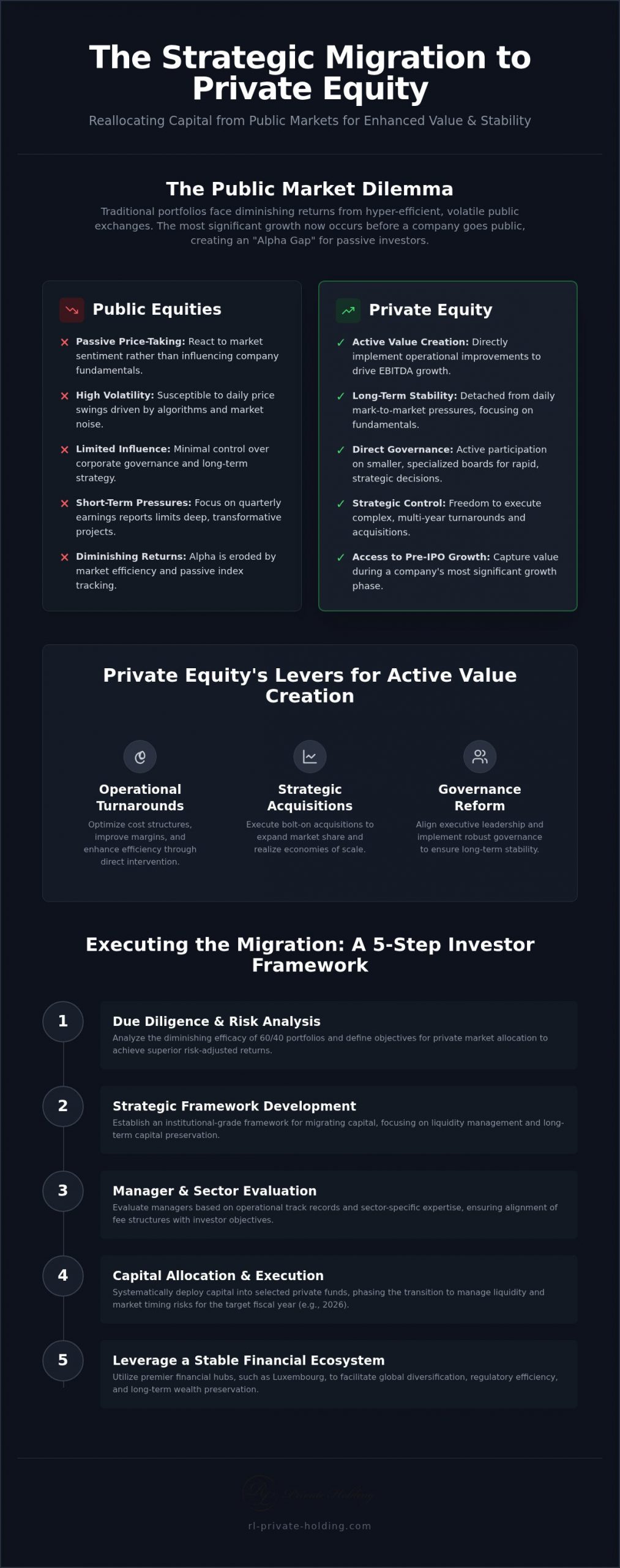
Executing the Migration: A 5-Step Investor Framework
The transition from secondary markets to primary asset ownership demands a structured approach. To migrate from public equities to private equity manager partnerships successfully, an investor must first define clear allocation targets. This involves a rigorous assessment of liquidity constraints over a 7-10 year horizon. Precision is paramount. Once the capital commitment is established, the focus shifts to manager selection. This stage requires deep due diligence into historical track records and specific sector expertise.
Navigating the J-Curve is the third critical phase. Investors must prepare for initial capital calls and the impact of management fees during the early investment period. The process concludes with the establishment of key performance indicators (KPIs) to monitor manager performance. Metrics such as Total Value to Paid-In (TVPI) and Distributed to Paid-In (DPI) provide the necessary transparency for institutional reporting. Discipline drives results. These steps ensure that the shift in capital remains aligned with the overarching financial objectives of the portfolio.
Manager Due Diligence and Selection
Selecting a partner requires more than a cursory review of past returns. It’s essential to analyze the “persistence of returns” to determine if a manager consistently outperforms relevant benchmarks across multiple cycles. We examine the team’s operational background to ensure they possess the skills for active value creation rather than relying solely on financial engineering. A disciplined approach to private equity risk management ensures that capital is protected while pursuing aggressive growth targets.
Luxembourg Structures for Capital Migration
The structural environment in which capital is held is as important as the asset class itself. The Luxembourg special limited partnership (SCSp) serves as a premier vehicle for this migration. It offers unparalleled flexibility for sophisticated allocation strategies. For those requiring a holding company structure, the SOPARFI provides significant tax efficiency and regulatory stability. These frameworks have established Luxembourg as the global hub for fund administration, providing the institutional gravity required for large-scale capital reallocation. For institutional assistance in executing this transition, investors may engage our private equity investment management services.
RL Private Holding: Your Partner in Private Market Migration
RL Private Holding operates with institutional gravity to facilitate the transition of capital from volatile public indices to structured private vehicles. Our firm provides a stable framework for those who seek to migrate from public equities to private equity manager oversight while maintaining global portfolio integrity. We don’t rely on market hype. Instead, we focus on factual, objective reporting and the rigorous application of institutional discipline. This approach ensures that the migration of assets isn’t just a change in classification, but a strategic move toward wealth preservation and long-term value creation. Our persona as a “silent giant” in the financial landscape reflects our commitment to stability and professional distance.
Our diversified global portfolio focuses on two primary pillars:
- Technology: Identifying growth-stage firms with scalable operational models and clear paths to profitability.
- Real Estate: Utilizing strategic assets to provide stability and wealth preservation across major global markets.
A Disciplined Approach to Global Asset Management
Our investment methodology focuses on identifying high-potential growth-stage technology firms that exhibit strong fundamentals before they reach public saturation. This selection process is rooted in technical analysis and deep sector expertise across global markets. To provide a balanced risk profile, we integrate real estate asset management Luxembourg into our broader investment framework. This diversification helps mitigate the risks associated with sector-specific downturns and provides a steady yield to complement the growth potential of venture capital holdings. We maintain professional distance from the assets we manage, focusing on the structural components of value creation and EBITDA growth. Our “Quiet Authority” approach means we prioritize the steady hand of experience over disruptive innovation, ensuring that our partners benefit from a worldly and highly organized investment partner.
Wealth Management for Sophisticated Allocators
The transition from public holdings to private equity requires a sophisticated understanding of global investment structures and organizational hierarchy. We offer tailored family office investment strategies Luxembourg that address the unique needs of UHNWIs and institutional allocators. Our expertise in the Luxembourg financial ecosystem allows us to manage the migration of capital with minimal friction, utilizing vehicles that provide both tax efficiency and regulatory transparency. We understand the serious and high-stakes nature of asset management. Every decision is methodical, deliberate, and steady. This allows for a controlled pace of capital deployment that aligns with your long-term objectives. To discuss the specific requirements of your portfolio and how to migrate from public equities to private equity manager oversight effectively, we invite you to contact our Luxembourg office for a professional consultation on portfolio migration.
Strategic Capital Reallocation for the 2026 Fiscal Horizon
The transition from highly efficient public exchanges to the active governance of private markets represents a fundamental shift in wealth preservation strategy. By choosing to migrate from public equities to private equity manager partnerships, investors move beyond the limitations of passive index tracking and capture the operational value inherent in primary asset ownership. This framework has detailed the structural advantages of the illiquidity premium and the necessity of rigorous manager due diligence within the Luxembourg financial ecosystem. It’s a move toward active stewardship and away from market-driven volatility.
RL Private Holding provides the institutional gravity and professional distance required to manage this complex transition. Our expertise in diversified global portfolio management ensures that capital is deployed across high-potential technology and real estate sectors with disciplined oversight. We maintain a commitment to objective reporting and institutional-grade governance, providing a steady hand for sophisticated allocators. If you’re prepared to enhance your portfolio’s long-term value through a structured private market entry, we invite you to Consult with RL Private Holding on your strategic portfolio migration. Securing a position in the private markets today establishes the foundation for resilient growth and generational stability.
Frequently Asked Questions
What are the main risks when migrating from public equities to a private equity manager?
The primary risks associated with the decision to migrate from public equities to private equity manager partnerships include structural illiquidity and manager-specific execution risk. Investors must recognize that capital is typically committed for a multi-year duration, which limits the ability to respond to immediate liquidity needs. Additionally, the absence of public market transparency means that the performance of the investment is heavily dependent on the manager’s ability to implement operational improvements and achieve successful exits.
How long does the migration process typically take for institutional investors?
The migration process for institutional investors generally spans six to eighteen months. This timeline accounts for the initial strategic allocation review, rigorous manager due diligence, and the legal structuring of the investment vehicle. The actual deployment of capital often occurs over several years as the manager identifies suitable acquisition targets. This phased approach ensures that capital isn’t deployed prematurely into suboptimal assets, maintaining the integrity of the long-term investment strategy.
Why is Luxembourg considered the best jurisdiction for private equity management?
Luxembourg is the preferred jurisdiction due to its sophisticated legal framework and the flexibility of its investment vehicles, such as the Special Limited Partnership (SCSp). The country offers a stable regulatory environment and a specialized ecosystem of fund administrators and legal experts. This infrastructure provides institutional investors with the transparency and security necessary for managing global private market allocations. It remains the primary hub for cross-border private equity fund distribution within the European Union.
What is the typical minimum commitment for a private equity manager allocation?
Minimum commitments for institutional-grade private equity managers typically range from €5 million to €10 million, though these figures can be higher for top-tier global funds. These thresholds ensure that the investor has the scale to absorb the structural costs and benefit from the diversification of the underlying portfolio. Smaller allocations may be possible through feeder funds or co-investment vehicles, but direct participation in primary fund structures usually requires a significant capital commitment to align with institutional standards.
How does the “J-Curve” affect the initial years of a private equity migration?
The J-Curve describes the typical performance trajectory where an investment experiences negative returns in its early years. This occurs because management fees and setup costs are incurred before the portfolio companies have matured or achieved profitable exits. As the manager implements operational turnarounds and begins to realize gains, the internal rate of return typically trends upward. Understanding this cycle is essential for investors who migrate from public equities to private equity manager oversight to manage expectations during the initial deployment phase.
Can I migrate my public holdings directly into a private equity fund structure?
It’s generally not possible to migrate public holdings directly into a private equity fund structure through an in-kind transfer. Private equity managers typically require cash commitments to fund specific acquisitions or capital expenditure plans. Investors must liquidate their public positions and reallocate the resulting cash into the private vehicle according to the capital call schedule. This process allows the manager to maintain a clean capital structure and ensures that all limited partners are contributing liquid assets for new investments.
How do private equity fees compare to public equity management fees?
Private equity fees are structured differently than the low-cost management fees common in public equity indices. The standard “two and twenty” model includes a 2% management fee and a 20% performance fee, or carried interest. While the base cost is higher, the performance fee ensures that the manager’s incentives are directly aligned with the investor’s realized gains. This structure rewards active value creation and long-term results rather than simple asset gathering, which is often the case in public market management.
What reporting standards should I expect from a private equity manager?
Investors should expect quarterly financial statements and audited annual reports that comply with international accounting standards. These reports typically include key metrics such as Total Value to Paid-In (TVPI), Distributed to Paid-In (DPI), and the current Internal Rate of Return (IRR). Unlike the daily updates of public markets, private equity reporting focuses on the fundamental progress of portfolio companies. This provides a clear view of long-term value creation without the noise of temporary market fluctuations.