

A technical presentation often fails not because the data is insufficient, but because the narrative is too dense for the strategic oversight required at the director level. Most executive teams recognize the frustration of watching a sophisticated investment thesis get lost in a sea of spreadsheets when presenting a private equity strategy to the board. It’s difficult to bridge the gap between granular financial modeling and the high-level governance priorities that institutional boards demand.
This article provides a structured framework designed for the 2026 fiscal environment. You’ll gain a methodical approach to communicating complex investment structures, ensuring your proposal secures unanimous approval while demonstrating institutional authority and strategic foresight. We’ll examine how to distill complex risk profiles into actionable governance insights and align all stakeholders on long-term value creation milestones. This ensures a composed, factual presentation that meets the rigorous standards of global asset management and private equity investment management.
Key Takeaways
- Align your investment vision with board governance by clearly defining the roles of directors in validating risk appetite and capital allocation.
- Master the art of presenting a private equity strategy to the board by focusing on high-growth sectors such as technology and real estate.
- Distinguish between strategic clarity and operational detail by identifying the critical metrics that influence high-level institutional decision-making.
- Implement a phased communication framework that establishes global investment context before introducing a specific, evidence-based strategic thesis.
- Secure stakeholder alignment by detailing operational improvements and value-creation milestones that demonstrate disciplined, long-term foresight.
The Strategic Imperative: Aligning Private Equity Vision with Board Governance
The relationship between an investment team and its board of directors is defined by a shared commitment to institutional stability. When presenting a private equity strategy to the board, executives must move beyond simple data reporting to establish a unified vision. In the evolving financial environment of 2026, the board’s role has transitioned from passive operational oversight to active strategic stewardship. They are responsible for validating the firm’s risk appetite and ensuring that capital allocation aligns with the broader corporate mission. Strategic alignment isn’t merely a preference; it’s the primary objective of any high-level presentation, as it provides the mandate required for long-term execution.
Understanding the Fiduciary Mindset
Directors approach every proposal through the lens of fiduciary duty, prioritizing capital preservation alongside sustainable growth. It’s essential to frame private equity not as a speculative venture, but as a disciplined tool for institutional portfolio diversification. By demonstrating how a specific strategy mitigates volatility while capturing market inefficiencies, the executive team addresses the board’s core concerns regarding asset protection. Fiduciary alignment requires that private equity investment management remains strictly focused on the long-term wealth preservation and growth objectives of the institution. This clarity of purpose reduces friction during the approval process and establishes a foundation of trust between all parties.
The Governance Framework in Luxembourg
Operating within sophisticated European jurisdictions requires a deep understanding of institutional asset management standards. Luxembourg maintains rigorous requirements for transparency and structural integrity that boards must uphold. When presenting a private equity strategy to the board, the inclusion of clear fee structures and performance-based incentives is mandatory to satisfy these governance expectations. Sophisticated institutional investors demand a high degree of granularity regarding how incentives align with stakeholder interests. Navigating these requirements involves presenting a framework that balances regulatory compliance with the pursuit of alpha. A well-ordered governance structure reflects the firm’s internal discipline, suggesting that the proposed strategy is both viable and managed with professional distance.
Core Pillars of a Comprehensive Private Equity Strategy
A robust framework for private equity strategy and performance requires a focus on four structural pillars. These pillars provide the necessary evidence for institutional boards to validate long-term capital commitments. Asset allocation remains the primary driver of returns, with a specific focus on sectors exhibiting high growth potential, such as technology and real estate. Risk mitigation serves as the protective layer, utilizing structured investment vehicles to manage market volatility and protect institutional capital. When presenting a private equity strategy to the board, these elements must be presented as a cohesive system rather than isolated components. This methodical approach ensures that the board understands how capital is both deployed and protected within the global financial landscape.
Success in 2026 relies on the ability to demonstrate a disciplined approach to capital preservation. It’s not enough to identify growth sectors; the executive team must explain the mechanics of the investment vehicles used to shield the portfolio from macroeconomic shifts. This level of technical detail provides boards with the confidence that the firm is operating with strategic foresight. By focusing on these core pillars, the presentation maintains a high formality register that reflects the serious nature of institutional wealth management.
Value Creation and Operational Alpha
Modern private equity has shifted away from simple financial engineering toward active portfolio management. Boards now demand a detailed Value Creation Plan (VCP) that outlines specific operational improvements for portfolio companies. This plan shouldn’t just list goals; it must quantify the expected impact of management interventions on the Internal Rate of Return (IRR). Demonstrating operational alpha involves showing how the executive team will drive efficiency, expand market share, or optimize cost structures. By presenting a clear VCP, the investment team proves its ability to generate value independently of broad market movements. This transition from passive oversight to active stewardship is a critical component of institutional-grade private equity management.
Strategic Exit Planning
Capital realization is the ultimate test of any investment thesis. A well-defined private equity exit strategy must be integrated into the initial proposal to establish clear timelines for liquidity. Whether the preferred route is an Initial Public Offering (IPO), a secondary sale to another financial sponsor, or a trade sale to a strategic buyer, the timing must align with broader market cycles. Boards value the foresight required to anticipate fund life cycles and macroeconomic shifts that could impact carried interest. Establishing these milestones early ensures that all stakeholders are aligned on the path to capital realization. For institutions seeking to refine these complex frameworks, partnering with an experienced firm for private equity investment management can provide the necessary institutional gravity to secure board-level consensus.
Strategic Clarity vs. Operational Detail: Navigating Board Expectations
A successful presentation requires a deliberate balance between strategic clarity and the technical depth necessary for institutional trust. Many executive teams fall into the “Executive Summary” trap, where extreme brevity sacrifices the institutional gravity required for significant capital commitments. When presenting a private equity strategy to the board, the objective is to provide a clear narrative without omitting the structural details that demonstrate thorough due diligence. This involves identifying the “Critical Few” metrics, such as cash-on-cash multiples and net IRR, that drive board-level decision-making. Technical appendices should be utilized for exhaustive data sets, allowing the primary narrative to remain focused on high-level strategic alignment. This approach is particularly effective when introducing venture capital Luxembourg opportunities, where the potential for high growth must be balanced with transparent risk disclosures.
The Hierarchy of Information
Data must support the narrative rather than replace it. A methodical hierarchy of information ensures that directors can digest the strategic thesis before encountering technical complexity. Benchmarking against peer group performance and historical vintage years establishes strategic credibility, providing the board with a relative context for the proposed allocation. While financial modeling is essential for internal validation, it should be presented in a board setting only when it clarifies the sensitivity of the investment to specific market variables. This disciplined presentation style suggests a firm that is organized and focused on long-term stability.
Managing the Q&A: Demonstrating Technical Mastery
The Q&A session provides an opportunity to reinforce the firm’s “quiet authority” through precise, factual responses. Anticipating board objections regarding liquidity constraints or market headwinds demonstrates a proactive approach to risk management. Directors often seek clarity on the technicalities of Luxembourg investment structures and their associated tax efficiencies. Handling these inquiries with professional distance and technical mastery confirms the firm’s expertise in global financial markets. By maintaining a composed and objective register throughout the dialogue, the executive team secures the trust required for unanimous approval when presenting a private equity strategy to the board.
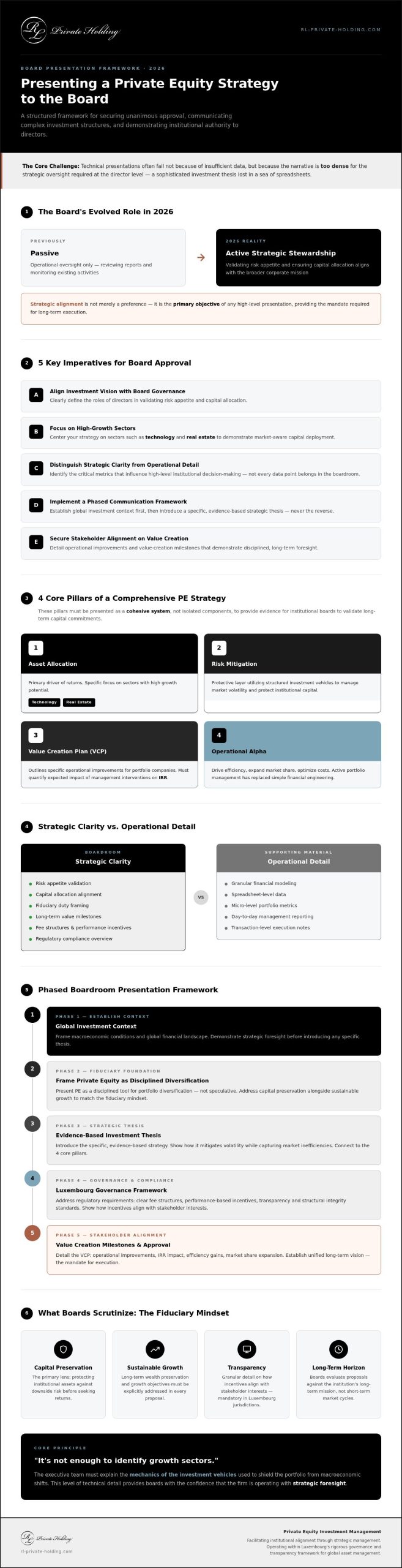
A Structured Framework for Executing the Boardroom Presentation
Executing a successful board meeting requires a phased approach that respects the time and intelligence of the directors. The presentation begins with a Contextual Opening, where the executive team establishes the current global investment landscape. This is followed by the Strategic Thesis, providing a factual justification for the “Why Now” behind the proposed capital allocation. Once the thesis is established, the Execution Roadmap details the methodical deployment of capital across selected sectors. Phase four involves a transparent Risk-Reward Calculus, where potential downsides are addressed with the same rigor as projected gains. The process concludes with a Fiduciary Conclusion that reaffirms the strategy’s alignment with the board’s long-term objectives. Using this framework when presenting a private equity strategy to the board ensures a logical progression that builds institutional confidence.
Crafting the Strategic Narrative
A consistent theme provides the structural integrity needed when presenting a private equity strategy to the board, as it ties disparate investments into a singular vision. Successful presenters often look to family office investment strategies Luxembourg to illustrate how long-term wealth preservation is achieved through disciplined allocation. This historical context serves as a proof point for the proposed strategy. To transition from market data to strategic action, the presenter must demonstrate how specific macroeconomic inefficiencies directly inform the chosen entry points. This narrative approach transforms a collection of data points into a coherent roadmap for value creation.
Visual Design for Institutional Gravity
The aesthetic of the presentation materials must reflect the firm’s professional distance and discipline. Slide designs should strictly avoid marketing hyperbole or unnecessary decorative elements. Clear financial data visualization is paramount, ensuring that directors can immediately identify trends and variances without distraction. A sober, factual aesthetic in institutional decks reinforces the firm’s “quiet authority” and transparency. By prioritizing legibility and structural clarity, the visual component supports the verbal narrative rather than competing with it. For organizations seeking to implement these frameworks, partnering with an expert in private equity investment management provides the necessary institutional stability to secure board-level consensus.
RL Private Holding: Facilitating Institutional Alignment through Strategic Management
RL Private Holding acts as a disciplined partner for institutional boards, providing the structural support required to refine and execute sophisticated investment mandates. Our firm specializes in the development of diversified portfolios, focusing specifically on high-growth technology sectors and stable real estate assets. By leveraging a global perspective, we assist executive teams in presenting a private equity strategy to the board that emphasizes capital preservation and long-term value creation. This approach ensures that all stakeholders are aligned on the firm’s risk appetite and strategic milestones. The use of Luxembourg-based investment structures provides an additional layer of institutional security, offering a transparent framework that meets the rigorous standards of international finance.
Expertise in Global Investment Structures
Navigating complex regulatory environments requires a high degree of institutional discipline and a commitment to professional excellence. RL Private Holding maintains a focus on transparency, ensuring that all investment vehicles are structured to optimize performance while adhering to strict governance protocols. It’s this commitment to transparency that allows us to integrate real estate asset management Luxembourg into a broader private equity strategy effectively. By combining diverse asset classes within a unified holding structure, we provide boards with a comprehensive overview of their risk exposure and return potential. This methodical management style reflects our firm’s established presence in the global financial landscape and our ability to manage the nuances of European holding structures.
A Partner for Long-Term Value Creation
We collaborate closely with boards to ensure that every strategic objective is met through a steady and deliberate execution plan. The RL Private Holding philosophy is rooted in stability, exclusivity, and understated confidence, prioritizing the long-term interests of our institutional partners over short-term market fluctuations. When presenting a private equity strategy to the board, we provide the technical mastery and strategic foresight necessary to secure unanimous approval. Our role as a steady hand in the background of major capital allocations allows us to provide institutional gravity without the need for aggressive self-promotion. This partnership fosters an environment of trust and professional distance, ensuring that corporate governance remains the primary focus of all investment activities. To learn more about how we support institutional growth, explore our institutional private equity management services.
Advancing Institutional Governance Through Strategic Alignment
Successful boardroom engagement in 2026 requires more than just financial data; it demands a disciplined alignment between investment vision and corporate governance. Executives who focus on the “Critical Few” metrics while maintaining a structured execution roadmap will find the path to unanimous approval much clearer. Mastering the nuances of presenting a private equity strategy to the board ensures that institutional goals are met with precision and transparency. This methodical approach reflects the professional gravity required to manage high-stakes capital allocations effectively.
RL Private Holding remains a steady partner in this process, managing a diversified global portfolio across technology and real estate. Our specialized expertise in Luxembourg institutional structures provides the stability and transparency that sophisticated boards expect. We maintain a reputation for strategic discipline and professional distance, focusing on long-term value creation rather than short-term market fluctuations. To secure your firm’s strategic future, partner with RL Private Holding for institutional investment management. A well-ordered strategy is the foundation of institutional permanence.
Frequently Asked Questions
What are the key elements of a private equity strategy for a board presentation?
The primary components include a strategic thesis, asset allocation, a value creation plan, and a defined exit strategy. These elements provide a comprehensive view of the investment lifecycle and its expected milestones. A well-structured proposal identifies high-growth sectors, such as technology or real estate, and details the operational improvements intended for portfolio companies. When presenting a private equity strategy to the board, you must also include a clear risk-reward calculus to ensure alignment with institutional governance standards.
How much technical detail should be included in a board-level PE strategy deck?
Board-level decks should prioritize strategic clarity over granular operational data. Directors require enough information to validate the investment thesis and assess risk without becoming lost in technical minutiae. It’s effective to include high-level metrics such as net IRR and cash-on-cash multiples in the main narrative. Exhaustive financial modeling and due diligence data are better suited for a technical appendix, allowing the primary presentation to maintain institutional gravity and focus on strategic stewardship.
How do you address risk appetite when presenting to an institutional board?
Risk appetite is addressed by framing the private equity strategy within the context of the board’s existing fiduciary duties. Presenters should demonstrate how the proposed allocation fits into the broader portfolio’s diversification goals. By using structured investment vehicles to manage volatility, the executive team shows a disciplined approach to capital protection. Transparently discussing potential downsides and mitigation strategies helps align the investment team with the board’s tolerance for market headwinds and liquidity constraints.
What is the best way to handle board objections during a PE strategy presentation?
The most effective way to handle objections is through a composed, factual response that reinforces the firm’s technical mastery. Anticipating concerns regarding liquidity or macroeconomic shifts allows the presenter to address them proactively. When presenting a private equity strategy to the board, objections should be viewed as an opportunity to demonstrate quiet authority. Providing precise data on historical performance and benchmarking against peer groups helps resolve doubts and builds the trust necessary for unanimous approval.
How does the Luxembourg regulatory environment impact private equity strategy?
The Luxembourg regulatory environment provides a sophisticated framework that emphasizes transparency and structural integrity for institutional investors. It requires rigorous compliance regarding fee structures and performance-based incentives, which must be clearly detailed in any board presentation. This jurisdiction’s focus on investor protection and standardized investment vehicles enhances the credibility of the private equity strategy. Navigating these requirements with precision demonstrates internal discipline and professional excellence in the context of global asset management and private equity investment management.
Why is value creation more important than financial engineering in board presentations?
Value creation is prioritized because it demonstrates a sustainable path to alpha through operational improvements rather than temporary financial adjustments. Boards demand evidence of active portfolio management where specific interventions drive growth and efficiency. While financial engineering may offer short-term gains, a robust Value Creation Plan provides the long-term foresight required for institutional-grade private equity. Quantifying the impact of management changes on IRR provides directors with a reliable narrative for future capital realization and fund performance.
How often should a private equity strategy be presented to the board for review?
A comprehensive private equity strategy is typically presented annually for major reviews, with quarterly updates on specific performance milestones. This rhythm allows the board to maintain oversight of the execution roadmap without infringing on the executive team’s operational autonomy. Regular reporting ensures that the investment strategy remains aligned with evolving market conditions and the firm’s long-term corporate governance goals. Consistent communication fosters a steady partnership and allows for timely adjustments to the capital deployment schedule as macroeconomic conditions shift.
Can a private equity strategy include venture capital and real estate allocations?
A diversified private equity strategy frequently includes allocations to venture capital and real estate to optimize the risk-reward profile. Venture capital offers exposure to high-growth technology sectors, while real estate asset management provides stability and capital preservation. Integrating these asset classes within a single strategic framework allows boards to view the entire portfolio’s diversification. This holistic approach is common in sophisticated Luxembourg investment structures, where multiple sectors are managed under a unified institutional vision to drive long-term value creation.