

By 2026, treating venture capital as a secondary interest within a private wealth structure is no longer a viable strategy for sustained capital preservation. Many principals find that the administrative weight of managing direct deals and inconsistent deal flow can quickly erode the advantages of the asset class. Achieving institutional-grade results requires a shift from informal participation to a disciplined approach when structuring a family office for venture capital investments. It’s essential to move beyond the excitement of individual deals and focus on the structural integrity and long-term stability of the investment vehicle itself.
You likely recognize that balancing high-risk venture allocations with overall portfolio liquidity is a complex endeavor that requires rigorous governance and clear separation of duties. This article provides an institutional-grade framework for professionalizing venture capital allocations through strategic Luxembourg-based structures. We’ll examine how the SOPARFI and SCSp models facilitate tax-efficient global allocations while separating family legacy from investment discipline. You’ll also learn how these professionalized networks provide access to high-tier co-investment opportunities that remain out of reach for less structured entities.
Key Takeaways
- Understand the transition from informal angel participation to an institutionalized mandate focused on growth-stage innovation and technology.
- Identify the optimal legal frameworks for structuring a family office for venture capital investments to ensure governance and operational efficiency.
- Evaluate the strategic benefits of Luxembourg-based vehicles, such as the SOPARFI, for managing global venture holdings with precision.
- Learn how to integrate venture allocations into a total portfolio approach that balances high-risk growth with established real estate asset management.
- Establish rigorous protocols for manager selection and co-investment to secure access to high-tier opportunities within professionalized networks.
The Evolution of Venture Capital in Modern Family Offices
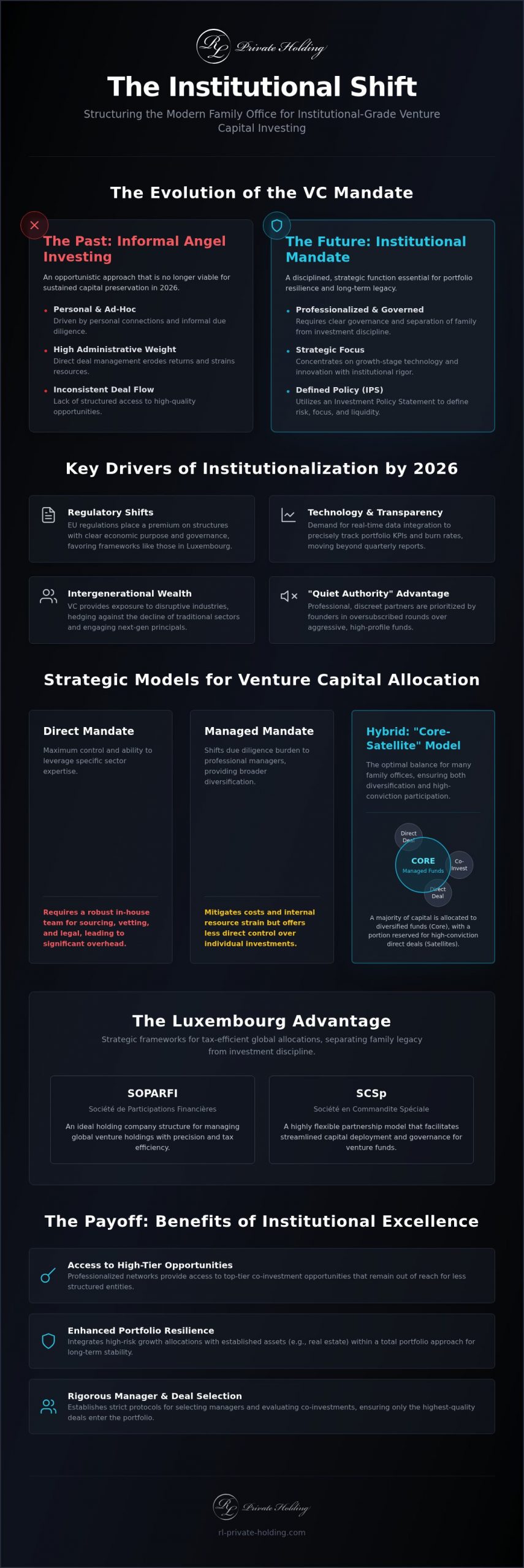
The venture capital investment mandate has transitioned from opportunistic deal-making into a disciplined strategic function. Historically, many private wealth entities engaged in “checkbook” angel investing, which was often characterized by personal connections and informal due diligence processes. By 2026, this model has become insufficient for the preservation of capital in volatile markets. A professionalized mandate now focuses on growth-stage technology and innovation, requiring the same level of institutional rigor found in top-tier private equity. Understanding What is a Family Office? in the modern context reveals why structuring a family office for venture capital investments is now a requirement for ensuring long-term legacy and portfolio resilience.
The Professionalization of Private Wealth
The process of structuring a family office for venture capital investments also requires a clear governance model that separates family dynamics from investment discipline. Transitioning from ad-hoc participation to dedicated venture sleeves is now a standard requirement for maintaining institutional gravity. This process involves establishing a specific Investment Policy Statement (IPS) tailored to venture allocations. This document defines risk parameters, sector focus, and specific liquidity expectations that differ from traditional equity or real estate holdings. Within this framework, maintaining “quiet authority” is essential. It allows a firm to access oversubscribed venture rounds where founders prioritize stable, discreet partners over aggressive, high-profile institutional funds. This professional distance builds trust and secures long-term positioning in competitive markets.
Drivers of Institutionalized VC in 2026
The 2026 economic landscape demands increased transparency and substance within all investment vehicles. Regulatory shifts in the European Union have placed a premium on venture capital Luxembourg structures that demonstrate clear economic purpose and governance. Technology now plays a central role in monitoring portfolio performance, moving away from quarterly reports toward real-time data integration. It’s essential for modern structures to utilize these tools to track portfolio KPIs and burn rates with precision.
Venture capital serves as a critical tool for maintaining intergenerational wealth. By providing exposure to disruptive industries, family offices can hedge against the gradual decline of traditional sectors. Next-generation principals often show a strong preference for innovation-led growth, seeing venture capital as a way to engage with the future of the global economy while fulfilling fiduciary duties. This alignment ensures that the family office remains relevant as market dynamics shift toward technology-driven value creation.
Strategic Models for Venture Capital Allocation
Selecting the appropriate allocation model is a critical phase in structuring a family office for venture capital investments. The choice between direct participation and managed mandates dictates the internal resource requirements and the firm’s overall risk profile. Direct investments offer maximum control and allow principals to leverage specific sector expertise, yet they demand a robust governance framework. Without an institutional-grade team to handle deal sourcing and legal vetting, the administrative weight can quickly become unmanageable. It’s vital to align these models with the family’s broader financial objectives to ensure long-term stability.
Direct vs. Managed Venture Mandates
Operational excellence is the differentiator between successful venture portfolios and those that struggle with inconsistent returns. Maintaining an in-house team involves significant overhead, including salaries for specialized analysts and the costs of proprietary deal-flow networks. Many offices choose to mitigate these costs by utilizing managed funds. This approach shifts the due diligence burden to professional managers while providing broader diversification. A hybrid “Core-Satellite” model often provides the best balance. In this structure, a family office allocates a majority of its venture capital to diversified funds while reserving a portion for high-conviction direct deals. This strategy is essential for ensuring long-term success for family offices by providing both stability and the potential for outsized returns.
Risk Management in Venture Portfolios
Rigorous risk management protocols are necessary to prevent venture allocations from destabilizing the broader estate. Concentration risk is a common pitfall, particularly when a portfolio becomes heavily weighted toward a single technology niche or geographic region. Managing capital call obligations is equally vital. Principals must maintain sufficient liquidity to meet these commitments without forced asset liquidations in other areas of the portfolio. Fiduciary duty requires that these high-risk assets are monitored with the same precision as fixed-income or real estate holdings. Integrating professionalized private equity investment management standards ensures that every venture commitment aligns with the family’s overarching financial objectives.
Co-investment dynamics offer a sophisticated middle ground. By partnering with established firms, family offices can participate in high-tier deals that would otherwise be inaccessible. This collaborative approach allows for the sharing of due diligence resources and reduces the individual risk profile of any single transaction. It’s a method that prioritizes institutional gravity over speculative ventures. For those aiming to professionalize their approach, aligning with a discreet partner for wealth management services can provide the necessary structural support to execute these complex mandates effectively.
Luxembourg Structural Frameworks for Venture Capital
Luxembourg has solidified its position as the premier jurisdiction for sophisticated family office investment strategies Luxembourg. The nation’s legal stability and specialized toolkits provide a level of security that is essential when structuring a family office for venture capital investments. Unlike jurisdictions that offer generic corporate forms, Luxembourg provides vehicles specifically designed for the complexities of private equity and venture capital. This specialized environment ensures that global UHNWIs can manage cross-border allocations with institutional precision and full regulatory alignment.
Leveraging the SCSp and SOPARFI
The choice between a SOPARFI and an SCSp depends on the specific mandate of the venture sleeve. The SOPARFI (Société de Participations Financières) functions as a fully taxable commercial company, making it ideal for long-term holdings due to its extensive network of double tax treaties. It’s the preferred vehicle for holding significant stakes in growth-stage companies. Conversely, the Luxembourg Special Limited Partnership (SCSp) offers tax neutrality and contractual flexibility. It mirrors the common law limited partnership structure, which is familiar to global venture managers. This flexibility is vital as Family Offices in Venture Capital increasingly lead co-investment rounds. Using these vehicles in tandem allows an office to serve as a gateway for global technology investments while maintaining tax efficiency and confidentiality.
Governance and Fiduciary Oversight
Success in venture capital requires a governance framework that extends beyond simple financial reporting. Establishing a Venture Investment Committee (VIC) with independent oversight ensures that every commitment undergoes rigorous scrutiny. This committee should operate with a clear mandate derived from the family constitution, which defines the specific risk appetite and innovation goals of the principal. Integrating these venture mandates into the broader governance structure prevents the “silo effect” where venture risk is viewed in isolation.
By 2026, transparency standards and economic substance requirements have become more stringent. Every structure must demonstrate genuine management and control within Luxembourg to remain compliant with evolving EU directives. This institutional approach to structuring a family office for venture capital investments ensures that the entity remains a respected partner in the global financial landscape. It’s no longer enough to have a legal presence; an office must prove operational substance to satisfy both regulators and high-tier investment partners.
Integrating Venture Capital into the Institutional Portfolio
Integrating venture capital into a diversified estate requires a shift from viewing it as a standalone alternative to seeing it as a component of a “Total Portfolio” approach. This methodology ensures that every allocation, whether in liquid markets or private innovation, aligns with the principal’s long-term mission. For instance, aligning high-growth venture mandates with stable real estate asset management Luxembourg provides a necessary hedge. While real estate offers predictable yields and capital preservation, venture capital provides the outsized growth required to offset inflationary pressures in a late-cycle economy. This balance is a core principle when structuring a family office for venture capital investments.
Venture Capital and ESG Synergies
Proactive impact has replaced passive ESG screening in the 2026 investment landscape. Family offices are increasingly identifying growth-stage technology firms that address global environmental and social challenges. This transition allows for a direct connection between capital and tangible change. Impact Venture Capital is defined as the strategic allocation of capital into early or growth-stage companies with the primary intent of generating measurable social or environmental benefits alongside competitive financial returns. It’s an approach that enables principals to fulfill philanthropic objectives through market-driven innovation rather than traditional grant-making alone.
Technology and Growth-Stage Allocation
Sector focus in 2026 has narrowed toward high-conviction mandates in AI, Fintech, and Biotech. These sectors represent the primary drivers of global economic restructuring. Diversifying venture exposure across geographic innovation hubs is essential to mitigate localized downturns. Growth-stage venture capital is particularly valuable in a late-cycle economy, as these companies have already demonstrated product-market fit and are scaling toward maturity. Measuring the “Return on Innovation” requires new benchmarks that account for technological milestones and intellectual property value, moving beyond simple IRR or TVPI metrics. When structuring a family office for venture capital investments, integrating these sophisticated tracking mechanisms is vital for fiduciary oversight.
To ensure your venture allocations are managed with institutional gravity, it’s beneficial to partner with a firm that understands the nuances of private equity investment management.
Institutional Excellence in Venture Management
Achieving long-term success in venture capital requires more than significant capital; it demands institutional gravity. While structuring a family office for venture capital investments provides the legal and tax framework, the ongoing management of the portfolio determines the ultimate legacy. The transition from ad-hoc project participation to a disciplined, institutionalized mandate is essential for principals who wish to be viewed as sophisticated partners by top-tier founders and funds. This evolution ensures that venture allocations are not merely speculative bets but are integrated components of a multi-generational wealth strategy.
Partnering for Strategic Growth
A discreet partner provides the infrastructure necessary to execute complex venture mandates with precision. Selecting an investment holding company as a strategic partner offers family offices access to institutional-grade due diligence protocols that are often difficult to maintain in-house. These protocols involve rigorous vetting of venture capital managers and direct deals, ensuring every commitment aligns with the office’s fiduciary standards. Leveraging global networks through a professionalized partner also opens doors to exclusive co-investment opportunities that remain closed to less structured entities. In the 2026 environment, these partnerships are vital for navigating the increased demand for transparency and economic substance in cross-border transactions.
Defining the 2026 Venture Legacy
Structured venture capital transforms family wealth into a steady driver of global innovation. This institutional permanence allows a family office to remain a consistent force in the market across multiple economic cycles. It’s a shift from being a passive observer to being an active, disciplined participant in the growth of disruptive industries. To ensure your office is prepared for the next decade of innovation, consider this final structural checklist:
- Does the current structure meet 2026 EU substance and transparency requirements?
- Is there a formal Investment Policy Statement (IPS) specifically for growth-stage technology?
- Are governance models in place to separate family legacy from investment discipline?
- Is the venture sleeve properly balanced with core holdings like real estate and private equity?
RL Private Holding structures global venture mandates for institutional success, providing the stability and professional distance required for high-stakes asset management. By moving away from informal deal-making and toward a professionalized framework, principals can secure their position as authoritative experts in the global financial landscape. This disciplined approach ensures that structuring a family office for venture capital investments results in a resilient and impactful legacy for the next generation.
Securing Private Wealth through Institutional Innovation
Professionalizing a venture mandate is no longer optional for principals who seek to preserve and grow intergenerational wealth. The transition from informal participation to a disciplined, institutionalized framework ensures that every allocation serves a broader strategic purpose. By leveraging Luxembourg’s specialized legal vehicles, such as the SCSp and SOPARFI, family offices can achieve the necessary balance between tax efficiency and operational flexibility. Integrating these high-growth assets with stable holdings like real estate creates a resilient portfolio capable of navigating the complexities of the 2026 economic landscape.
The process of structuring a family office for venture capital investments requires a commitment to institutional gravity and the selection of a discreet partner. RL Private Holding is headquartered in Luxembourg and offers a global investment reach with deep expertise in venture capital structural frameworks. We’re committed to providing institutional-grade portfolio management for UHNWIs through a steady and methodical approach. Establish a foundation that transforms speculative innovation into a permanent legacy of growth and stability.
Explore Institutional Investment Structures at RL Private Holding
Frequently Asked Questions
What is the best legal structure for a family office investing in venture capital?
The optimal legal structure often involves a combination of the SOPARFI and the Special Limited Partnership (SCSp). These Luxembourg-based vehicles provide the necessary governance and tax-efficiency required for global mandates. While the SOPARFI is suited for long-term holding, the SCSp offers the contractual flexibility essential for co-investment and manager selection. Structuring a family office for venture capital investments through these frameworks ensures institutional-grade stability and provides a clear separation of family legacy from investment discipline.
How does a Luxembourg SCSp differ from a SOPARFI for venture investments?
The Luxembourg SCSp is a transparent vehicle that mirrors common law limited partnerships, making it ideal for managing capital calls and external manager relationships. In contrast, a SOPARFI is a fully taxable commercial holding company that benefits from Luxembourg’s extensive double tax treaty network. This makes the SOPARFI more appropriate for holding significant, long-term equity stakes in growth-stage companies. Each vehicle serves a distinct purpose within a professionalized venture sleeve to ensure maximum structural integrity.
What percentage of a family office portfolio should be allocated to venture capital in 2026?
While individual risk appetites vary, many institutional-grade family offices target an allocation between 10% and 25% for venture capital in 2026. This range allows for meaningful exposure to disruptive innovation while maintaining overall portfolio stability. The specific percentage depends on the office’s liquidity requirements and its ability to manage the long-term nature of venture cycles. Balancing this high-risk allocation with stable assets like real estate is a fundamental principle of modern wealth management.
Can a family office invest directly in startups or should they use venture funds?
Most family offices utilize a hybrid approach, often referred to as a Core-Satellite model. Investing in venture funds provides broad diversification and access to professional manager expertise, which is essential for risk mitigation. Direct investments should be reserved for sectors where the family possesses deep expertise or has the infrastructure to conduct institutional-grade due diligence. This combined strategy reduces the administrative burden while allowing for high-conviction participation in specific growth-stage opportunities that align with family values.
What are the tax benefits of structuring venture capital through Luxembourg?
Luxembourg offers significant tax advantages, including a broad network of double tax treaties and exemptions for qualifying dividends and capital gains under the participation exemption regime. Structuring venture capital through a SOPARFI allows for tax-efficient repatriation of profits from global holdings. Additionally, the SCSp provides tax neutrality, ensuring that the tax treatment of the investment is determined at the level of the partners. These benefits are critical for maintaining the long-term financial performance of the portfolio.
How do family offices manage the liquidity risks associated with venture capital?
Managing liquidity risk involves a disciplined approach to capital call forecasting and the maintenance of a liquid buffer within the broader estate. Family offices must ensure that commitments to venture funds don’t force the liquidation of core assets during market downturns. Utilizing structured secondary market participation can also provide a potential exit route for illiquid positions. Rigorous monitoring of the total portfolio ensures that venture risk remains balanced with more liquid fixed-income or real estate holdings.
What governance protocols are required for a family office venture investment committee?
A Venture Investment Committee requires formal protocols that define investment thresholds, sector focus, and exit strategies. These protocols should be independent of the family’s legacy business operations to ensure objective decision-making. Regular reporting on portfolio KPIs and technological milestones is necessary for fiduciary oversight. When structuring a family office for venture capital investments, establishing these governance models is vital for achieving institutional permanence and attracting high-tier co-investment partners who value professional distance and reliability.
How can family offices involve the next generation in venture capital decision-making?
Involving the next generation often begins with educational roles within the Venture Investment Committee or participation in specific sector due diligence. Venture capital serves as an ideal training ground for younger family members to engage with innovation and ESG-aligned growth. By assigning responsibility for monitoring specific technology hubs, principals can prepare the next generation for future leadership. This approach ensures that the family legacy remains relevant as the global economy transitions toward innovation-led value creation.