

The ability to secure allocations in high-alpha private equity vintages is increasingly a function of structural positioning rather than mere capital volume. While global markets continue to mature, many institutional and private investors remain hindered by significant information asymmetry and the inherent limitations of generic fund structures. It’s a common reality that the most desirable opportunities are often restricted to a narrow circle of established partners. Successfully accessing exclusive private equity deals requires a departure from traditional retail-adjacent models in favor of more sophisticated, institutional-grade frameworks.
This article outlines a strategic framework for 2026 that prioritizes structural efficiency and the utilization of global institutional networks to overcome regulatory and geographic barriers. You’ll discover how to navigate the complexities of cross-border allocations while maintaining the governance standards required for long-term capital appreciation. We’ll analyze the mechanisms of direct primary and secondary market access, the importance of Luxembourg-based investment vehicles for tax and operational optimization, and the disciplined management practices necessary to secure a position within elite investment circles.
Key Takeaways
- Understand the evolving definition of exclusivity, distinguishing between mass-market private offerings and true institutional-grade allocations.
- Identify the regulatory prerequisites and capital thresholds necessary for qualifying as a well-informed investor within the European financial ecosystem.
- Evaluate the strategic advantages of Luxembourg-based vehicles, such as the SCSp and SOPARFI, for accessing exclusive private equity deals with structural efficiency.
- Implement a 2026 due diligence framework that prioritizes operational alpha and the verification of alignment between general and limited partners.
- Gain insights into the private equity landscape through a disciplined focus on technology, real estate, and growth-stage venture capital.
Defining Exclusivity in the 2026 Private Equity Landscape
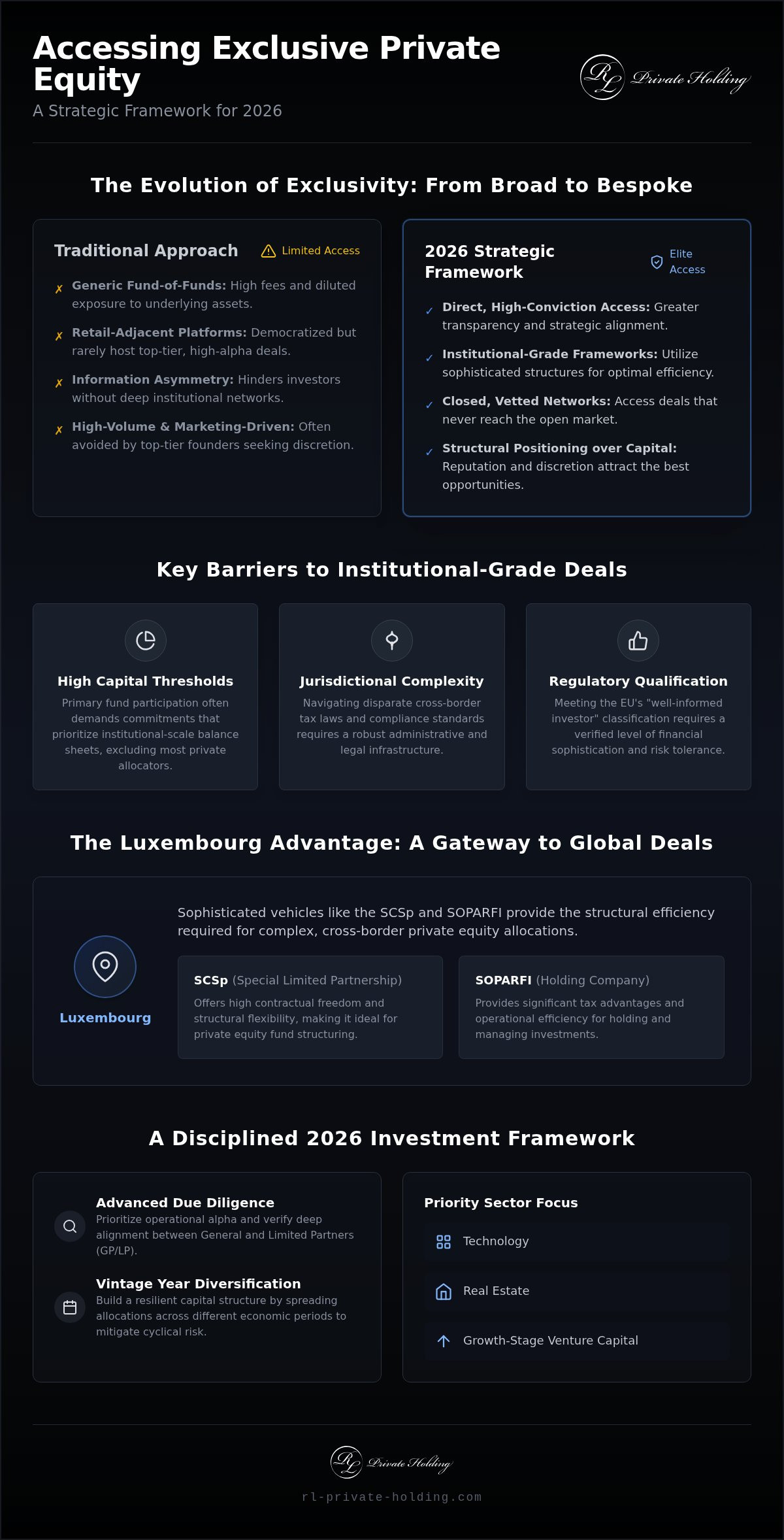
The concept of exclusivity in private equity has undergone a significant transformation. Historically, many allocators relied on generic fund-of-funds to gain exposure. By 2026, the market has bifurcated. Sophisticated investors now prioritize direct, high-conviction access over broad, diluted vehicles. This shift is driven by a desire for greater transparency and the necessity of accessing exclusive private equity deals that broad market indices cannot provide. Direct participation allows for a more precise alignment with specific strategic goals and a clearer understanding of the underlying asset performance.
It’s vital to distinguish between retail-accessible “private markets” and true institutional-grade private equity. While digital platforms have democratized access to certain asset classes, these public-facing portals rarely host the most competitive opportunities. True exclusivity is defined by the absence of broad marketing. High-alpha allocations are typically secured through established institutional networks where information asymmetry remains a protective barrier. Accessing exclusive private equity deals is, therefore, a matter of structural positioning rather than simple capital availability. The most sought-after transactions occur within closed ecosystems where participants are vetted for their long-term strategic value and professional discretion.
The Evolution of High-Alpha Deal Sourcing
The focus of deal sourcing has moved from broad sector bets toward specialized plays in technology and real estate. In a maturing market, the importance of vintage year diversification is paramount. Sophisticated allocators recognize that the “Access Gap” in 2026 isn’t just about capital. It’s about the ability to identify and enter niche markets before they reach institutional saturation. Diversifying across different vintage years ensures that a portfolio isn’t overly exposed to the economic conditions of a single period. This methodical approach allows for a more resilient capital structure that can withstand cyclical volatility while capturing growth in emerging sectors.
Institutional Gravity and the Value of Discretion
Top-tier founders and management teams increasingly favor discreet capital partners. They often avoid high-volume firms that prioritize aggressive marketing over strategic alignment. This “silent giant” approach creates a sense of stability and institutional permanence. A firm’s reputation acts as a primary filter for deal flow quality. When a partner demonstrates a disciplined, long-term focus, they attract high-conviction deals that never reach the open market. This relationship between discretion and deal quality remains a cornerstone of the private equity ecosystem. Founders value partners who provide steady governance without the distraction of public-facing promotional cycles, ensuring that the focus remains on operational excellence and long-term value creation.
Structural Barriers to Entry for Private and Institutional Allocators
Securing a position in top-tier private equity isn’t solely a matter of capital allocation. It requires navigating a complex environment of regulatory restrictions and structural hurdles. In the European Union, the classification of a “well-informed investor” carries specific legal weight, necessitating a level of financial sophistication and risk tolerance that excludes the broader market. These regulatory standards ensure that participants possess the technical capacity to evaluate high-alpha opportunities, but they also serve as a significant barrier for those without institutional support. Primary fund participation typically demands capital commitments that exceed the reach of most private allocators, often starting at levels that prioritize institutional-scale balance sheets.
Beyond capital and regulation, the complexity of cross-border tax and legal governance presents a formidable challenge. Global private equity involves managing disparate jurisdictions, each with its own compliance requirements and reporting standards. Maintaining structural efficiency while ensuring robust governance is essential for protecting long-term ROI. For many, accessing exclusive private equity deals remains out of reach because they lack the administrative infrastructure to manage these multi-layered requirements effectively.
The Network Effect in Private Equity
Proprietary deal flow is a byproduct of established reputations and historical success. When a firm consistently demonstrates disciplined governance and delivers successful exits, it gains preferential access to co-investment rights. These rights are rarely granted to newcomers; they’re earned through years of reliable partnership within the institutional ecosystem. In many cases, the most attractive transactions are fully subscribed by a closed circle of limited partners before any formal marketing begins. This internal circulation of opportunities ensures that the highest-quality deals stay within a network of trusted allocators who provide more than just capital.
Technical and Regulatory Hurdles
The due diligence burden for institutional-grade allocations is exhaustive. It requires a deep analysis of operational alpha, sector-specific risks, and the alignment of interest between general partners and limited partners. Sophisticated global structures expect a level of governance that meets international standards for transparency and risk management. Navigating these barriers effectively requires professional private equity investment management to ensure that every allocation is structurally sound and legally compliant. Investors who prioritize structural integrity often find that a disciplined global partner is necessary to bypass these technical entries and secure meaningful participation in restricted markets.
The Strategic Role of Luxembourg in Global Deal Access
Luxembourg remains the primary jurisdiction for institutional allocators who prioritize structural integrity and legal certainty. Its financial ecosystem provides a predictable environment for managing high-value assets across diverse geographic regions. The SOPARFI (Société de Participations Financières) serves as a standard tool for global deal holding, offering a robust platform for managing equity participations with technical precision. When accessing exclusive private equity deals, the choice of jurisdiction often determines the long-term stability and viability of the allocation. A well-ordered legal framework reduces the administrative burden on partners and ensures that all transactions meet international compliance standards.
The Luxembourg Special Limited Partnership (SCSp) offers significant flexibility for private equity structures. This vehicle allows for tailored governance arrangements that can be adapted to the specific requirements of a high-conviction deal. It facilitates efficient capital calls and distributions, which is essential for maintaining liquidity and meeting the operational demands of growth-stage investments. This operational efficiency is a key requirement for institutional ROI in a maturing global market. By utilizing these structures, investors can move with the speed and discretion required to secure participation in restricted vintages.
Structural Efficiency and Wealth Preservation
Centralized holding structures in Luxembourg are a cornerstone of the sophisticated strategies employed by leading private wealth management firms Luxembourg. Consolidating assets within a single, transparent jurisdiction allows for the effective management of diversified global portfolios. This approach is particularly beneficial for mitigating the risks of double taxation on cross-border exits, ensuring that capital is preserved and reinvested according to a long-term plan. Such structural sophistication provides a steady hand in the background of major global investments.
Governance and Institutional Trust
The Luxembourg financial center is characterized by rigorous oversight standards that define its global reputation. These standards are vital for building and maintaining trust between General Partners (GPs) and Limited Partners (LPs). A transparent regulatory environment reduces operational risk and enhances a firm’s ability to secure allocations in competitive deals. Accessing exclusive private equity deals requires this level of institutional trust to ensure all parties remain aligned on governance and reporting protocols. The SOPARFI is a robust vehicle that provides the necessary legal and tax framework for the strategic management of global asset portfolios in 2026.
Evaluating Deal Quality: A 2026 Due Diligence Framework
Evaluating deal quality in 2026 requires a rigorous departure from surface-level documentation. While the Information Memorandum provides a baseline, sophisticated allocators must move deeper to verify operational and sector-specific alpha. This involves a granular analysis of how a target company generates value beyond market beta. Accessing exclusive private equity deals is only the first step; the ability to discern which opportunities possess sustainable competitive advantages is what defines long-term success. Verification of these advantages requires access to proprietary data and a deep understanding of industry-specific benchmarks that are often shielded from the broader market.
Analyzing the alignment of interest between general partners (GPs) and limited partners (LPs) is a primary component of this framework. The carried interest structure serves as a critical predictor of performance focus. It’s essential to ensure that incentives are weighted toward realized gains rather than asset accumulation. A robust exit strategy is equally non-negotiable in a volatile global economy. Due diligence must confirm that multiple exit paths exist, whether through secondary sales, strategic acquisitions, or public listings, ensuring that liquidity can be achieved even when traditional capital markets face headwinds.
The Mechanics of Private Equity Selection
Sophisticated holdings utilize a combination of quantitative and qualitative metrics to filter opportunities. Verifying track records across different market cycles is vital, as performance in a low-interest-rate environment may not translate to the current landscape. Investors should identify red flags in management fees and incentive structures, such as “catch-up” clauses that favor the GP at the expense of the LP. A disciplined approach prioritizes deals where the management team has a significant personal stake, ensuring they’re as committed to the downside protection as they are to the upside potential.
Risk Mitigation in Sophisticated Portfolios
Sector diversification within a private equity allocation remains a fundamental risk mitigation tool. By spreading capital across technology, real estate, and growth-stage ventures, an allocator can offset the volatility of any single industry. The use of secondary markets has also become a strategic necessity for managing liquidity and vintage exposure. This allows for the active rebalancing of a portfolio in response to shifting economic conditions. Implementing these sophisticated family office investment strategies Luxembourg ensures that deal evaluation is supported by a robust administrative and legal framework. For those focused on accessing exclusive private equity deals, establishing a disciplined global partnership is the most effective way to ensure that due diligence remains both comprehensive and objective.
Navigating the Private Equity Ecosystem with RL Private Holding
RL Private Holding operates as a discreet gateway for institutional and private allocators seeking exposure to diversified global investment sectors. From its Luxembourg headquarters, the firm manages a portfolio that prioritizes structural integrity and long-term capital appreciation. It’s a model that prioritizes institutional gravity over marketing hyperbole. Accessing exclusive private equity deals requires more than capital; it requires a partner with the standing to navigate restricted markets and high-conviction vintages. This ensures institutional permanence. This worldly perspective allows the entity to act as a disciplined global partner, focusing on the structural components of every investment.
A Disciplined Approach to Global Allocation
The firm’s methodology is rooted in a sober, factual assessment of market opportunities. This disciplined approach focuses on high-growth sectors, including technology, real estate, and growth-stage venture capital Luxembourg. By maintaining a sense of “quiet authority,” RL Private Holding secures proprietary deal access that remains invisible to the broader market. The objective is to provide stability and capital preservation through a steady, methodical allocation process. This long-term focus ensures that portfolios are resilient against cyclical volatility while capturing specific operational alpha. Each sector is approached with technical precision, ensuring that the firm’s hierarchy and organizational framework support sustainable growth.
The Logic of Partnership
Partnering with an established holding company allows investors to leverage a professional infrastructure designed for high-stakes environments. RL Private Holding acts as a steady hand, managing the technical and regulatory complexities of cross-border private equity. This partnership model provides a transparent and well-ordered path for accessing exclusive private equity deals without the administrative burden of direct management. Sophisticated investors benefit from the firm’s global scale and its commitment to institutional governance standards. The firm doesn’t rely on marketing hyperbole; instead, it offers a factual presentation of its scope and principles. For those seeking to engage with these services, the path involves a formal alignment on strategic objectives and risk parameters within a professional and composed environment.
Institutional Excellence in Private Equity Allocation
The transition toward direct, high-conviction deal access marks a definitive shift in the global investment landscape for 2026. Success in this environment is no longer a matter of capital volume alone; it depends on the structural sophistication and institutional networks that define the elite tier of the market. By utilizing the legal stability of Luxembourg and implementing rigorous due diligence frameworks, allocators can overcome traditional barriers to entry. Accessing exclusive private equity deals requires a disciplined approach that prioritizes long-term governance and operational alpha over speculative growth.
RL Private Holding provides the discreet expertise and global scale necessary to navigate these complex environments. With a diversified portfolio across technology and real estate, the firm offers a foundation of sophisticated governance and structural efficiency. Maintaining a focus on capital preservation and institutional ROI ensures a steady path forward in a maturing market. We invite you to Explore Strategic Investment Management with RL Private Holding to align your objectives with a partner dedicated to institutional gravity and professional excellence. Your strategic positioning today will define your portfolio’s resilience for the decade ahead.
Frequently Asked Questions
What qualifies as an exclusive private equity deal in 2026?
In 2026, an exclusive private equity deal is defined by its restricted availability and the absence of public marketing. These opportunities are typically reserved for institutional partners or well-informed investors who provide strategic value beyond capital. Such deals often bypass digital retail platforms to maintain confidentiality and ensure a stable cap table of long-term partners. True exclusivity is found in direct allocations within niche technology or real estate sectors that prioritize operational alpha over mass-market participation.
Why is Luxembourg considered the premier jurisdiction for private equity deal access?
Luxembourg is the preferred jurisdiction due to its robust legal framework, political stability, and range of specialized investment vehicles. The country provides a predictable environment for accessing exclusive private equity deals while ensuring high standards of institutional oversight. Its reputation as a global financial hub facilitates cross-border transactions and builds trust between General Partners and Limited Partners. This regulatory maturity allows for efficient capital management and governance within a globally recognized ecosystem.
How does a SOPARFI structure benefit institutional investors in Luxembourg?
The SOPARFI (Société de Participations Financières) acts as a fully taxable commercial company that benefits from Luxembourg’s extensive network of double tax treaties. It’s particularly effective for institutional investors who require a centralized vehicle to manage global equity participations. By qualifying for the participation exemption regime, the structure allows for the efficient collection of dividends and realization of capital gains. This technical efficiency is essential for preserving ROI in complex, multi-jurisdictional private equity portfolios.
Can individual investors access top-tier private equity deals directly?
Direct access for individual investors is generally restricted by regulatory requirements and high capital thresholds. Most top-tier deals require participants to qualify as “well-informed investors” under European standards, which involves demonstrating significant financial sophistication. Partnering with a professional holding company or wealth management firm is often the most viable path for individuals to gain exposure to these restricted vintages. This approach ensures that the legal and administrative complexities of institutional-grade allocations are managed with professional discipline.
What is the role of carried interest in aligning GP and LP interests?
Carried interest serves as a performance-based incentive that aligns the interests of the General Partner (GP) with those of the Limited Partners (LP). It’s a share of the profits, typically 20%, paid to the manager only after the initial capital and a preferred return have been distributed to investors. This structure ensures the GP is focused on achieving realized gains and operational excellence rather than simply accumulating assets under management. It remains a fundamental mechanism for driving high-alpha performance in private equity.
How does RL Private Holding manage risk across its diversified portfolio?
RL Private Holding manages risk through a disciplined strategy of sector and geographic diversification. The firm allocates capital across technology, real estate, and growth-stage venture capital to mitigate the impact of volatility in any single industry. By utilizing sophisticated Luxembourg investment structures, the firm maintains high governance standards and structural efficiency. This methodical approach prioritizes long-term capital preservation and stable growth, acting as a steady hand in the background of global institutional investments.
What are the typical capital commitment requirements for exclusive PE funds?
Capital commitment requirements for exclusive private equity funds are significantly higher than those found in retail-accessible markets. These thresholds often start at several million euros for primary fund participation, reflecting the institutional scale of the transactions. Such requirements ensure that all partners have the financial capacity to meet capital calls over the life of the fund. For many investors, accessing exclusive private equity deals is achieved by participating in co-investment structures or through established holding companies that aggregate capital.
How does the SCSp structure provide flexibility for private equity managers?
The Luxembourg Special Limited Partnership (SCSp) provides extensive contractual freedom, allowing managers to tailor governance and profit-sharing arrangements to specific deal requirements. It’s a vehicle that doesn’t have a separate legal personality from its partners, which can offer tax transparency in various jurisdictions. This flexibility makes it an ideal vehicle for private equity and venture capital funds that require a bespoke structural framework. The SCSp allows for rapid deployment of capital and efficient management of distributions within a highly regulated legal environment.