

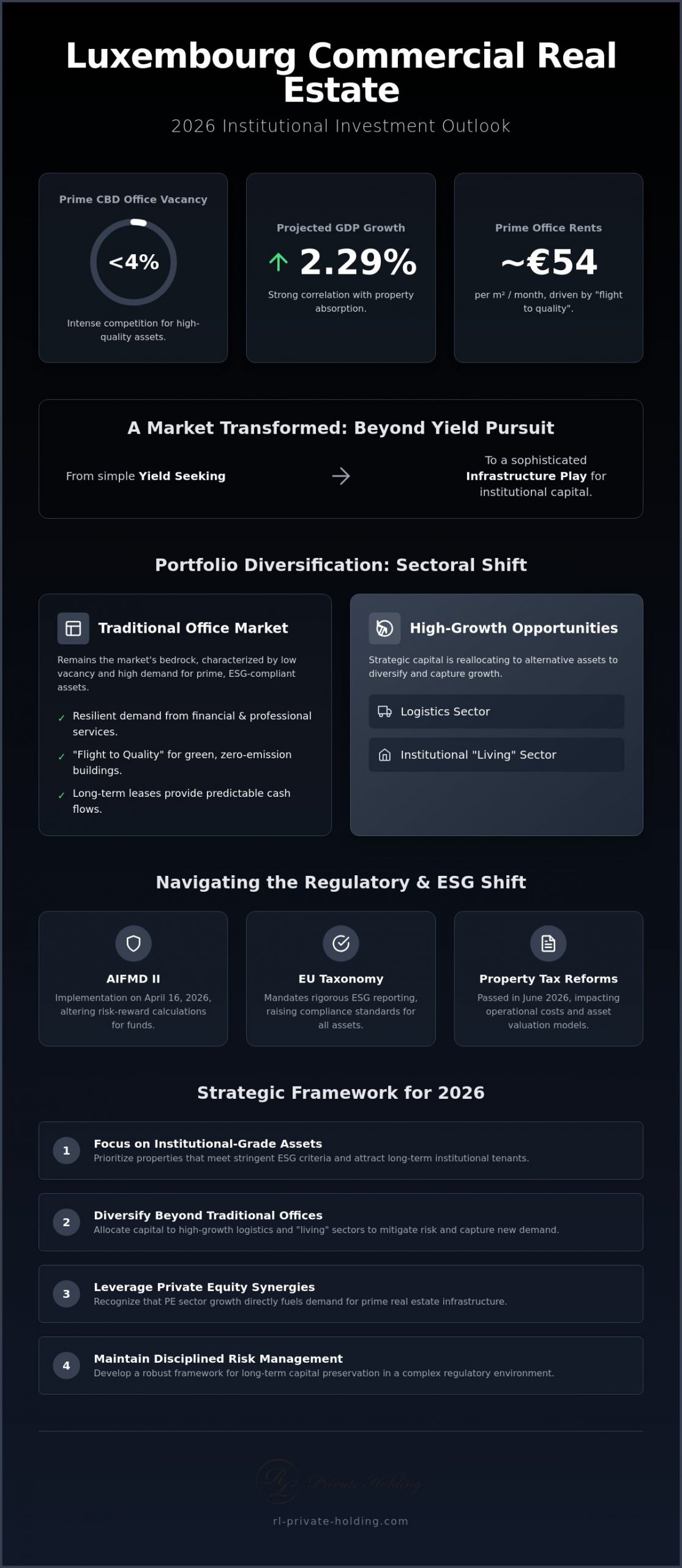
In 2026, the Luxembourg commercial real estate market has ceased to be a simple pursuit of yield, transforming instead into a sophisticated infrastructure play essential for global private equity and institutional capital. With prime CBD office vacancy rates remaining below 4.0 percent, the competition for high-quality assets has intensified, forcing a disciplined re-evaluation of traditional portfolios. Understanding the current commercial real estate investment trends Luxembourg presents is now a requirement for asset managers who seek to preserve capital in a complex regulatory environment.
You likely recognize that yield compression in traditional office spaces and the implementation of AIFMD II on April 16, 2026, haven’t just changed the market; they’ve fundamentally altered the risk-reward calculation for the region. This article provides an institutional analysis of the evolving landscape, focusing on structural shifts and strategic capital allocation for the coming year. We’ll examine the transition toward logistics and “living” sectors, the impact of the property tax reforms passed in June 2026, and the rigorous ESG reporting requirements now mandated under the EU Taxonomy.
Key Takeaways
- Evaluate how Luxembourg’s position as a global investment fund hub continues to drive demand for institutional-grade commercial assets despite broader macroeconomic shifts.
- Identify high-growth opportunities within the logistics and institutional “living” sectors to diversify portfolios beyond traditional office spaces.
- Understand the operational implications of AIFMD II and the EU Taxonomy to ensure compliance and maintain alignment with institutional capital standards.
- Analyze the latest commercial real estate investment trends Luxembourg offers to develop a robust framework for long-term capital preservation and risk mitigation.
- Leverage the structural synergies between real estate asset management and private equity to optimize portfolio performance in a stabilized interest rate environment.
The Macroeconomic Framework of Luxembourg Commercial Real Estate in 2026
The 2026 market operates within a stabilized macroeconomic environment following the correction of previous cycles. With a projected GDP growth of 2.29 percent, the correlation between economic expansion and commercial property absorption remains strong. This growth correlates directly with the physical requirements of the professional services sector. As investment volumes recover, we’re seeing a distinct “rebound effect” where institutional capital, previously sidelined by higher interest rates, is now seeking entry into high-quality assets. Luxembourg’s economic framework provides the necessary stability for these large-scale allocations, anchoring the country’s status as a premier European investment hub.
The service industry continues to be the primary engine for office demand. Financial institutions and fund managers require centralized, high-specification infrastructure to meet their operational mandates. This consistent demand, coupled with a limited supply pipeline, maintains upward pressure on prime rents. These commercial real estate investment trends Luxembourg is currently experiencing suggest a market that has transitioned from a period of uncertainty into one of disciplined growth.
Defining Commercial Real Estate in the Luxembourg Context
Asset categorization in the Grand Duchy is precise, spanning prime office space, retail, logistics, and the increasingly institutionalized “living” sector. The market’s structural constraints, particularly the limited supply of new developments, ensure that it remains a defensive hedge against broader European volatility. Commercial real estate in Luxembourg is a strategic institutional asset in 2026. Low vacancy rates, specifically the sub-4.0 percent rate in the office sector, underline the scarcity that defines this market. These commercial real estate investment trends Luxembourg exhibits are the result of deliberate urban planning and sustained corporate demand.
The Influence of the Private Equity Sector on Real Estate
The expansion of private equity investment management is a primary driver of demand for prime infrastructure. Fund administration hubs and legal entities require central, ESG-compliant offices to support their global operations. This creates a synergy where the growth of the financial services sector directly fuels the absorption of Grade A assets. Institutional tenants in this space typically commit to long-term lease structures, providing the predictable cash flows that asset managers prioritize. This relationship ensures that the market remains anchored in its role as a global financial intermediary, shielding it from the more aggressive fluctuations seen in purely speculative markets.
Sector-Specific Trends: From Prime Offices to Institutional Living
The 2026 market shows distinct divergence across asset classes. While the office sector remains the bedrock of the market, there’s a visible shift toward alternative assets. The OECD economic outlook for Luxembourg supports this diversification, highlighting a resilient growth trajectory that underpins long-term demand. These commercial real estate investment trends Luxembourg is navigating reflect a sophisticated institutional appetite for assets that offer both stability and ESG alignment. Investors are increasingly moving away from speculative developments, focusing instead on core assets with proven occupancy records.
Office Market Resilience and the Return-to-Office Dynamics
Prime office space remains highly sought after, with vacancy rates in the Central Business District holding below 4.0 percent. Fiscal and social security regulations for cross-border employees continue to incentivize a physical office presence, reinforcing the necessity of high-quality corporate infrastructure. It’s clear that the demand for “Green” buildings has reached a critical threshold. Investors prioritize assets that meet zero-emission standards, as these properties command a significant premium. This flight to quality has pushed prime rents to approximately €54 per square meter per month. Tenants now demand modern amenities that support employee retention and stringent corporate governance goals. The pipeline for new office space remains very limited for 2026, which suggests that supply constraints will continue to support high rental yields in the medium term.
The Rise of Logistics and Data Centres
Luxembourg’s geographical position as a European gateway has accelerated the demand for logistics and industrial real estate. E-commerce tailwinds and a structural scarcity of industrial land have created a high-barrier-to-entry market. Data centres have emerged as a significant alternative asset class, driven by the country’s advanced digital infrastructure and stable energy grid. These assets provide institutional investors with a hedge against inflation. They also offer a way to capitalize on the ongoing digitalization of the European economy. Because available land is finite, existing facilities are seeing substantial valuation increases as redevelopment opportunities become more rare.
Institutional Living: A New Frontier
The residential sector is undergoing a profound institutionalization. Previously dominated by private individual owners, large-scale residential portfolios are now being managed as commercial assets. This “Living” sector, which includes student housing and senior residences, outperformed traditional retail segments during the 2024-2025 period. The transition’s driven by the consistent housing shortage and the stability of residential cash flows. Retail real estate, meanwhile, has bifurcated. Institutional capital now focuses almost exclusively on high-street luxury segments and experience-based retail parks that offer defensive qualities against online competition. Professional real estate asset management is essential for navigating the operational complexities of these multi-unit complexes and ensuring long-term value preservation.
The Regulatory and ESG Shift: Navigating AIFMD II and EU Taxonomy
The implementation of the Amended AIFM Law on April 16, 2026, marks a fundamental shift in how fund managers operate within the Grand Duchy. This regulatory update, transposing AIFMD II, introduces stringent requirements for liquidity management and loan origination that directly affect real estate investment vehicles. The CSSF has intensified its supervision, ensuring that managers maintain robust governance frameworks and transparent reporting standards. For institutional investors, these changes represent an evolution toward higher transparency and enhanced risk mitigation, aligning with the broader commercial real estate investment trends Luxembourg is currently defining.
Compliance with the EU Taxonomy and SFDR is no longer a peripheral concern; it’s a prerequisite for accessing institutional capital. As observed in recent commercial real estate trends, assets failing to meet Article 8 or 9 standards face significant “brown discounts” during valuation. The market has moved beyond simple energy certificates. It now requires granular data on carbon intensity and climate resilience. Transparency regarding AML/CFT requirements remains a cornerstone of the market, with strict enforcement of ultimate beneficial ownership reporting for all property transactions.
ESG as a Value Creator, Not Just a Compliance Burden
ESG credentials now serve as primary drivers for asset valuation and successful exit strategies. Institutional buyers prioritize properties that align with net-zero targets to avoid future stranded asset risks. This demand has accelerated the retrofitting of older commercial stock, where energy efficiency upgrades provide a measurable uplift in prime rental yields. Within the framework of commercial real estate investment trends Luxembourg is witnessing, the integration of ESG data into property management systems has become a standard operational requirement. Owners who invest in zero-emission building (ZEB) standards are seeing faster absorption rates compared to non-compliant peers.
Structuring Real Estate Investments in Luxembourg
The Luxembourg special limited partnership (SCSp) remains the preferred vehicle for sophisticated real estate allocations due to its contractual flexibility and tax transparency. Alongside this, SOPARFI structures continue to provide a reliable framework for cross-border holding activities, especially when managing diversified European portfolios.
Tax considerations for 2026 include the new IMOB tax on undeveloped building land, which was passed in June 2026. While the rate is currently 0 percent for the first five years, it requires careful long-term planning for land banks. The regulatory environment demands a disciplined approach to structuring, where tax efficiency must be balanced against the increasing complexity of international reporting standards. These structural choices are essential for capital preservation in a market where regulatory precision is as critical as asset selection.
Strategic Portfolio Allocation and Risk Management for 2026
Strategic allocation in 2026 requires a transition from passive capital placement to active, operationally focused management. As interest rates have stabilized following the volatility of previous years, the focus shifts toward debt optimization and sophisticated hedging strategies that protect against tail risks. The prevailing commercial real estate investment trends Luxembourg exhibits favor portfolios that balance core office holdings with high-growth segments like logistics and institutional residential complexes. This multi-sector approach effectively mitigates cyclical exposure and ensures a more consistent cash flow profile. Institutional capital is increasingly directed toward assets that demonstrate structural resilience and a clear path to long-term value preservation.
Risk Mitigation Frameworks for Institutional Holders
Institutional holders must adopt rigorous risk mitigation frameworks to address evolving corporate behaviors and regulatory mandates. Managing tenant concentration risk is particularly vital in the Luxembourg office market, where large financial entities often occupy significant portions of a portfolio’s gross leasable area. Managers are now evaluating the long-term impact of hybrid work dynamics on lease renewal probabilities, often opting for shorter, more flexible terms to maintain high occupancy in prime locations. It’s essential that managers perform regular stress-testing of their portfolios against energy price volatility to ensure operational resilience in an era of fluctuating utility costs. This disciplined approach ensures that the underlying asset value remains protected against external macroeconomic shocks.
Technological Integration in Asset Management
The integration of technology has moved from a competitive advantage to an institutional requirement for 2026. PropTech and AI applications are now standard tools for optimizing building operations, reducing utility expenditures, and enhancing the overall tenant experience. Data-driven decision making allows for more precise acquisition and disposal timing, moving away from anecdotal market sentiment toward verified performance metrics. Digital transparency in investor reporting has also improved, providing limited partners with real-time access to asset-level data and ESG performance indicators. These technological advancements facilitate a more granular understanding of portfolio health, allowing for proactive adjustments before market shifts occur.
Evaluating exit readiness has become a primary consideration for 2026, as the secondary market shows increased liquidity compared to previous years. Preparing assets for disposal involves ensuring full ESG compliance and comprehensive digital documentation to satisfy the rigorous due diligence requirements of institutional buyers. A well-structured exit strategy accounts for the specific tax implications of recent reforms, ensuring that capital gains are maximized within the current regulatory framework. For those seeking to align their portfolios with these institutional standards, our firm provides disciplined real estate asset management to optimize strategic outcomes.
The RL Private Holding Perspective: Disciplined Real Estate Management
RL Private Holding adopts a methodical approach to the market, viewing the current commercial real estate investment trends Luxembourg offers as a landscape requiring deep integration across financial disciplines. Our focus remains on high-quality, sustainable assets that align with the rigorous requirements of institutional capital. By maintaining a headquarters in this global financial hub, we ensure that our real estate asset management Luxembourg operations benefit from the country’s robust legal framework and its status as a premier investment fund center. This positioning allows us to manage complex portfolios with the precision required by sophisticated partners who value long-term stability over speculative volatility.
The firm recognizes structural synergies between its various investment arms. Insights from our private equity activities often signal shifts in corporate infrastructure needs, while our venture capital allocations provide early indicators of emerging demand in technology and logistics hubs. This cross-disciplinary perspective ensures that every real estate acquisition is supported by a broader macroeconomic thesis. We prioritize assets that demonstrate both capital preservation qualities and operational efficiency, reflecting our identity as a steady hand in the background of major global investments.
Managing Diversified Portfolios from a Global Hub
Luxembourg provides the ideal infrastructure for managing diversified global portfolios with professional gravity. RL Private Holding operates with a sense of “quiet authority,” functioning as a disciplined partner in the background of significant institutional transactions. This “silent giant” approach reflects our commitment to stability and professional distance, qualities that are highly valued in the private equity and asset management sectors. We prioritize structural integrity and transparency, ensuring that our organizational framework supports the high-stakes nature of global capital preservation. Our presence in the Luxembourg market serves as a strategic gateway for institutional investors seeking exposure to resilient, high-grade commercial infrastructure.
Future-Proofing Investments for 2026 and Beyond
Anticipating future cycles is essential for maintaining a competitive edge in a stabilized market. We closely monitor the trajectory of venture capital Luxembourg to forecast the next generation of office and infrastructure requirements. By integrating wealth management principles into our real estate strategies, we ensure that capital preservation remains the primary objective. This holistic view of the investment landscape allows us to identify sub-sectors that offer both resilience and growth potential. We invite institutional partners who value a disciplined, long-term approach to explore strategic alignment with our firm as we analyze the evolving commercial real estate investment trends Luxembourg presents in 2026 and beyond.
Navigating the Institutional Path for 2026
The transition toward high-growth logistics and institutional residential sectors, coupled with the rigorous implementation of AIFMD II, defines the current investment landscape. Success in this environment requires a disciplined integration of ESG standards and active risk management to mitigate cyclical exposure. Understanding the evolving commercial real estate investment trends Luxembourg presents is essential for any portfolio prioritizing capital preservation and structural resilience. These shifts reflect a market that has matured into a sophisticated infrastructure play for global capital.
RL Private Holding operates from the heart of the Luxembourg financial centre, managing a diversified global portfolio that spans technology and real estate. Our institutional-grade expertise in private equity and asset management provides the steady hand required for navigating these complex structural transitions. We maintain a focus on stability and professional gravity to serve the long-term interests of our partners. We invite you to explore our strategic approach to Real Estate Asset Management as you position your portfolio for the next cycle of growth.
Frequently Asked Questions
What are the dominant commercial real estate trends in Luxembourg for 2026?
The market is currently defined by a pronounced flight to quality in office space and a strategic pivot toward logistics and institutional residential assets. These commercial real estate investment trends Luxembourg is experiencing are driven by institutional demand for ESG-compliant infrastructure. Investors now prioritize assets that offer long-term capital preservation over speculative short-term gains in a stabilized interest rate environment.
How has AIFMD II impacted real estate investment management in Luxembourg?
The Amended AIFM Law entered into force on April 16, 2026, introducing more rigorous requirements for liquidity management and loan origination. Real estate fund managers must now adhere to enhanced reporting obligations and stricter governance frameworks concerning delegation. These changes aim to increase transparency and protect institutional capital within the Luxembourg alternative investment fund ecosystem.
Is the Luxembourg office market still a viable investment in 2026?
The office market remains a viable investment, particularly for Grade A assets in the Central Business District and established business hubs. With vacancy rates holding below 4.0 percent and a limited construction pipeline for the next two years, supply constraints continue to support rental growth. Institutional interest is concentrated on buildings that meet zero-emission standards and offer modern amenities for financial sector tenants.
What role does ESG play in commercial real estate valuation today?
ESG performance is now a primary determinant of an asset’s market value and liquidity. Properties that fail to meet EU Taxonomy or SFDR Article 8 standards often face significant discounts during the due diligence process. Compliance with zero-emission building requirements is seen as essential for securing institutional funding and ensuring a successful exit in the current market.
Why is the “Living” sector becoming an institutional asset class in Luxembourg?
The “Living” sector has institutionalized due to the persistent national housing shortage and the high stability of residential cash flows. Professional managers are consolidating smaller portfolios into larger, institutional-grade vehicles to meet the demand for student and senior housing. This sector has shown greater resilience compared to traditional retail segments over the 2024 to 2025 period.
What are the most effective structures for holding commercial real estate in Luxembourg?
The Special Limited Partnership (SCSp) and the SOPARFI remain the most effective vehicles for structuring real estate holdings. The SCSp is favored for its contractual flexibility and tax transparency, making it ideal for institutional co-investment. These structures allow managers to navigate the specific commercial real estate investment trends Luxembourg requires for efficient cross-border capital allocation.
How does Luxembourg compare to other European hubs for logistics investment?
Luxembourg serves as a strategic gateway for cross-border logistics, offering superior connectivity to major European markets. The extreme scarcity of industrial land creates a high-barrier market that supports robust valuations for existing facilities. Additionally, the country’s advanced digital infrastructure makes it a leading choice for high-growth data center investments compared to larger, more congested hubs.
What is the outlook for prime rental rates in the financial districts?
The outlook for prime rental rates in the financial districts is one of stability with potential upward pressure. Prime CBD rents have reached approximately €54 per square meter per month, supported by the scarcity of available space. Because the pipeline for new developments is constrained through 2027, well-located office assets are expected to maintain their premium pricing levels.