

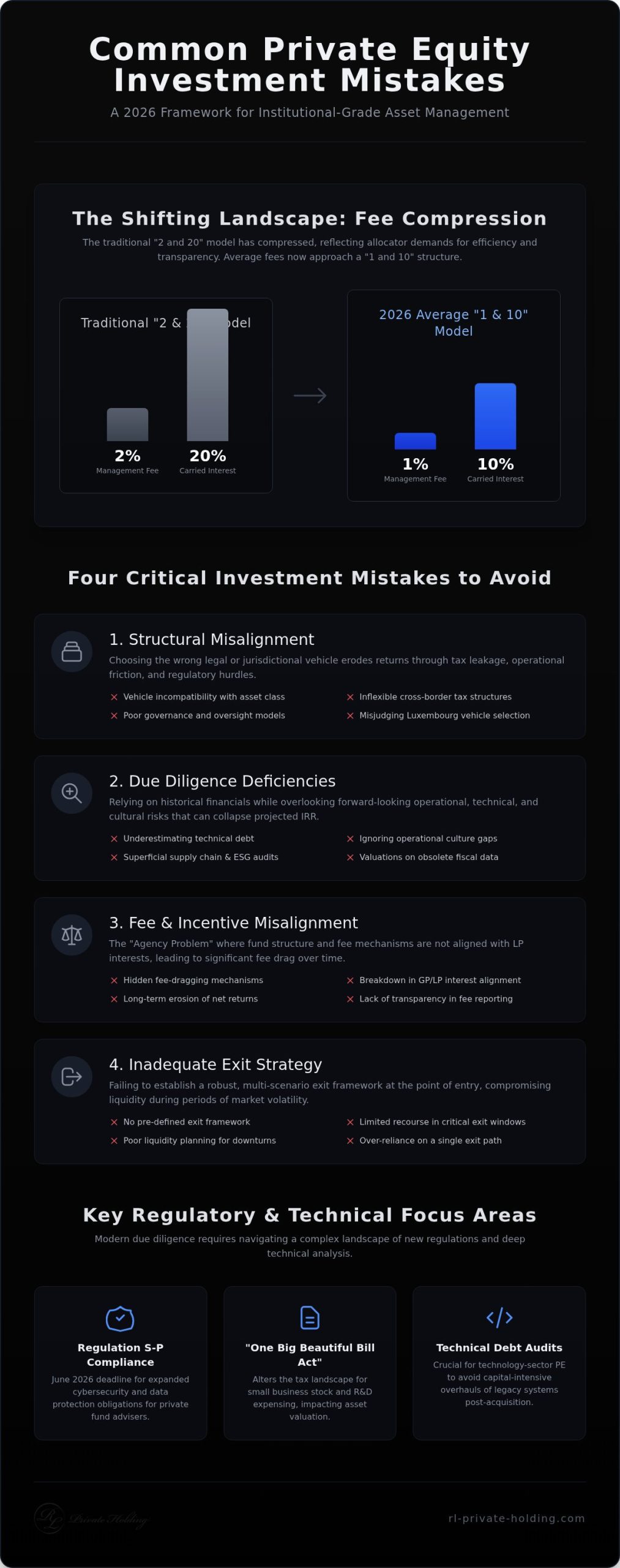
The traditional “2 and 20” fee model has largely vanished from the institutional landscape, as 2026 data shows average carried interest has compressed to 10 percent while management fees settle near 1 percent. This shift reflects a broader demand for transparency and structural efficiency among sophisticated allocators. You likely understand that securing alpha in this environment requires more than just identifying high-growth sectors; it demands a meticulous approach to the underlying investment architecture. This article identifies the most common private equity investment mistakes to avoid to prevent capital from being trapped in underperforming structures or compromised by misaligned incentives.
We’ll provide a disciplined framework for evaluating private equity opportunities within the current regulatory framework, including the June 2026 Regulation S-P compliance requirements and the implications of the “One Big Beautiful Bill Act.” You’ll learn how to optimize tax and legal structures for global holdings while mitigating the friction caused by state-level scrutiny in sensitive sectors. By refining your oversight and addressing structural vulnerabilities, you can achieve the superior risk-adjusted returns that define institutional-grade asset management. This overview serves as a technical guide for maintaining portfolio integrity in a complex global market.
Key Takeaways
- Precision in vehicle selection, specifically regarding Luxembourg structures, is necessary to prevent long-term structural misalignment and jurisdictional friction.
- Modern due diligence must prioritize the assessment of technical debt and digital infrastructure to accurately value assets in technology-driven sectors.
- Institutional investors must address the agency problem and minimize fee-dragging mechanisms that can significantly erode net returns over a ten-year horizon.
- Establishing a multi-scenario exit framework at the point of entry is critical for maintaining liquidity during periods of market volatility.
- Utilizing a rigorous oversight model helps institutional allocators identify and mitigate common private equity investment mistakes to avoid within the 2026 regulatory landscape.
Structural Misalignment: Jurisdictional and Vehicle Errors
Selecting an inappropriate legal structure remains one of the most persistent and common private equity investment mistakes to avoid in the 2026 market. While a fund’s performance captures the majority of investor attention, the underlying vehicle dictates the actual efficiency of capital distribution and tax optimization. An inflexible structure often leads to significant friction during long-term hold periods, particularly when the vehicle doesn’t align with the liquidity profile of the underlying assets. This misalignment can lock capital into sub-optimal tax regimes for years, eroding the benefits of otherwise strong asset performance.
Many institutional allocators fail to distinguish between the operational flexibility of a Luxembourg special limited partnership and the more rigid requirements of corporate holding structures. While a partnership offers tax transparency and contractual freedom, a corporate entity might be more suitable for specific reinvestment strategies. Misjudging this choice results in unexpected tax leakage or administrative burdens that diminish net returns. Failure to account for cross-border tax treaty eligibility during the initial structuring phase can also jeopardize the viability of international holdings, especially as the “One Big Beautiful Bill Act” has altered the tax landscape for small business stock and R&D expensing.
Vehicle Incompatibility with Asset Classes
The structural requirements for private equity vary significantly depending on the target asset class. Real estate assets require robust legal protections and specific debt-structuring capabilities that differ from the needs of venture capital funding. Utilizing a SOPARFI is a standard strategy for global holding, yet errors occur when managers apply a ‘one-size-fits-all’ governance model to multi-sector portfolios. Managing a ‘blind pool’ structure requires different oversight than a deal-by-deal arrangement; conflating the two leads to operational bottlenecks that hinder capital deployment.
Governance and Regulatory Oversight Failures
Inadequate reporting standards frequently create transparency gaps between General Partners and Limited Partners. With the June 3, 2026, compliance deadline for Regulation S-P amendments, private fund advisers must now meet expanded cybersecurity and data protection obligations. One of the common private equity investment mistakes to avoid is failing to define clear decision-making rights in co-investment scenarios. Without precise governance, investors may find themselves with limited recourse during critical exit windows. This lack of clarity often triggers a breakdown in the alignment of interests, particularly when regulatory changes impact cross-border holdings unexpectedly.
Due Diligence Deficiencies: Beyond the Balance Sheet
Traditional due diligence often focuses too heavily on historical financial statements, a practice that proves inadequate in the volatile 2026 economic environment. Relying on past performance figures without adjusting for the permanent extension of the 2017 tax cuts or recent shifts in global trade routes is one of the most common private equity investment mistakes to avoid. Investors who fail to look forward often find themselves holding assets that were valued based on obsolete fiscal assumptions rather than current market realities.
In technology-sector private equity, underestimating technical debt and digital infrastructure risks remains a critical oversight. If a target firm’s core systems are built on legacy frameworks that require immediate, capital-intensive overhauls, the projected IRR will likely collapse post-acquisition. Similarly, the ‘culture gap’ occurs when investors ignore operational compatibility during the integration phase. Without aligning corporate values and management styles, even the most financially sound acquisitions can suffer from talent attrition and productivity loss. Comprehensive audits must also extend to deep-tier supply chain and ESG resilience to prevent unexpected regulatory friction.
The Operational Due Diligence (ODD) Gap
Institutional investors must scrutinize a General Partner’s internal infrastructure as rigorously as the target company itself. This includes assessing the robustness of cybersecurity and data privacy protocols, especially following the June 3, 2026, Regulation S-P compliance deadline. Operational Due Diligence is the verification of a firm’s ability to execute its stated strategy. Without a verified operational backbone, a firm cannot maintain the transparency or security required for institutional-grade disciplined investment management.
Valuation Errors in a High-Interest Environment
Using outdated EBITDA multiples from the low-rate era is a dangerous strategy that leads to significant overpayment. In 2026, the distinction between revenue growth and sustainable cash flow is more vital than ever, particularly within venture capital funding. Managers must prioritize liquidity over “paper gains” to ensure long-term stability. Incorporating private equity risk management into the initial valuation model allows for a more realistic assessment of potential returns. This disciplined approach ensures that valuations reflect the cost of capital and the specific risks associated with the current economic cycle, protecting the portfolio from the effects of “multiple contraction” during the holding period.
Fee and Incentive Misalignment: The ‘Agency Problem’
The persistence of the agency problem remains a central challenge for institutional allocators. When General Partners (GPs) prioritize high assets under management (AUM) fees, a fundamental conflict of interest arises. This structure often incentivizes asset gathering rather than the rigorous pursuit of alpha. It’s one of the most common private equity investment mistakes to avoid, as it shifts the GP’s focus from performance to organizational scale. Over a ten-year investment horizon, “fee dragging” significantly erodes net returns. Cumulative management fees, transaction costs, and monitoring charges can consume a substantial portion of the initial capital commitment if they aren’t strictly capped or offset against the GP’s carry.
Carried interest hurdles also require careful calibration to ensure true alignment. If a hurdle rate is set too low, a GP may receive performance-based compensation for returns that merely track market beta rather than reflecting managerial skill. In the current 2026 environment, where the traditional “2 and 20” model has compressed toward 1 percent management fees and 10 percent carried interest, structural precision is paramount. Co-investment rights have become a standard mechanism to balance the fee-to-performance ratio, allowing Limited Partners (LPs) to deploy capital alongside the fund with reduced or zero fees.
Benchmarking Management and Performance Fees
The evolution of the industry has led to a notable shift toward performance-based incentives among private wealth management firms Luxembourg. This transition emphasizes the alignment of interests through tiered fee structures and performance benchmarks that reflect actual value creation. Identifying hidden fees, such as excessive monitoring charges or transaction fees that aren’t 100 percent offset, is critical during the due diligence phase. Negotiating favorable terms through side letters ensures that the LP’s specific return requirements are met without compromising the fund’s operational stability.
Incentive Deadlocks in Partnership Agreements
Deadlocks often occur when the exit timelines of GPs and LPs diverge. A GP might seek to hold an asset longer to continue collecting management fees, while an LP requires liquidity for rebalancing. This mismatch can lead to “style drift,” where a GP departs from the original investment strategy to chase fees or extend the fund’s life. Properly structuring these agreements is a prerequisite for those seeking to mitigate the common private equity investment mistakes to avoid that typically arise from incentive deadlocks. Robust key-man clauses are also essential to ensure that the specific expertise responsible for the initial commitment remains dedicated to the portfolio throughout its lifecycle.
Inadequate Exit Strategy and Liquidity Planning
Entering a position without a clearly defined, multi-scenario exit framework is a critical oversight in the 2026 fiscal environment. As interest rates remain at higher levels than in the previous decade, the traditional leveraged buyout model faces increased pressure, making debt-heavy exit strategies less viable. One of the common private equity investment mistakes to avoid is over-estimating the availability of the IPO window. With the number of U.S. public companies having decreased to fewer than 4,000 by 2024, the path to a public offering has become increasingly narrow and volatile. Relying on this single exit route without considering trade sales or secondary markets often leads to liquidity deadlocks.
Preparing for secondary market liquidity needs during the hold period is no longer optional. Institutional allocators often underestimate the time and capital required for a clean carve-out or a complex trade sale, which can take 12 to 18 months to execute properly. These processes involve significant legal and separation costs that can erode the final return if not budgeted from the outset. This delay is particularly costly when market conditions shift rapidly, potentially forcing a sale at a distressed valuation during a period of low market appetite.
The ‘Trapped Capital’ Risk
Structural impediments at the time of entry frequently limit future exit options, creating significant ‘trapped capital’ risk for the investor. The rise of GP-led secondaries has introduced new complexities, often resulting in valuation conflicts between the existing fund and the continuation vehicle. Exit planning must begin during the pre-acquisition due diligence phase. This early focus ensures that the investment vehicle remains compatible with various disposal methods, whether through a strategic acquisition or a secondary sale to another financial sponsor, while maintaining the primary keyword common private equity investment mistakes to avoid as a central planning pillar.
Post-Acquisition Value Creation Failures
Passive management is a recurring error in what is fundamentally an active asset class. Failing to align management teams with the ultimate exit objective results in operational drift and wasted resources. Instead of tracking generic metrics, firms should focus on KPIs that directly influence exit valuation, such as recurring revenue quality or EBITDA margins adjusted for the current interest rate environment. To ensure your portfolio remains liquid and resilient against these structural hurdles, it’s vital to partner with a firm that understands Private Equity Investment Management and prioritizes structural exit integrity from the first day of the holding period.
The RL Private Holding Approach to Disciplined Allocation
RL Private Holding operates with a philosophy rooted in institutional gravity and structural precision. By maintaining our headquarters in Luxembourg, we leverage a stable, transparent financial infrastructure that’s essential for managing complex cross-border holdings. Identifying and mitigating the common private equity investment mistakes to avoid requires a transition from reactive management to a disciplined, proactive framework. Our approach prioritizes the legal and tax integrity of every vehicle, ensuring that our partners’ capital is protected from the jurisdictional friction that often compromises global portfolios. This focus on stability is what distinguishes our firm as a steady hand in the global market.
A Multi-Sector Strategic Framework
We integrate venture capital funding, real estate asset management, and private equity into a unified strategy designed for balanced, long-term growth. This multi-sector approach allows us to diversify across technology and real estate, effectively mitigating cyclical risks that might impact a more concentrated portfolio. Utilizing an institutional holding company structure provides the stability necessary for wealth preservation across multiple decades. We believe that disciplined, sober analysis of fundamental value consistently outperforms attempts at market-timing. This methodology ensures that every allocation is based on verified data and structural compatibility rather than industry sentiment or hype-cycles. By focusing on the intersection of these asset classes, we create a resilient portfolio that can withstand shifts in the 2026 interest rate environment.
Partnering for Institutional Success
RL Private Holding provides the rigorous oversight required to navigate the complexities of the 2026 investment landscape. Our commitment to performance-based incentives ensures that our interests remain perfectly aligned with those of our investors, fostering a relationship based on transparency and results. By focusing on the structural and operational details discussed throughout this overview, we help our partners bypass the common private equity investment mistakes to avoid that frequently erode institutional returns. Our team maintains a worldly, sophisticated perspective while utilizing Luxembourg’s robust regulatory framework to provide a secure environment for asset growth.
We invite institutional allocators to contact our Luxembourg office for a strategic discussion on portfolio allocation and risk mitigation. You can also explore our private equity investment management frameworks for 2026 to see how our disciplined approach can enhance your long-term objectives. Our firm stands ready to act as a steady, professional partner in the background of your most significant investments.
Strategic Resilience in the 2026 Private Equity Landscape
Strategic performance in 2026 hinges on the transition from opportunistic asset gathering to a model of structural and operational discipline. Success requires a meticulous focus on jurisdictional efficiency, particularly through Luxembourg institutional structures, and a proactive approach to liquidity that begins at the point of entry. By addressing the common private equity investment mistakes to avoid, such as fee-dragging mechanisms and inadequate exit frameworks, institutional allocators can secure more stable, risk-adjusted returns. It’s this level of technical precision that protects capital from the volatility of shifting global markets.
RL Private Holding maintains a global portfolio across real estate, venture capital, and private equity with a steadfast commitment to long-term value creation. Our specialized expertise in Luxembourg ensures that every investment vehicle is optimized for transparency and regulatory compliance. We invite you to Discover our strategic approach to Private Equity Investment Management to see how our oversight can protect your capital. Maintaining a high standard of due diligence today provides the necessary foundation for institutional growth tomorrow. We look forward to supporting your long-term strategic objectives.
Frequently Asked Questions
What is the most common reason for private equity investment failure in 2026?
Failure in 2026 often results from structural misalignment rather than market volatility. Many investors choose inflexible vehicles that don’t account for the current interest rate environment or the June 2026 Regulation S-P cybersecurity deadlines. This is one of the common private equity investment mistakes to avoid. Without a vehicle that allows for jurisdictional flexibility and tax efficiency, otherwise profitable assets can suffer from significant capital friction and unexpected regulatory costs.
How do Luxembourg investment structures help mitigate private equity risk?
Luxembourg structures provide a stable and transparent legal framework that offers high levels of investor protection. By utilizing vehicles like the Special Limited Partnership (SCSp), investors benefit from tax transparency and contractual freedom. These structures are recognized globally by institutional allocators, which reduces the risk of jurisdictional friction. The country’s robust regulatory oversight ensures that funds remain compliant with evolving EU directives, providing a secure hub for cross-border private equity management.
What are the red flags to look for during private equity due diligence?
Critical red flags include an over-reliance on historical financial data and a lack of transparency regarding hidden transaction fees. Investors should be wary of GPs who don’t have a clear, multi-scenario exit strategy defined at the point of entry. Another significant concern is high technical debt within technology-sector targets. If the GP’s internal infrastructure hasn’t been updated to meet 2026 data protection standards, it indicates a broader failure in operational oversight.
How can investors ensure their interests are aligned with the fund manager’s fees?
Alignment is best achieved through performance-based incentives and robust co-investment rights. Investors should negotiate tiered management fees that decrease as the fund’s AUM grows, preventing the GP from prioritizing asset gathering over alpha. Side letters can be used to establish specific hurdles that ensure the manager only receives carried interest after achieving a preferred return. This disciplined approach helps mitigate the common private equity investment mistakes to avoid related to the agency problem.
What is the difference between AUM fees and performance fees in private equity?
Assets Under Management (AUM) fees are recurring charges based on a percentage of the total capital committed, intended to cover the fund’s operational costs. In 2026, these typically hover around 1 percent. Performance fees, or carried interest, are only collected upon the successful realization of investment gains, usually averaging 10 percent. While AUM fees provide the manager with steady income, performance fees are designed to align the manager’s incentives with the investor’s actual returns.
Is the Luxembourg SCSp better than a SOPARFI for private equity investments?
Neither is objectively superior; the choice depends on the investor’s specific tax and operational requirements. The SCSp is a tax-transparent partnership that offers significant contractual flexibility, making it ideal for typical private equity fund structures. Conversely, a SOPARFI is a fully taxable corporate entity that benefits from Luxembourg’s extensive tax treaty network. It’s often preferred for holding companies that intend to reinvest proceeds or require a more traditional corporate governance framework for global holdings.
How should institutional investors plan for liquidity in a 10-year PE fund?
Planning for liquidity requires establishing a secondary market strategy well before the fund’s tenth year. Investors should ensure the partnership agreement allows for GP-led secondaries or transfers to continuation vehicles if the IPO window is closed. It’s also vital to budget for the time and cost of carve-outs or trade sales, which can take up to 18 months. Maintaining a diversified portfolio across venture capital and real estate can help balance the longer liquidity cycles of private equity.
What role does technical due diligence play in 2026 venture capital investments?
Technical due diligence is now a mandatory component of risk management due to the June 2026 cybersecurity compliance deadlines. It involves a rigorous assessment of a firm’s digital infrastructure, data privacy protocols, and technical debt. In venture capital, where growth is tied to scalability, a flawed tech stack can prevent a company from reaching its exit objectives. Verifying a target’s ability to protect customer data under Regulation S-P is essential for maintaining institutional-grade security.