

The traditional reliance on public equity markets as a primary engine for growth has reached a point of diminishing returns for the disciplined investor. Systematic volatility and tightening correlations often obscure the underlying quality of a portfolio, leading to persistent mark-to-market anxiety. Diversifying investment portfolio with real estate Luxembourg represents a strategic shift from passive price-taking to active, operational value creation. This migration allows capital to reside within a premier financial hub that prioritizes institutional stability and long-term wealth preservation.
You likely recognize that true portfolio resilience requires assets that don’t move in lockstep with broader market swings. This article provides a professional framework for reallocating capital from liquid equities into the Luxembourg private real estate market. We’ll examine the structural advantages of the Grand Duchy and how a managed private equity approach can stabilize your returns during the market stabilization of 2026. By focusing on non-correlated assets, you can access superior risk-adjusted returns while benefiting from the deep integration of the Luxembourg financial ecosystem.
Key Takeaways
- Identify the structural drivers behind diminishing alpha in public markets and the transition toward the stability inherent in private asset valuations.
- Evaluate the strategic advantages of the illiquidity premium and how performance-based fee structures ensure a rigorous alignment of interests between investors and managers.
- Implement a professional framework for diversifying investment portfolio with real estate Luxembourg, focusing on specific allocation targets for a 7-10 year horizon.
- Compare the volatility profiles of liquid portfolios against the superior risk-adjusted returns generated through active operational value creation in private equity structures.
- Understand the role of institutional-grade asset management in navigating the Luxembourg financial ecosystem to facilitate long-term capital growth and wealth preservation.
The Strategic Rationale for Diversifying Investment Portfolios with Luxembourg Real Estate
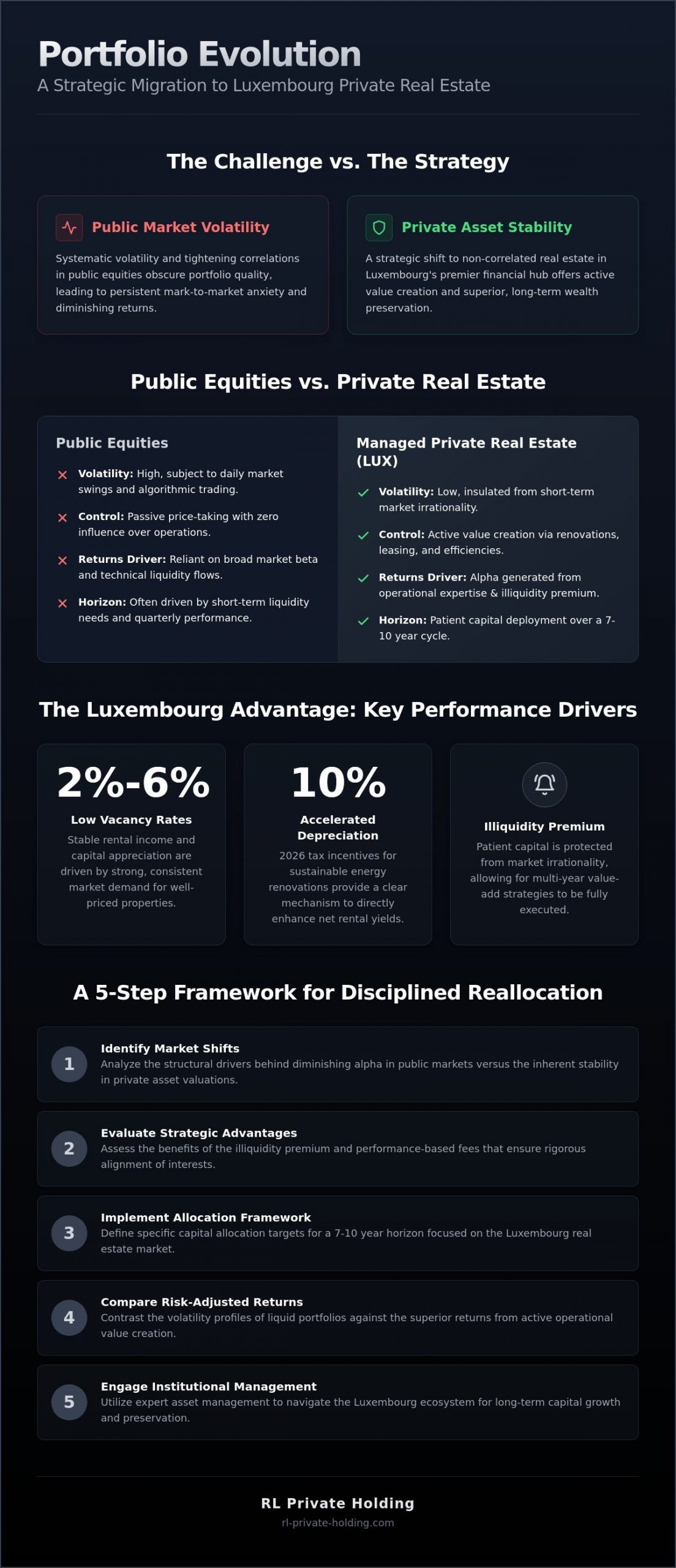
The 2026 economic environment has fundamentally altered the risk-return profiles of traditional asset classes. Institutional and private allocators face a landscape where public equity markets are characterized by high efficiency and reduced premiums. This shift necessitates a broader perspective on capital preservation. Diversifying investment portfolio with real estate Luxembourg offers a structured alternative to the erratic movements of exchange-traded securities. By reallocating toward private assets, investors move away from the noise of public exchanges into the tangible stability of the Luxembourg’s economic landscape. This transition isn’t merely about risk reduction; it’s about capturing the “Alpha Gap” that exists between passive price-taking and active real estate management.
Mitigating Public Market Volatility
High-frequency trading and algorithmic execution have compressed margins across global exchanges. These technologies create an environment where public valuations often reflect technical liquidity flows rather than fundamental asset health. For many investors, the constant mark-to-market fluctuations of a liquid portfolio generate unnecessary psychological and financial strain. Transitioning to private real estate removes this daily volatility. Institutional capital is increasingly seeking “patient” assets that prioritize long-term valuation cycles over short-term liquidity. In Luxembourg, where vacancy rates for well-priced rental properties remain low at 2% to 6%, the focus remains on steady income and capital appreciation rather than the whims of high-frequency traders.
The Shift Toward Active Value Creation
The core advantage of private equity real estate lies in the ability to exert direct influence over asset performance. Unlike public stocks, where an investor has zero control over corporate operations, private real estate asset management allows for hands-on value creation. Managers drive performance through strategic renovations, lease restructuring, and operational efficiencies. The 2026 tax incentives for sustainable energy renovations, which increased the depreciation rate to 10%, provide a clear mechanism for enhancing net rental yields. This level of control is essential for diversifying investment portfolio with real estate Luxembourg. It ensures that returns are driven by internal management decisions and operational execution rather than being solely dependent on broader market beta. Professional oversight transforms a passive holding into a disciplined vehicle for wealth preservation.
Structural Advantages of Private Equity Real Estate in Luxembourg
The structural advantages of private equity real estate are rooted in the concept of the illiquidity premium. Investors often perceive restricted access to capital as a disadvantage, yet in a private equity context, it serves as a protective mechanism. It allows managers to insulate assets from the irrationality of short-term market cycles. This structural rigidity facilitates the execution of multi-year value-add strategies that would be impossible in a liquid environment. When diversifying investment portfolio with real estate Luxembourg, this premium becomes a fundamental driver of superior risk-adjusted returns over a 7-10 year investment horizon. It ensures that capital is deployed with a focus on terminal value rather than daily liquidity needs.
Performance-based fee structures and carried interest ensure that the interests of the asset manager are inextricably linked to those of the investor. This alignment fosters a culture of discipline and transparency. Utilizing professional real estate asset management Luxembourg allows families and institutions to secure generational wealth through a partner whose success depends on the actual performance of the assets. Information asymmetry also plays a critical role. In a market as specialized as the Grand Duchy, proprietary deal sourcing and local network depth provide a competitive advantage that public markets cannot replicate.
Luxembourg Investment Vehicles: SCSp and SOPARFI
The Luxembourg special limited partnership (SCSp) has emerged as a premier vehicle for international allocators. Its contractual flexibility allows for bespoke governance terms that suit specific institutional requirements. Additionally, the SOPARFI remains a staple for holding real estate assets due to its tax efficiency and broad treaty network. These structures are supported by Luxembourg’s economic profile, which defines the country as a leading global financial powerhouse and the world’s second-largest investment fund domicile. This regulatory stability is essential for those diversifying investment portfolio with real estate Luxembourg at an institutional scale.
Operational Control and Strategic Governance
Private equity managers operate with a degree of strategic autonomy that is unavailable to public company executives. They’re not beholden to the distorting pressure of quarterly earnings calls. This independence allows for the implementation of long-term capital expenditure projects that prioritize structural integrity and energy efficiency. Such initiatives are particularly relevant given the 2026 tax depreciation rate of 10% for sustainable renovations. Direct access to proprietary market data and local management teams allows for a more granular level of risk mitigation. This methodical governance ensures that every asset is positioned for maximum performance within the broader portfolio. For those seeking a disciplined approach to capital growth, reviewing the Private Equity Investment Management frameworks of established partners can provide much-needed clarity.
Comparative Analysis: Public Equities vs. Managed Private Real Estate
Comparing the standard deviation of returns reveals a stark contrast between public and private domains. Public equities are subject to instantaneous sentiment shifts and algorithmic trading pressures that don’t always reflect fundamental value. In contrast, private real estate valuations move with the deliberate pace of appraisal cycles and long-term lease structures. Diversifying investment portfolio with real estate Luxembourg provides a necessary buffer against the high-frequency volatility that has come to define global exchanges in 2026. While public stocks offer the benefit of liquidity, they often lack the structural stability required for disciplined, multi-generational wealth preservation.
Leverage serves as a primary tool for enhancing equity returns within the private sector. Private equity managers utilize disciplined debt structures to amplify the internal rate of return (IRR) on specific assets, often securing financing terms that are unavailable to individual investors. Unlike the volatile margin requirements associated with public trading, real estate leverage in a professional context is typically structured to align with the asset’s cash flow. Reporting standards also represent a key point of differentiation. Public regulations mandate exhaustive quarterly disclosures that can lead to short-termism. The private market, however, relies on detailed periodic reports that focus on operational milestones and terminal value growth.
Risk-Adjusted Returns and Portfolio Diversification
The Sharpe ratio, which measures return per unit of risk, often favors private allocations in the stabilized 2026 market environment. By integrating private equity investment management, allocators can achieve a degree of portfolio stabilization that public indices simply cannot match. Private real estate acts as a robust hedge against systemic public market shocks. This is because the underlying value of a Luxembourgish asset is tied to physical occupancy and contractual rental income rather than the broad, often irrational, sentiment of liquid markets. It’s a fundamental shift from being a price-taker to an asset owner.
Volatility Smoothing and Mark-to-Market Realities
The inherent valuation lag in private equity is frequently discussed, yet it provides a functional benefit for institutional capital. This “smoothing” effect prevents the reactionary decision-making that frequently erodes value in liquid portfolios during periods of stress. It allows for a more methodical approach to capital requirements and long-term strategic planning. To navigate these complexities, it’s essential to understand the various legal structures for Luxembourg real estate funds, such as RAIFs and AIFs. These frameworks provide the necessary regulatory oversight while maintaining the benefits of private ownership. Balancing liquid reserves with these commitments ensures that the portfolio remains resilient while pursuing the superior yields associated with the Grand Duchy’s real estate sector.
Executing the Migration: A 5-Step Framework for Institutional Allocators
Successfully diversifying investment portfolio with real estate Luxembourg requires a disciplined migration framework that accounts for the unique liquidity and structural characteristics of private assets. The transition from liquid equities to private real estate is a multi-stage process that prioritizes long-term terminal value over immediate market access. This framework provides a methodical approach for institutional and private allocators to rebalance their portfolios without compromising operational stability.
- Step 1: Define Allocation and Liquidity: Establish a clear target for the real estate allocation within the context of a 7-10 year investment horizon. This period aligns with the typical life cycle of Luxembourgish private equity real estate vehicles.
- Step 2: Manager Selection: Conduct exhaustive due diligence on prospective managers, focusing on verified track records and specific sector expertise within the local market.
- Step 3: Account for the J-Curve: Recognize the initial period of capital deployment where management fees and setup costs may result in temporary negative returns before the underlying assets mature.
- Step 4: Structural Implementation: Utilize flexible vehicles such as the Special Limited Partnership (SCSp) to ensure tax efficiency and bespoke governance.
- Step 5: Performance Monitoring: Establish rigorous KPIs that focus on net operating income (NOI) growth and operational milestones rather than daily valuation changes.
Manager Due Diligence and Selection
Analyzing the persistence of returns is critical during the selection process. It’s essential to determine if a manager consistently outperforms benchmarks through skill rather than market beta. Evaluation should prioritize a team’s operational background over pure financial engineering. A manager’s ability to navigate local regulations, such as the IMOB tax on vacant land effective from 2026, demonstrates the depth of their local integration. Rigorous risk management protocols must be verified to ensure capital preservation remains the primary objective. For a detailed overview of institutional-grade oversight, you may explore our Private Equity Investment Management frameworks.
Managing the Transition and J-Curve
The J-Curve effect is a standard reality of private equity real estate. Initial years are often characterized by capital calls and deployment costs, which can temporarily weigh on reported performance. To mitigate entry-point risk, investors should utilize staggered capital commitments rather than a single lump-sum deployment. This approach ensures a smoother transition and allows for better alignment with broader family office investment strategies Luxembourg. By pacing the migration, allocators can maintain sufficient liquid reserves while building a robust, non-correlated real estate core. This disciplined entry ensures that the portfolio remains resilient throughout the entire investment cycle.
RL Private Holding: Expert Management for Portfolio Diversification
RL Private Holding operates as a disciplined partner for institutional and private allocators seeking to optimize their capital structures. We provide institutional-grade management of diversified private equity and real estate portfolios, ensuring that every allocation is grounded in technical precision and strategic focus. Diversifying investment portfolio with real estate Luxembourg is a complex undertaking that requires deep integration within the local financial ecosystem. Our firm’s “Quiet Authority” approach prioritizes wealth preservation and steady growth over the aggressive self-promotion often seen in modern asset management. This steady hand allows us to navigate the 2026 economic landscape with a focus on terminal value and long-term sustainability.
Our organizational framework is designed to support the sophisticated needs of global investors. We maintain an established presence in the Grand Duchy, utilizing our worldly perspective to identify assets that offer superior risk-adjusted returns. By focusing on the structural components of each investment, we ensure that our partners benefit from a well-ordered and transparent management style. This commitment to discipline is the foundation of our ability to create long-term value through both technology-driven assets and physical real estate.
A Disciplined Approach to Global Asset Management
Identifying high-potential assets requires a methodical screening process that prioritizes fundamental health over market sentiment. We evaluate both real estate and venture capital Luxembourg opportunities through the same lens of structural integrity and operational value creation. Every portfolio allocation is supported by institutional-grade governance, ensuring that risk management protocols are strictly observed. Our reporting is factual and objective. It maintains a professional distance that allows investors to review their holdings without the distortion of marketing hyperbole. We utilize proprietary data and local network depth to source deals that are often unavailable on public exchanges.
Strategic Consultation for Sophisticated Allocators
Sophisticated allocators, including family offices and UHNWIs, require tailored solutions that account for specific liquidity constraints and the unique tax environment of the Grand Duchy. Managing the transition from volatile public equities to private assets is a core competency of our firm. We facilitate this migration with minimal friction, ensuring that the migration framework is executed with methodical precision. For those diversifying investment portfolio with real estate Luxembourg, the objective is often to build a resilient core of non-correlated assets. RL Private Holding stands as a silent giant in the background of these major investments, providing the structural framework necessary for institutional permanence. To begin the process of capital reallocation, you may contact RL Private Holding for a professional consultation on portfolio migration.
Securing Institutional Permanence through Strategic Allocation
The shift toward private assets is a fundamental requirement for maintaining capital resilience in a volatile global economy. By diversifying investment portfolio with real estate Luxembourg, allocators move beyond passive price-taking into a realm of active, operational value creation. This migration relies on the structural integrity of the Grand Duchy’s financial framework and the disciplined execution of a long-term strategy. The transition from liquid equities into private real estate allows for the capture of the illiquidity premium while removing the daily mark-to-market fluctuations that often undermine portfolio stability.
As a member of the Luxembourg global financial ecosystem, RL Private Holding provides the institutional-grade governance and objective reporting necessary for such a high-stakes reallocation. Our expertise in diversified global portfolio management ensures that your transition is managed with the professional distance and technical precision your capital deserves. We invite you to consult with RL Private Holding on your strategic portfolio migration to explore how a steady, authoritative hand can secure your long-term terminal value. Establishing a non-correlated core today is the most effective way to ensure wealth preservation for the decades ahead.
Frequently Asked Questions
What are the main risks when diversifying into Luxembourg private real estate?
The primary risks involve the inherent illiquidity of the asset class and its sensitivity to long-term interest rate cycles. While Luxembourg remains a stable market, capital is typically committed for a 7 to 10 year horizon, meaning it isn’t available for immediate withdrawal during market downturns. Investors must also account for regulatory shifts, such as the 7% property transfer tax or land taxes, which can impact terminal value if they aren’t managed with professional foresight.
How long does the migration from public equities to a private manager typically take?
A strategic migration typically spans 6 to 18 months from the initial planning phase to full capital deployment. This timeline accounts for the structured liquidation of public equity positions and the rigorous due diligence required for manager selection. Because private equity real estate operates on a capital call basis, the actual deployment of funds depends on the manager’s ability to source and close high-quality deals that meet the portfolio’s specific mandate.
Why is Luxembourg considered the premier jurisdiction for real estate asset management?
Luxembourg is the world’s second largest investment fund domicile, offering an unparalleled level of regulatory sophistication and stability. The jurisdiction provides specialized investment vehicles like the SCSp and RAIF that are specifically designed for institutional-grade asset management. Diversifying investment portfolio with real estate Luxembourg allows allocators to benefit from a mature financial ecosystem that prioritizes investor protection and tax transparency. This established infrastructure is a primary reason why global capital flows through the Grand Duchy.
What is the typical minimum commitment for a private equity real estate allocation?
Minimum commitments are typically governed by the legal status of the investor and the specific vehicle used. For many Luxembourg-regulated structures, such as the RAIF, the minimum entry for a “well-informed investor” is €125,000. However, institutional-grade private equity real estate allocations often involve significantly higher thresholds to ensure a meaningful impact on the broader portfolio. These requirements reflect the sophisticated nature of private market participation and the need for a stable capital base.
How does the “J-Curve” affect the initial years of a portfolio diversification strategy?
The J-Curve describes a period of temporary negative returns that often occurs during the early stages of a private equity investment. This happens because management fees and acquisition costs are paid while capital is being deployed into assets that haven’t yet reached their full operational potential. As the manager implements value-add strategies and rental income stabilizes, the portfolio’s internal rate of return typically trends upward, eventually surpassing the initial costs as the assets mature.
Can I migrate public holdings directly into a private equity structure?
Direct migration usually requires the liquidation of public holdings to provide the cash necessary for capital calls. While some specialized structures allow for in-kind contributions of assets, this is rare for public equities due to the mismatch in liquidity and valuation profiles. Most institutional allocators prefer a staggered liquidation strategy that provides a steady stream of cash to meet the commitment schedule of their chosen private real estate manager over several years.
How do private real estate fees compare to public equity management fees?
Private real estate fees are generally higher than public equity fees because they reflect active, hands-on asset management rather than passive tracking. While public funds focus on low expense ratios, private structures utilize a performance-aligned model, often involving a base management fee and “carried interest.” This ensures the manager only receives significant additional compensation after achieving a predetermined hurdle rate, which creates a strong alignment of interests between the manager and the investor.
What reporting standards should I expect from a Luxembourg-based asset manager?
Investors should expect high-level transparency through reporting that is compliant with the Alternative Investment Fund Managers Directive (AIFMD). This includes quarterly or semi-annual statements that provide a detailed breakdown of the Net Asset Value (NAV), capital accounts, and operational progress against specific KPIs. Professional managers in Luxembourg prioritize factual, objective reporting that allows institutional allocators to monitor their diversifying investment portfolio with real estate Luxembourg with the same rigor applied to their public holdings.