

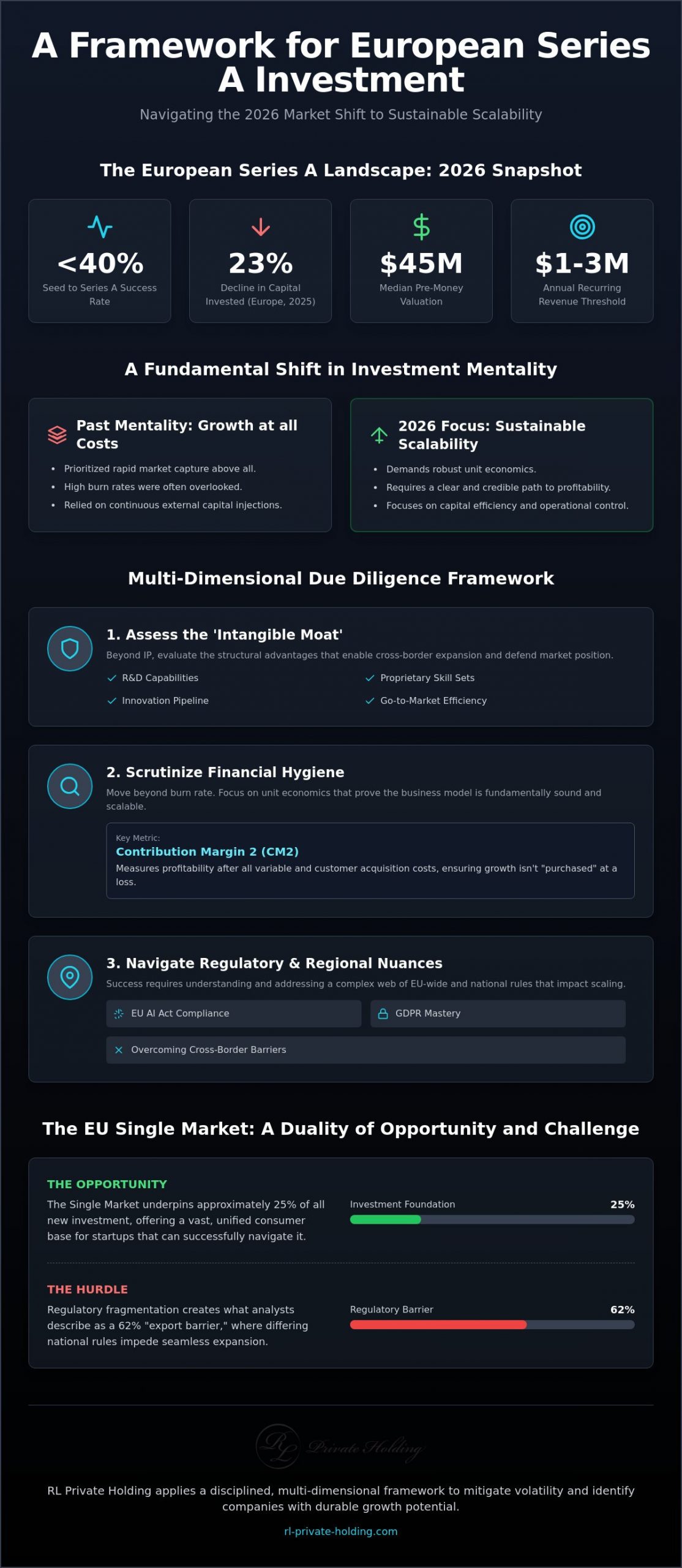
Less than 40 percent of seed funded startups successfully transition to a Series A round, a reality underscored by the 23 percent decline in total capital invested across the European market during 2025. When evaluating series A investment opportunities in Europe, institutional partners often encounter a landscape defined by fragmented regulatory environments and the persistent challenge of benchmarking European valuations against their United States counterparts. It’s widely understood that the ability to identify companies capable of scaling across the Single Market requires more than a superficial analysis of revenue growth. This article provides a disciplined framework for assessing high potential technology and growth investments in the 2026 environment. We examine the specific indicators of cross border scalability, the implications of the 2026 AIFMD and EuVECA reforms, and the strategic role of Luxembourg structures in mitigating risk for global portfolios. By analyzing the current median pre money valuation of 45 million dollars alongside the necessary 1 million to 3 million dollar ARR thresholds, investors can better navigate the complexities of the European venture capital market.
Key Takeaways
- Understand the transition from rapid expansion to sustainable scalability and how the European Tech Champions Initiative influences late stage liquidity.
- Develop a rigorous methodology for evaluating series A investment opportunities in Europe by measuring intangible moats and technological integration.
- Navigate the regional nuances of emerging tech hubs while addressing the specific compliance requirements of the EU AI Act and GDPR.
- Execute sophisticated due diligence using unit economic analysis and cohort modeling to identify companies with durable growth potential.
- Recognize how it’s possible to mitigate volatility through the disciplined asset allocation of a global holding company.
The European Series A Landscape: Context and Market Sentiment in 2026
The 2026 investment environment marks a definitive departure from the growth at all costs mentality that characterized earlier cycles. Institutional investors now prioritize sustainable scalability, focusing on companies that demonstrate robust unit economics alongside technological differentiation. It’s a climate that demands a clear path to profitability, moving away from the reliance on continuous external capital injections. When evaluating series A investment opportunities in Europe, capital efficiency has become a primary metric for long term viability. A Series A funding round in this period requires a management team capable of balancing aggressive market capture with disciplined operational control.
The European Tech Champions Initiative (ETCI) has played a significant role in stabilizing this ecosystem by addressing late stage liquidity. By providing the necessary capital for domestic scale ups, the ETCI has reduced the historical dependency on non European exit routes. This improved liquidity at the growth stage encourages institutional capital to move earlier into the Series A phase, effectively narrowing the Series A Gap where many promising startups previously stalled. Public private partnerships continue to serve as a critical de risking mechanism, offering co investment structures that align public policy goals with private sector returns and institutional standards.
Current Market Dynamics and Exit Optimism
Market sentiment in 2026 reflects a measured rebound in exit activity. While public listings have returned to the agenda, mergers and acquisitions remain the dominant exit route for technology firms. US policy shifts, particularly regarding trade and interest rate adjustments, continue to exert influence on European fundraising volumes. However, the stabilization of corporate investment in intangible assets like R&D indicates a sustained demand for innovative solutions, providing a predictable backdrop for growth stage valuations and long term strategic planning.
The EU Single Market: A Catalyst for Scalability
The Single Market remains a foundational asset for European startups, yet it is often underutilized. While it underpins approximately 25 percent of new investment, regulatory fragmentation still presents a significant hurdle for firms attempting to scale across borders. Startups must navigate what many analysts describe as a 62 percent export barrier, where differing national rules impede seamless expansion. When evaluating series A investment opportunities in Europe, the ability of a management team to navigate these fragmented rules is a key indicator of trade resilience and their capacity to weather global volatility.
A Multi-Dimensional Framework for Evaluating Series A Growth
A multi-dimensional framework for evaluating series A investment opportunities in Europe starts with the “Intangible Moat.” This metric encompasses a firm’s R&D capabilities, innovation pipeline, and the proprietary skill sets of its core technical team. In the 2026 landscape, intellectual property alone is insufficient; it must be paired with a clear path to commercial application. Data from the Global Startup Ecosystem Report 2026 suggests that firms prioritizing these structural advantages outperform their peers in cross-border expansion. This involves moving beyond initial product-market fit to demonstrate go-to-market (GTM) efficiency that remains consistent across different European jurisdictions.
Institutional-grade due diligence requires a focus on financial hygiene that transcends simple burn rate metrics. Analysis must center on Contribution Margin 2 (CM2), providing a granular view of profitability after variable costs and customer acquisition expenses are deducted. This level of transparency is necessary to ensure that growth is not being “purchased” at an unsustainable loss. Many sophisticated entities refine their private equity investment management by applying these rigorous unit economic filters. When evaluating series A investment opportunities in Europe, a company’s ability to maintain a positive CM2 while scaling indicates a mature understanding of its operational costs and market position.
Technological Scalability and AI Integration
Investors must distinguish between companies that have integrated AI into their core value proposition and those that are merely “AI wrappers.” True proprietary technology involves custom models or unique data sets that provide a defensible advantage. Technical debt is a significant risk factor; any shortcuts taken during the Seed stage can hinder pan-European infrastructure rollouts. Assessing the scalability of the underlying tech stack is critical. If the architecture cannot handle the regulatory requirements of multiple EU member states, the path to international growth will be obstructed by high remediation costs.
Team Operational Maturity
The transition from founder-led sales to a repeatable, institutional sales organization is a hallmark of operational maturity. This shift often necessitates the strategic hiring of specialized C-suite talent capable of managing a “Series A” scale organization. Cultural adaptability is a non-negotiable trait for leadership teams operating within the European landscape. Managing a multi-national workforce requires a sophisticated understanding of local labor laws and diverse corporate cultures. Identifying leaders who possess this worldly perspective is essential for firms aiming to achieve long-term stability in a fragmented market.
Analyzing Regional Nuances and Regulatory Risk Profiles
The European technology landscape is no longer confined to the traditional dominance of London, Berlin, and Paris. Institutional investors are increasingly identifying “hidden gems” in emerging hubs such as Lisbon, Tallinn, and Munich. These locations offer specialized talent pools and lower operational overhead. When evaluating series A investment opportunities in Europe, a granular understanding of these regional nuances is essential. These secondary hubs often provide superior entry valuations while maintaining high levels of technical innovation. However, geographical diversification introduces complex regulatory layers. Navigating the EU AI Act, GDPR, and sector specific mandates requires a sophisticated due diligence process. This process must account for both current compliance and future legislative shifts.
Managing cross border investment risk often involves utilizing centralized structures, such as those provided by the Luxembourg financial ecosystem. These frameworks offer a stable environment for aggregating capital and streamlining the administration of multi jurisdictional portfolios. Additionally, evaluating energy bottlenecks has become a critical component of risk assessment for heavy compute or industrial technology investments. As data centers and industrial processes demand more power, the local energy infrastructure’s capacity to support rapid scaling must be verified. This is particularly relevant for firms looking to secure long term stability in energy intensive sectors.
The Impact of Regulatory Fragmentation
Expanding a startup into five or more EU member states incurs a substantial cost of compliance that can erode early stage margins. This fragmentation creates a barrier to entry. While challenging, it often provides a competitive moat for well capitalized firms in sectors like CleanTech and BioTech. Investors should assess the risk of regulatory capture, where established players influence policy to the detriment of new entrants. A company’s ability to anticipate and adapt to these shifts is a primary indicator of its long term resilience. It’s a factor that distinguishes institutional grade targets from speculative ventures.
Sector-Specific Evaluation: AI, CleanTech, and SaaS
In the CleanTech sector, the evaluation must distinguish between capital intensive hardware and software enabled services. Each carries a different risk profile and funding requirement. For SaaS enterprises, benchmarking LTV/CAC ratios against European churn norms is necessary to ensure sustainable unit economics. In the AI sector, focusing on data sovereignty and compliance serves as a growth driver. Companies that internalize these standards often find it easier to secure contracts with large, risk averse European corporations. When evaluating series A investment opportunities in Europe, these sector specific benchmarks provide a clearer picture of potential alpha.
How to Execute Series A Due Diligence: A Strategic Process
The execution of due diligence at the Series A stage requires a methodical transition from thematic interest to technical verification. A structured approach to evaluating series A investment opportunities in Europe involves five critical phases of verification. The process begins with a preliminary screening to ensure alignment with institutional mandates and risk appetite. This initial filter prevents the misallocation of analytical resources on ventures that do not meet core criteria. Following this, the second phase involves a deep dive into unit economic analysis and cohort retention modeling to confirm the durability of the revenue base. The third phase focuses on a comprehensive technical and code base audit, verifying that the proprietary claims made during the seed stage are structurally sound. The fourth phase addresses legal and structural reviews, with a particular emphasis on Luxembourg based holding options for tax efficiency and cross border stability. Finally, a risk adjusted ROI projection and exit strategy mapping provide the necessary data for a final investment decision.
This level of scrutiny is indispensable when evaluating series A investment opportunities in Europe to ensure capital preservation. Each step serves as a safeguard against the unique complexities of the European market, such as varying labor costs and local regulatory requirements. Institutional partners utilize this process to identify companies that possess not only innovation but also the operational discipline required for international scale.
Modeling Unit Economics for Series A
Analytical rigor must be applied to a 36 month forecast that accounts for the specificities of European labor laws and national tax variations. Social security contributions and benefit requirements in markets like France or Germany significantly impact the cost of scaling a workforce compared to the United States. Testing assumptions on customer acquisition costs is equally vital, as non English speaking markets often require higher localization and sales expenses. In 2026, the European SaaS Magic Number, which measures the efficiency of sales and marketing spend relative to net new recurring revenue, carries a benchmark of 0.75 for institutional grade Series A performance.
Legal and Compliance Scrutiny
The Cap Table must be evaluated for “dead equity,” which refers to significant stakes held by inactive founders or early investors who no longer contribute to the firm’s growth. Such imbalances can deter future talent and complicate subsequent funding rounds. Reviewing IP ownership is another priority, ensuring that all R&D and proprietary developments are legally assigned to the corporate entity rather than individual contributors. Sophisticated firms utilize a private equity investment management framework to maintain long term governance standards. This disciplined oversight ensures that the investment remains compliant with evolving EU directives and internal risk protocols.
Secure your portfolio’s future by engaging with our venture capital funding experts for a tailored assessment of your growth strategy.
Strategic Portfolio Allocation through Institutional Expertise
The integration of Series A assets into a broader, diversified holding structure serves as a primary mechanism for mitigating the volatility inherent in early stage growth. While the 2025 market experienced an 18 percent decline in deal volume, a disciplined allocation strategy ensures that high growth technology investments are balanced by more stable asset classes. When evaluating series A investment opportunities in Europe, RL Private Holding utilizes a global lens to identify high alpha prospects that align with institutional standards of governance. This approach moves beyond the limitations of local market fluctuations by considering the 47 percent of venture capital that originates from non European sources.
Successful allocation requires a transition from the role of a passive investor to that of a strategic partner. This evolution is characterized by a deep involvement in the structural development of the portfolio company, ensuring it possesses the resilience to navigate the fragmented European landscape. By providing access to international networks and institutional grade operational frameworks, a holding company can accelerate a firm’s path to maturity. This partnership model is essential for evaluating series A investment opportunities in Europe, as it allows for the early identification of value creation levers that a purely financial investor might overlook.
Leveraging Global Portfolio Synergies
The efficacy of a technology investment is often amplified when it can leverage synergies within established real estate and asset management networks. For instance, a SaaS platform specializing in property technology gains immediate validation and a testing environment when integrated into a diversified real estate portfolio. Utilizing a venture capital Luxembourg framework provides the necessary legal and fiscal stability to manage these cross sector interactions effectively. These frameworks allow institutional partners to consolidate their holdings while maintaining the flexibility required for rapid growth stage adjustments.
Discreet Asset Management for Sophisticated Investors
Maintaining institutional gravity and a sense of quiet authority is critical when participating in competitive deal rounds. Sophisticated investors prioritize partners who demonstrate long term thinking rather than those distracted by short term market volatility or trendy industry cycles. This disciplined perspective is vital for securing positions in high potential ventures where the path to liquidity may extend beyond traditional venture timelines. For those seeking to refine their portfolio’s exposure to European growth, engaging with a global holding structure provides a secure and organized pathway for Series A allocation. Professional inquiries regarding our private equity investment management and venture capital strategies may be directed through our institutional channels.
Advancing Institutional Growth through Disciplined Selection
The 2026 European market rewards investors who prioritize operational maturity over speculative expansion. Success in evaluating series A investment opportunities in Europe depends on a dual commitment to rigorous unit economic analysis and a sophisticated understanding of regional regulatory frameworks. As the landscape shifts toward sustainable scalability, identifying companies with defensible technological moats and the capacity for cross border expansion remains the primary objective for institutional capital. A methodical due diligence process ensures that growth is supported by structural integrity rather than temporary market sentiment.
RL Private Holding provides the institutional gravity and specialized expertise required to navigate these complexities. Headquartered in Luxembourg with a global investment reach, the firm manages a diversified portfolio for institutional and private investors across technology, real estate, and private equity sectors. This worldly perspective allows for the identification of high alpha opportunities while maintaining a focus on long term stability. We invite you to Explore Strategic Venture Capital Allocation with RL Private Holding to learn how a disciplined global partner can enhance your portfolio’s resilience. The evolution of the European ecosystem offers significant potential for those who apply a steady and organized approach to capital deployment.
Frequently Asked Questions
What is the typical Series A valuation range in Europe for 2026?
In 2026, the median pre-money valuation for a Series A round in Europe is approximately 45 million dollars. A typical funding round ranges from 10 million to 20 million dollars, with a median size of around 12 million dollars. These figures reflect a more selective market where institutional investors prioritize firms with strong fundamentals and a clear path to profitability over rapid, high-burn expansion strategies.
How does the EU AI Act affect the evaluation of Series A investment opportunities?
The EU AI Act introduces mandatory compliance layers that directly influence the risk profile and operational costs of technology firms. When evaluating series A investment opportunities in Europe, investors must verify a company’s data sovereignty and its adherence to ethical AI standards. Firms that internalize these regulations early often find it easier to secure contracts with risk-averse corporate partners, effectively turning compliance into a competitive advantage.
Why is Luxembourg considered a primary hub for European venture capital structures?
Luxembourg is a preferred hub due to its stable legal environment and the availability of sophisticated investment vehicles like the SOPARFI and RAIF. These structures provide the transparency and tax efficiency required by global institutional partners. The jurisdiction’s central location and established ecosystem of financial professionals make it an ideal base for managing multi-jurisdictional portfolios while mitigating cross-border regulatory risks.
What are the most critical unit economic metrics to analyze at the Series A stage?
Investors focus on Contribution Margin 2 (CM2) and the European SaaS Magic Number, which carries a 2026 performance benchmark of 0.75. Other critical indicators include an Annual Recurring Revenue (ARR) between 1 million and 3 million dollars and robust cohort retention modeling. These metrics provide a granular view of a company’s ability to scale efficiently across diverse markets without incurring unsustainable acquisition costs.
How much dilution should a Series A investor expect in a typical European round?
A typical Series A investor should expect a dilution range between 15 and 25 percent per round. This percentage varies based on the company’s valuation and the specific capital requirements of the sector. Maintaining a balanced cap table is essential for preserving founder motivation and ensuring the company remains attractive for subsequent Series B and C funding phases as it scales internationally.
What is the “Series A Gap” and how can investors mitigate this risk?
The Series A Gap refers to the trend where less than 40 percent of seed-funded startups successfully raise their next round of capital. Investors mitigate this risk by focusing on companies with demonstrated product-market fit and a repeatable sales organization. Utilizing institutional-grade due diligence frameworks and de-risking mechanisms, such as public-private partnerships, helps identify firms with the operational maturity needed to survive this transition.
Can institutional investors use SOPARFI structures for venture capital holdings?
Institutional investors frequently utilize the SOPARFI structure for venture capital holdings because of its flexibility and favorable participation exemption regime. This vehicle is particularly effective for managing a diversified portfolio of international technology and growth assets. It offers a reliable framework for aggregating capital while ensuring compliance with global asset management standards and internal institutional governance requirements.
How does the EIF survey impact the outlook for venture capital exits in 2026?
The EIF survey indicates a measured rebound in exit optimism for 2026, with an increasing preference for M&A over public listings. This sentiment influences how entities approach evaluating series A investment opportunities in Europe, as it suggests a more predictable liquidity environment for mature assets. Understanding these trends allows investors to better map their exit strategies and align their entry valuations with realistic market expectations.