

A larger funding headline does not necessarily signal a stronger market. The central question behind fintech investment trends Europe 2026 is which businesses can turn demand into durable economics, rather than simply attract capital around a compelling technology story.
Investors need to look beyond sector forecasts. European fundraising can appear resilient in aggregate while activity remains uneven, and a prominent theme does not establish commercial viability. For fintech companies, the quality of revenue, compliance costs and ability to execute matter alongside market growth.
This article sets out the forces shaping European fintech investment in 2026 and a practical framework for assessing their relevance to a portfolio. It considers selective capital allocation, applied artificial intelligence, financial infrastructure and the commercial implications of regulatory change. For each theme, investors can test three areas: business fundamentals, regulatory readiness and execution capacity. The goal is to distinguish durable investment cases from short-lived enthusiasm and connect market signals with company-level diligence and portfolio decisions.
Key Takeaways
- Read European funding figures in context by comparing periods, deal counts and deal sizes, rather than relying on headline totals alone.
- The fintech investment trends Europe 2026 analysis separates visible themes from opportunities supported by customer demand and commercial evidence.
- Compare infrastructure, AI-enabled services, digital assets and payment-related opportunities by the problem they solve and the risks to execution.
- Use a structured diligence sequence to test customer demand, unit economics, defensibility and implementation capacity.
- Translate market and regulatory signals into portfolio monitoring while grounding investment judgment in business fundamentals.
2026 Europe Fintech Investment Trends: Market Signals
A prominent trend is not, by itself, evidence of an investable business. For investors assessing fintech investment trends Europe 2026, market visibility can identify areas for further diligence. Customer demand, viable economics and execution determine whether a particular company merits capital.
What the Q1 2026 European fintech data does, and does not, show
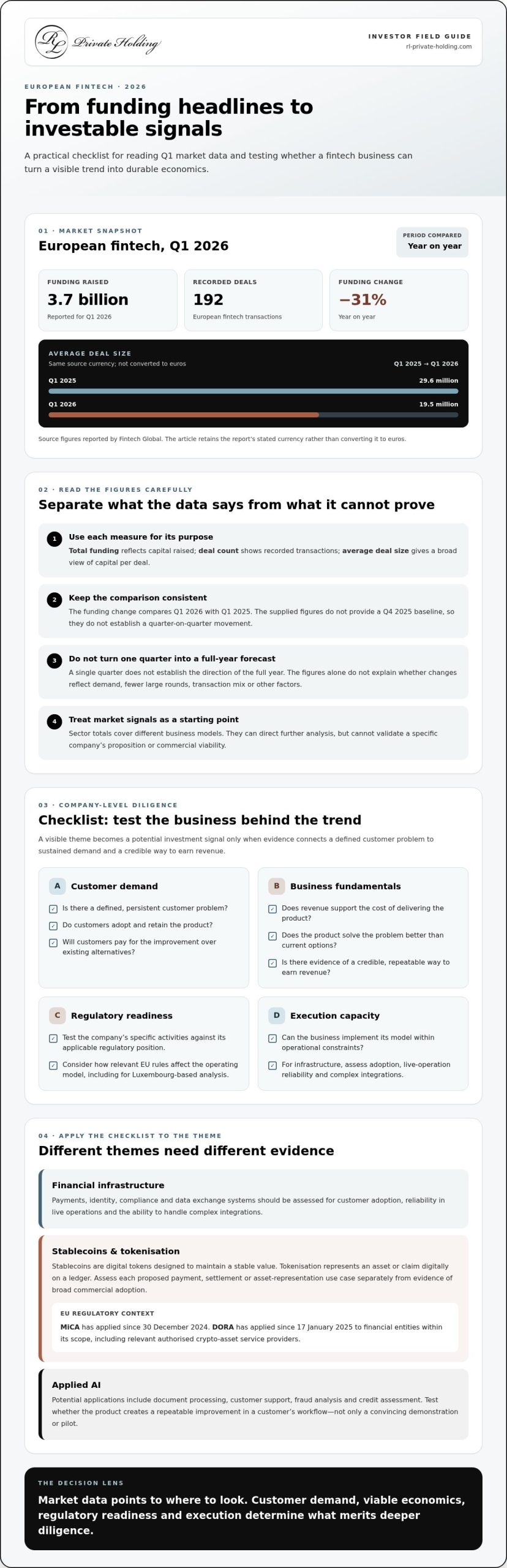
Fintech Global reported that European fintech companies raised 3.7 billion in Q1 2026 across 192 deals, with funding down 31% year on year. The figure covers Europe and the first quarter of 2026; the report’s stated currency is retained, rather than converted to euros. Fintech Global also reported a decline in average deal size, from 29.6 million in Q1 2025 to 19.5 million in Q1 2026, in the same source currency.
These measures describe different aspects of the market. Total funding reflects the capital raised, deal count indicates the number of recorded transactions, and average deal size provides a broad view of capital per deal. Here, the reported annual fall in funding and lower average deal size accompany 192 transactions. None of these figures alone shows whether the change reflects weaker demand, fewer large rounds, a different transaction mix or other factors.
The comparison is year on year, against Q1 2025. It should not be presented as a quarter-on-quarter movement: the supplied figures do not provide a Q4 2025 baseline. Nor does one quarter establish a full-year direction. Reports of cautious large-round activity alongside resilience in smaller transactions add context, but do not replace a consistent comparison of deal sizes and volumes across periods.
From headline trends to investable signals
Financial technology encompasses a range of products and activities, as outlined in this broad overview of Financial Technology (Fintech). That breadth matters when reading market totals: capital may flow to materially different business models, so sector-wide figures cannot validate a company’s specific proposition.
A trend becomes a potential investment signal when evidence connects a defined customer problem to sustained demand and a credible way to earn revenue. Investors can examine whether customers adopt and retain the product, whether revenue supports the cost of delivery, and whether the company can implement its model within relevant regulatory and operational constraints. These are company-level questions, not conclusions that follow from a market forecast.
Forecasts can help frame scenarios, but they remain estimates, not settled outcomes or guaranteed returns. An expectation of stronger funding, for example, says little about which firms will attract capital or build durable economics. Use market data to identify areas for analysis, then test each company’s demand, economics and execution independently. Market signals are a starting point for diligence, not a substitute for investment judgment.
The forces shaping European fintech investment trends in 2026
The fintech investment trends Europe 2026 story is not one technology moving uniformly from novelty to adoption. It comprises distinct commercial problems, from costly financial operations to slow payments, with different evidence requirements. Investors should distinguish enabling infrastructure, which supports other financial services, from applications that directly serve customers. A theme’s strategic importance does not establish that a particular business can capture value from it.
The KPMG Pulse of Fintech H1 2026 Report points to investor interest in infrastructure and AI businesses with defensible value propositions. That is a useful frame, not proof that every company in either category has a viable model. The key diligence question is whether a product solves a costly or persistent problem better than existing alternatives, and whether customers will pay for that improvement.
Financial infrastructure, stablecoins and tokenisation
Financial institutions and fintech firms rely on systems for payments, identity, compliance and data exchange. Infrastructure businesses seek to reduce friction in these functions or make them easier to integrate. Their investment case depends on customer adoption, reliability in live operations and the provider’s ability to support complex integrations, not simply on the importance of the underlying technology.
Stablecoins are digital tokens designed to maintain a stable value, while tokenisation represents an asset or claim digitally on a ledger. Possible functions include payment or settlement and the digital representation of assets. These use cases are distinct from evidence of broad commercial adoption. Investors should assess the use case, regulatory position and operational readiness separately. In the EU, MiCA has applied since 30 December 2024, while DORA has applied since 17 January 2025 to financial entities within its scope, including relevant authorised crypto-asset service providers. For Luxembourg-based analysis, consider how the applicable EU framework affects the company’s specific activities and operating model.
Applied AI, agentic commerce and financial services
AI may help address labour-intensive tasks such as document processing, customer support, fraud analysis or credit assessment. A demonstration or pilot, however, is not the same as a repeatable improvement in a customer’s workflow. Agentic commerce, in which AI systems may help initiate or manage purchasing activity, is an emerging use case; forecasts about its future scale should not be treated as established demand.
For AI investment cases, measurable customer value matters because a defined improvement in cost, speed or decision quality gives investors evidence to test against deployment expense and ongoing risk. This directs diligence toward outcomes rather than model novelty. Examine whether the product improves a specific process, how implementation and maintenance costs affect unit economics, and whether customers continue using it after deployment. The EU AI Act has applied from 2 August 2026, including core requirements for high-risk AI systems such as those used in credit scoring. Applicability depends on the system and its role; investors should assess this alongside data governance, cybersecurity and human oversight.
These themes intersect with changing financial services, including payment infrastructure, compliance technology and AI-enabled insurance or credit processes. A sound investment thesis identifies the customer or institutional need being addressed, then tests commercial traction and the capacity to deliver within applicable regulatory and operational constraints. Investors applying this lens to capital allocation can connect the analysis with RL Private Holding’s venture capital and private equity perspective.
Which fintech themes merit attention, and where are the risks?
A high-profile trend can attract attention without establishing an attractive investment. The fintech investment trends Europe 2026 are best assessed by separating a sector’s potential from a company’s customer demand, economics, valuation and portfolio fit. Start by asking who pays, what problem the product solves and what evidence would show that adoption is durable.
Compare opportunity maturity and evidence
Infrastructure generally enables other financial services, while AI applications, digital-asset products and payment services may compete directly for institutional or end-user budgets. This distinction affects sales cycles, integration requirements and the evidence investors should expect. The table sets out diligence questions, not a universal ranking of themes.
| Theme | Customer problem and paying customer | Evidence to assess | Principal execution risk |
|---|---|---|---|
| Financial infrastructure | Financial institutions or fintech firms need reliable payments, compliance, identity or data systems. | Paid deployments, repeat usage, renewals and successful integrations with customer workflows. | Long sales cycles, complex integration, concentration among a small number of customers, or demanding reliability requirements. |
| AI-enabled services | Financial firms seek to improve a defined process, such as document handling or risk assessment. | Measured improvements in the targeted process, continued use after deployment and a credible relationship between revenue and delivery costs. | Weak results outside pilots, high implementation expense, data governance failures or inadequate human oversight. |
| Digital assets | Institutions or businesses may seek digital settlement or ways to represent assets on a ledger. | A specific, recurring use case; paying counterparties; operational controls; and a viable approach to applicable regulation. | Regulatory dependencies, custody and security exposure, uncertain demand or reliance on ecosystem partners. |
| Payment-related services | Merchants, financial institutions or consumers need to move funds with less friction or better service. | Transaction activity that converts to revenue, repeat customer use and evidence that the service fits existing payment operations. | Integration challenges, fraud and cybersecurity exposure, competitive pressure or dependence on external networks. |
The evidence threshold should reflect maturity. A functioning product and repeat commercial use offer a different signal from a pilot, proposed partnership or forecast. Label market forecasts as estimates and attribute them to their publishers. They can inform scenarios, but do not demonstrate that a particular company has product-market fit. A technology that enables several products may also have a different route to adoption from an application competing for an existing customer budget.
Test regulatory, operational and funding exposure
Regulatory analysis should distinguish rules already in force from proposals or future developments, then assess applicability to the company’s activities and jurisdictions. For a Luxembourg-based investor, EU-level rules may be relevant, but exposure depends on the business model and operating role. Legal readiness is one factor, not a substitute for commercial evidence.
Diligence should also examine cybersecurity, data handling, integration capacity and the capital required to reach sustainable operations. Smaller reported deal sizes alone do not establish stronger fundamentals, lower risk or better valuation. They describe transaction activity, not company quality. A portfolio decision still depends on whether the business can meet customer needs, withstand execution demands and justify its price relative to the investor’s objectives.
How investors can assess European fintech opportunities in 2026
A market thesis is useful only if it can be tested against a company’s commercial evidence and its place in a portfolio. For investors evaluating fintech investment trends Europe 2026, the following sequence moves from the customer problem to portfolio fit. It supports disciplined diligence, but does not constitute legal or investment advice.
A five-step fintech investment assessment
- Define the problem and buyer. Identify the customer with the need, the financial or operational problem being addressed and the person or institution that pays. Test whether buyers already allocate budget to solving it, or whether adoption depends on creating a new behaviour or budget category.
- Verify demand. Separate expressions of interest, pilots and partnerships from paid use and repeat purchasing. Look for evidence that customers adopt the solution in ordinary operations, continue using it and have a clear reason to choose it over existing alternatives.
- Test revenue quality and unit economics. Examine revenue sources, customer retention, acquisition economics and the cost of onboarding and serving customers. Consider whether growth improves the path to sustainable operations or requires continued spending that the business model may not support.
- Assess defensibility and implementation. Evaluate what could preserve the company’s position, such as customer workflow integration, technical capability or operational expertise. Review the team’s capacity to deliver alongside cybersecurity, data governance, technology dependencies and relevant regulatory obligations. Applicable requirements depend on the company’s activities and jurisdictions.
- Model downside and portfolio fit. Consider slower adoption, higher implementation costs, further financing needs and less favourable exit conditions. Then assess the opportunity against the portfolio’s time horizon, concentration limits, objectives and mandate. A strong company may still be unsuitable if its risk profile duplicates existing exposure.
Fit the opportunity within a portfolio
Portfolio analysis should look beyond the fintech label. Two businesses in different subsectors may share exposure to the same funding conditions, technology providers, customer base or regulatory changes. Conversely, companies serving different buyers and solving distinct problems may have different risk drivers even when they use similar technology. Map these dependencies before deciding how an opportunity relates to existing holdings.
For venture investments, an investment framework for venture capital and portfolio diversification can help structure questions about exposure and long-term objectives. For more mature businesses or institutional portfolio decisions, a private equity management framework offers a complementary perspective on disciplined assessment. Neither framework replaces company-specific diligence.
Record the thesis, evidence, key assumptions and conditions that would change the decision. This makes later monitoring more useful: investors can compare actual customer adoption, economics and implementation progress with the original case rather than relying on changing market narratives. Explore RL Private Holding’s venture capital and private equity perspective for related investment context.
Turning fintech investment trends into disciplined portfolio decisions
The fintech investment trends Europe 2026 can help investors identify questions worth examining, but a sector theme is not an investment decision. Portfolio judgment depends on company-specific evidence, the price and terms of an opportunity, and its relationship to wider objectives. Monitoring those factors over time helps investors distinguish durable progress from a thesis that no longer reflects the business.
Use milestones to revisit the investment thesis
At the outset, record the assumptions that support the investment case and the milestones that would test them. These should relate to the company’s actual model, not generic sector expectations. A review can then assess whether customer adoption, retention and commercial economics are developing as anticipated, and whether management is delivering against stated operational milestones.
Keep a concise record of the evidence under three headings: validated, unresolved and invalidated. For example, recurring customer use may support a demand assumption, while continued dependence on pilots may leave commercial adoption unresolved. A material change in delivery costs or customer behaviour could invalidate an assumption about the path to sustainable operations. This record makes changes to the thesis explicit rather than allowing market sentiment to substitute for evidence.
Regulatory assumptions also require review. Track relevant updates from authoritative EU and Luxembourg sources, and assess whether a change affects the company’s activities, obligations or operating model. Distinguish enacted requirements from proposals and announcements. Funding conditions merit the same discipline: reassess access to follow-on capital and plausible financing needs as the market changes, without treating a shift in sector funding as proof of a company’s prospects.
Connect market analysis with investment discipline
Keep sector outlooks, company diligence and portfolio decisions distinct. A forecast about infrastructure, AI or digital assets can help frame a market scenario; it cannot demonstrate that a specific company has paying customers, defensible economics or the capacity to execute. Likewise, positive operating evidence does not by itself determine valuation or establish that an opportunity suits every mandate.
At portfolio level, review whether an investment increases concentration in shared technology, customer, funding or regulatory risks. Consider its time horizon and intended role alongside existing objectives. Readers assessing broader allocation choices can draw on family office investment strategies as a related framework, while keeping any fintech decision grounded in its own diligence and mandate.
RL Private Holding works across technology, venture capital and private equity. This provides institutional context for considering how emerging themes relate to capital allocation, without implying specific fintech holdings or outcomes. Explore the firm’s family office investment framework for a broader perspective on allocation questions.
Keep Portfolio Decisions Grounded in Evidence
Fintech investment trends Europe 2026 are most useful as prompts for ongoing review, not fixed allocation signals. As customer behaviour, funding access and regulatory interpretations evolve, investors can revisit the assumptions behind each position and adjust their assessment when evidence changes. This preserves flexibility while keeping long-term objectives in view.
A practical next step is to translate each investment thesis into observable milestones, assign responsibility for monitoring them and define what would warrant renewed diligence. Record which assumptions remain valid and which require further examination. This keeps sector narratives in proportion and gives portfolio decisions a clear basis for review over time.
RL Private Holding’s focus spans technology, venture capital, private equity and asset management within a diversified portfolio of businesses. This institutional perspective provides context for considering how emerging themes relate to capital allocation, without implying specific fintech holdings or outcomes. Explore RL Private Holding’s investment perspective and continue evaluating opportunities with care and consistency.
Frequently Asked Questions
What are the main fintech investment trends in Europe in 2026?
The main themes include financial infrastructure, applied artificial intelligence, digital assets and tokenisation, payments, and open finance. These are areas for assessment, not guaranteed opportunities. For investors following fintech investment trends Europe 2026, the practical test is whether customers have a clear reason to adopt and pay for a product, whether its regulatory position is understood, and whether the company can execute its model effectively.
Is European fintech investment falling in 2026?
Fintech Global’s Q1 2026 report records a year-on-year fall in European fintech funding, while deal volume was slightly higher, with 192 deals reported for the quarter. This comparison covers Q1 2026 against Q1 2025; it does not establish what happened across the full year. Funding totals measure capital raised, deal counts measure transaction volume, and neither directly measures the quality of the businesses receiving investment.
Why are investors focusing on fintech infrastructure in 2026?
Fintech infrastructure provides the technology and services financial institutions and fintech businesses use to operate, such as payment, compliance and core systems. KPMG’s 2026 outlook identifies infrastructure as an investment priority amid interest in stablecoins, digital assets and modernising existing systems. An integration tool may address a genuine operational need, but investors still need evidence of paying customers, secure delivery, workable integrations and sustainable economics.
How is artificial intelligence changing fintech investment in Europe?
KPMG’s 2026 outlook anticipates greater investor emphasis on AI businesses that demonstrate value, rather than relying on pilots alone. A practical assessment could compare a customer’s process before and after deployment while accounting for implementation and ongoing operating costs. Investors should also examine data governance, cybersecurity, operational controls and the role of human review. The outlook describes an investment focus, not a verified market-wide outcome or assurance of commercial success.
What does tokenisation mean for fintech investors?
Tokenisation means representing an asset or financial interest digitally through tokens. That description alone does not establish that a product is legally workable or commercially useful. Investors can examine what asset or rights are represented, who the intended customer is, how the operating model functions and what regulatory treatment applies in the relevant jurisdiction. Taylor Wessing’s 2026 outlook identifies tokenisation as a theme, while specific legal implications require current, jurisdiction-specific analysis.
Can regulatory changes create investment opportunities in fintech?
Yes, regulatory changes can alter product design, operating costs, market access and demand for compliance tools. A new requirement may create demand for specialised infrastructure while increasing implementation burdens for the firms subject to it. Investors should distinguish enacted rules from proposals and forecasts, then consider the relevant jurisdiction and business model. For Luxembourg-linked analysis, assess applicable EU and national requirements in context. This overview is informational and is not legal advice.
How should investors assess a fintech company in 2026?
Assess whether a defined customer group shows real demand, then examine revenue quality, unit economics, defensibility, technology delivery, regulatory dependencies and financing needs. A useful practical exercise is to test whether the company could meet its operating milestones if customer adoption takes longer than management expects. Consider downside scenarios and portfolio fit as well. The weight assigned to each factor should reflect the company’s stage, business model and the investor’s mandate.