

A venture capital fund’s past performance is frequently a poor predictor of its future success. In an environment defined by shifting liquidity and heightened regulatory oversight, the distinction between genuine investment skill and market-driven luck has become increasingly opaque. You likely find that traditional metrics often fail to capture the nuances of GP team stability or the robustness of operational due diligence. It’s a common frustration for institutional investors who require more than just a high internal rate of return to justify a long-term commitment.
Learning how to evaluate a venture capital fund manager in 2026 demands a shift toward auditing the repeatability of the investment process itself. This guide provides a strategic framework to master the institutional-grade protocols required to identify elite managers who operate beyond surface-level metrics. We’ll explore standardized due diligence procedures, the impact of new AML regulations, and methods for ensuring deep alignment between LP and GP interests. By the end of this analysis, you’ll possess a repeatable methodology for assessing manager quality and structural integrity in a global context.
Key Takeaways
- Identify the criteria for testing a GP’s sourcing engine to ensure deal flow results from a repeatable process rather than market beta.
- Assess organizational stability by evaluating team tenure, historical collaboration markers, and the effective mitigation of key-man risk.
- Apply a multi-stage technical framework for how to evaluate a venture capital fund manager that prioritizes deep-dive track record attribution analysis.
- Analyze the 2026 evolution of management fee structures and incentive alignment to ensure governance frameworks favor long-term LP interests.
- Navigate the updated regulatory landscape for 2026, including new AML compliance protocols and heightened SEC oversight regarding fee disclosures.
The Multi-Dimensional Nature of Venture Capital Manager Evaluation
The role of the General Partner (GP) has transitioned from simple capital allocation to a sophisticated form of institutional stewardship. Understanding how to evaluate a venture capital fund manager in 2026 requires a move beyond examining historical returns to auditing the underlying organizational framework. In the current market, “access” to high-growth deals is a baseline requirement; the true differentiator is the GP’s ability to provide structural value-add and professional governance within their portfolio companies. This shift reflects a broader trend where institutional gravity and disciplined management are prioritized over speculative growth. Strategy dictates results.
Traditional metrics like Internal Rate of Return (IRR) often provide an incomplete picture of a manager’s performance. While quantitative data points are essential, they frequently reflect market beta rather than a manager’s specific alpha generation. Venture capital (VC) investments require a long-term horizon, making qualitative factors such as sourcing engines and team stability equally critical. Institutional-grade due diligence now focuses on the repeatability of the investment process to ensure that past successes weren’t merely the product of favorable economic cycles.
Quantitative vs. Qualitative Evaluation Metrics
Total Value to Paid-In (TVPI) and Distributed to Paid-In (DPI) remain the primary benchmarks for liquidity and value creation. However, institutional LPs in 2026 prioritize DPI as the most reliable indicator of realized success. Assessing the “edge” of a manager involves a granular look at their sourcing, selection, and support capabilities. A manager who relies solely on market tailwinds lacks the repeatability necessary for sustained performance. Skill must be proven. When determining how to evaluate a venture capital fund manager, one must audit whether the GP possesses a proprietary sourcing engine that consistently identifies non-obvious opportunities before they reach the broader market.
The 2026 Venture Capital Landscape
The current investment environment is shaped by rapid technology shifts and a rigorous regulatory climate. Managers must now demonstrate proficiency in AI oversight and data security, specifically regarding compliance with updated Regulation S-P and FinCEN rules effective as of 2026. Global diversification has become a necessity for risk mitigation in institutional portfolios. Professional structures, such as those found in Luxembourg, provide a benchmark for regulatory excellence and structural integrity. These frameworks offer the transparency and professional governance that modern investors demand, ensuring that the fund operates with a clear plan and high internal discipline.
Auditing the Investment Thesis and Process Repeatability
Identifying a high-performing manager requires more than a review of past wins; it necessitates a deep audit of their investment thesis. A clear mandate serves as a filter against style drift, which occurs when managers chase trending sectors without a fundamental edge. When determining how to evaluate a venture capital fund manager, LPs should prioritize those who demonstrate a repeatable sourcing engine. Success in 2026 isn’t built on participating in widely syndicated deals but on the ability to uncover non-obvious opportunities through proprietary networks. The architecture of the Investment Committee (IC) provides a window into the firm’s internal discipline, revealing whether decisions are based on data-driven conviction or consensus-driven mediocrity.
The Sourcing and Selection Mechanism
A critical component of how to evaluate a venture capital fund manager involves testing the sourcing engine. Proprietary deal flow is the hallmark of an elite GP. You should analyze the ratio of proprietary leads versus syndicated opportunities to determine if the manager is a leader or a follower in the market. A thesis-driven approach is particularly vital in technology sectors, where specialized knowledge allows a GP to spot value before it becomes consensus. Evaluating the rejection rate and selection discipline is equally informative. A manager who reviews 1,000 opportunities to select 10 shows a level of rigor that suggests a commitment to quality over deployment velocity. Deployment speed must never compromise the integrity of the selection process.
Post-Investment Value Creation
The distinction between a capital provider and a strategic partner is most evident after the deal closes. You must examine how the manager supports growth-stage firms beyond providing liquidity. This support often involves active board participation, talent acquisition assistance, and facilitating follow-on funding. Measuring the impact of the GP’s network on portfolio exits provides a concrete metric for value creation. Many elite venture firms are now integrating private equity value creation principles into their VC strategies to drive operational excellence. This cross-pollination of disciplines ensures that portfolio companies aren’t just growing, but are scaling with professional governance and structural stability. For those prioritizing structural integrity, observing how a firm applies these rigorous management protocols offers a clear indicator of long-term potential.
- Thesis Clarity: Is the mandate specific enough to prevent style drift?
- Sourcing Alpha: Does the GP access deals that aren’t visible to the broader market?
- IC Rigor: Is the decision-making process transparent, documented, and objective?
- Exit Support: Can the GP point to specific instances where their intervention directly led to a successful liquidity event?
Assessing Team Dynamics and Organizational Stability
A venture capital firm is only as resilient as its underlying partnership. While individual track records provide historical context, the stability of the organization determines the fund’s capacity to navigate long-term cycles. When analyzing how to evaluate a venture capital fund manager, institutional investors must look past the “star power” of a single founder. True institutional gravity requires a decentralized decision-making structure where knowledge and relationships are shared across the team. Excessive dependency on a single individual, often termed “key-man risk,” creates a structural vulnerability that can jeopardize a fund’s performance if that individual departs or becomes inactive.
Team tenure and historical collaboration markers offer the most reliable data points for assessing cohesion. You should examine how long the senior partners have worked together and whether they’ve successfully navigated previous market downturns as a unit. High turnover at the junior and mid-levels is often a leading indicator of internal friction or a flawed compensation structure. A firm that cannot retain its junior investment talent will struggle with succession and long-term institutional memory. The back office and operational support staff are equally vital. A professionalized middle office ensures that the GP can focus on investment activities without compromising on reporting or compliance standards.
Partnership Cohesion and Succession Planning
The 2026 outlook for venture capital is increasingly focused on generational wealth transfer within GP organizations. It’s essential to audit the history of partner additions and departures to identify patterns of instability. You should ask how carried interest is distributed across the firm. A lopsided distribution that favors only the founding partners often discourages the next generation of leaders. Alignment of personal capital is another critical metric. A significant GP commitment level ensures that the managers have “skin in the game,” aligning their personal financial outcomes with those of the Limited Partners. This commitment serves as a psychological and financial anchor for the firm’s strategy.
Operational and Institutional Maturity
Operational due diligence must extend to the firm’s internal governance and reporting standards. Elite managers adopt rigorous protocols that mirror the transparency and discipline found in other high-stakes asset classes. For instance, the professional standards maintained by private wealth management firms Luxembourg offer a relevant benchmark for VC operations. These standards include robust risk management protocols and clear internal reporting lines. A GP that operates with this level of institutional maturity is better equipped to handle the complex regulatory requirements of 2026, such as updated AML and KYC protocols. Professional governance isn’t a luxury; it’s a prerequisite for managing institutional capital at scale.
- Key-Man Risk: Is the firm’s success tied to a single individual or a repeatable team process?
- Succession Logic: Does a clear path exist for junior talent to ascend to the partnership?
- GP Commitment: Is the manager’s personal capital meaningfully aligned with the fund’s success?
- Operational Integrity: Does the firm utilize institutional-grade reporting and compliance frameworks?
Understanding these organizational nuances is a fundamental part of how to evaluate a venture capital fund manager. A firm that prioritizes structural stability and professional governance is far more likely to deliver consistent results over multiple fund cycles.
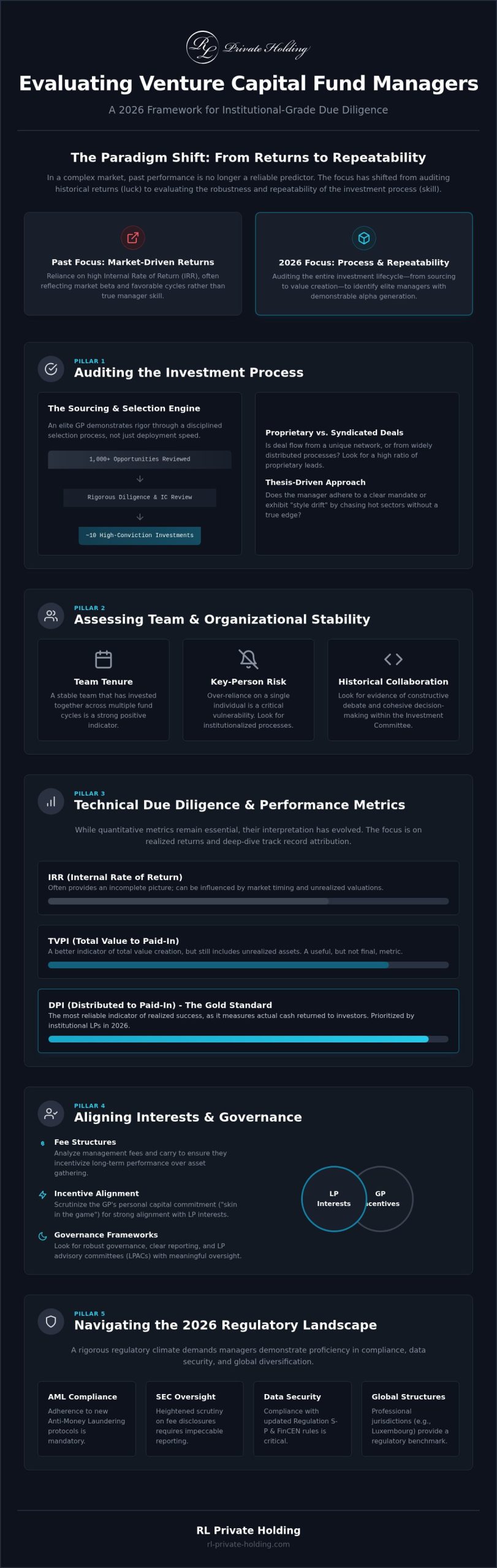
The Technical Due Diligence Framework: A Step-by-Step Guide
Technical due diligence represents the transition from theoretical interest to institutional commitment. It’s a rigorous process designed to stress-test every claim made by the General Partner. Effective protocols demand a multi-stage approach that moves beyond the surface-level contents of a data room. When determining how to evaluate a venture capital fund manager, LPs must implement a structured framework to ensure consistency across their portfolio. This methodical progression ensures that only the most resilient managers receive funding.
The process begins with preliminary screening to confirm thesis alignment. Stage two involves a deep-dive track record attribution analysis. Stage three shifts focus to qualitative verification through reference calls with founders and co-investors. Stage four requires a thorough operational and legal review. Finally, stage five culminates in the final Investment Committee presentation and capital allocation. Skill must be proven. Each stage serves as a filter to remove managers whose success is tied to market beta rather than repeatable investment alpha.
Track Record Attribution Analysis
Identifying the specific individuals responsible for historical returns is paramount. It’s not enough to see a high IRR; you must determine which partners drove specific successful exits. This analysis helps distinguish between firm-wide institutional knowledge and the talent of a single departing partner. LPs should also scrutinize the loss ratio to understand the manager’s risk tolerance and capital preservation discipline. Persistence of returns across multiple fund cycles is a key indicator of investment skill. Performance should always be measured against relevant venture capital Luxembourg benchmarks to provide a localized and accurate context for European allocations.
Legal and Regulatory Verification
The structural integrity of a fund is as important as its investment strategy. Reviewing the Limited Partnership Agreement (LPA) is a critical component of how to evaluate a venture capital fund manager. This review ensures that governance terms, fee structures, and distribution waterfalls are aligned with LP interests. In the 2026 regulatory environment, the strategic use of the Luxembourg special limited partnership (SCSp) has become a standard for institutional-grade funds. This structure offers the flexibility and transparency required to meet AIFMD requirements and local Luxembourg regulations. Confirming compliance with these standards protects the LP from unforeseen operational or legal liabilities.
For institutions seeking to refine their allocation strategies, professional investment management provides the necessary governance to ensure long-term stability.
Aligning Interests: Fees, Incentives, and Governance
The 2026 evolution of management fee structures reflects a growing demand for transparency and performance-based accountability. While the “two and twenty” model remains a primary reference point, it’s no longer accepted without scrutiny. Limited Partners (LPs) increasingly negotiate management fee step-downs, which typically reduce the fee from 2% to approximately 1% after the initial investment period, usually around year four or five. When determining how to evaluate a venture capital fund manager, auditing these economic terms is essential for ensuring that the GP’s compensation is tied to value creation rather than just asset accumulation. Clawback provisions further protect LPs by ensuring that any excess carried interest paid to the GP is returned if the fund’s overall performance falls below agreed thresholds.
The choice between American and European distribution waterfalls significantly impacts alignment. The American model allows GPs to receive carried interest on a deal-by-deal basis, while the European model requires the return of all contributed capital and expenses to LPs before the GP participates in profits. The latter is often preferred for its conservative approach to capital preservation. Professional governance is maintained through the Limited Partner Advisory Committee (LPAC), which oversees conflicts of interest and ensures the GP adheres to the fund’s mandate. Transparency in reporting isn’t just a compliance requirement; it’s a marker of institutional maturity that distinguishes elite managers from their peers.
Incentive Structure Optimization
Performance fees should be structured to drive long-term strategic growth. Hurdle rates, or preferred returns, act as a benchmark that the GP must exceed before earning carried interest. This mechanism ensures that the manager is only rewarded for generating genuine alpha. Many LPs find it useful to compare these benchmarks against family office investment strategies Luxembourg to ensure their venture allocations align with broader wealth preservation goals. A well-aligned incentive structure reduces the likelihood of reckless risk-taking and encourages a disciplined approach to deployment. It’s a fundamental component of structural integrity.
Conclusion: The RL Private Holding Approach
Mastering how to evaluate a venture capital fund manager involves a comprehensive audit of thesis, team, and structural alignment. At RL Private Holding, we integrate these rigorous frameworks into a diversified global portfolio, prioritizing structural integrity and professional governance. Our approach focuses on long-term stability and the discreet management of private assets. We prioritize structures like the SCSp that offer the transparency required by sophisticated investors. This methodology ensures that every allocation is backed by a clear plan and a high level of internal discipline. Explore our institutional investment frameworks to understand how we apply these principles to identify elite managers in the global landscape.
Prioritizing Structural Integrity in Manager Selection
Success in venture capital for 2026 depends on a transition from reactive selection to proactive, structural auditing. You’ve seen that understanding how to evaluate a venture capital fund manager requires a deep analysis of sourcing alpha, team cohesion, and the repeatability of the investment process. By prioritizing technical due diligence and ensuring rigorous alignment through transparent fee structures, institutional investors can effectively mitigate the risks of market beta. These frameworks provide the stability necessary to navigate a complex global landscape with confidence.
RL Private Holding offers specialized expertise in Luxembourg financial structures and discreet, institutional-grade portfolio management. Our focus remains on identifying high-potential opportunities in global technology and growth-stage firms while maintaining professional governance and structural integrity. We invite you to Consult with RL Private Holding on Strategic VC Allocations to refine your approach to private market investments. Building a resilient portfolio starts with a disciplined framework and a steady partner by your side.
Frequently Asked Questions
What is the most critical qualitative factor in VC manager evaluation?
The most critical qualitative factor is the repeatability of the investment process, specifically the GP’s proprietary sourcing engine. Investors should determine if deal flow is the result of a deliberate, thesis-driven strategy or merely participation in widely syndicated rounds. A manager’s ability to identify non-obvious opportunities before they reach the broader market indicates genuine skill. This qualitative edge ensures the fund can consistently access high-quality deals regardless of fluctuating market cycles.
How do you distinguish between luck and skill in a venture capital track record?
Distinguishing between luck and skill requires a deep-dive track record attribution analysis. This process identifies which specific partners drove successful exits and whether those returns resulted from a repeatable methodology. Skill is evidenced by the persistence of returns across multiple fund cycles and a disciplined loss ratio. If a manager’s success is concentrated in a single “unicorn” during a bull market, it may suggest market beta rather than individual investment alpha.
What are the standard management fees for venture capital funds in 2026?
The “two and twenty” structure remains the standard benchmark, though it’s increasingly subject to negotiation in 2026. Many Limited Partners now secure management fee step-downs, where the 2% fee reduces to approximately 1% after the investment period ends. Understanding how to evaluate a venture capital fund manager involves auditing these fee structures to ensure alignment. GPs often face pressure to offset monitoring or transaction fees against the base management fee to protect LP interests.
How does the Luxembourg SCSp structure benefit Limited Partners?
The Luxembourg Special Limited Partnership (SCSp) provides Limited Partners with a high degree of contractual flexibility and transparency. This structure is tax-neutral and aligns with AIFMD requirements, offering the professional governance institutional investors demand. It allows for bespoke arrangements regarding distribution waterfalls and governance rights. The SCSp is a preferred vehicle in 2026 because it combines structural integrity with the regulatory excellence associated with Luxembourg’s established financial ecosystem.
What is a “Key-Man” clause and why is it essential for due diligence?
A Key-Man clause is a protective provision that prevents the GP from making new investments if specific lead partners depart or become inactive. It’s essential for due diligence because venture capital is a long-term commitment heavily reliant on individual expertise. If the primary decision-makers leave, the fund’s strategic direction may be compromised. This clause ensures that LPs aren’t locked into a vehicle that lacks the talent originally responsible for the investment thesis.
How should institutional investors assess a GP’s ESG and impact reporting?
Institutional investors should assess ESG by reviewing a GP’s adherence to standardized reporting frameworks and the integration of these factors into the investment committee process. In 2026, surface-level claims aren’t sufficient. LPs require data-driven outcomes that demonstrate how ESG considerations mitigate risk or drive value within portfolio companies. Evaluating the GP’s internal policies on data privacy and cybersecurity is also a critical component of modern operational due diligence and risk management.
What is the role of the LP Advisory Committee (LPAC) in fund governance?
The LP Advisory Committee (LPAC) primarily serves to resolve potential conflicts of interest between the GP and the fund. It provides a platform for LPs to oversee the fund’s mandate, approve valuation policy changes, and review related-party transactions. While the LPAC doesn’t participate in day-to-day investment decisions, its presence ensures a layer of professional governance. This oversight is vital for maintaining transparency and protecting the collective interests of the Limited Partners throughout the fund’s life.
How often should an institutional LP perform a full re-evaluation of a GP?
Institutional LPs should perform a full re-evaluation of a GP at the end of each investment period or before committing to a successor fund. While reporting occurs quarterly, a deep-dive audit is necessary to determine how to evaluate a venture capital fund manager against updated 2026 benchmarks. This re-evaluation should focus on team stability, deployment velocity, and any shifts in the investment thesis. Continuous monitoring ensures that the GP remains aligned with the LP’s long-term strategic objectives.