

The assumption that a General Partner’s interests are perfectly aligned with those of a Limited Partner during a syndication process is a systemic risk that institutional investors can’t afford to ignore. While the trend toward direct exposure grows, the threat of adverse selection remains a reality when GPs syndicate deal portions that may not meet their own internal hurdle rates. Success in structuring co-investment deals in Luxembourg requires more than capital. It demands a disciplined, independent verification of the underlying asset’s standalone merit. This level of scrutiny ensures the investment thesis remains valid under objective analysis, especially as the ECB benchmark interest rate sits at 2.40% and AIFMD II reporting obligations increase.
You understand the difficulty of performing deep-dive due diligence on compressed timelines when internal resources are stretched thin. This article outlines a strategic institutional framework designed to neutralize GP bias and validate commercial claims with technical precision. We’ll explore the protocols required to mitigate asset-level risk and ensure your co-investments achieve the superior risk-adjusted returns expected in a sophisticated financial hub.
Key Takeaways
- Identify the drivers of adverse selection and why independent due diligence is necessary to verify the standalone merit of GP-syndicated assets.
- Apply a four-pillar protocol to validate commercial claims and financial exit assumptions, ensuring valuation models reflect objective market realities.
- Adopt a standardized framework for structuring co-investment deals in Luxembourg that leverages the transparency and stability of local investment vehicles.
- Establish a specialized “Quick-Look” filter to efficiently screen opportunities and maintain institutional discipline during compressed deal timelines.
- Mitigate information asymmetry by triangulating GP data with independent sector specialists to ensure total alignment with the target asset’s long-term potential.
The Strategic Role of Independent Due Diligence for Co-investments
Institutional investors are increasingly moving away from a passive posture toward a more rigorous, active validation of individual assets. Independent due diligence in this context refers to a comprehensive, third-party analysis of a target asset that’s conducted separately from the General Partner’s (GP) own underwriting process. While the GP provides a data room and an investment memorandum, these documents are designed to facilitate a specific outcome: the successful syndication of the deal. Equity co-investment requires a level of scrutiny that goes beyond confirming the GP’s findings; it involves challenging the underlying assumptions of the deal to ensure alignment with the Limited Partner’s (LP) risk appetite.
The process of structuring co-investment deals in Luxembourg often utilizes flexible vehicles such as the Special Limited Partnership (SCSp). This structure provides the necessary legal framework for sophisticated LPs to exercise greater control over their capital allocation while benefiting from the GP’s sector expertise. However, the reliance on the GP’s narrative can lead to significant information asymmetry. Independent analysis serves as the essential governance layer needed to bridge this gap and verify the asset’s standalone merit.
Neutralizing the Adverse Selection Risk
Adverse selection remains a primary concern for institutional LPs. GPs may choose to syndicate a deal for legitimate reasons, such as managing concentration limits or addressing deal fatigue after a long pursuit. There’s also a risk that a GP syndicates a portion of a deal because the asset’s quality or growth profile doesn’t justify a full fund commitment. LPs must develop proprietary insights that look past the provided data room. This independent verification is a cornerstone of sophisticated private equity investment management. By validating the GP’s thesis through independent market research and technical audits, LPs can distinguish between a strategic syndication and a sub-optimal asset disposal.
Economic and Governance Benefits
The economic rationale for co-investment is compelling. By investing directly alongside the GP, LPs can significantly reduce the effective management fees and carried interest associated with traditional fund structures. This carry optimization directly enhances the institutional ROI and supports long-term wealth preservation. Governance also improves through direct asset access. LPs can negotiate specific information rights and governance protections within side letters or shareholders’ agreements. This level of transparency is essential for structuring co-investment deals in Luxembourg, where the regulatory environment under AIFMD II demands higher standards of reporting and liquidity risk management. Direct interaction with the target company’s management team provides a clearer view of operational risks that might be obscured in a broader fund report.
The Four Pillars of the Independent Due Diligence Protocol
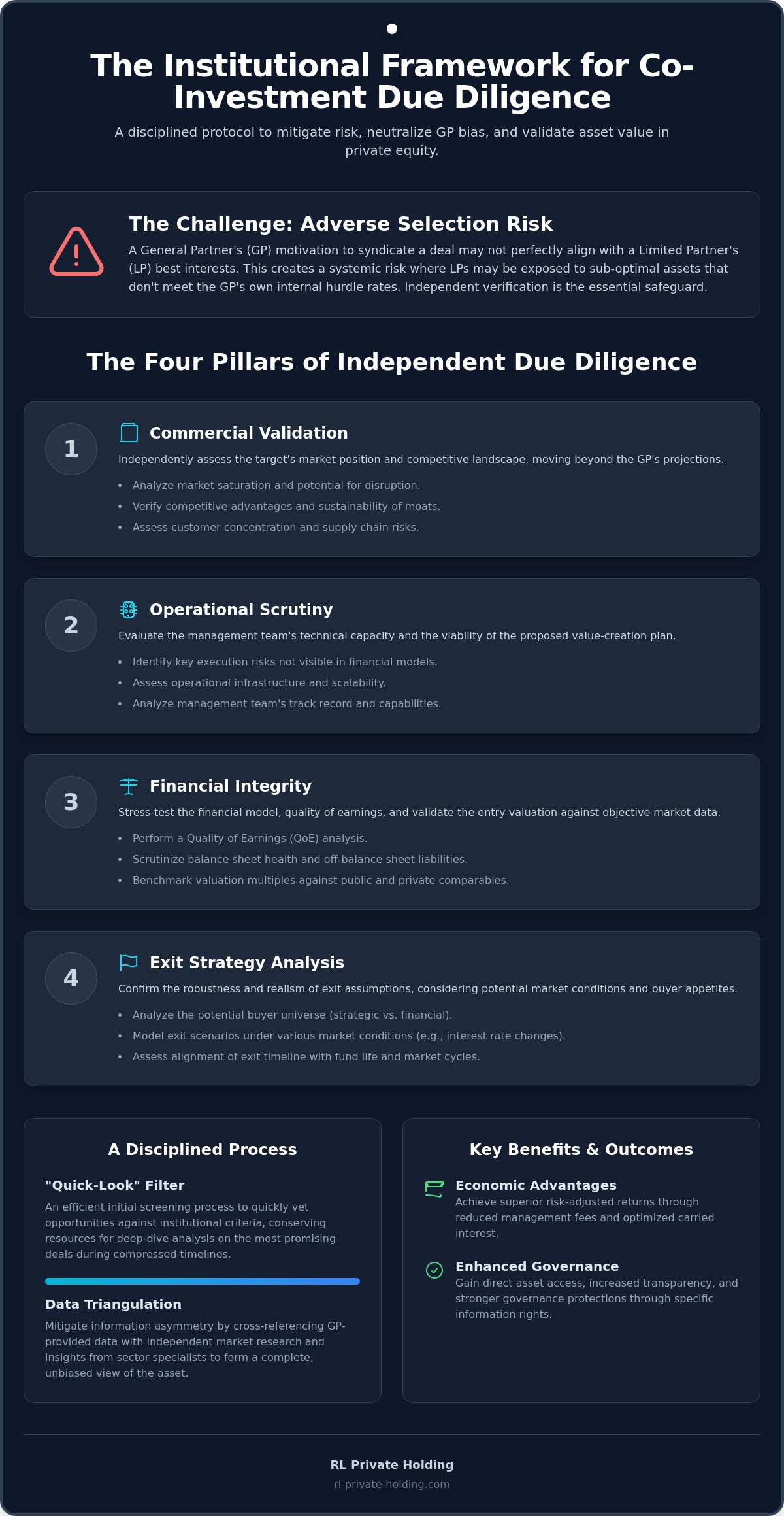
The execution of a successful co-investment strategy requires a framework that moves beyond the scope of a GP’s provided materials. A standardized protocol allows institutional investors to maintain a consistent evaluation process across various sectors and geographies. When structuring co-investment deals in Luxembourg, this protocol must be adapted to the specificities of the local regulatory and legal environment, ensuring that the vehicle’s design supports the underlying investment thesis. This disciplined approach serves as the primary defense against the erosion of institutional capital through unverified assumptions.
Commercial due diligence involves an independent assessment of the target’s market position and competitive advantages. It shouldn’t rely on the GP’s growth projections alone. Instead, it must look at market saturation, technological disruption, and customer concentration. Operational due diligence follows, evaluating whether the existing management team possesses the technical capacity to execute the proposed value-creation plan. This phase identifies execution risks that might not appear in a financial model but are critical to long-term performance.
Financial and Valuation Integrity
Financial due diligence focuses on validating the entry valuation and the robustness of exit assumptions. With the ECB benchmark interest rate at 2.40%, the cost of capital must be accurately reflected in all pro-forma projections. Stress-testing the GP’s base case is essential to understand how the asset performs under adverse conditions. This involves a granular review of debt covenants and refinancing risks, alongside a verification of EBITDA adjustments. Identifying aggressive pro-forma add-backs often reveals a significant gap between the GP’s narrative and the asset’s historical performance. Validation of these figures ensures that the entry price reflects the asset’s true earning potential rather than a speculative future state.
Structural Optimization in Luxembourg
The legal and tax framework is the final pillar. Evaluating the suitability of a SOPARFI versus a Luxembourg special limited partnership is critical for maximizing tax efficiency and ensuring treaty access. Since the implementation of AIFMD II on April 16, 2026, institutional LPs must also consider enhanced reporting obligations and delegation rules. A well-structured vehicle ensures that governance rights are protected and that the investment remains compliant with evolving ESG Ratings Regulations. For institutions seeking to refine their approach, consulting with an established partner ensures these structural nuances are managed with institutional precision.
Mitigating GP Bias and Information Asymmetry
Maintaining institutional composure is the first requirement of effective deal evaluation. While the partnership between a General Partner (GP) and a Limited Partner (LP) is foundational, the LP must recognize that the GP acts as a seller during the syndication process. This dual role creates a natural bias toward highlighting an asset’s strengths while downplaying its structural or operational vulnerabilities. When structuring co-investment deals in Luxembourg, the sophistication of the legal framework doesn’t exempt the investor from the psychological trap of deal excitement. Institutional distance is necessary to ensure that the desire for direct exposure doesn’t cloud the objective assessment of the asset’s risk profile.
Triangulating GP data with independent third-party experts and sector specialists is a critical step in neutralizing this bias. Relying solely on the GP’s internal underwriting team can lead to a narrow perspective. Independent specialists provide a counter-narrative, often identifying sector-specific headwinds or technological shifts that the GP’s memorandum might omit. A significant red flag in this process is the absence of raw data or the use of overly curated benchmarks in GP-provided reports. LPs should also evaluate the “Skin in the Game” by comparing the GP’s own capital commitment to the total syndicate size. A disproportionately large syndication relative to the GP’s fund commitment may suggest a lack of conviction in the asset’s long-term performance.
Identifying Information Gaps
The most valuable insights often reside outside the official data room. Identifying what the GP isn’t showing is just as important as analyzing what they are. This requires conducting off-book inquiries and independent management interviews to assess leadership depth beyond the CEO and CFO. Customer and supplier reference checks serve as primary validation tools, offering an unvarnished view of the target’s market reputation and operational stability. These direct inquiries often reveal underlying issues with customer churn or supply chain fragility that financial statements alone cannot capture.
Analyzing GP Incentives
GP incentives are rarely neutral. Management fees can influence the timing of capital calls and the motivation to syndicate a deal rather than funding it entirely from the main fund. It’s essential to analyze how the carried interest structure and potential cross-fund investments might impact exit timing. In some cases, a GP may syndicate an asset to free up capacity for a new fund cycle, which could lead to a misalignment of interests regarding the investment horizon. A thorough review of side letters and governance agreements ensures that the LP’s interests remain protected throughout the holding period, regardless of the GP’s broader fund-level objectives.
Actionable Steps for Executing Independent Deal Reviews
The transition from a theoretical framework to practical execution requires a structured sequence of operational steps. Structuring co-investment deals in Luxembourg necessitates a high degree of organizational readiness to match the rapid pace of private equity syndications. Institutional investors must establish a repeatable process that allows for deep-dive analysis without causing deal slippage. This starts with the formation of a dedicated co-investment investment committee (IC) that possesses specialized expertise in asset-level underwriting rather than just fund-level selection. This committee serves as the final gatekeeper, ensuring that every direct commitment meets the firm’s specific risk-adjusted return profiles.
A standardized due diligence checklist is essential for maintaining consistency across diverse opportunities. This document should cover all four pillars of the protocol, from commercial validation to structural tax efficiency. Post-investment monitoring is equally critical. LPs must move beyond the passive receipt of quarterly GP reports and seek direct, real-time data access to the target asset’s performance. This active oversight ensures that the investment remains aligned with the original thesis and allows for early intervention if operational benchmarks aren’t met.
The 48-Hour Filter
Speed is a necessity in the co-investment market, but it shouldn’t come at the expense of discipline. Establishing a 48-hour “Quick-Look” filter allows the IC to discard misaligned deals before committing significant resources. This filter focuses on key metrics such as sector alignment, geographical footprint, and entry multiples. It also involves a preliminary assessment of the GP’s track record in the specific sub-sector of the deal. The opportunity must demonstrate a clear fit with existing venture capital Luxembourg or private equity portfolio goals to move into the deep-dive phase.
Proprietary Analysis Frameworks
Modern due diligence requires the integration of ESG and sustainability metrics, especially with the ESG Ratings Regulation applicable as of July 2, 2026. LPs should develop an independent Exit Memo before capital is committed, outlining the most likely liquidation paths and potential buyer pools. Investment Thesis Validation phase represents the core of independent due diligence by rigorously testing the fundamental assumptions that underpin the asset’s projected value creation. This proprietary analysis ensures that the institutional investor isn’t merely adopting the GP’s optimism but is making a calculated decision based on verified data. To enhance your firm’s deal execution capabilities, you may partner with an institutional expert to refine your internal review protocols.
Institutional Excellence: RL Private Holding’s Approach
RL Private Holding operates with a commitment to technical precision that defines its role in the global investment landscape. We prioritize disciplined, independent analysis over market volatility, ensuring that every asset within our portfolio is validated through rigorous protocols. This approach is central to our methodology when structuring co-investment deals in Luxembourg, where we serve as a discreet and authoritative partner for institutional Limited Partners. By maintaining a sober, factual perspective on asset performance, we neutralize the emotional biases that often accompany high-stakes private equity transactions. Our firm functions as a steady hand in the background, providing the stability required to manage complex capital allocations with institutional gravity.
The management of a diversified global portfolio requires a level of organizational discipline that transcends market cycles. Whether we’re evaluating real estate asset management opportunities or growth-stage technology ventures, we apply a standardized framework that emphasizes long-term value creation. This technical rigor is particularly relevant for family office investment strategies Luxembourg, where the integration of direct deal evaluation has become a standard requirement for sophisticated wealth preservation. We focus on assets that demonstrate clear standalone merit, ensuring that our partners benefit from structures built on verified data rather than speculative projections or GP-led narratives.
Global Portfolio Discipline
Technical analysis remains our primary tool for neutralizing the informational advantages often held by General Partners during the syndication process. We manage our diverse interests across private equity and venture capital by maintaining a strict separation between deal excitement and commercial reality. Our investment committee utilizes proprietary benchmarks to evaluate entry valuations, particularly as the ECB benchmark interest rate remains at 2.40%. This methodical approach allows us to identify sub-sector trends in fintech, AI, and the space sector while avoiding the pitfalls of adverse selection. We don’t attempt to persuade through hyperbole; instead, we project confidence through a composed, neutral assessment of an asset’s potential institutional ROI.
The Luxembourg Advantage
The Luxembourg financial ecosystem serves as the ideal hub for these sophisticated operations, offering a level of stability and transparency that’s unmatched in other jurisdictions. By utilizing the strategic benefits of the SOPARFI and the Special Limited Partnership (SCSp), we create vehicles that optimize tax efficiency while ensuring full regulatory compliance. This is especially critical under the AIFMD II framework implemented in April 2026 and the ESG Ratings Regulation that became applicable in July 2026. Such a robust environment allows for the precise execution required when structuring co-investment deals in Luxembourg for a global institutional audience. For entities seeking a partner that values professional distance and disciplined execution, RL Private Holding provides the expertise necessary to navigate the complexities of modern asset management. We invite qualified institutional LPs to contact us to discuss how our strategic framework can support your long-term investment objectives.
Advancing Institutional Governance in Private Markets
The evolution of the co-investment landscape requires a transition from passive capital allocation to active, independent validation. Success in these high-stakes environments depends on an investor’s ability to neutralize information asymmetry through a protocol that prioritizes commercial and financial integrity. By utilizing a standardized framework for structuring co-investment deals in Luxembourg, institutional LPs can leverage a stable regulatory environment to secure long-term value. This disciplined approach ensures that every commitment is based on verified data rather than the curated narratives of a syndication process. It’s the only way to ensure that alignment between the partner and the target asset remains intact throughout the holding period.
RL Private Holding stands as a discreet global investment holding company with extensive expertise across private equity, venture capital, and real estate. Headquartered in Luxembourg’s premier financial hub, we provide the institutional gravity required to manage sophisticated global portfolios with technical precision. We invite you to explore RL Private Holding’s institutional investment management frameworks to refine your firm’s approach to direct deal evaluation. Achieving superior risk-adjusted returns is a matter of technical rigor and institutional discipline.
Frequently Asked Questions
What is the difference between GP due diligence and independent LP due diligence?
General Partner (GP) due diligence is the primary underwriting process conducted to justify an investment for a main fund, while independent Limited Partner (LP) due diligence is a separate verification performed by the co-investor. The GP effectively acts as a seller during the syndication phase, which creates a natural bias toward the asset’s strengths. Independent review provides a neutral perspective, ensuring that the target asset meets the LP’s specific risk-adjusted return requirements without relying solely on curated data rooms.
Why is adverse selection a risk in private equity co-investments?
Adverse selection arises when a GP syndicates a deal portion because the asset’s quality or growth profile doesn’t justify a full fund commitment. While GPs often cite concentration limits or deal fatigue as reasons for syndication, there’s a structural risk that they’re offloading sub-optimal assets. Independent analysis is the only way to determine if a syndication is a strategic choice or a result of the asset failing to meet the GP’s internal performance hurdles.
How much time should an institutional investor allocate for independent due diligence?
Institutional investors should typically allocate two to four weeks for a deep-dive independent review, though the complexity of the asset can influence this timeline. Establishing a “Quick-Look” filter allows the investment committee to screen opportunities within 48 hours to avoid wasting resources on misaligned deals. This methodical approach ensures that structuring co-investment deals in Luxembourg doesn’t bypass critical governance steps due to the rapid pace of private equity syndications.
Can independent due diligence improve the returns of a co-investment?
Independent due diligence improves risk-adjusted returns by identifying overvalued entry points and unrealistic exit assumptions before capital is committed. By stress-testing the GP’s base case against an ECB benchmark interest rate of 2.40%, LPs can avoid assets with fragile capital structures or excessive leverage. This validation process prevents the capital erosion that occurs when an investor accepts optimistic pro-forma projections without verifying historical performance and market headwinds.
What are the key red flags to look for in a co-investment opportunity?
Key red flags include a disproportionately large syndicate size relative to the GP’s commitment and the omission of raw operational data from the data room. LPs should also be wary of aggressive EBITDA adjustments and a lack of transparency regarding customer concentration or supply chain fragility. If a GP provides only highly curated benchmarks or refuses direct management access, it suggests a potential misalignment of interest that requires further off-book inquiry.
How does the Luxembourg SCSp structure benefit co-investment vehicles?
The Luxembourg Special Limited Partnership (SCSp) offers high levels of contractual flexibility and tax transparency for structuring co-investment deals in Luxembourg. It allows sophisticated investors to negotiate specific governance and information rights within side letters while benefiting from a stable and recognized regulatory environment. This structure is particularly effective for vehicles that require rapid deployment and clear legal segregation of assets under the AIFMD II framework.
Is independent due diligence necessary if the GP is a top-tier firm?
Institutional discipline requires that every deal undergoes a standalone validation process regardless of the GP’s reputation or previous track record. Even top-tier firms are subject to concentration constraints and deal-specific biases that might not align with an LP’s portfolio objectives. Relying solely on a GP’s brand name creates a governance gap that ignores the specific commercial and operational merits of the individual target asset.
What role does operational due diligence play in co-investment success?
Operational due diligence evaluates the management team’s technical capacity to execute the proposed value-creation plan over the holding period. It identifies execution risks that financial models often overlook, such as leadership depth and the scalability of internal technology systems. This phase of the review is essential for confirming that the target company possesses the operational infrastructure required to achieve the exit multiples projected in the GP’s investment memorandum.